
Heating System Repair Cost: A Practical Homeowner Breakdown
Most heating-system repairs fall in the hundreds, not the thousands, and a typical furnace service call lands near $318. If you're staring at a cold house and a repair quote, that's the range your bill is likely to live in, unless the problem is a major part like a blower motor or heat exchanger.
What feels unfair at first is usually just a quote you haven't decoded yet. A fair heating system repair cost depends on the failed part, the labor needed to prove the fix, and how urgent or difficult the job is.
What a Fair Heating Repair Quote Looks Like
A homeowner in Tucson wakes up to a chilly house, calls for help, and gets a $1,400 quote before breakfast. That number can feel arbitrary until you break it into its parts, because a heating system repair cost is never just “the part.” It's the diagnosis, the labor, the access, and the local market all stacked together.
The bill has three real drivers
The first driver is the failed component itself. A control issue, pump issue, or sensor issue is usually a much smaller job than a motor or combustion-path failure, and the national cost data reflects that spread, with many repairs landing well below replacement territory (HomeServe HVAC repair cost guide).
The second driver is labor intensity. Some jobs are quick because the technician can test, remove, and replace the part fast. Others need more diagnostic time, more safety checks, and more verification after the repair, which is where the quote climbs.
The third driver is local conditions. Tucson labor rates, emergency timing, equipment age, and parts availability can all shift the final invoice even when two homes have the same symptom.
Practical rule: don't judge the bill by the headline total. Judge it by whether the technician identified the failed part, explained the labor, and proved the repair with testing.
A smart comparison also starts with the right context. If you need broader emergency help in a pinch, even an unrelated trade page like emergency water heater service shows the same basic truth, emergency service changes price, and urgency itself carries a premium.
The fair quote is the one that tells you what failed, why it failed, and what the technician will do to confirm the fix. If the invoice can't explain those three things, keep asking until it can.
Furnace Repair Costs by Component
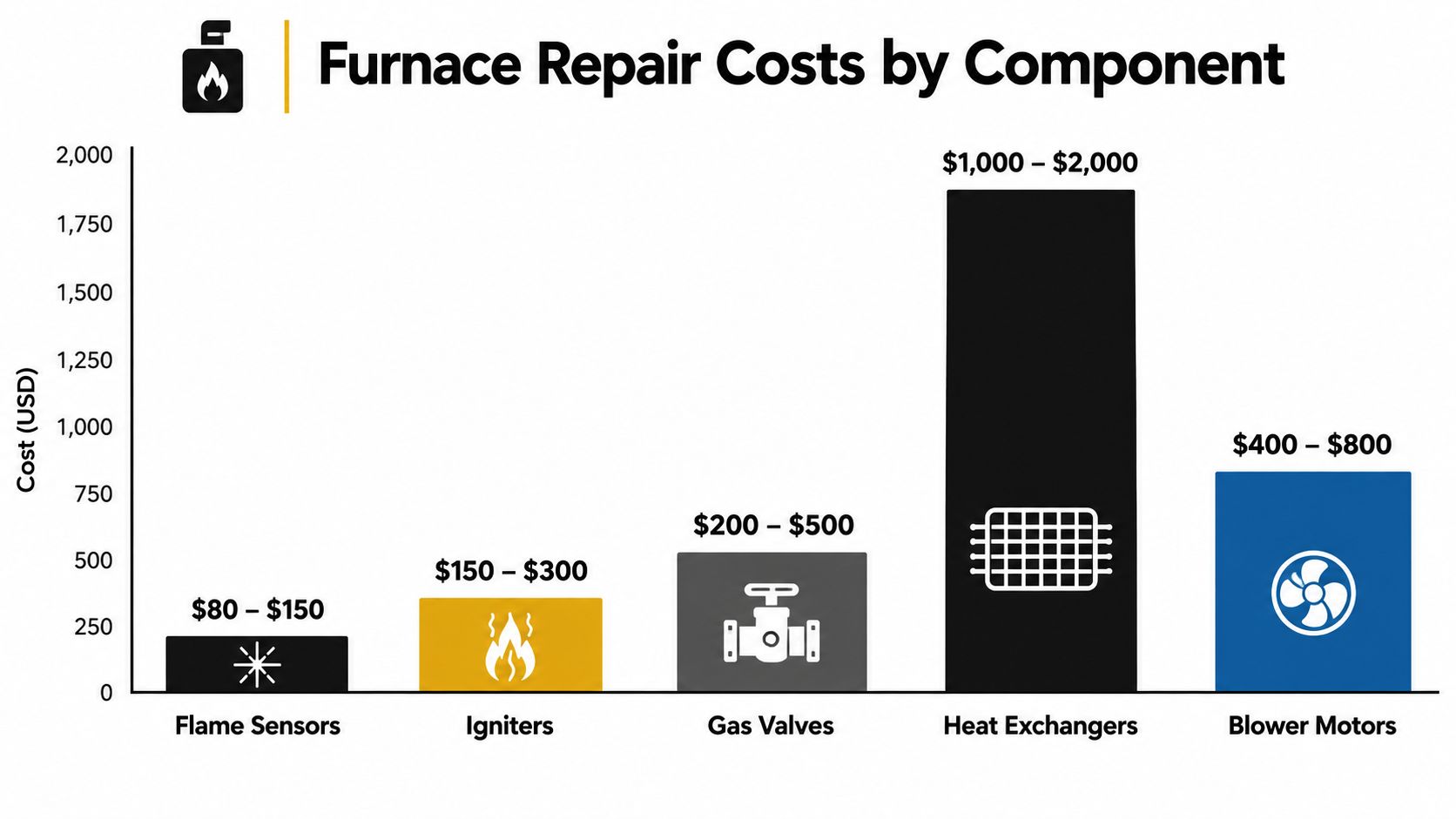
A furnace repair quote starts making sense when you compare the part, the labor, and the age of the unit. A simple flame sensor or igniter problem is usually a smaller bill because the part is easy to reach and the diagnosis is straightforward (HVAC Guidepost furnace cost guide). On an older furnace, even a modest repair deserves more scrutiny, because repeated fixes can push you toward higher total ownership costs without addressing the underlying wear pattern.
Start with the small parts
Flame-sensor service tends to sit around $80 to $250, and igniter replacement around $150 to $450. Those jobs are cheap because they usually involve a fast part swap, not major disassembly or combustion work. On a newer furnace, that can be the right move. On an older unit that already has airflow or ignition problems, it may only buy time.
Gas-valve and blower issues are a different tier. National HVAC repair data shows gas-valve repairs averaging about $544 as of December 2024, while blower motor and wheel repairs averaged $744 and fan-limit switch repairs averaged $349 (HomeServe HVAC repair cost guide). These repairs cost more because the technician spends more time testing, opening the cabinet, and confirming the system runs safely after the fix. If the furnace is aging, that labor matters as much as the part itself.
Heat exchanger work changes the stakes
Heat-exchanger replacement sits at the top of the furnace repair ladder, commonly around $1,500 to $2,500 in benchmark estimates, and some repair benchmarks place it even higher depending on warranty coverage and labor conditions (HVAC Guidepost furnace cost guide, HVAC Laboratory furnace repair article). That is not a routine part swap. It calls for combustion safety checks, venting review, and carbon-monoxide testing.
Heat-exchanger failures also change the repair-versus-replace math because the bill is tied to safety, not convenience. For a closer look at what that work involves, this heat exchanger replacement guide is useful because it treats the part as a safety issue first and a price line second.
A cheap repair on paper can be expensive in practice if the technician skipped the proper diagnosis.
The clean takeaway is simple. Small furnace repairs are usually minor component swaps. Mid-range repairs involve more electrical or airflow work. Heat-exchanger problems belong in their own category, because safety and remaining furnace life should decide the next step.
Heat Pump Repair Costs and Refrigerant Considerations
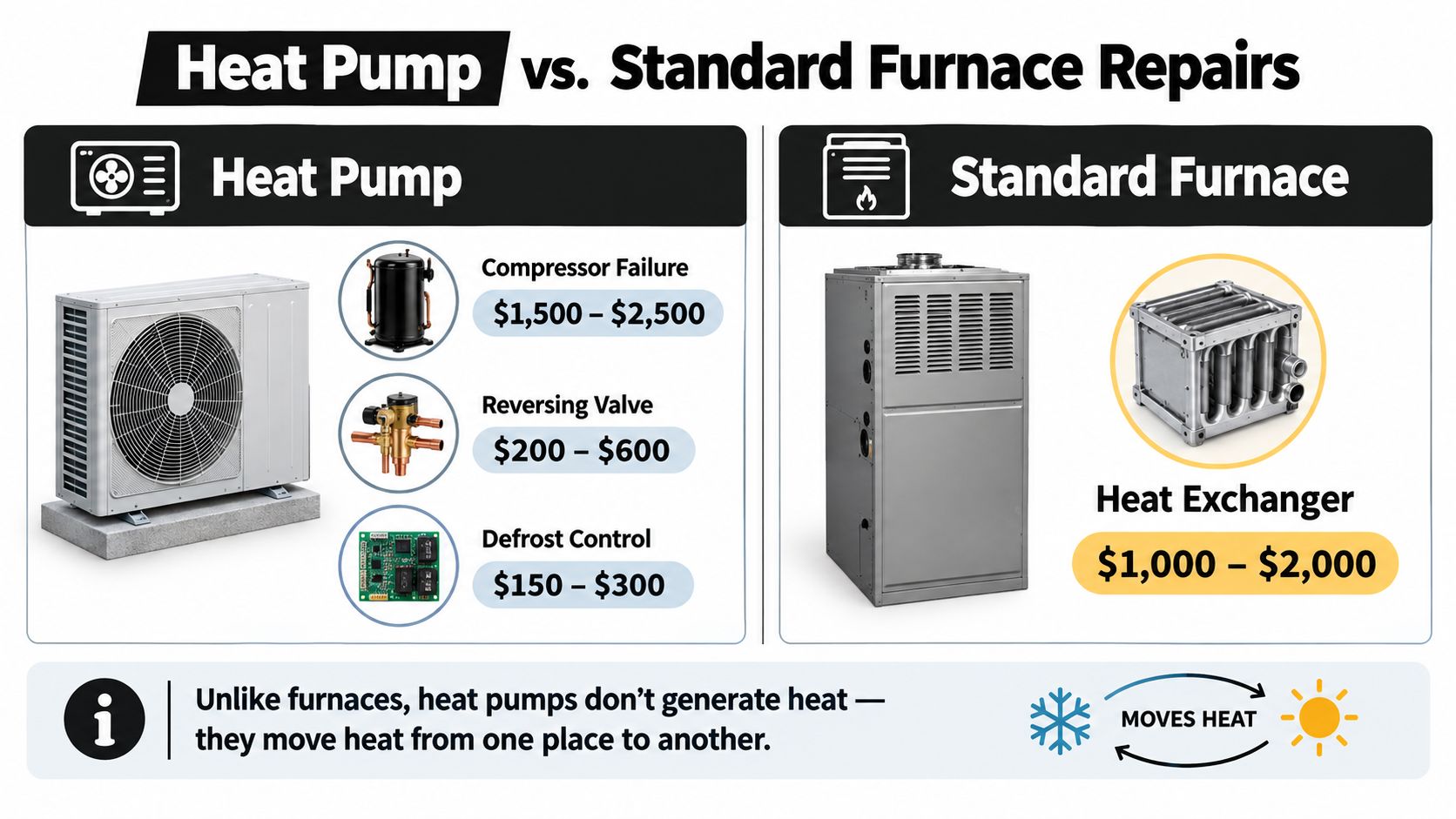
Heat pumps move heat instead of burning fuel, so the repair bill usually centers on compressors, reversing valves, defrost controls, and refrigerant faults rather than burners or igniters.
Refrigerant type matters, but it doesn't force panic
The refrigerant changeover is real, but homeowners hear too much drama about it. Existing R-410A systems can still be serviced under current guidance, while newer systems use refrigerants such as R-454B or R-32 (Lennox refrigerant guide).
A leak or coil issue does not automatically mean replacement. It does mean you should ask what refrigerant the unit uses, whether the failed part is getting hard to source, and whether the same problem is likely to come back after another repair.
Compressor work is the line item that changes the math fastest. A 2025 estimate places compressor replacement around $800 to $2,800, and says replacement becomes more financially sensible when a system is around 12 to 15 years old (Filterbuy heat pump cost and operating guide). At that point, you are not just paying for a part, you are deciding whether to keep pouring money into an aging system.
Don't let a refrigerant issue become a vague “system problem”
Reversing-valve repairs and defrost-control fixes usually sit in a more moderate range than compressor or coil failure. That matters because heat pump ownership is tied to the refrigerant circuit, and the bill changes fast once the circuit itself is the problem.
This refrigerant transition resource keeps the discussion grounded in serviceability instead of panic. A homeowner should not hear “new refrigerant” and jump straight to replacement.
If the repair is mostly refrigerant handling and one failed part, keep the system in service. If it involves a compressor, older equipment, and repeated leaks, stop treating repair as the cheap answer.
The right call is blunt. Moderate heat pump repairs can still make sense. Compressor trouble and repeated refrigerant issues deserve hard replacement scrutiny, especially on older equipment where total cost of ownership starts to matter more than the next service ticket.
Labor, Parts, and Regional Factors That Move the Final Bill
The bottom of the invoice tells you what a heating repair really costs. A heating system repair cost is usually a mix of diagnostic labor, the part itself, small materials, and final testing, not just the replacement component.
Read the invoice line by line
A technician can spend less on the part and far more on the time needed to confirm the failure, remove the old component, install the new one, and verify safe operation. That is why two quotes for the same symptom can look very different, even when both are legitimate.
Here is a simple way to read a repair quote.
Line Item | Typical Range | What It Covers |
|---|---|---|
Diagnostic labor | About $90 to $200 per visit | Testing, troubleshooting, and identifying the failed part |
Replacement part | No single range applies | The actual sensor, motor, valve, board, or exchanger |
Labor for installation | About $75 to $150 per hour | Removal, install, wiring, calibration, and testing |
Ancillary materials | About $20 to $75 | Fasteners, sealants, wiring, connectors, and small supplies |
Access or permit-related charges | No consistent national range | Hard-to-reach equipment or job-specific administrative costs |
Functional testing | Usually included, sometimes billed separately | Safety and performance checks after the repair |
National furnace cost data shows professional repair can run from roughly $64 to $1,475, with a typical homeowner payment near $318 for service and parts (Repair Advisor Pro furnace replacement and maintenance report). Labor alone is often quoted around $75 to $150 per hour in separate national estimates, which is why complexity matters so much. A long diagnosis, cramped access, or a part that takes real disassembly will move the bill fast.
Tucson changes the bill in practical ways
Tucson heat does not just strain equipment. It strains schedules. Summer demand can squeeze technician availability, emergency calls can carry premiums, and a delayed part can turn a modest fix into a longer, pricier visit.
The right comparison is not “Who gave me the lower total?” It is “Who quoted the same scope, the same warranty, and the same safety testing?”
If you want a practical local reference point, this HVAC repair cost guide shows the line-item structure instead of hiding it inside a lump sum.
A fair quote separates diagnosis, parts, labor, and testing. If it does not, you are not comparing prices, you are guessing.
Repair vs. Replacement: How to Decide
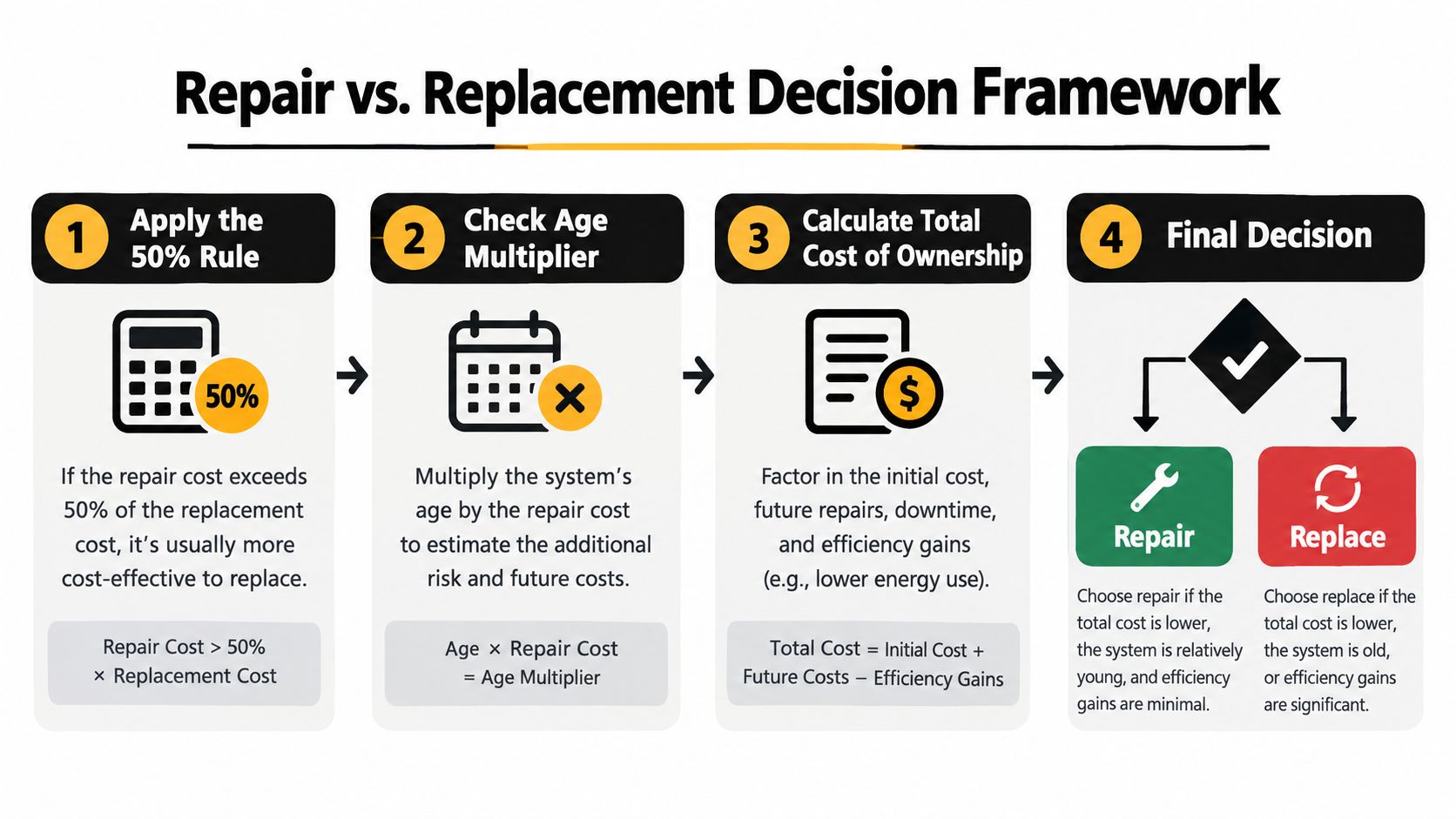
A repair quote looks cheap until you compare it with what the system still has left to give. The question to ask is age, efficiency, expected remaining life, and the cost of replacing the whole unit.
Use the 50% rule as a screening tool
The 50% rule is a screening tool, not a law. If a repair gets close to half the price of a comparable new system, replacement deserves serious attention (Goode Brothers replacement rule guide).
That matters because a small bill on a young system is one thing, and a large bill on an aging unit is another. A $400 repair on a $3,000 replacement is a very different call from a $1,800 repair on the same replacement base.
Age changes the meaning of the number
Industry material citing ENERGY STAR guidance says homeowners should consider replacing a furnace or boiler that is more than 15 years old (Pinnacle Air Control furnace replacement cost article). The same source uses an age-times-cost screen, where a $450 repair on a six-year-old furnace looks far better than a $600 repair on a 16-year-old furnace.
That is blunt, and that is why it works. It forces the decision toward remaining value, not just the bill in front of you.
Refrigerant-driven heat pump problems deserve special attention. If the issue is a leak, a recharge, or repeated refrigerant loss, repair can still make sense on a newer system, but once the unit is older and inefficient, the long-term cost of patching it keeps climbing. At that point, replacement should be compared against the likely service life you are buying.
A replacement quote should also spell out AFUE, ductwork work, permits, and disposal. If you want a clean way to compare those numbers, this heating system replacement cost guide is the right kind of reference.
My view: if the repair is large, the system is old, and efficiency is weak, replacement usually wins on total cost of ownership.
Repair makes sense when the failure is isolated, the equipment is still reasonably young, and the remaining life is worth paying for. Otherwise, you are buying time, not value.
Practical Ways to Reduce Heating Repair Costs
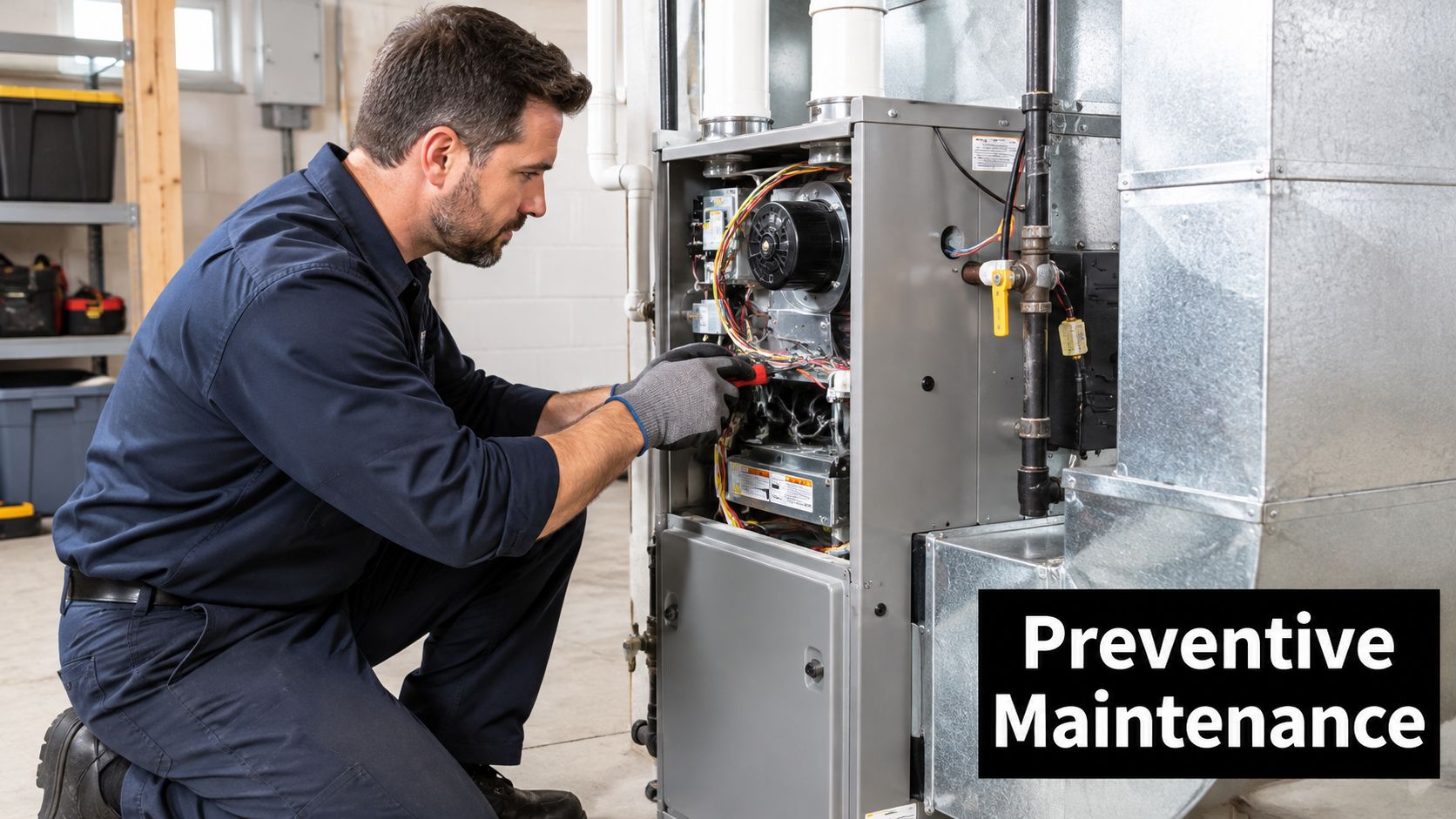
The cheapest repair is the one you catch early. A noisy blower, short cycling, or a rising energy bill is the warning, and waiting usually turns a smaller job into a larger one.
Pay for prevention before you pay for failure
Preventive maintenance plans are worth the money when they include biannual checkups, priority scheduling, and member discounts. Covenant Aire Solutions offers that kind of structure, including transparent upfront pricing and special rates for teachers, military personnel, and first responders, which is exactly the sort of setup that helps families control repair exposure without chasing the lowest one-off quote.
You can also protect yourself by asking for a written, itemized quote before work starts. That keeps scope inflation down and makes it easier to compare two bids fairly.
If you need a service line that handles initial customer contact cleanly, AI reception for trade businesses is a good example of how responsiveness can reduce missed calls and speed up scheduling without adding confusion for the homeowner.
Ask for warranty details in writing
Parts and labor warranties should be separate and clear. A quote that hides those terms is not really a complete quote.
A practical checklist for cost control looks like this:
Schedule early: Don't wait for a no-heat emergency if the system is already acting up.
Request itemization: Separate diagnosis, parts, labor, and testing.
Confirm warranty coverage: Get parts and labor terms in writing.
Compare maintenance terms: Membership pricing can lower the cost of recurring service.
Act on symptoms fast: Odd noises and short cycling are repair warnings, not background noise.
For homeowners who want a structured plan, this preventive maintenance plan resource gives the right mindset, which is to pay a little to avoid paying a lot later.
The best way to reduce heating repair cost is simple, keep the system from failing in the first place, and when it does fail, make the technician prove exactly what needs fixing.
Common Misconceptions That Cost Homeowners Money
The cheapest quote is usually the most expensive mistake. A low number can hide a weak diagnostic, a short warranty, or a repair that only quiets the symptom for a few weeks.
The same mistake shows up with national averages. They are useful for context, but Tucson labor, equipment access, and parts supply move the final bill up or down.
Homeowners also get trapped by extremes. Some replace too quickly because they assume every older system is finished. Others keep paying for repair after repair because they hope one more fix will buy years of life.
Maintenance plans get dismissed for the wrong reason. A decent plan does not make every repair cheap, but it can reduce surprise service calls, catch small problems earlier, and help you spend less over the life of the system.
Aging equipment should be judged by total cost, not by panic. If a system is already inefficient and the repair history keeps growing, the quote is only part of the decision. You also have to weigh future breakdowns, higher operating cost, and whether you are throwing money at a unit that is already near the end of its useful life.
For refrigerant changes, the right takeaway is simple. Existing R-410A systems do not need automatic replacement just because refrigerants are changing, as noted in the Lennox refrigerant guide. What matters is the age of the equipment, the type of failure, and whether repeated repairs are starting to outrun the value of keeping it.
The smart move is to compare the quote with the system's age, efficiency, safety, and likely future repairs.
A Short Checklist Before You Sign Any Repair Order
Ask for an itemized diagnosis, not a lump sum. Make sure parts and labor are separated, warranty terms are written down, and any combustion or safety test results are included when the issue involves burners or heat exchangers.
If the repair is close to half the price of a comparable new system, stop and compare replacement quotes too. Check technician credentials, confirm what's covered, and ask what happens if the same issue returns.
Don't buy the cheapest repair. Buy the one that makes sense for the age, safety, and total cost of ownership of your system.
If you want a straight answer on whether your heating system should be repaired or replaced, Covenant Aire Solutions handles diagnosis, repair, maintenance, and replacement for Tucson homes and businesses. Visit Covenant Aire Solutions to compare your quote with a practical, local recommendation that's built around safety, value, and long-term comfort.