
Dusty Air Vents: A Complete Cleaning and Prevention Guide
You notice it while walking through the living room: a gray film around the supply register, darker streaks along the slots, and a return grille that looks dusty again even though you cleaned it recently. In Tucson, that dust may come from ordinary household activity, desert soil, pets, cooking, or a problem hidden behind the grille. The vent cover is visible, but it isn't always the source.
The useful question isn't, “How do I scrub this vent?” It's, “Why is dust collecting here, and is the HVAC system moving it into the room?” That distinction can save you from paying for unnecessary duct cleaning when a properly fitted filter or a sealed return connection would address the underlying issue.
When Dusty Vents Are Just Dust
A homeowner may see dusty registers throughout the house and assume the ductwork is contaminated. In many cases, the dust is sitting on the grille because room air, foot traffic, pets, cooking, and outdoor infiltration have deposited particles on an exposed surface. A light layer on a vent cover can look unpleasant without representing a health hazard.
The U.S. Environmental Protection Agency says available studies haven't conclusively shown that dirty air ducts increase particle levels inside homes, and it reports no evidence that a light amount of household dust or particulate matter in ducts poses a health risk. EPA guidance on air ducts and indoor air separates visible dust from measurable exposure in occupied rooms, which is an important distinction for homeowners.
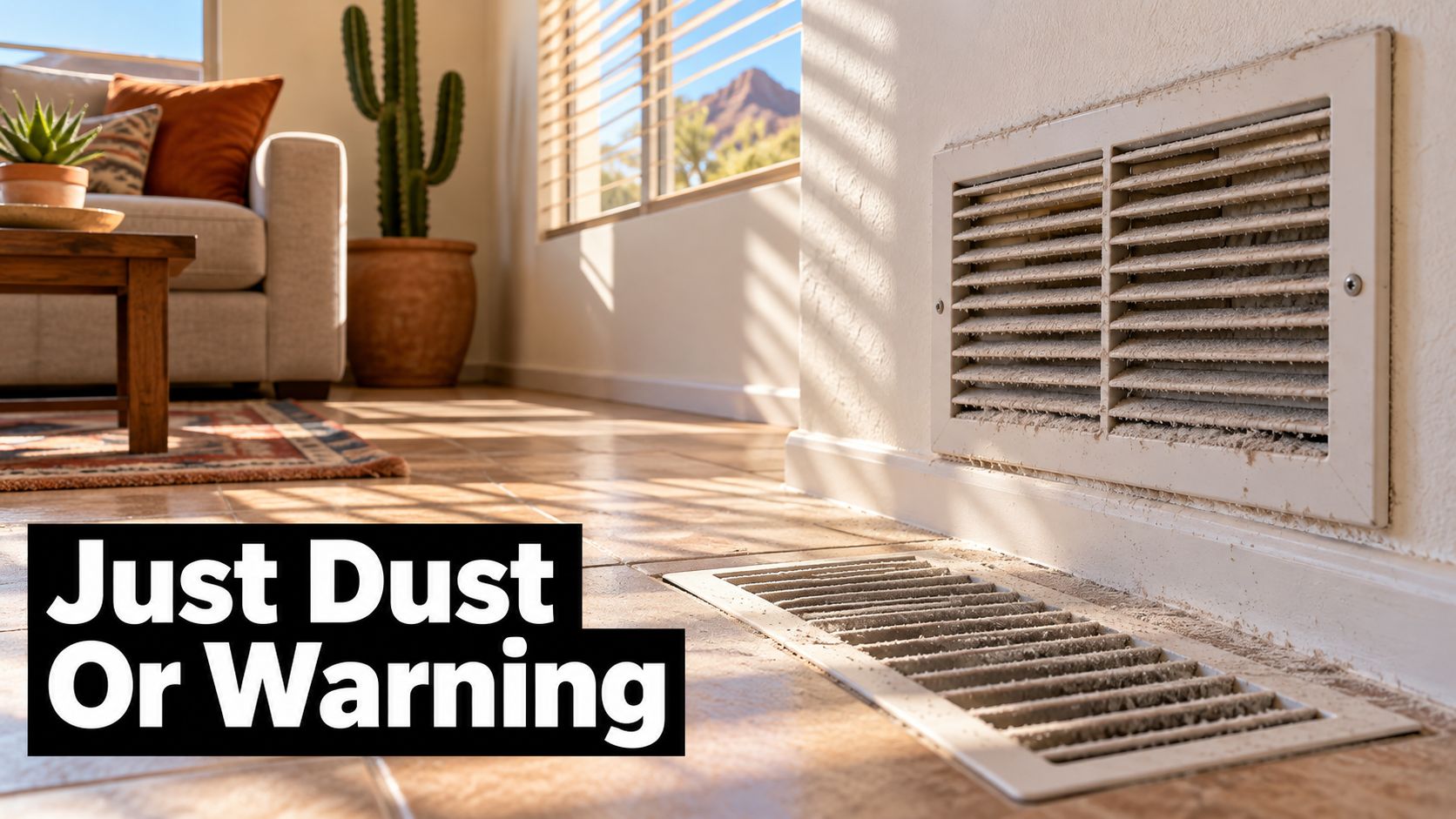
Supply registers and return grilles tell different stories
A supply register sends conditioned air into the room. Dust around its edges may come from the room itself, especially if the register sits near a doorway, a pet bed, or a high-traffic floor. If dark material is repeatedly blowing out of the slots, however, photograph it and note when it appears.
A return grille pulls room air back toward the HVAC equipment. It naturally catches more household dust because it operates as part of the system's return path. A return grille that looks dirty may need cleaning, but persistent buildup can also point to a filter that doesn't fit tightly or a return-side leak that allows unfiltered air into the system.
Most household dust is a mixture of everyday material:
Skin and fabric fibers: Normal shedding from people, bedding, clothing, and upholstery.
Pet dander and hair: More noticeable around homes with dogs and cats.
Desert soil: Fine outdoor particles carried in on shoes, through doors, or through small openings.
Cooking residue: Greasy particles can cling to metal grilles and feel sticky rather than powdery.
Practical rule: A dusty grille is evidence worth observing, not automatic proof that the entire duct system needs professional cleaning.
Clean the cover first, then check whether the pattern returns quickly. If you want broader household cleaning ideas alongside HVAC maintenance, indoor air quality deep cleaning advice can help you think beyond the vent itself. If a register produces an unusual odor when the system starts, compare that symptom with guidance on a heating system that smells like burning, because odor changes deserve a separate diagnosis.
What Causes Dusty Air Vents in the First Place
Dust buildup has several possible sources, and each leaves a different pattern. A thin film on one grille usually calls for a surface cleaning. Dust on many return grilles, visible debris coming from supplies, or rapid re-soiling after cleaning suggests you should inspect filtration, leakage, and the condition of the HVAC cabinet.
Match the pattern to the likely cause
Filter bypass is one of the first things to check. A filter that's too small, warped, installed backward, or not seated against the housing can let air travel around the filter media. That unfiltered air carries particles toward the blower, coil, and supply ductwork.
Return-side leakage creates a more serious pathway. If a return plenum or duct joint pulls air from an attic, wall cavity, garage, or dusty mechanical area, the HVAC system can draw in particles before filtration has a chance to capture them. Persistent dust at return grilles often points to this kind of problem rather than a need to brush the grilles more often.
Renovation residue behaves differently from ordinary household dust. Sanding, drywall, tile cutting, and demolition can leave fine particles that continue settling after the work appears finished. A post-renovation cleanup checklist is useful for checking floors, soft furnishings, and surfaces that may continue releasing construction residue.
Outdoor infiltration is common in desert homes. Door openings, window gaps, poorly sealed return boots, and duct joints can introduce soil and other outdoor particulates. If dust increases after windy conditions or monsoon activity, record that timing instead of assuming the vent cover caused it.
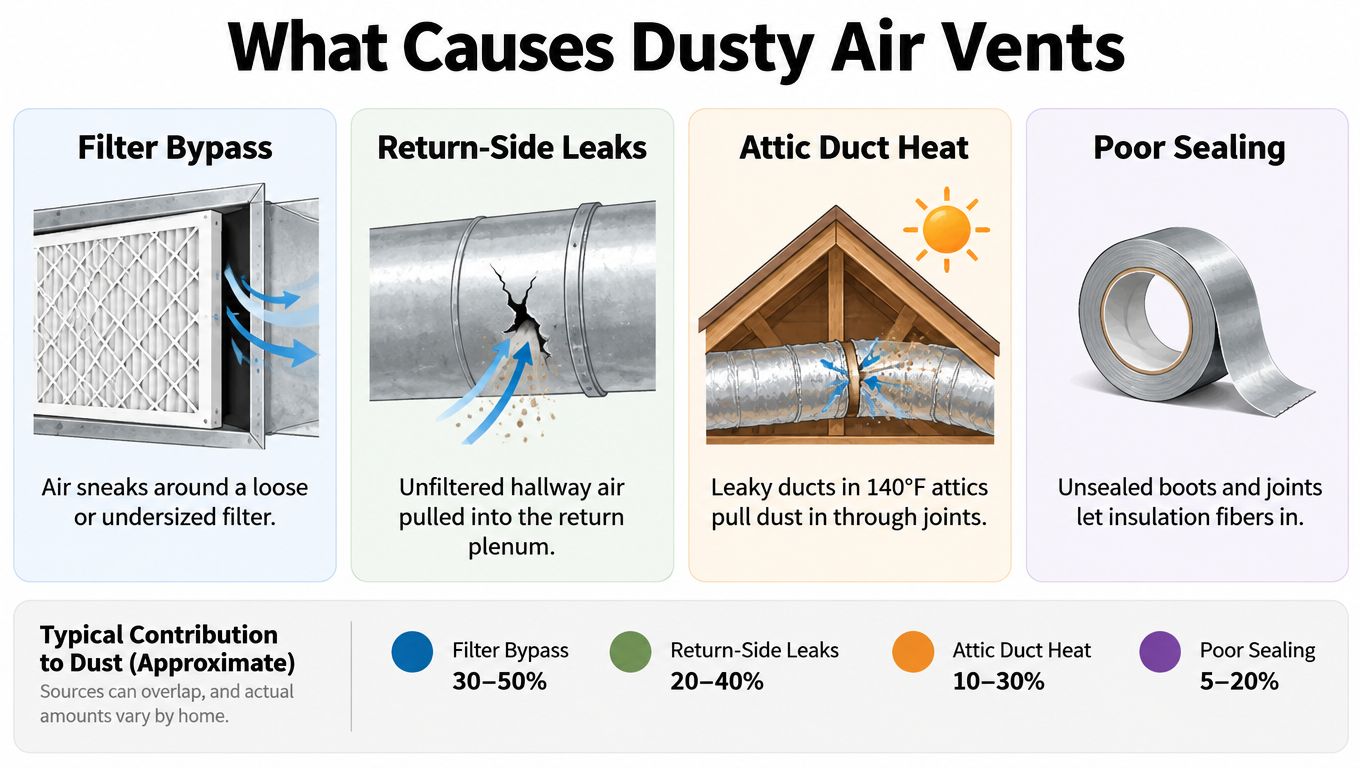
Likely Cause | Where You See It | What to Check First |
|---|---|---|
Loose or undersized filter | Return grille, blower area, several supplies | Filter dimensions, fit, and installation direction |
Return-side leak | Return grille, plenum, equipment cabinet | Gaps, disconnected joints, and nearby dusty spaces |
Construction dust | Registers and horizontal surfaces after remodeling | Drywall, sanding, tile, and cleanup residue |
Poorly sealed duct boots or joints | Around grilles, attic runs, or insulation | Damaged insulation, open seams, and loose connections |
The U.S. Department of Energy reports that typical duct systems lose 25% to 40% of the heating or cooling energy produced by a furnace, heat pump, or air conditioner. DOE information on duct losses makes the larger point: dusty vents should be assessed alongside leakage, insulation damage, and comfort problems. For additional household troubleshooting, this guide to why a house gets dusty and practical fixes is a useful companion.
How to Clean Dusty Vents Safely at Home
Start with a screwdriver, a shop vacuum with a brush attachment, a microfiber cloth, a bucket of mild soapy water, and a dry towel. Turn the HVAC system off at the thermostat before removing any grille. If the blower could start while you're working, use the appropriate service disconnect or breaker only if you can identify it safely.
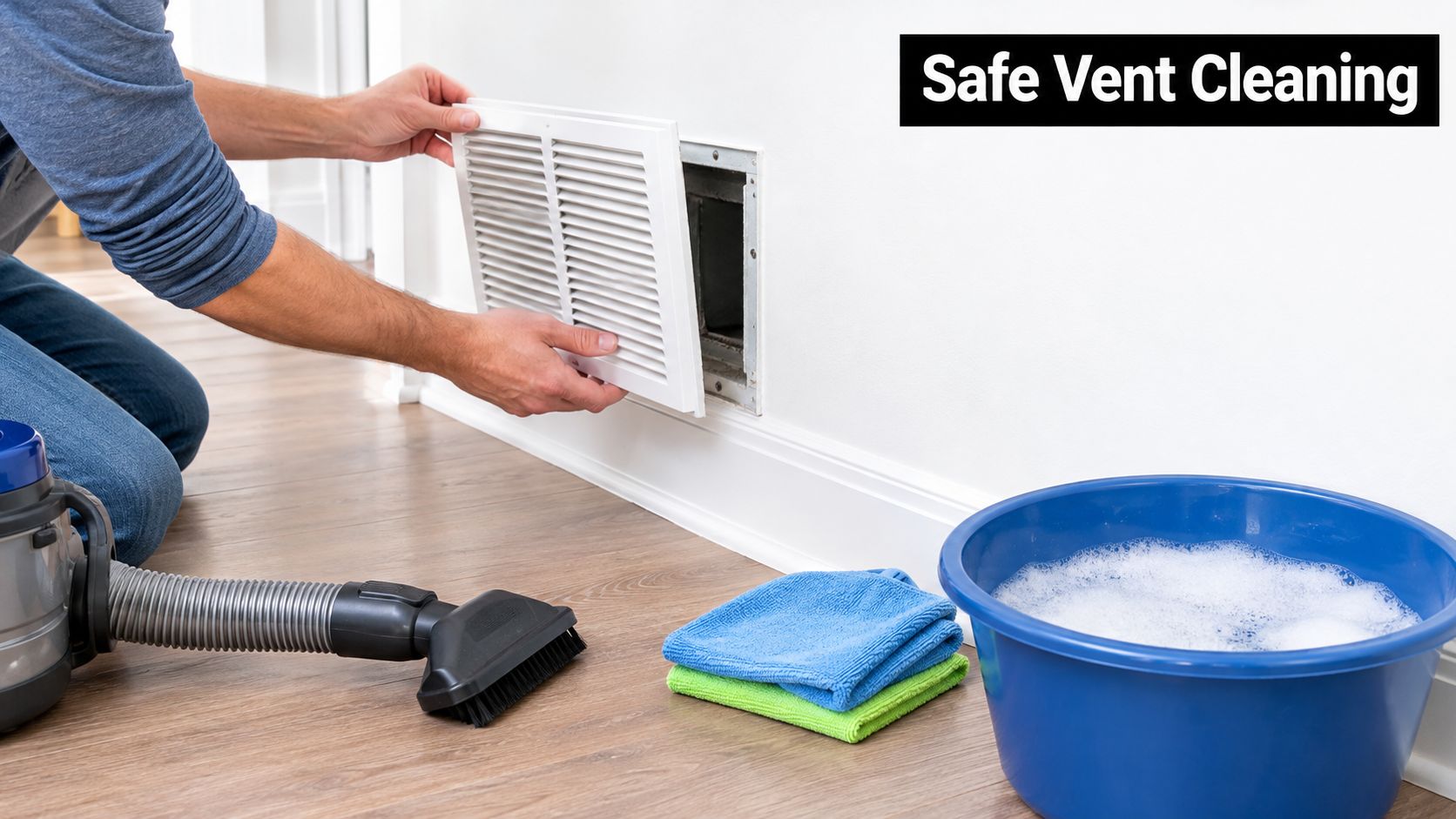
Remove supply registers and return grilles carefully so you don't bend the metal or scatter the accumulated dust. Take a quick photo of each location if the grilles differ, then vacuum both sides with the brush attachment. Wash metal or plastic covers with mild soap, rinse them, and let them dry fully before reinstalling them.
Clean the opening, not the hidden system
With the grille removed, vacuum the register boot and only the first few inches of accessible ductwork. Keep the vacuum nozzle controlled and avoid pushing it into flexible duct, insulation, wiring, or damp material. A microfiber cloth works well around the lip of the boot, where desert soil and pet hair often collect.
Kitchen vents may have a thin grease film that traps dust. Mild soap is safer than spraying degreaser into the opening. For stubborn residue on a removable metal grille, clean the grille separately and dry it completely. Don't spray any cleaner into open ductwork, and don't run the system while grilles are removed.
The filter protects the equipment as well as the air path. A U.S. Department of Energy technical document states that filters remove particulates from forced-air heating and cooling airstreams, protecting equipment from buildup that can reduce efficiency, reliability, and heat transfer. The American Lung Association's particulate matter guidance also explains that dust, dirt, soot, smoke, and liquid droplets are forms of particulate matter, and that outdoor particles can enter through openings and ventilation systems.
If you inspect the blower compartment, remove only the access cover you can handle safely. Vacuum loose dust from the cover and accessible surfaces without touching electrical components, the blower wheel, coil fins, or wiring. If the compartment contains heavy debris, oily residue, moisture, damaged insulation, or biological contamination, stop at the cover and arrange an inspection.
A simple routine can leave the visible parts clean, but it won't correct a loose filter, leaking return, contaminated blower, or debris deep in the duct system. For more general advice on how to clean house air vents safely, pay attention to the same principle: control the dust instead of redistributing it. A brush kit can help with accessible surfaces, but duct-cleaning brush kits aren't a substitute for negative-pressure extraction when the system itself is contaminated.
Choosing and Replacing the Right Air Filter
The filter is often the least expensive part of the diagnosis, but it has to fit correctly and match the equipment. A higher rating isn't automatically better if the system can't move air through it. Confirm the manufacturer's requirements before changing filter type or thickness.
MERV ratings in practical terms
MERV 8 is a reasonable starting point for many homes and generally offers lower airflow resistance. MERV 11 captures finer dust and pet dander, making it a possible middle ground for households with animals. MERV 13 captures smaller particles, including smoke and bacteria, but the HVAC system must be able to handle the added restriction.
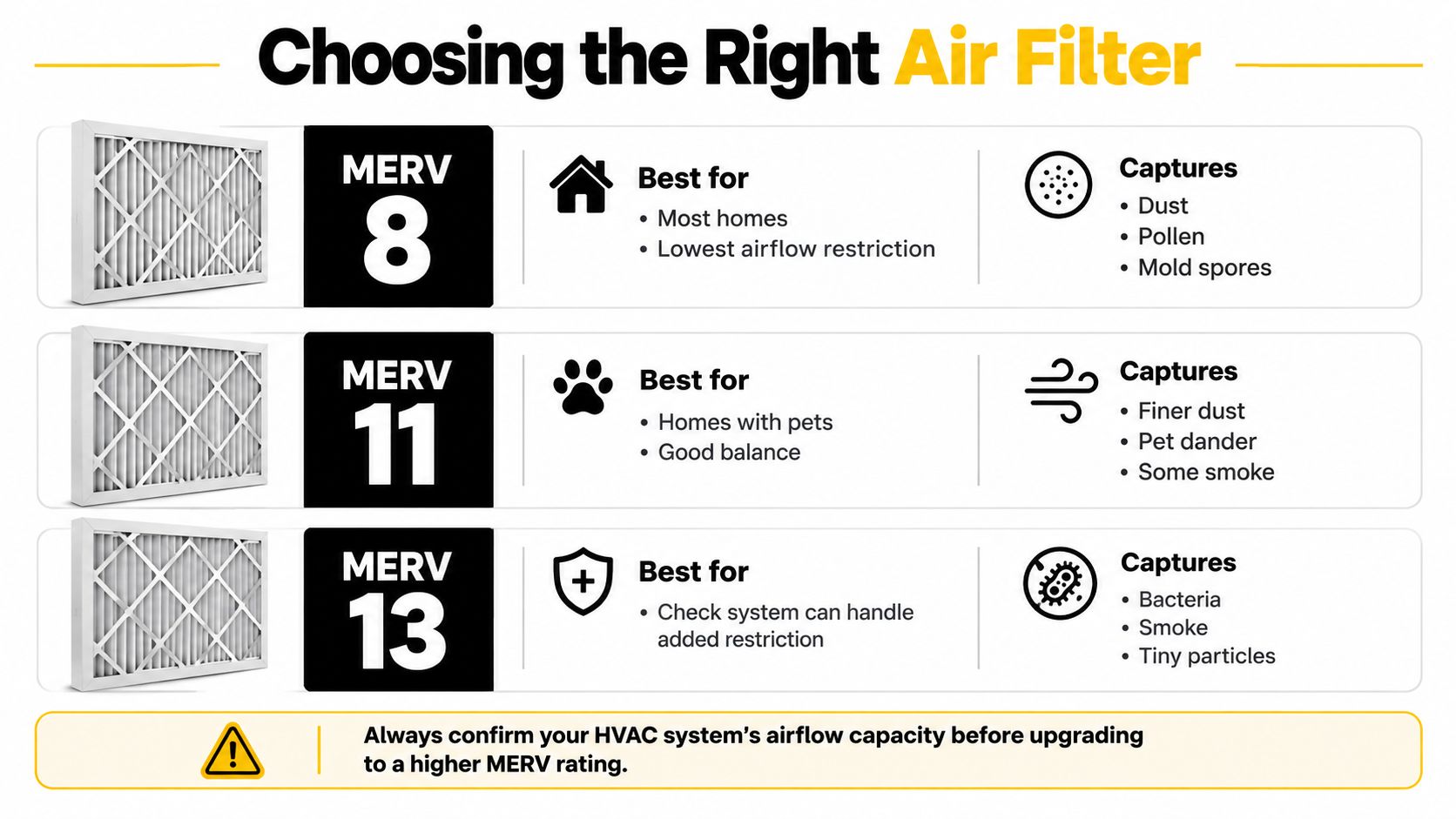
MERV Rating | What It Catches | Best For |
|---|---|---|
MERV 8 | Dust, pollen, and mold spores | Many standard systems with modest filtration needs |
MERV 11 | Finer dust, pet dander, and some smoke | Homes with pets that need a balance |
MERV 13 | Bacteria, smoke, and tiny particles | Systems confirmed to handle added restriction |
An overly restrictive filter can reduce airflow. In cooling season, weak airflow can contribute to a coil freezing, while distant rooms may receive noticeably less conditioned air. Those symptoms need equipment-specific diagnosis, so don't respond by installing the densest filter available.
Fit matters as much as rating
Measure the existing filter and check the printed dimensions. The filter should sit squarely in its housing without visible gaps along the edges. A filter that doesn't seal against the frame lets air bypass the media, carrying dust directly toward the ductwork and evaporator coil.
Replacement timing should reflect conditions rather than a rigid calendar. Check more often after renovation work, during allergy-heavy periods, in homes with pets, and during dusty Tucson weather. Replace the filter when it is loaded, damaged, damp, or no longer seated properly, while following the equipment manufacturer's instructions. This guide to finding the best air filters for dust can help you compare options without treating MERV as the only decision.
Sealing Ductwork to Stop Dust at the Source
A clean vent cover won't solve a return duct that pulls air from an attic or wall cavity. The return side operates under suction, so gaps at plenums, boots, and joints can draw dusty air into the system before the filter captures it. The blower then distributes some of that load through the supply network.
Accessible ductwork deserves a visual inspection. Look for disconnected joints, crushed flexible duct, torn insulation jackets, loose register boots, and seams with visible gaps. Check the area around the return plenum for dust trails, because a clean grille with a dirty surrounding cabinet can indicate air movement through an unintended opening.
A simple leakage check
With the system operating, hold a thin strip of tissue near a suspected return-side gap. Movement toward the joint suggests suction, although this isn't a substitute for a professional leakage test. Keep hands, clothing, and loose material away from the blower and moving components.
For accessible supply joints, look for escaping air, damaged insulation, and dust marking around a seam. Sealing should use HVAC-appropriate mastic or foil-backed tape. Ordinary cloth-backed duct tape often dries out and loses its grip, especially in hot attic conditions.
Tucson attic ductwork faces severe heat exposure. Ducts routed through an attic can lose more energy than ducts in protected areas, and heat can accelerate deterioration of insulation jackets and joints. Don't climb into an attic or disturb insulation if access is unsafe. A technician can inspect the return path, evaluate insulation, and determine whether sealing or replacement makes more sense.
A return-side leak is a filtration problem in disguise. Sealing the leak can prevent new dust from entering, while cleaning only the visible grille leaves the cause untouched.
Duct sealing also affects comfort and operating cost. The DOE's documented duct-loss range, cited earlier, is why a dusty vent inspection should include disconnected joints and damaged insulation, not just the register face. For a more detailed look at materials and methods, see this guide to ductwork sealing.
When Dusty Vents Mean You Need a Pro
Routine dust on a grille doesn't automatically justify professional duct cleaning. The EPA says available studies haven't conclusively shown that dirty ducts increase household particle levels, and it reports no evidence that a light amount of household dust in ducts poses a health risk. The EPA's consumer guidance also says routine duct cleaning isn't generally recommended without a specific reason.
A professional inspection becomes more defensible when you find visible mold growth, pest contamination, substantial debris, water damage, or material being discharged from supply registers. Restricted airflow also deserves attention, especially when it appears alongside a dirty blower compartment, damaged ductwork, or a filter that loads unusually fast.
What legitimate duct cleaning looks like
A technically sound service addresses the whole accessible HVAC system, not only the registers. That typically means inspecting and documenting supply and return paths, the blower compartment, coil, drain pan, filter housing, and accessible duct interiors. The crew should isolate the system, protect the occupied space, establish containment, connect high-efficiency vacuum collection, and maintain negative pressure while mechanical agitation loosens deposits.
NADCA identifies agitation and extraction as essential elements. Brushes, air whips, compressed air, and contact-vacuum tools can loosen material, but they should work with active extraction. Blasting compressed air into an open duct without collection can redistribute dust into the home.
Ask the company these questions before scheduling:
System coverage: Will the crew clean the return path, blower compartment, coil area, and supply runs, or only the grille covers?
Containment: How will the company maintain negative pressure and protect furnishings?
Equipment: What vacuum collection and filtration equipment will be used?
Verification: Will you receive before-and-after photographs and a record of the components cleaned?
Cause correction: Will the technician check filter bypass, return leakage, moisture, pests, and damaged insulation?
Cleaning can remove deposited material from accessible duct surfaces, but it isn't a guaranteed treatment for allergies, household dust, or indoor air quality. If dust returns quickly, investigate the filter fit, return leakage, moisture, damaged ducts, and indoor particle sources before paying for another cleaning.
A Simple Routine to Keep Vents Clean Year-Round
Use four Tucson checkpoints instead of waiting for the grilles to look neglected. After monsoon dust storms, inspect returns and check the filter. After holiday cooking, wipe nearby grilles and surfaces where greasy residue can trap dust. During spring pollen periods, check filter loading more often. Before the first major summer heat wave, inspect accessible ductwork and confirm that supply airflow feels consistent.
Save this short checklist:
Inspect grilles: Look for unusual discharge, staining, moisture, or pest evidence.
Vacuum registers: Clean covers and accessible boot surfaces without pushing debris deeper.
Replace the filter: Confirm the size, direction, fit, and equipment compatibility.
Check the return seal: Look for gaps around the grille and plenum.
Glance at accessible ducts: Note damaged insulation, disconnected joints, or dust trails.
Escalate changes: Arrange a professional check if airflow, odor, moisture, or contamination has changed.
The aim isn't a sterile HVAC system. It's a controlled one, where the filter captures particles, the return side stays sealed, and you notice trouble before it becomes an equipment or comfort problem. Covenant Aire Solutions also offers HVAC inspections and ActivePure air purification options for homeowners who need a broader indoor air quality assessment.
Covenant Aire Solutions can inspect dusty air vents, evaluate filters and duct leakage, and provide air duct cleaning with rotating brushes, negative-air vacuuming, and HEPA filtration when the system actually needs it. Visit Covenant Aire Solutions to schedule an HVAC inspection or discuss air purification options for your Tucson home.