
3.5 Ton Heat Pump Package Unit: Sizing and Cost Guide
A 3.5-ton heat pump package unit provides approximately 42,000 Btu/h of nominal cooling and heating capacity. It's typically suited to larger homes or small commercial spaces, but the correct size depends on a professional load calculation, not square footage alone.
That distinction matters in Tucson. A unit can carry the right number on its nameplate and still struggle through an extreme afternoon if the ducts leak, the airflow is wrong, or the home's actual load doesn't match the equipment selection. It can also be too large, cycling off before it properly manages comfort.
What Is a 3.5 Ton Heat Pump Package Unit
A Tucson homeowner usually starts asking about this equipment after a familiar failure: the house feels warm in the afternoon, the rooftop unit runs constantly, and the old system either needs an expensive repair or stops working altogether. The contractor then says the replacement is a “3.5-ton package heat pump,” which sounds precise until you ask what those terms mean.
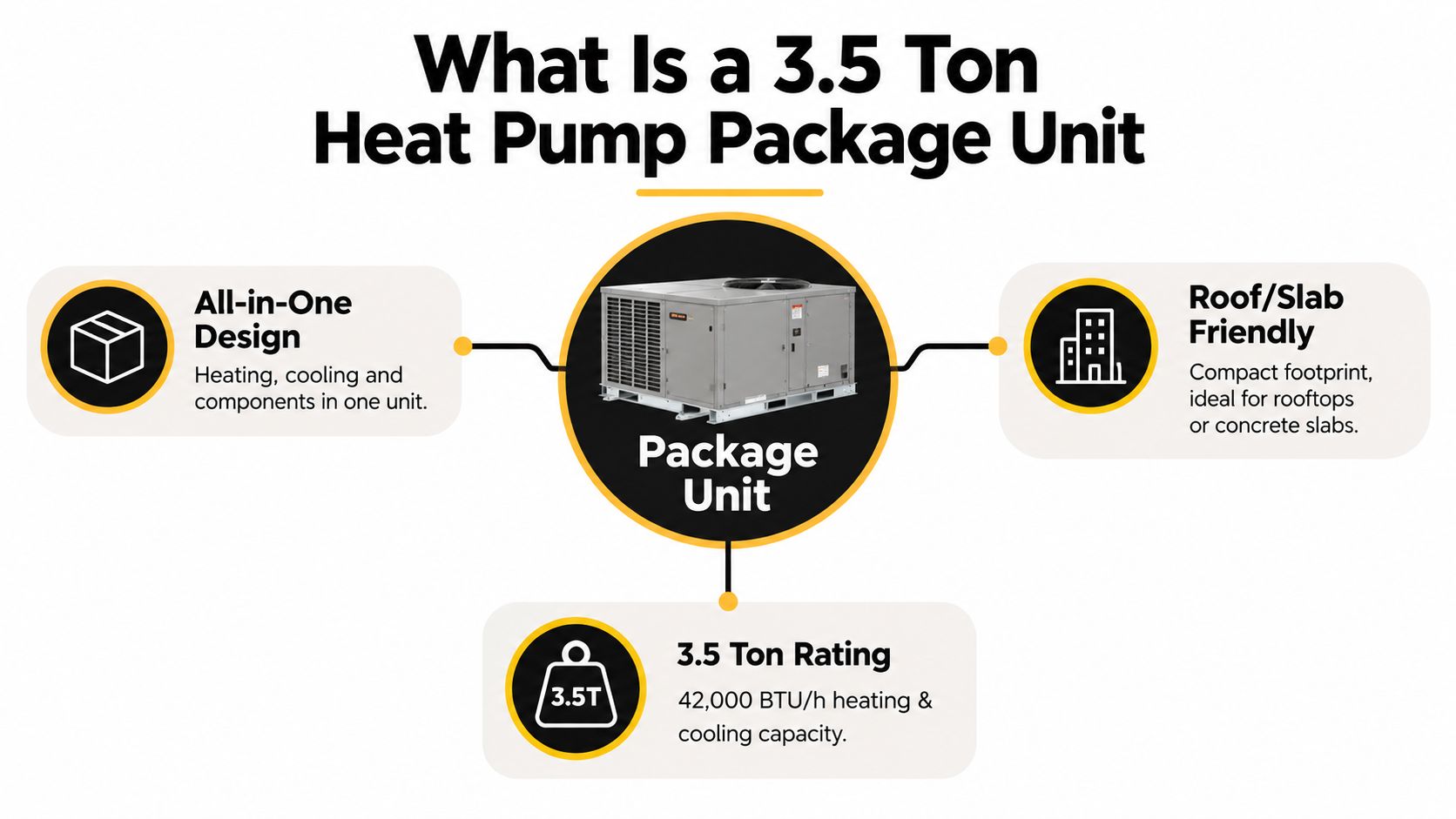
A 3.5-ton heat pump package unit has a nominal capacity of 42,000 Btu/h, because one refrigeration ton equals 12,000 Btu/h. That rating applies to both nominal cooling and heating capacity, and it places the equipment below the 65,000-Btu/h threshold used in U.S. federal guidance for residential air-source heat pumps. The U.S. Department of Energy guidance on residential air-source heat pumps includes both single-package and split-system equipment operating on single-phase electricity.
The word package describes the physical layout. Instead of dividing major components between an outdoor condenser and an indoor air handler, the compressor, outdoor coil, indoor coil, blower, controls, and related parts sit inside one cabinet. That cabinet is commonly installed on a roof or exterior slab, which can preserve indoor space and simplify access to a home that was designed around rooftop equipment.
The rating is a starting point
Think of the 42,000-Btu/h figure as the engine's advertised capability under defined rating conditions, not as a promise that the home will receive that output during every Tucson afternoon. Outdoor temperature, duct losses, indoor airflow, coil condition, refrigerant charge, and the manufacturer's rated operating point all affect delivered capacity.
That's why replacing an old 3.5-ton unit with another one isn't automatically a like-for-like engineering decision. The cabinet may fit the existing curb, but the house, duct system, insulation, windows, and operating requirements may have changed. A qualified technician can also help with ongoing heat pump service when performance changes after installation.
Sizing Your Home for a 3.5 Ton Heat Pump
Square footage can help a contractor begin a conversation, but it can't finish the sizing decision. Two Tucson homes with similar floor areas may have very different cooling requirements because one has shaded low-e windows, tight ductwork, and good insulation while the other has west-facing glass, attic heat gain, infiltration, and poorly sealed supply runs.
A Manual J load calculation accounts for the conditions that determine how much heat enters or leaves the building. The technician should evaluate:
Envelope performance: Insulation levels, ceiling construction, exterior walls, window area, window orientation, and solar exposure all affect the cooling load.
Air leakage: Infiltration through doors, penetrations, duct connections, and other gaps adds work for the system.
Internal heat: Occupants, lighting, appliances, and equipment contribute heat that the unit must remove.
Distribution losses: A properly sized cabinet can still deliver poor comfort if the ducts are undersized, damaged, disconnected, or leaking.
Design conditions: Tucson equipment selection must account for the outdoor conditions the system is expected to handle, not just a mild day during the service visit.
A Southwest Energy Efficiency Project analysis lists a Tucson new-home cooling load of 25,700 Btu/h at 110°F and a heating load of 25,200 Btu/h at 26°F. Those figures demonstrate why a nominal 42,000 Btu/h system can be oversized for some properties when a contractor selects equipment from floor area alone. The figures and their design-condition context appear in the Southwest heat-pump study.
What the assessment should include
Ask the contractor to show how the recommendation was produced. The visit should include measurements or documented observations, not just a glance at the old nameplate and a guess that the replacement should match it.
The technician should inspect the return path, supply branches, filter arrangement, registers, duct insulation, and accessible connections. A blower door test isn't always necessary for every replacement, but the contractor should identify obvious leakage and explain whether the duct system can move the required airflow.
Practical rule: If the recommendation changes neither after a site inspection nor after a discussion of insulation, windows, ducts, and solar exposure, it probably isn't a real sizing analysis.
The contractor can then compare the calculated load with the manufacturer's certified equipment combination and its capacity at relevant operating conditions. A smaller or variable-capacity system may run longer and provide steadier comfort, while a larger fixed-capacity system may cycle more often. Neither choice is automatically right. The load calculation and distribution inspection decide the question.
For a useful explanation of the calculations involved, review this guide to calculating HVAC size for your home.
Understanding Efficiency Ratings and Operating Costs
A nameplate rating doesn't tell you how much cooling the unit will deliver at every outdoor temperature, and it doesn't predict a bill by itself. It gives you standardized comparison points. The installation, duct condition, airflow, thermostat settings, and local weather determine how closely real operation approaches those ratings.
SEER2 describes seasonal cooling efficiency across a defined test method. It's useful for comparing seasonal performance between eligible models, but it shouldn't be treated as a direct forecast of a Tucson household's electricity use. EER2 measures efficiency at a defined test condition and is especially useful when comparing equipment expected to operate under sustained high cooling loads. HSPF2 measures seasonal heating efficiency.
Metric | What It Measures | Why It Matters in Arizona |
|---|---|---|
SEER2 | Seasonal cooling efficiency under standardized conditions | Helps compare cooling performance across equipment, but actual results depend on installation and Tucson operating conditions |
EER2 | Efficiency at a defined test condition | Offers a useful comparison for sustained high-load cooling, when the system is working hard |
HSPF2 | Seasonal heating efficiency | Helps evaluate heat-pump heating performance during the cooler season |
For current single-package heat pumps, ENERGY STAR qualification thresholds include at least 15.2 SEER2, 10.0 EER2, and 7.2 HSPF2. Higher-performing single-package models may qualify at 8.1 HSPF2 or above. These thresholds are listed in the ENERGY STAR key product criteria.
Read beyond the sticker
A contractor should provide the exact model numbers for the outdoor package, controls, and any related components. Then verify that the proposed combination is recognized by the manufacturer or AHRI and ask which capacity and efficiency values apply at the intended operating point.
A unit rated at 42,000 Btu/h may deliver something different when the outdoor temperature rises, airflow falls, the coil gets dirty, or duct losses consume part of the output. Incorrect refrigerant charge can also reduce performance. A commissioning report should document airflow, temperature split, refrigerant-related measurements appropriate to the equipment, and control operation.
The most useful bill discussion starts with operating conditions, not a promise of a fixed monthly saving. A properly sized unit with clean airflow and sound ducts has a better chance of operating efficiently than an oversized unit installed into a restrictive or leaky distribution system. For additional context on comparing new equipment, see whether new heat pumps are more efficient.
Package Units vs Split Systems vs AC Only
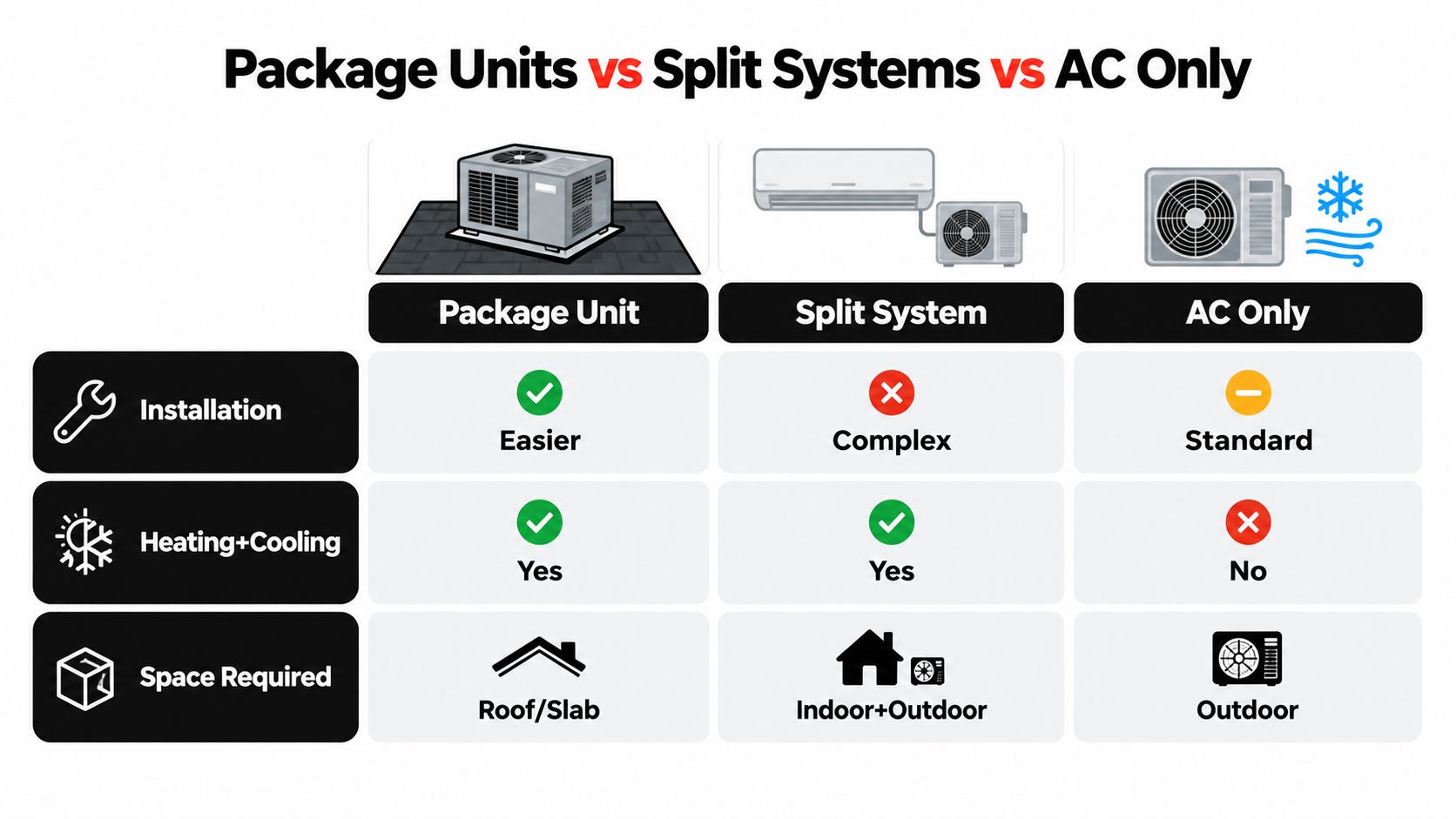
A package unit keeps the major heating and cooling components in one outdoor cabinet. A split-system heat pump separates the outdoor section from an indoor air handler or coil. An air-conditioning-only system provides cooling, while a separate furnace or other heat source handles heating.
The best arrangement depends on the building, not on a universal ranking. A rooftop package unit may be practical where the home already has a roof curb and accessible service platform. A split system can make sense when indoor equipment space is available and the installation needs more flexibility. An AC-only system may suit a property with an existing, reliable heating system that the owner wants to retain.
Where each design works
System | Installation and access | Heating and cooling | Main consideration |
|---|---|---|---|
Package unit | Roof or exterior slab, with major components in one cabinet | Yes | Convenient for limited indoor space, but roof access and cabinet exposure matter |
Split-system heat pump | Indoor and outdoor components connected during installation | Yes | Offers layout flexibility, but requires suitable indoor equipment space and refrigerant connections |
AC-only system | Outdoor cooling equipment with a separate heating arrangement | Cooling only | Works when the existing heating system remains appropriate |
Package equipment can reduce the amount of mechanical equipment inside the home and may fit properties built around rooftop or slab installations. It also concentrates serviceable components in one cabinet, which can simplify some repairs while making cabinet condition, weather exposure, and access especially important.
Split systems may offer more equipment choices for a particular indoor layout, but the installation has more separate components and connections to coordinate. For older homes, the existing electrical service, return path, line-set condition, and indoor coil arrangement deserve close inspection rather than automatic reuse. This discussion of air conditioning in older homes provides useful background for that evaluation.
A video can also help homeowners visualize the differences between these system configurations:
Don't choose based only on whether the equipment fits the current footprint. Check whether technicians can safely reach filters, coils, electrical components, and controls for the entire service life.
Refrigerant Transition and Service Implications
Refrigerant selection is now part of the equipment decision, not a detail to leave until a repair is needed. New packaged heat pumps may use refrigerants such as HFC-32 or R-454B, depending on the approved model and manufacturer design. The refrigerant affects factory components, safety controls, labels, service procedures, recovery equipment, and the parts a technician must keep available.
An older package unit can't be converted to any newer refrigerant. The equipment must be specifically designed and approved for the refrigerant used. EPA material lists HFC-32, R-452B, R-454A, R-454B, R-454C, R-457A, R-290, and R-441A as acceptable for new residential and light-commercial air conditioners and heat pumps, subject to stated use conditions. The EPA refrigerant fact sheet and federal notice also addresses required markings and equipment-specific approval.
Questions to put in the proposal
Before approving a replacement, ask the contractor to record:
Factory refrigerant: Which refrigerant does the exact model use?
Service readiness: Does the company have technicians trained and equipped to work on that refrigerant?
Parts access: Can the contractor obtain controls, sensors, valves, and other model-specific parts through normal channels?
Repair policy: What procedures apply to leak detection, recovery, charging, and disposal?
Replacement compatibility: Which future equipment can and can't connect to the existing ductwork, electrical service, and controls?
A lower-global-warming-potential refrigerant can be a sensible part of a new installation, but the label alone doesn't guarantee easy service or lower ownership cost. Ask about the complete equipment combination and local technician familiarity. The practical background on refrigerant in a heat pump can help you prepare for that conversation.
Cost Ranges and Installation Requirements
A trustworthy price for a 3.5-ton package heat pump can't be separated from the installation scope. Equipment tier, efficiency, roof or slab access, curb condition, duct repairs, electrical work, controls, permits, disposal, and commissioning all affect the final proposal. A bare equipment price tells you very little about the completed system.
The contractor should separate the work into understandable categories:
Site preparation: Confirm the roof curb, slab, service clearance, drain arrangement, and equipment support are suitable.
Removal and placement: Protect the property, remove the old cabinet, position the new unit, and address access requirements.
Duct connection: Seal and reinforce supply and return connections, correct obvious restrictions, and verify that the transition fits the new cabinet.
Electrical work: Confirm disconnects, conductors, breakers, grounding, controls, and any equipment-specific requirements.
Refrigerant and drain work: Follow the manufacturer's procedures for the approved refrigerant, condensate management, and leak checks.
Startup and testing: Verify airflow, temperature performance, controls, safety operation, and the equipment combination before handing it over.
What a useful quote includes
The proposal should identify the exact model numbers, nominal capacity, efficiency ratings, refrigerant, warranty terms, labor scope, duct modifications, electrical changes, permit responsibilities, and commissioning steps. It should also say what the quote excludes. That prevents a low initial figure from becoming a series of additions after removal begins.
Don't accept a recommendation that relies only on the old system's tonnage. Ask for the load calculation, duct inspection findings, and the reason the proposed unit matches the calculated requirement. If the contractor can't explain the relationship between those documents, the proposal isn't complete.
A licensed and insured installer should be able to explain who will perform the work and who remains responsible for startup and warranty support. Homeowners evaluating service providers may also find this overview of local SEO for electricians useful when checking how clearly a local trade company presents its services and credentials online, although online visibility doesn't replace licensing verification or technical documentation.
For more budgeting context, use an HVAC replacement cost estimator as a planning aid, not as a substitute for a site-specific proposal. The final decision should follow the load calculation, equipment selection, and installation scope.
Making the Right Choice for Your Home
A 3.5-ton package heat pump is a 42,000-Btu/h nominal system, but that number doesn't prove it's right for a Tucson property. Start with a Manual J calculation, then inspect the ducts, airflow path, insulation, windows, electrical service, equipment location, and manufacturer-certified combination.
Compare EER2, SEER2, and HSPF2, but ask how the equipment performs under the conditions your home experiences. Confirm the factory refrigerant and local service readiness. Finally, demand a written scope that identifies model numbers, duct and electrical work, commissioning, and warranty responsibilities.
A replacement should be engineered for the house you have now, not copied from the nameplate of the system that just failed.
Ask questions before the old unit is removed. That's when you still have time to compare options, correct sizing assumptions, and choose an installation that will remain serviceable through Tucson's demanding cooling season.
Covenant Aire Solutions offers heat pump installation, replacement, repair, and maintenance for Tucson-area homes and commercial properties, with technicians who can evaluate sizing, ductwork, airflow, and equipment condition. Visit Covenant Aire Solutions to request an assessment and discuss a package heat pump installation based on your property's actual requirements.