
Commercial AC Unit Maintenance: A Guide for Property Owners
A tenant calls at 2 p.m. because the office is warm, the thermostat says the system is running, and the rooftop unit sounds normal from the ground. By late afternoon, several rooms are uncomfortable, the building engineer is checking breakers, and your service contractor is trying to find an emergency opening during a busy cooling period. The immediate problem may be a failed component, but the business problem started earlier, with a missed inspection, a drifting sensor, a restricted filter, or a small refrigerant leak that nobody documented.
Commercial AC unit maintenance works best when it's treated as an operating discipline, not a seasonal reminder. A useful program combines scheduled inspections, professional measurements, control-system review, clear records, and a method for deciding which repairs deserve attention first. That approach helps property owners protect comfort and reliability while avoiding the false economy of fixing only the most visible defect.
The Hidden Cost of Ignoring Commercial AC
A retail store loses comfort during its busiest hours. Employees in an office start moving between rooms to find a cooler space. Property management receives complaints while the contractor searches for emergency labor and replacement parts. The failed component may be the immediate fault, but the financial exposure began with earlier warning signs, such as restricted airflow, drifting controls, dirty coils, or a leak that was never documented.
The repair invoice is only one cost. Discomfort can strain tenant relationships, interrupt operations, and reduce confidence in the property. If deterioration continues, the owner may also face a rushed capital decision instead of scheduling a replacement around occupancy, budget, and equipment availability.
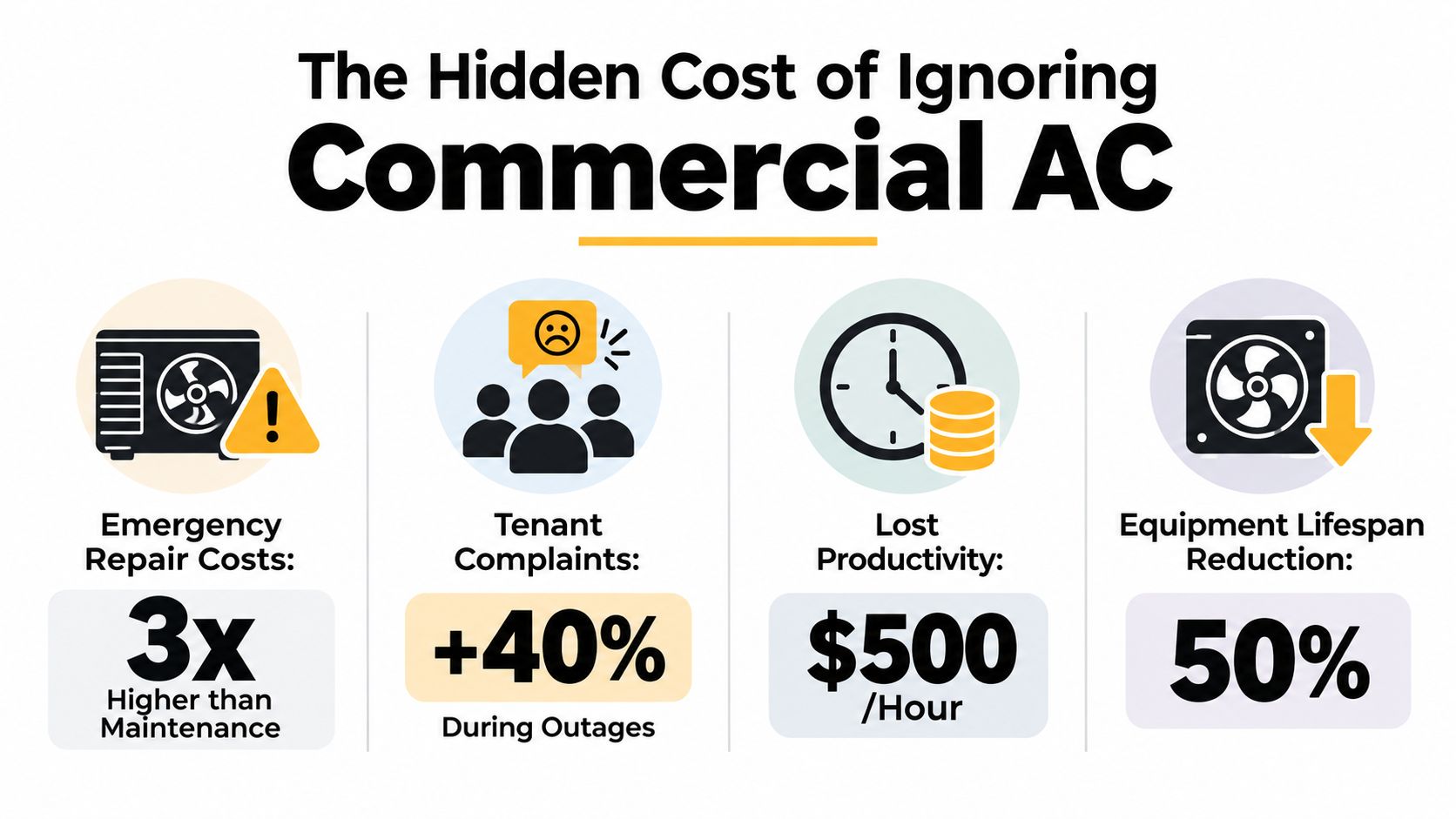
Energy waste adds a recurring cost. A U.S. Department of Energy analysis summarized in this ASHRAE maintenance and energy-efficiency fact sheet found that regularly serviced HVAC equipment is typically 15–20% more efficient. The analysis also estimated annual national savings potential of 0.609 quadrillion British thermal units of electricity and 0.263 quads of natural gas from improved commercial HVAC maintenance.
Commercial HVAC represents a substantial operating load. The Department of Energy estimated that U.S. commercial buildings consumed about 17.83 quads of primary energy in 2017, with HVAC systems using approximately 5.35 quads, or 30%, of commercial-building energy consumption. That makes maintenance an operating-cost decision, not only an emergency repair expense.
Scheduled work versus forced replacement
Scheduled service gives facility managers time to review readings, correct airflow or refrigerant problems, clean heat-transfer surfaces, test controls, and track recurring defects. Reactive work removes those choices. The contractor must restore cooling quickly, even when the sounder repair requires a longer shutdown or a replacement decision.
A documented plan should rank equipment by age, condition, failure history, and the spaces it serves. A unit supporting a critical tenant area may warrant attention before an older unit serving a low-impact space. This risk-based triage directs limited repair funds toward failures that could cause the greatest operational disruption.
When replacement is becoming likely, owners can review options in advance through resources such as planning for rooftop unit replacement. That preparation allows decisions based on equipment condition and site constraints rather than a complaint during peak cooling demand.
Arizona properties face added pressure because cooling equipment operates for long periods against high outdoor temperatures. Preventive inspection can identify performance loss before a breakdown, protect tenant comfort, and help keep equipment closer to its intended efficiency.
Practical rule: Rank maintenance by business impact. A missed visit for a unit serving critical space is an operational risk, not an administrative delay.
Understanding Recommended Maintenance Schedules
A commercial AC schedule should match the equipment's workload, environment, and business impact. A lightly occupied office and a dusty facility running through long cooling periods should not receive identical attention just because they share a calendar.
Use monthly filter inspections, at least semiannual professional service, and quarterly performance reviews for critical or heavily used equipment as a starting point, following Department of Energy guidance on commercial building HVAC. Adjust the interval when operating data, site conditions, or failure history shows that the baseline is too loose.
Monthly checks that prevent avoidable strain
A loaded filter increases pressure drop and restricts evaporator airflow. Cooling capacity falls, while fan energy and compressor stress can rise. Staff should check filter condition and record pressure drop against the manufacturer's final-resistance limit, rather than relying only on a calendar reminder.
High occupancy, dusty work areas, construction, high outdoor-air intake, and high-MERV filters can shorten the replacement interval. Tucson-area properties need close attention during extended cooling operation, dust events, and construction activity. A useful monthly log includes filter condition, pressure drop, unusual sounds, drain-pan condition, and visible belt wear. Escalate readings or conditions that fall outside the site's normal range.
Quarterly and semiannual reviews
Quarterly reviews help identify performance changes before they become seasonal failures, especially on equipment serving critical or heavily used areas. Compare airflow, temperature split, electrical behavior, runtime, control response, and refrigerant readings with earlier records. One reading may be inconclusive, but a trend can point to a developing restriction, control error, or capacity problem.
At least semiannually, a qualified technician should complete a broader service visit and document:
Air movement: Airflow, temperature split, and signs of duct leakage or a restricted coil.
Refrigeration circuit: Refrigerant pressures and leak evidence, not merely a “topped off” note.
Mechanical condition: Belts, bearings, fans, motors, and heat-transfer surfaces.
Electrical safety: Connections, current behavior, protective devices, and safety controls.
Water management: Condensate drainage and signs of overflow or standing water.
Controls: Thermostat or BAS calibration, schedules, sensors, and operating sequences.
Poorly maintained controls can reduce efficiency by 5–30%, while maintained HVAC equipment can be 15–20% more efficient than deteriorated equipment, according to the DOE analysis linked above. The practical takeaway is to measure control response and system performance, not just confirm that the unit starts.
For multi-site portfolios, standard records make risk-based prioritization easier. Log the asset identifier, date, technician, readings, deficiencies, corrective action, parts used, and follow-up date. Teams can use a guide to optimize maintenance scheduling to turn those records into repeatable work. A commercial preventive maintenance schedule provides a useful structure for assigning intervals and documenting completion.
Key Tasks in a Professional Service Visit
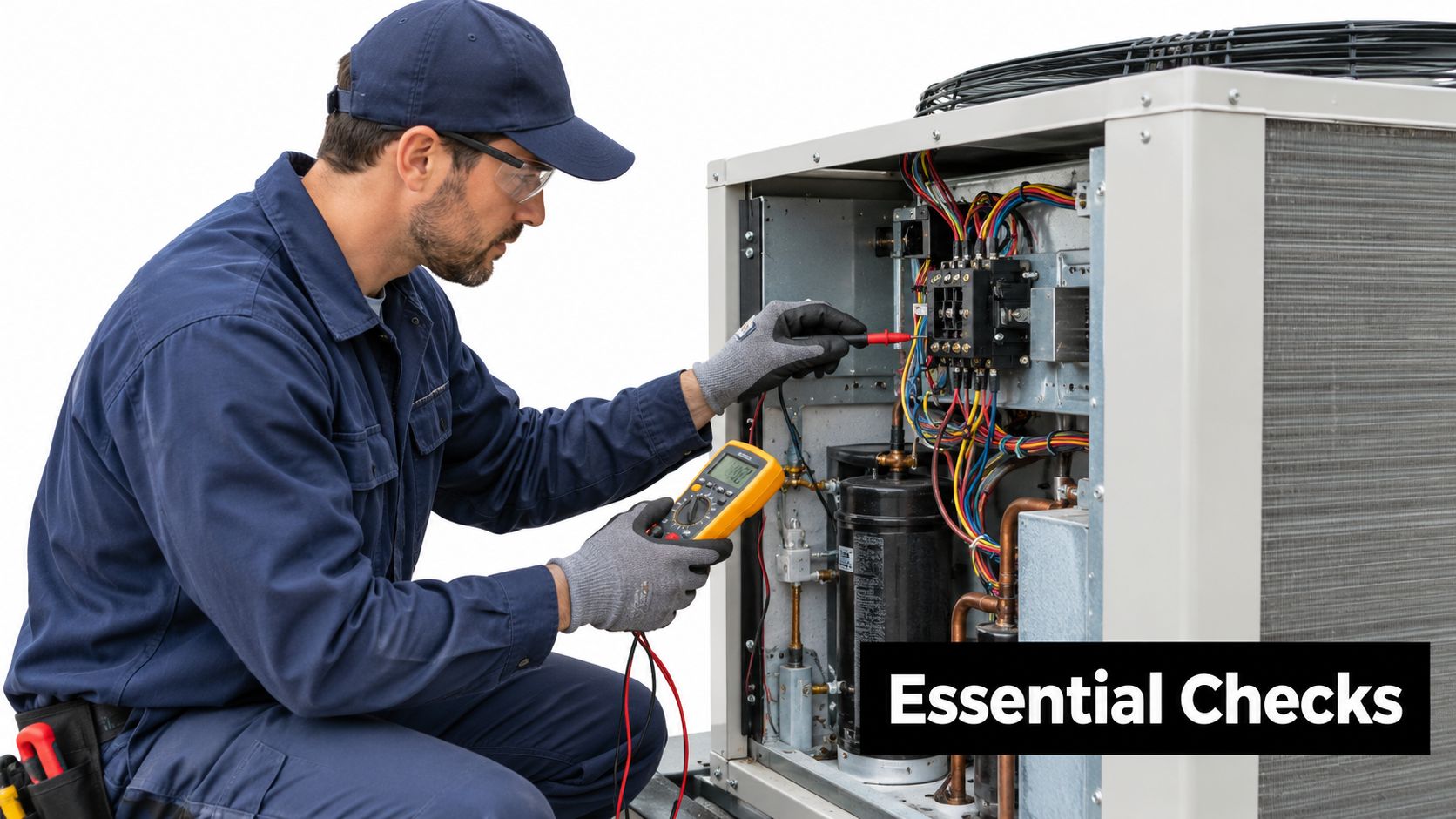
A professional visit should produce evidence about system condition, not just a checked box on a work order. The technician should inspect the full cooling path, from controls and airflow to the refrigeration circuit, electrical components, condensate management, and distribution.
Start with operating evidence
The technician should first understand how the system is behaving under load. That means reviewing thermostat or BAS commands, confirming schedules, checking whether the unit reaches the requested condition, and recording airflow and temperature split. If the system runs continuously, cycles too often, or serves some zones while ignoring others, those symptoms should be recorded before components are disturbed.
The filter and coil inspection comes next. A loaded filter increases resistance, while dirty evaporator or condenser surfaces interfere with heat transfer. Cleaning may restore performance, but the report should also identify why the condition developed, such as construction dust, poor access, inadequate replacement frequency, or an outdoor coil exposed to debris.
Verify the refrigeration and electrical sides
Refrigerant pressures should be interpreted alongside operating conditions, airflow, temperature readings, and the equipment manufacturer's requirements. Adding refrigerant without looking for the cause can hide a leak and leave the owner with a recurring service problem. The technician should inspect fittings, valves, service ports, line insulation, and visible oil residue, then document refrigerant type and any amount added.
Electrical work requires qualified personnel. The visit should include electrical connections, contactors, capacitors where applicable, motors, safety controls, and protective devices. Loose connections, abnormal current, or failing protection can create both reliability and safety concerns. Belt condition, alignment, fan operation, vibration, and unusual noise also deserve written findings because mechanical wear often announces itself before a failure.
This commercial HVAC system tune-up guide provides useful context for evaluating whether a contractor's tune-up includes meaningful diagnostic work rather than a superficial visual check.
A good technician should also test condensate drainage, inspect pans, confirm thermostat or BAS calibration, examine dampers and actuators, and look for duct leakage. Controls deserve the same attention as mechanical components because a unit can be clean and electrically sound while still operating on an incorrect schedule or responding to a drifting sensor.
Service standard: Every finding should answer three questions, what was measured, what condition was found, and what action should follow.
The report should include before-and-after readings where corrective work occurs, photographs when access or damage matters, the deficiency's priority, and a follow-up date. That record helps the facility manager compare performance over time and verify whether a repair restored the intended operation.
Common Problems That Regular Maintenance Prevents
A commercial AC unit can keep a room comfortable while operating with hidden faults. That creates a difficult choice for the facility manager: keep running the equipment until a complaint or alarm forces action, or identify the problem while repair timing and cost remain manageable. Preventive maintenance supports the second approach.
Filters load with dust, coils collect debris, belts wear, drains restrict, electrical connections loosen, and refrigerant leaks develop. A routine inspection can find these conditions before they trigger a shutdown. It should also test less visible problems, including drifting sensors, incorrect schedules, stuck dampers, simultaneous heating and cooling, and faulty control sequences.
The hidden faults behind a comfortable room
A large empirical study covering more than 60,000 HVAC assets and over 90 fault types found that 21 air-handler-unit faults appeared in at least 20% of units, while 18 faults persisted for more than 20% of the observation period, according to the study of fault prevalence in commercial HVAC systems. A recently serviced unit can still waste energy or create repeat comfort complaints if testing stops at cleaning and visual inspection.
Use BAS trends and operating data when runtime stays high, zones drift repeatedly, supply-air conditions change without an obvious mechanical cause, or alarms return after service. The diagnostic method should match the risk and the evidence available.
Condition | Reactive response | Better maintenance response |
|---|---|---|
Restricted airflow | Wait for weak cooling or a trip | Measure filter resistance and airflow |
Refrigerant loss | Add charge during a complaint | Document charge, inspect for leakage, and verify operation |
Incorrect schedule | Accept long runtime | Compare BAS schedules with occupancy |
Sensor drift | Adjust comfort complaints repeatedly | Compare sensor readings with a calibrated reference |
Duct or damper fault | Increase equipment runtime | Inspect distribution and verify damper operation |
Existing-building commissioning produced median whole-building energy savings of 6% across a dataset of more than 1,500 buildings, while fault-detection-and-diagnostics software produced median savings of 9%, as reported in the same study. These results do not mean every facility needs advanced software. They support a practical rule: investigate control faults with trend data before replacing components that may be working correctly.
Repair priority should reflect consequence, not convenience. Address conditions that threaten occupants, could damage major equipment, or keep the system running unnecessarily before lower-impact cosmetic defects.
Compressor problems deserve early attention. Poor airflow, incorrect charge, or electrical stress can turn a smaller fault into a major repair if the unit continues operating. This guide to AC compressor failure explains why a compressor complaint warrants diagnosis beyond a quick reset.
Benefits of a Preventive Maintenance Plan
A preventive plan earns its budget when it reduces business risk, not only when a technician completes a checklist. A well-run program supports reliable comfort, controlled energy use, indoor-air-quality management, documented compliance, and better decisions about repair or replacement.
The value becomes clear during a hot workday. A unit with a small control fault may continue running after occupants leave, while a restricted coil or leaking duct makes the equipment work harder. The immediate complaint may be minor, but the building still pays through wasted energy, shortened component life, disrupted operations, and emergency service.
A maintenance plan also assigns ownership. One person schedules access, the technician records readings, and the facility manager approves or assigns corrective work. That chain keeps a deficiency from disappearing into a service report.
Prioritize risk before convenience
A useful repair queue ranks problems by occupant risk, equipment risk, and energy impact. Research estimates that faults in U.S. commercial buildings waste approximately 0.7 quadrillion British thermal units annually, worth nearly $14 billion. The Department of Energy evaluation of fault prevalence also describes key faults increasing commercial-building energy consumption by 4% to 18% across HVAC, lighting, and refrigeration. HVAC operating during unoccupied periods and duct leakage account for at least half of the estimated impact.
That evidence changes the order of work. Filter replacement still matters, yet correcting an incorrect schedule, leaking duct, failed damper, or refrigerant-charge problem may produce greater savings. Use a risk-based triage:
Protect occupants and the building first. Address ventilation failures, excessive humidity, condensate risks, and conditions that could contribute to health complaints or moisture damage.
Correct persistent waste next. Investigate schedules, controls, dampers, duct leakage, and charge problems that keep equipment operating longer than necessary.
Maintain component condition continuously. Clean coils, replace filters, inspect belts, test drains, and tighten electrical connections according to the equipment's needs.
OSHA guidance calls for maintaining outdoor-air ventilation and controlling indoor humidity within roughly 30% to 60%. Indoor air quality therefore belongs in the same maintenance discussion as equipment reliability. If a building has recurring humidity complaints, verify measurements and equipment operation before treating every complaint as a thermostat problem.
For broader property operations, facility managers can compare HVAC work with other commercial facility upkeep strategies and build one coordinated inspection calendar. The HVAC plan should state visit frequency, included tasks, priority response, documentation, warranty requirements, and the process for approving repairs. A written commercial HVAC preventive maintenance plan gives the facility team a clear basis for comparing service visits and deciding which findings require immediate action.
EPA requirements make accurate records important. Under Section 608, owners or operators of comfort-cooling appliances containing 50 or more pounds of ozone-depleting refrigerant must take corrective action when the annualized leak rate exceeds 10% of the appliance's full charge, according to the EPA leak-repair requirements. The owner or operator generally must repair the leak within 30 days of discovery, or create a retrofit or retirement plan within that period and complete it within one year. Initial and follow-up verification tests are required after repair.
Service records should connect equipment charge, refrigerant added, calculated leak rate, repair date, and verification results. “Refrigerant added” alone is not a sufficient maintenance history.
Why Choose Covenant Aire Solutions for Your Commercial AC
The right commercial HVAC partner doesn't just arrive when a tenant complains. The contractor should understand the building's operating profile, preserve useful service data, explain trade-offs in plain language, and distinguish an urgent safety or comfort problem from a repair that can be planned.
For an Arizona commercial property, local operating conditions matter. Long cooling periods, high outdoor temperatures, dust, construction activity, and demanding tenant schedules can expose weaknesses that a generic seasonal checklist misses. A contractor should adjust inspection depth and frequency to the equipment, occupancy, and consequences of downtime.
Covenant Aire Solutions provides commercial heating, cooling, indoor-air-quality, repair, replacement, and maintenance services across Tucson and surrounding areas. Its preventive maintenance plans include biannual check-ups, priority service, and exclusive discounts. For a facility manager, the useful question isn't whether a plan sounds thorough. It's whether the plan produces the records and measurements needed to manage the building.
What to expect from a workable partnership
A credible provider should be able to:
Define the maintenance scope: State whether the visit includes airflow, temperature split, refrigerant measurements, electrical inspection, condensate drainage, controls, ductwork, and safety checks.
Document deficiencies: Separate observations from recommended repairs, identify priority, and explain what can happen if the issue remains open.
Support emergency response: Provide a clear escalation route for failures that threaten tenant operations or critical spaces.
Use transparent pricing: Present upfront costs and explain optional work without pressuring the owner into unnecessary replacement.
Adapt to the property: Treat a multi-tenant office, retail building, and high-use facility as different operating environments.
Covenant Aire Solutions is a family-owned, licensed, bonded, and insured Arizona HVAC company founded in 2019 by industry veteran Danny Polangco. Its certified technicians work on commercial and residential air conditioning systems, furnaces, heat pumps, ductwork, and indoor air quality solutions. The company also offers 24/7 emergency response, flexible financing, and an honest, consultative service approach.
The maintenance relationship should still include owner-side controls. Ask for asset lists, service histories, readings, photographs where useful, refrigerant records, open work orders, and clear follow-up dates. Review recurring failures at portfolio meetings, compare units serving similar spaces, and verify whether corrective work changed runtime, comfort, alarms, or measured performance.
A plan won't eliminate every failure. It can give the facility manager earlier warning, better repair choices, and a documented basis for protecting comfort and operating costs. That is the practical difference between buying visits and managing commercial AC performance.
Covenant Aire Solutions provides commercial AC maintenance, repairs, replacements, and indoor-air-quality services for Tucson-area properties, with biannual preventive check-ups and priority service options. Review the available maintenance support and contact Covenant Aire Solutions to discuss a service plan built around your equipment, occupancy, and operating risks.