
Commercial HVAC Emergency Service: What to Do First
Your phone lights up before your alarm does. A tenant, a night manager, or an alarm panel is telling you the building is hot, a walk-in is warming, or a rooftop unit has gone silent. You don't need a lecture on thermodynamics. You need a decision sequence that protects people, inventory, and operations while a technician is rolling.
The 2 a.m. Rooftop Outage and What Comes Next
The call rarely sounds dramatic at first. A restaurant manager says the dining room feels warm. A retail lead reports a thermostat climbing. Then someone checks the roof and finds a rooftop unit tripped, a belt shredded, or a compressor short cycling while the building load keeps rising.
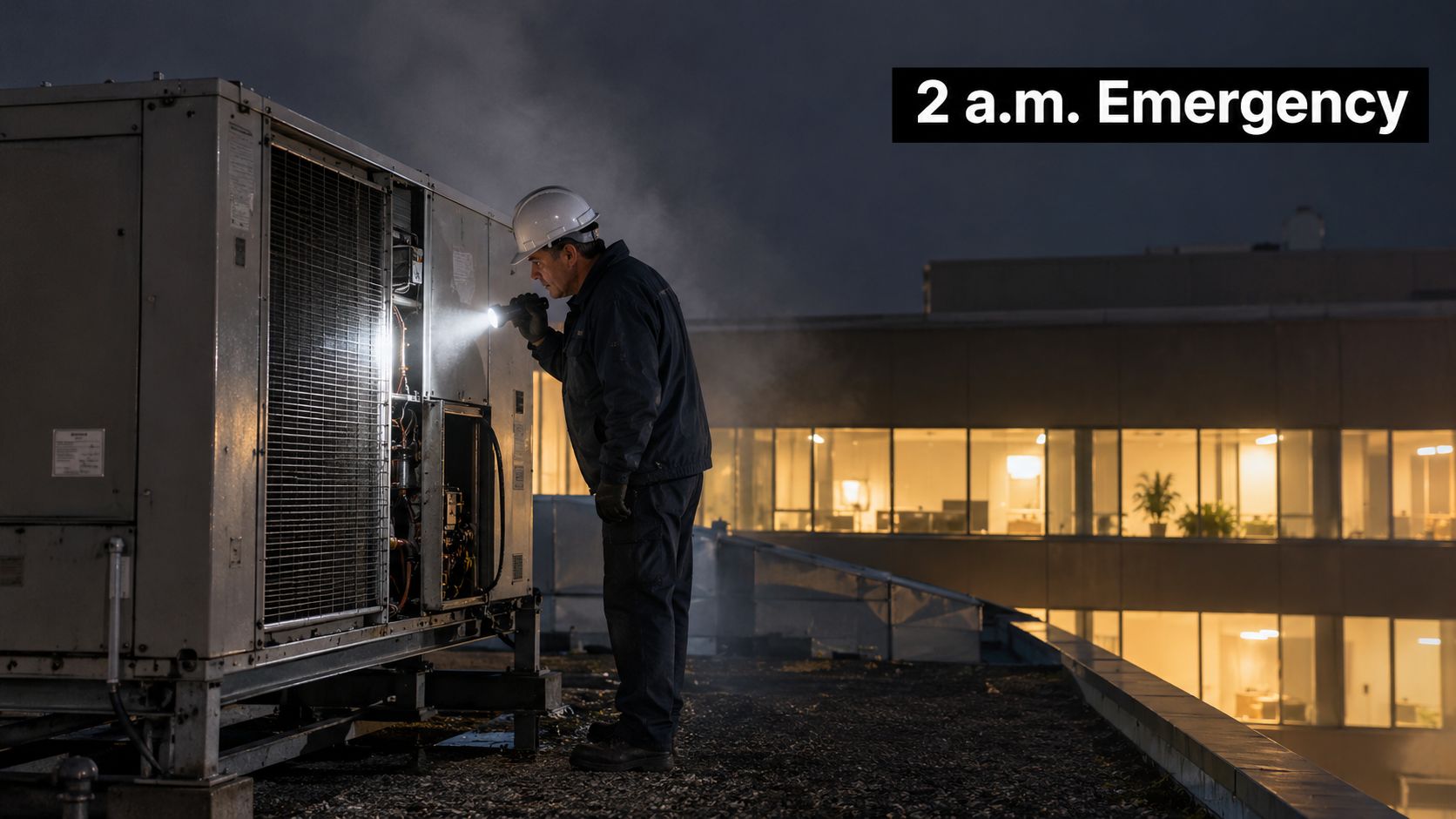
What happens next separates a managed incident from a chaotic one. You assign one person to communicate with occupants, one to meet the technician and open access, and one to record temperatures, alarms, and the time cooling was lost. Nobody resets breakers repeatedly hoping for a different result.
Why One Failure Rarely Means One Fault
Commercial systems accumulate hidden problems. Research on commercial building faults found that, on any given day, approximately 40% of air-handling units and 30% of air-terminal units had at least one reported fault, with an average of 245 reported HVAC faults per building per month. That's why I don't trust a diagnosis that stops at the first failed part.
A burned contactor may be the visible failure. The underlying cause could be low airflow, a dirty coil, a failing sensor, or a control sequence driving the equipment hard. If the technician replaces the contactor and leaves without checking those conditions, you'll likely buy another emergency visit.
Practical rule: Treat the first repair as stabilization until the technician verifies airflow, controls, electrical condition, and operating trends.
Your immediate priorities are practical, not technical. Move temperature-sensitive inventory if you can do it safely. Relocate occupants from the hottest zones. Tell tenants what you know, what you don't know yet, and when you'll update them again.
Don't authorize major replacement work at 2 a.m. unless safety, property loss, or a complete lack of temporary options forces it. Stabilize first, document second, and make capital decisions with a written diagnosis in hand. If replacement is on the table, review what rooftop unit replacement involves before you sign under pressure.
That's the mindset behind effective commercial HVAC emergency service. It's a business-continuity response built around safety, communication, evidence, and verified restoration, not just a fast truck and a hopeful reset.
Defining Commercial HVAC Emergency Service
A commercial emergency exists when a failure threatens life safety, business operations, inventory, regulatory compliance, or occupant habitability. A warm office on a mild morning may be urgent. A failed chiller serving a medical suite, a refrigerant leak in a mechanical room, or a complete cooling loss during extreme Tucson heat is an emergency.
Commercial work involves rooftop units, air handlers, chillers, large split systems, pumps, cooling towers, and commercial refrigeration. These systems serve many people at once, interact with building automation, and often require crane planning, three-phase electrical work, refrigerant recovery, and controls expertise. A residential technician may be excellent at home systems and still be the wrong choice here.
To understand the scale difference, it helps to know how a commercial HVAC system works before an outage forces you to learn it by phone.
Residential Versus Commercial HVAC Emergency Work
Dimension | Residential Call | Commercial Emergency |
|---|---|---|
People affected | One household | Tenants, employees, customers, patients |
Equipment | Furnace, split AC, heat pump | Rooftop units, chillers, air handlers, refrigeration |
Decision risk | Comfort and household cost | Revenue, inventory, leases, compliance, safety |
Documentation | Invoice and basic findings | Alarm history, readings, photos, verification records |
Coordination | Homeowner and technician | Facility staff, tenants, vendors, building controls |
Not every after-hours problem deserves emergency labor rates. Use this triage:
Emergency now: Suspected refrigerant release, burning odor, electrical arcing, no cooling in extreme heat, water actively damaging property, or failure in a critical space.
Priority next business window: One zone is uncomfortable, redundant equipment is carrying the load, and operations can continue safely.
Routine service: Noise, mild efficiency loss, or a noncritical fault with cooling and ventilation still operating.
Be honest during triage. If you label everything an emergency, you'll pay emergency prices for routine work and weaken your negotiating position. If you downgrade a critical failure to save money, you may lose inventory, tenants, or an entire operating day.
A qualified provider should ask about equipment type, affected areas, alarms, safety concerns, roof access, and whether redundant systems are running. If dispatch only asks for an address and a credit card, that's not triage. It's order taking.
Response Protocols and What a Real SLA Looks Like
A real service-level agreement defines commitments you can measure. It should state how quickly dispatch confirms your call, when a qualified technician arrives, who can authorize repairs, how you'll receive updates, and what verification the technician completes before closing the ticket.
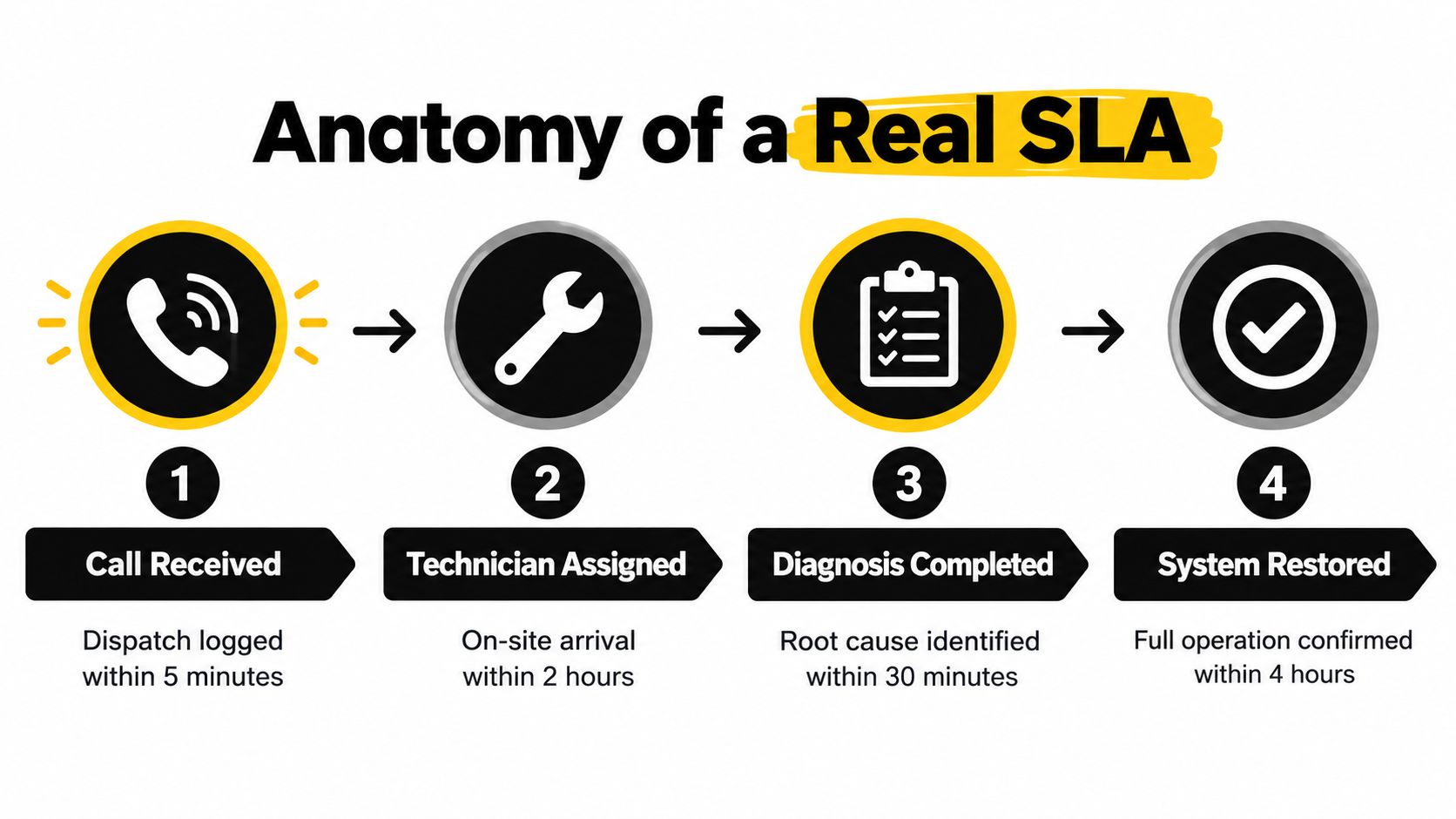
EPA guidance for commercial refrigeration emergency response recommends that an emergency-response policy establish a maximum response time that is as short as reasonably possible, giving two to four hours as an example. Use that as a serious planning benchmark, not as permission to accept vague language like fast response or priority handling.
Clauses That Matter More Than Arrival Time
Arrival alone doesn't restore cooling. Your SLA should also cover stocked parts, escalation to a senior technician, temporary cooling options, after-hours decision authority, and written closeout requirements. For refrigerant work, require recovery rather than release, leak testing beyond the repaired joint, and post-repair verification that the system is leak-free.
Safety belongs in the agreement too. If a refrigerant release is suspected, the technician shouldn't rush into disassembly. The area needs control, ventilation where appropriate, atmospheric evaluation, and proper respiratory protection before work begins. A provider who treats that as optional is creating liability along with downtime.
The structure behind priority dispatch often starts with planned service, which is why many managers review commercial AC maintenance options alongside emergency coverage instead of buying the two separately.
Ask these questions before you sign:
Who answers at night: An employee dispatcher or a third-party answering service?
Who gets dispatched: A commercial technician with the right refrigerant and controls experience?
What happens if the part isn't on the truck: Is there a local supply path or temporary stabilization plan?
What do you receive afterward: Photos, readings, alarm history, repair notes, and follow-up recommendations?
If a provider won't put response, escalation, and verification commitments in writing, you're buying a promise, not an SLA.
Watch for another warning sign. Some companies advertise around-the-clock availability but only take messages after hours. That's not commercial HVAC emergency service. Real coverage means a qualified technician can be assigned, reach your site, diagnose the system, and either repair it or stabilize it with a clear next step.
First Thirty Minutes Inside an Active Emergency
Your first job isn't repair. It's exposure control. Keep people away from electrical hazards, suspected refrigerant releases, roof hazards in the dark, and spaces where heat is becoming unsafe. If you smell burning electrical insulation or see arcing, shut the equipment down at the disconnect only if you can do so safely, then keep people clear.
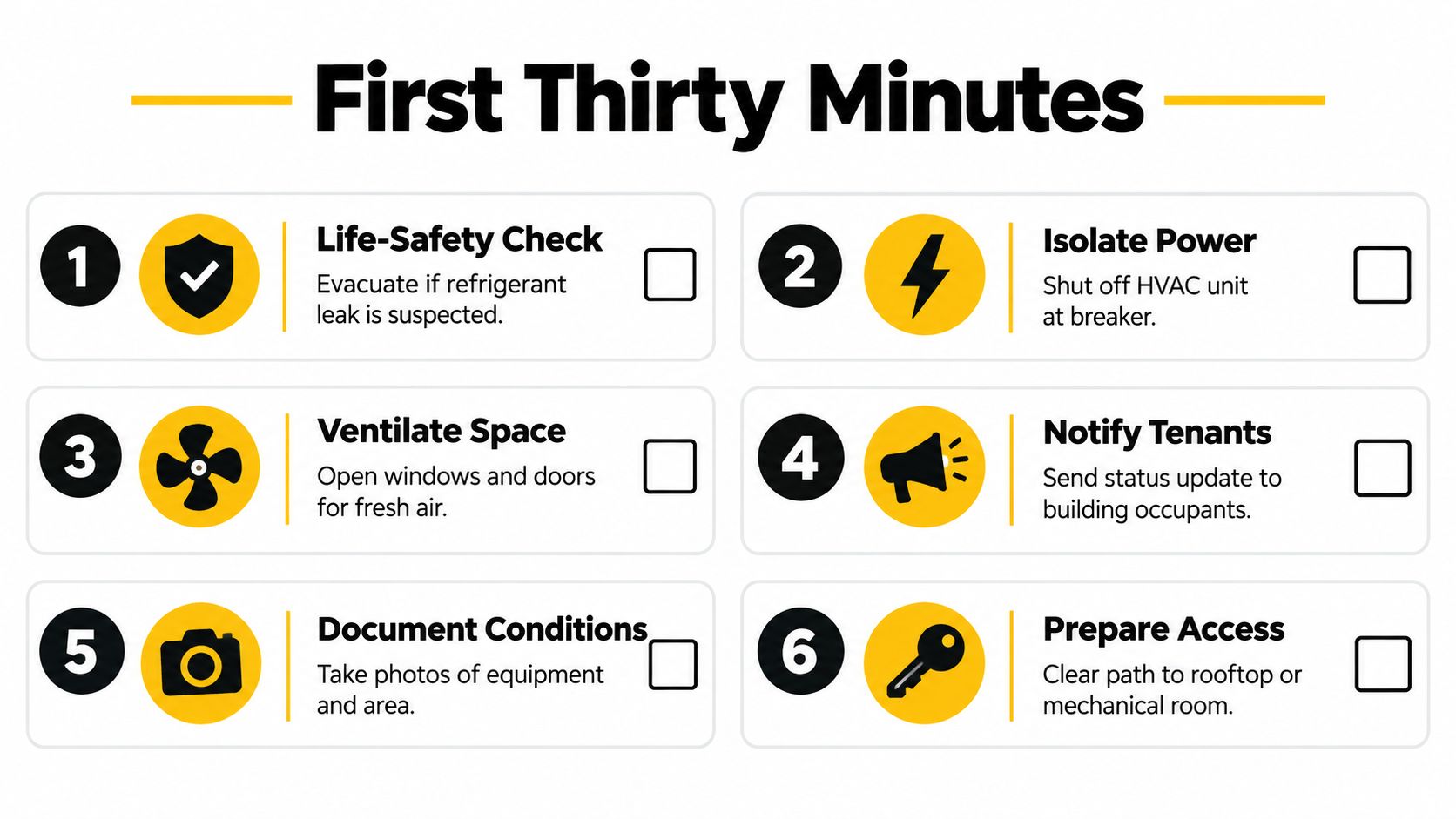
OSHA guidance on refrigerant release safety treats an unidentified refrigerant release as potentially immediately dangerous to life or health; the area should be controlled, ventilated where appropriate, and evaluated with suitable respiratory protection before technicians enter or disassemble equipment. Don't send an employee into a mechanical room to investigate a chemical odor or visible vapor cloud.
Your Sequence While Help Is Coming
Control access: Clear the affected area, ventilate from a safe position where appropriate, and prevent reentry until it's evaluated.
Isolate equipment: Use labeled disconnects and lockout procedures if your trained staff are authorized to do so.
Record conditions: Photograph alarms, thermostat readings, equipment nameplates, water damage, and anything unusual before settings are changed.
Protect operations: Move occupants, secure temperature-sensitive inventory, and shut doors to zones you want to keep cool.
Prepare access: Open roof hatches or mechanical rooms, clear the path, and have keys, codes, and escort arrangements ready.
Communicate once, clearly, and then update on schedule. Tell occupants which areas are affected, whether they should relocate, and when the next update will arrive. Speculation creates more calls than silence punctuated by honest updates.
Refrigerant incidents also carry documentation consequences. EPA stationary refrigeration leak repair requirements identify a 10% annual leak-rate trigger for comfort-cooling appliances and generally require repair within 30 days or development of a retrofit or retirement plan within that period when the applicable threshold is exceeded. Ask for leak findings, refrigerant type, recovery information, and verification results in writing.
Don't accept repeated refrigerant top-offs as a repair plan. A top-off without leak detection, repair, and verification postpones the emergency and can expand your compliance exposure. The technician should reduce refrigeration circuits to 0 psig before disassembly, retest lines after repair, and leave the equipment shut down if the leak persists.
Those first thirty minutes determine whether the technician starts with evidence or guesswork. Give them evidence.
Why Controls and Ventilation Often Hide Behind Cooling Failures
A compressor can run while the building still fails. I've seen emergency calls blamed on cooling capacity when the underlying problem was a closed outdoor-air damper, a drifting sensor, a failed exhaust interlock, or a control sequence fighting itself across zones. Replacing mechanical parts won't fix bad instructions.
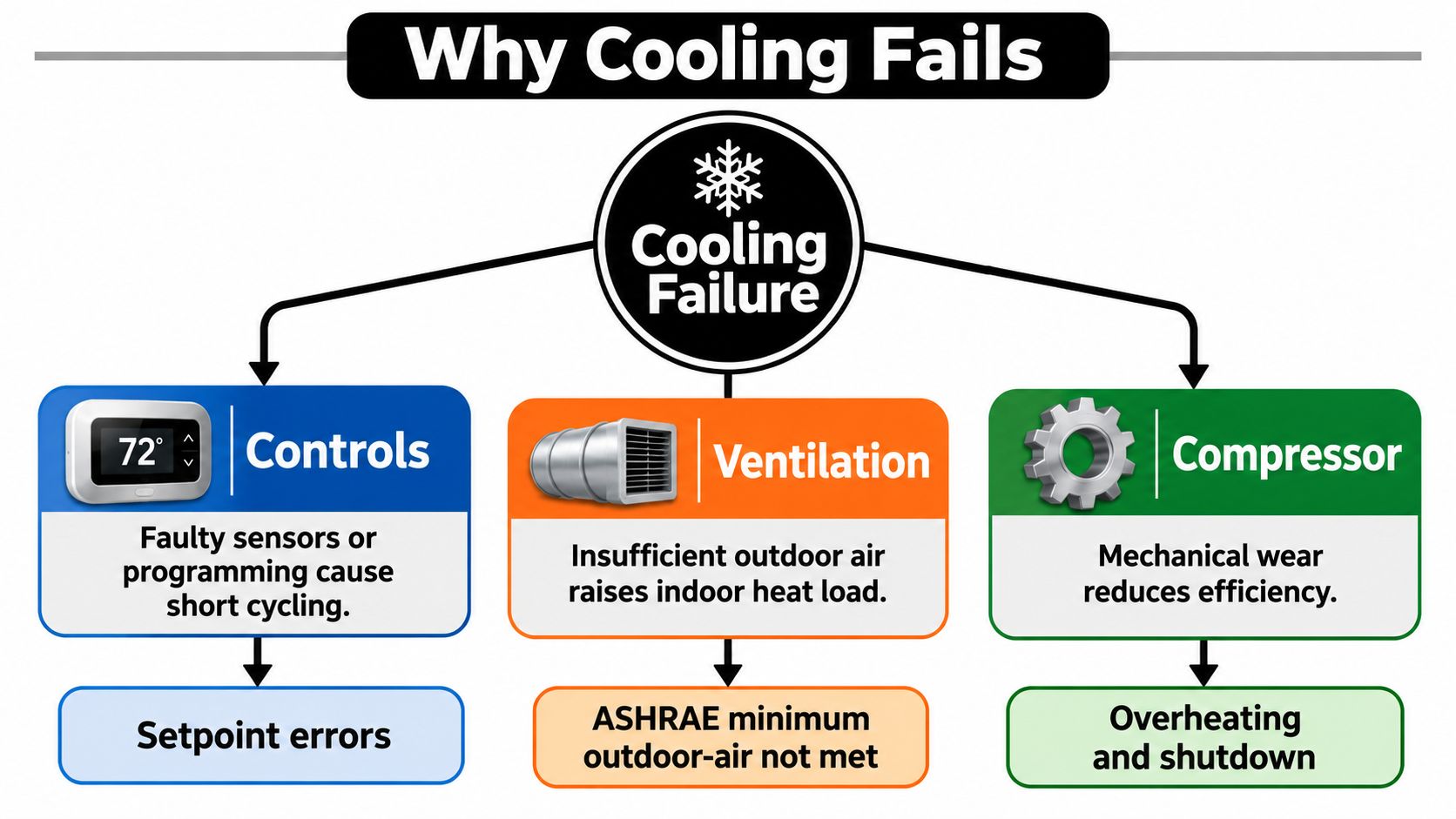
Your technician should compare supply and return air, damper position feedback, static pressure, trend data, and alarm history. Those readings distinguish a mechanical failure from loss of ventilation or poor sequencing. That diagnostic discipline matters for commercial HVAC emergency service, because a temporary reset can restore a green light while leaving the underlying fault active.
For a visual walkthrough of how these failures can present, watch the diagnostic example below before your next service review.
ASHRAE commercial building guidance supports functioning remote monitoring and alarms, verification that minimum outdoor-air quantities are delivered, correct outdoor-air damper control, and filtration at MERV 13 or better for recirculated air when applicable. The same body of guidance connects to a major cost issue: HVAC faults in U.S. commercial buildings have been estimated to waste approximately 0.7 quads of energy annually, valued at nearly $14 billion.
That's the financial argument for verification. A building can feel cool enough at closeout while wasting energy through simultaneous heating and cooling, excessive outdoor air, leaking dampers, or constant fan operation. Those faults raise operating costs and push equipment toward the next failure.
Require a closeout that confirms restored alarms, outdoor-air delivery, filter condition, pressure readings, sensor validation, and stable operating trends. If those items aren't checked, the visit isn't finished just because cold air is coming from a diffuser. Ventilation performance also belongs in your broader indoor air quality and ventilation planning, not only in emergency paperwork.
Director's test: If the report says reset unit and cooling normally, send it back and ask what caused the trip and what readings prove it won't recur tonight.
Preventive Planning That Makes Emergencies Less Common
Prevention isn't glamorous, but it's the cheapest emergency plan you can buy. Filters load up, belts crack, coils foul, condensate lines clog, contactors pit, and sensors drift. A competent maintenance visit finds those conditions during business hours, when you can schedule repairs instead of paying to improvise at night.
The maintenance gap is large. U.S. Energy Information Administration data summarized for commercial buildings indicate that regular HVAC maintenance was performed in 60% of the nation's estimated 5.9 million commercial buildings, although those buildings represented 81% of total commercial floorspace. In practical terms, about 40% of commercial buildings reported no regular HVAC maintenance, and smaller properties are heavily represented in that group.
What Your Maintenance Agreement Should Require
Don't buy a vague tune-up. Require documented inspections of filters, coils, belts, electrical connections, refrigerant performance, condensate drainage, controls, dampers, sensors, and safety devices. Require photos or readings when a technician recommends replacement parts. Require a deficiency list ranked by operational risk, not a sales sheet ranked by margin.
Your agreement should also define priority dispatch, after-hours rates, parts approval limits, reporting format, and whether emergency stabilization is included or billed separately. If you're drafting or comparing terms, you can find HVAC service agreement template resources to structure the document, then have your own counsel or procurement team adapt it to your properties.
Pair the contract with an equipment register. Record make, model, serial number, refrigerant type, filter sizes, belt sizes, disconnect locations, roof access instructions, and control credentials. That file saves diagnostic time during every future call.
For practical cost framing, review commercial HVAC preventive maintenance tips and compare those tasks against your current scope. You'll often find your agreement covers cleaning and inspection but not the controls verification that prevents repeat failures.
My recommendation is direct. Put critical equipment on scheduled maintenance first, even if budget forces you to phase in lower-risk units later. Protect the systems serving revenue space, regulated space, and temperature-sensitive operations before you worry about perfect coverage everywhere.
Fault detection can strengthen that plan where your building controls support it. The point isn't software for its own sake. It's earlier warning, better trend records, and fewer surprises discovered by tenants. Maintenance, monitoring, and a written emergency protocol work as one system. Separately, each leaves gaps.
How Covenant Aire Supports Commercial Clients
For Tucson-area properties, Covenant Aire Solutions offers one local option for commercial HVAC emergency service. The company was founded in 2019 by Danny Polangco and operates as a family-owned, licensed, bonded, and insured HVAC contractor serving commercial and residential clients in Tucson and surrounding areas.
Its commercial relevance here is structural rather than promotional. The company provides 24/7 emergency response, certified technicians, preventive maintenance plans with biannual check-ups, priority service, and exclusive discounts. It also states transparent upfront pricing and flexible financing for larger projects. Those features map directly to the requirements in this guide: reachable dispatch, planned maintenance, and clearer cost decisions during a breakdown.
How to Evaluate the Fit
Don't select any provider, including this one, on claims alone. Ask for the emergency escalation path in writing. Ask which commercial equipment types its technicians service, how refrigerant leaks are verified, what the closeout report includes, and how temporary stabilization is handled when a part isn't immediately available.
Use the same questions you'd ask a national contractor:
Coverage: Does a technician roll after hours in your service area?
Maintenance link: Does plan membership change dispatch priority or pricing in a documented way?
Repair discipline: Will you receive readings, photos, and root-cause notes rather than a one-line invoice?
Decision process: Can the technician separate tonight's stabilization from a later repair-versus-replace recommendation?
The company also offers special rates for teachers, military personnel, and first responders, which may matter for some locally owned commercial clients. Its stated consultative approach emphasizes genuine needs over upselling, but you should still verify that in the proposal. Require line-item scopes, approval thresholds, and a clear distinction between emergency stabilization and permanent repair.
A local provider can be a strong fit when it knows your buildings, keeps equipment history, and answers for both maintenance quality and emergency outcomes. A provider that only sells emergency visits has less incentive to reduce your emergency volume. Choose the relationship that rewards fewer 2 a.m. calls, then hold it accountable with reports after every visit.
Your Commercial HVAC Readiness Checklist
Do this work this week, before the next alarm forces your schedule. Readiness is mostly paperwork, labels, and confirmed phone numbers, which is exactly why busy teams postpone it.
Equipment file: Store model and serial numbers, refrigerant type, filter and belt sizes, warranty records, and recent service reports in one accessible place.
Isolation map: Label disconnects, gas valves, water shutoffs, roof access, and mechanical room keys.
Contact tree: Confirm who authorizes after-hours spending, who notifies tenants, and who meets the technician.
SLA review: Verify response targets, escalation steps, approval limits, temporary cooling options, and closeout documentation.
Critical-space plan: Decide in advance where occupants and temperature-sensitive inventory go if cooling is lost.
Then call your provider and test the process with a nonemergency question. Ask what tonight's dispatch would look like for your largest rooftop unit. If the answer is vague, fix the agreement now.
Covenant Aire Solutions provides 24/7 commercial HVAC emergency service, preventive maintenance, and repair support for properties in Tucson and surrounding areas, so your team can pair documented maintenance with a defined emergency response instead of improvising during an outage. Visit Covenant Aire Solutions to request a maintenance agreement review and confirm how after-hours dispatch would work for your building.