
Heat Pump Replace Air Conditioner: Tucson Homeowner Guide
Your AC is running, the house still feels warm, and the replacement quotes on your kitchen table don't agree. One contractor recommends another air conditioner. Another says a heat pump can handle summer cooling and winter heating. You're trying to buy reliable comfort, not become an HVAC engineer.
My recommendation: don't buy a heat pump just because it heats, and don't reject one because Tucson is hot. Compare the equipment's summer performance, the condition of your furnace, and the actual installed cost. A good conventional AC can be the right purchase. An inverter heat pump can be the smarter replacement when you need both heating and cooling.
Why Tucson Homeowners Are Asking the Heat Pump Swap Question
You've followed the technician toward the attic access, felt the heat coming down, and decided the kitchen table is a better place to discuss equipment. The cooling-only quote looks familiar. The heat-pump quote raises a reasonable question: why pay for more heating capability when summer comfort is what's keeping you awake?
For Tucson homeowners, cooling must remain the first test. The winter benefit only matters if the proposed equipment can maintain indoor comfort during demanding summer conditions. Don't let a sales presentation reverse those priorities.

Start With the Equipment You Already Own
The answer changes depending on whether your furnace is dependable, approaching replacement, or absent altogether. These are different purchases, even if the outdoor units look similar.
Replacement option | What you're buying | Strongest reason to choose it | Main caution |
|---|---|---|---|
Conventional central AC | Cooling, with separate heating retained | Your furnace is sound and cooling-only economics matter most | Doesn't solve an aging heating system |
Inverter heat pump | Variable-capacity cooling and electric heating | You need a coordinated heating-and-cooling replacement | Requires a model-specific summer performance comparison |
Dual-fuel system | Heat pump paired with a gas furnace | You want electric heating with a gas backup option | More equipment and controls to evaluate |
This isn't an obscure replacement idea. The Energy Information Administration's household cooling overview reports that 88% of U.S. households used air conditioning in 2020, with approximately two-thirds using central AC or a central heat pump as their primary cooling equipment. Existing central systems provide a starting point for comparing replacement options, not permission to skip an inspection.
Don't Confuse an Arizona Rebate With Your Rebate
Utility territory belongs near the top of your decision sheet. An APS-versus-SRP comparison can illustrate how incentives change the calculation, but it isn't proof that either program applies to your Tucson address.
Kitchen-table rule: Buy the system your house needs, then subtract the incentives you actually qualify for. Don't start with a rebate advertisement and work backward.
If you're arranging a replacement soon, ask for comparable quotes with the same installation scope. Otherwise, you may be comparing a complete heat-pump installation against an AC quote that leaves necessary work for later.
How a Heat Pump Replaces an Air Conditioner Without a Full Renovation
A heat pump isn't a different kind of cooling distribution system. In summer, it removes indoor heat and releases it outdoors through a refrigeration cycle. In winter, the system reverses that process and transfers available outdoor heat indoors.
That's why replacing central AC with a heat pump often doesn't require rebuilding the house. The existing installation may already provide usable ducts, indoor air handling, refrigerant connections, drainage, and electrical service.
ENERGY STAR's guidance on replacing central AC states that the change doesn't require a home renovation or electrical-panel upgrade and can involve a modest additional cost compared with standalone AC. Treat that as guidance about the replacement opportunity, not a promise that every existing component will work with every new model.
Understand What Gets Reused
The contractor should separate reusable infrastructure from equipment that needs replacement. Existing ductwork might remain, while the indoor coil, air handler, thermostat, or controls need to change.
Outdoor equipment: The replacement must provide reversible heating and cooling.
Indoor equipment: The coil or air handler must belong to an approved equipment combination.
Refrigerant connections: Reuse depends on condition and the selected equipment's requirements.
Controls: The thermostat must operate the compressor, heating modes, and any backup heat correctly.
Electrical service: Existing capacity needs verification, especially when electric resistance backup is proposed.
The plain-language explanation of how a heat pump works helps distinguish the refrigeration equipment from the ducts that distribute conditioned air.
This video provides another way to visualize the operating cycle.
Compare the Complete System, Not the Condenser
A matched system means the outdoor unit, indoor equipment, and controls are approved to work together. Keeping an incompatible indoor coil to make the quote cheaper can undermine the performance you thought you were buying.
Ask for the published rating of the proposed combination. A brochure showing the outdoor unit's highest available efficiency isn't enough.
You also need the right labels: SEER2 and EER2 for cooling, HSPF2 for heating. Older SEER and HSPF figures come from a different testing framework, so a casual comparison can mislead you.
The swap can be straightforward. The verification shouldn't be casual. A responsible quote identifies what stays, what changes, and what testing establishes that the completed system performs as intended.
Cooling Performance Comparison in Triple-Digit Heat
“Heat pump” doesn't tell you enough about summer performance. A fixed-speed replacement and an inverter-driven model belong in different conversations. The compressor's operating range, the matched system's efficiency, and its published capacity under demanding outdoor conditions matter more than the category name.
An Arizona-focused heat-pump comparison argues that conventional AC can outperform traditional heat pumps during peak summer cooling, while modern inverter equipment narrows that gap. It also describes a Phoenix study of 8,656 households in which heat-pump users began cooling at temperatures nearly 1°C lower and used less electricity per degree of outdoor-temperature increase. That finding isn't a guarantee for your home, but it's a useful warning against predicting comfort or bills from a label alone.
Compare Compressor Classes Side by Side
Equipment class | Operating approach | What deserves attention in Tucson |
|---|---|---|
Fixed-speed heat pump | Runs at a fixed compressor output when operating | Peak cooling capacity, cycling behavior, and sizing |
Two-stage heat pump | Provides distinct lower and higher operating stages | Whether lower-stage operation improves comfort without compromising peak-load coverage |
Inverter heat pump | Modulates compressor output across an operating range | Published hot-weather capacity, controls, and part-load comfort |
Premium conventional AC | Cooling-only equipment, with operation depending on model | Whether its cooling performance justifies retaining separate heating |
SEER2 describes seasonal cooling efficiency. EER2 provides another cooling-efficiency comparison, but neither substitutes for the manufacturer's capacity tables at your home's design conditions. HSPF2 belongs in the annual purchase decision, not as evidence that a unit cools better.
Ask the contractor to show what the proposed equipment delivers above 100°F, rather than assuming its nominal capacity remains sufficient. That's the distinction between selling a nameplate and designing a replacement.
Bigger Isn't the Fix
Oversizing can cause short cycling and reduce humidity removal. Undersizing can leave the system struggling to recover after a thermostat setback. The practical response is a load calculation and airflow verification, not adding capacity because the old system struggled.
Variable-capacity equipment can improve part-load comfort and humidity control, but an inverter isn't a substitute for adequate peak capacity. The discussion of whether new heat pumps are more efficient is useful preparation for asking model-specific questions.
Don't accept “it's variable-speed” as the entire answer. Ask what it delivers when your house needs its greatest cooling output.
My ranking is straightforward: favor a properly selected inverter heat pump when heating replacement is also useful. Keep a premium AC on the shortlist when your furnace is healthy and its documented summer performance and installed cost are stronger. Treat a fixed-speed heat pump as an option to prove, not an automatic upgrade.
Winter Heating and Cold-Weather Behavior in Southern Arizona
An Oro Valley or Vail homeowner doesn't need a sales pitch built around the coldest climate in the country. You need to know whether the selected system can heat your particular house on a cold morning, and whether its controls will do that without leaning unnecessarily on backup heat.
Winter capacity and winter efficiency are separate questions. A unit can have an appealing seasonal heating rating while still requiring careful evaluation of its output at your local design temperature.
Read Cold-Climate Ratings Without Overbuying
ENERGY STAR's cold-climate specification requires a COP of at least 1.75 at 5°F and retention of at least 70% of its 47°F heating capacity at 5°F. Those are demanding conditions relative to typical Tucson design points.
COP, or coefficient of performance, compares delivered heat with electrical input. The cold-climate test tells you something specific about low-temperature operation; it doesn't mean every Tucson replacement needs that designation.
Use the rating as a performance reference. Then ask the contractor to compare published heating capacity with your home's calculated heating load. Don't pay for a designation without understanding what problem it solves.
HSPF2: Compare seasonal heating efficiency across approved equipment combinations.
Heating capacity: Confirm the unit can meet the building's needs at the selected design temperature.
Backup operation: Identify when supplemental heat is permitted to run.
Comfort controls: Discuss thermostat setbacks, recovery behavior, and temperature consistency.
Backup Heat Should Have a Job
Electric resistance strips can supplement the compressor when the design calls for them. They shouldn't operate unnecessarily because of careless thermostat configuration.
Defrost behavior also belongs in the installation discussion. Ask how the proposed equipment manages it, what the homeowner may notice, and how backup heat is coordinated during that operation.
For a variable-speed system, my comfort priority is steady output that follows the heating load. For a single-speed replacement, I'd pay closer attention to cycling and temperature swings. Neither choice excuses poor sizing or restrictive ducts.
The guide to how heat pumps work in winter can help you prepare questions about normal heating, defrost, and supplemental operation.
Choose backup heat deliberately. Electric strips and a gas furnace are different solutions with different installation and operating implications. Your contractor should explain why the proposed backup belongs in your home rather than treating it as an unexplained line item.
Real Cost Numbers for a Tucson Heat Pump Replacement
There isn't an honest universal installed price or payback period for this decision. Equipment selection, reusable components, duct corrections, electrical work, financing, and the furnace you're keeping or replacing all affect the total.
The rebate divide is concrete: Arizona replacement-program information reports that APS residential energy-efficiency rebates ended January 1, 2026, while qualifying SRP rebates can provide $75 to $225 per ton through April 30, 2027. The SRP date is a scheduled program endpoint, not a guarantee of future eligibility or payment. Verify current terms and your actual utility before including an incentive in the purchase calculation.

Compare the Replacement You Actually Need
AC only, with a healthy furnace: Compare the conventional AC quote with the incremental cost of the heat pump. Don't credit the heat pump with avoiding a furnace purchase you weren't planning to make. Keeping conventional AC can be the sound financial choice.
AC plus an aging furnace: Request a complete AC-and-furnace quote alongside the heat-pump quote. Avoiding a separate furnace replacement belongs in the calculation here. Comparing the heat pump against the condenser alone would understate the alternative's cost.
Dual fuel: Ask for a heat pump paired with either the serviceable existing furnace or a specified replacement furnace. Include controls, maintenance, and any required modifications. Buy this configuration for a defined heating strategy, not because more equipment sounds safer.
The overview of average AC replacement cost in Arizona can help organize quote questions. Your written site-specific estimate should determine the budget.
Use a Transparent Break-Even Calculation
For a simple comparison, calculate:
Incremental net purchase cost ÷ estimated annual operating savings = simple payback.
Build the incremental cost from complete installed quotes, subtract only confirmed incentives, and include financing costs in a separate ownership-cost comparison. If estimated annual savings are negligible or negative, there isn't a useful positive operating-savings payback to advertise.
Ask for these inputs in writing:
Rate plan: Electricity and gas assumptions, including time-of-use or demand charges where applicable.
Heating use: Your actual occupancy pattern, especially if you're a seasonal resident.
Ownership period: Whether you expect to remain long enough to benefit from projected savings.
Maintenance and service life: The assumptions used for each option, without treating a guessed lifespan as guaranteed.
Electricity-price sensitivity: Whether the recommendation changes when electricity costs rise.
Budget reality: The lowest estimated operating cost doesn't necessarily produce the fastest payback.
With Tucson's cooling-dominated load, modest heating use can limit the value of paying extra for heating efficiency. Replacing an aging furnace at the same time can change that conclusion substantially.
Installation Details That Decide Real-World Performance
A good equipment choice can still produce a disappointing installation. Before discussing brands, I want to know whether the contractor measured the building load, checked the distribution system, and identified the electrical and control requirements.
The Department of Energy's updated equipment standards FAQ lists minimum ratings of 14.3 SEER2 and 7.5 HSPF2 for split-system heat pumps manufactured on or after January 1, 2023, compared with 13.4 SEER2 for split-system air conditioners in the applicable baseline category. Regional AC requirements must also be checked. SEER2 and HSPF2 reflect revised testing, and meeting a regulatory minimum doesn't guarantee your installed bills or comfort.
Require an On-Site Verification Scope
Ask for a fixed-price installation scope that identifies the checks, included corrections, and potential exclusions. A vague promise to “install to manufacturer specifications” doesn't tell you what happens if the existing ducts or wiring need work.
Manual J load calculation: Size from the home's cooling and heating needs, not merely the old unit's nominal tonnage.
Duct leakage and airflow: Establish whether conditioned air reaches the rooms as intended.
Electrical capacity: Check the panel, circuits, and proposed auxiliary-heating load.
Refrigerant-line condition: Determine whether existing lines meet the replacement equipment's requirements.
Matched-system documentation: Identify the outdoor unit, indoor equipment, and approved controls.
Thermostat compatibility: Verify staging, modulation, and backup-heat control.
Condensate management: Inspect drainage and the protection appropriate to the equipment's location.
Attic installations deserve particular attention to access, duct condition, and drainage. An installer should be able to explain how those details will be handled before you sign.
Don't Ignore Static Pressure
A restrictive return, unsuitable filter arrangement, or constrained duct system can impair airflow in both operating modes. Replacing the outdoor unit doesn't repair the distribution system.
Understanding static pressure in ductwork helps you ask a better question than whether the fan feels strong. Ask for measured results and the manufacturer's acceptable operating requirements.
There's no responsible universal number for how far a poor installation will reduce effective efficiency. The right response is to test and correct the installation, not attach a dramatic savings claim to duct repairs.
Before signing, ask: Who performs the load calculation? What measurements will I receive? Which corrections are included? How will the system be commissioned? A contractor who can answer those questions clearly has given you something more useful than a brand preference.
Decision Checklist for Switching from AC to Heat Pump
Choose the replacement that solves your actual equipment problem. A rebate, a heating-efficiency label, or an inverter compressor can support the decision. None should make it alone.
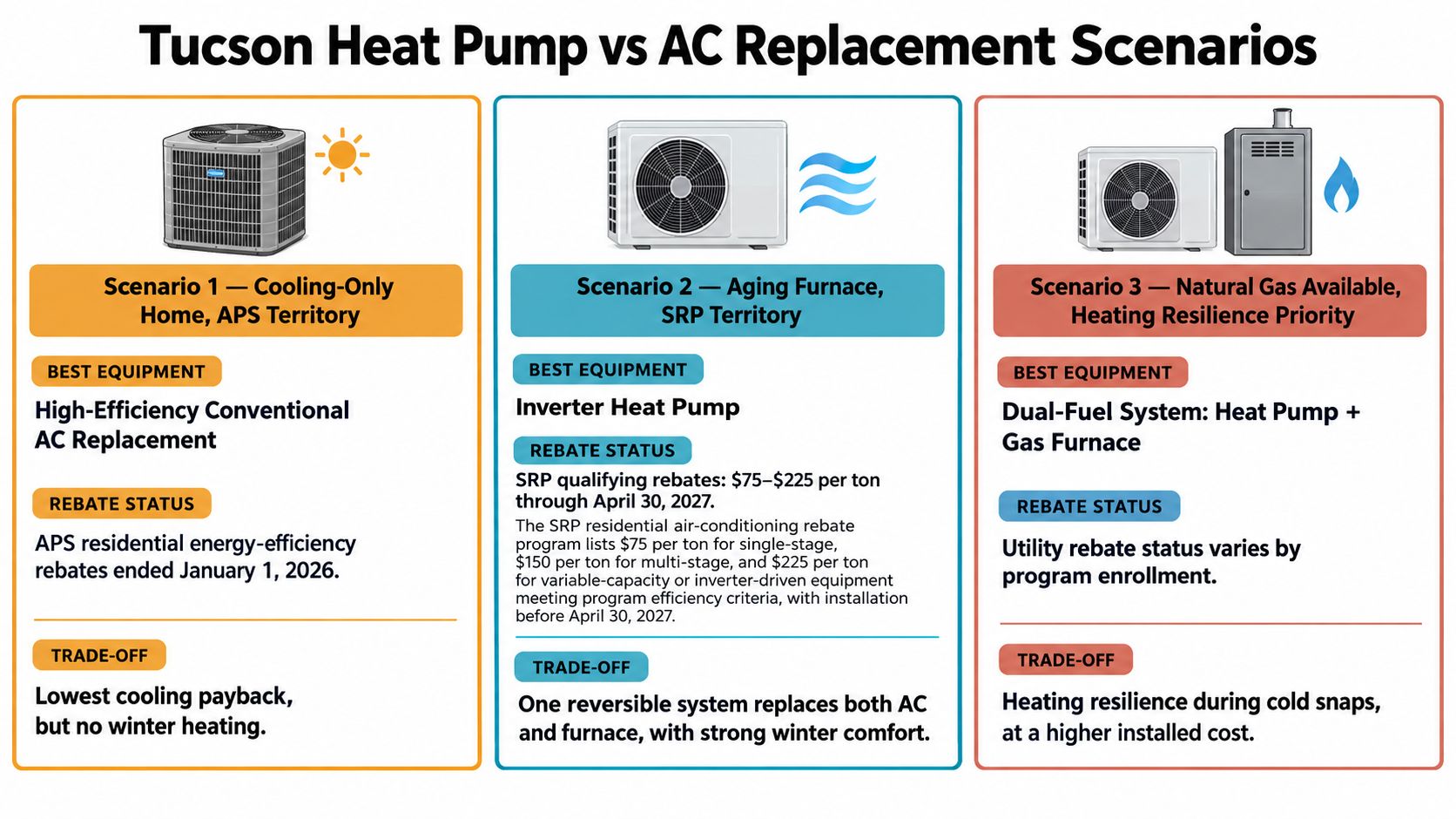
Tucson Heat Pump vs AC Replacement Scenarios
The utility examples below apply only when the property is in the named service territory. Rebate timing and eligibility remain subject to the program checks described earlier.
Scenario | Best Equipment Class | Utility Rebate Status | Trade-Off |
|---|---|---|---|
Cooling-only home, APS territory | High-efficiency conventional AC | Residential energy-efficiency rebates ended | Strong cooling-only payback candidate; no added winter heating |
Aging furnace, SRP territory | Inverter heat pump | Qualifying per-ton incentives have a scheduled endpoint | Can replace both functions with coordinated winter comfort |
Natural gas available, heating resilience priority | Dual-fuel heat pump and gas furnace | Varies by program eligibility and enrollment | Backup heating flexibility, with a higher installed-cost burden to evaluate |
Run the decision through these checks before approving a proposal:
Utility territory: Confirm the provider and qualifying program at your address.
Furnace condition: Separate a necessary replacement from an optional upgrade.
Summer performance: Require documented capacity, appropriate sizing, and verified airflow.
Winter use: Account for morning comfort needs and seasonal occupancy.
Electrical scope: Resolve panel and backup-heating requirements before installation.
Budget timeline: Compare net installed cost, financing, and realistic ownership assumptions.
Questions Homeowners Ask Before Signing
Can a heat pump replace an air conditioner in Tucson's extreme heat?Yes, provided the selected matched system meets the home's cooling load under local design conditions. Don't accept the heat-pump label, by itself, as evidence that a particular model will do the job.
What is backup heat for?It supports the heating strategy when the compressor alone isn't sufficient or when the controls require supplemental operation. Ask exactly when it will run.
When should I keep my AC?Keep a functioning AC when replacement isn't justified. If replacement is necessary, choose another conventional AC when your furnace remains useful and the complete cooling-only proposal makes better financial and performance sense.
For a site-specific comparison, Covenant Aire Solutions offers AC and heat-pump replacement services across Tucson and surrounding areas. Bring your current quotes and utility bill, and ask for a consultative proposal that compares equipment options, installation requirements, and upfront pricing before you commit.