
Heating and Cooling System Replacement: Costs and Timing
Is a heating and cooling system replacement due the day a part fails, or the day a refrigerant headline says your unit is obsolete? Most guides treat age as a countdown and a rule change as an order. In Tucson the better test is lifecycle cost: cooling hours left in the equipment you have, what a repair buys, and whether the next system is sized to the house instead of copied from the old nameplate.
Cooling runs for months here. A merely old unit can still be the cheaper choice. A younger unit with a leaking coil, weak ducts, or the wrong capacity can be the expensive one. I would not sign a repair invoice or a replacement contract until the age, the fault, and the load are on paper.
Replacement Age Benchmarks for Each System
The age you can verify today is on the nameplate. ENERGY STAR replacement guidance tells homeowners to evaluate replacement when an air conditioner or heat pump is more than 10 years old, and when a furnace or boiler is more than 15 years old. That is a prompt to look, not an order to remove a working system. The same guidance puts qualified furnaces about 15 percent more efficient than conventional models and qualified boilers about 5 percent more efficient than a new standard model, so age only matters next to operating cost.
National replacement records run on a different clock. A large equipment-replacement dataset lists median replacement ages of 15.3 years for air conditioners or condensers, 13.3 years for heat pumps, and 17.7 years for furnaces, according to ServiceTitan equipment lifespan trends. Air handlers show 12.7 years and evaporator coils 12.5 years in that data.
Those figures are medians, not guarantees. Maintenance quality, installation practices, operating hours, climate, humidity, filtration, and repair history can shorten or extend real service life. A carefully maintained condenser in a shaded yard can outlast a neglected twin on a west wall.
Equipment | Age to evaluate | National median replacement age |
|---|---|---|
Air conditioner or condenser | More than 10 years | 15.3 years |
Heat pump | More than 10 years | 13.3 years |
Furnace | More than 15 years | 17.7 years |
Boiler | More than 15 years | No separate median listed |
Air handler | With the cooling unit | 12.7 years |
Evaporator coil | With the cooling unit | 12.5 years |
The ENERGY STAR guidance covers air conditioners, heat pumps, furnaces, and boilers. Air handlers and evaporator coils are evaluated with the cooling unit they serve, not against a separate ENERGY STAR age.
Why one component resets the whole plan
An air handler or evaporator coil often reaches its replacement point before the furnace or condenser it serves. Swapping only the failed box can leave a mismatched set a season or two later. If the coil is 12 years old and the condenser is 9, get prices for both. A matched set also makes the load calculation and refrigerant charge easier to get right.
Do three things before you accept an "it's time" speech:
Read the nameplate. Find the manufacture date on the condenser, coil, air handler, furnace, or heat pump. The install sticker and the factory date are not always the same year.
Log each age. A single "the system is 11" hides a 14-year-old coil behind a newer outdoor unit.
Request a written evaluation. When any major component is at or past its threshold, get a look at the rest of the set and a room-by-room load calculation, not a capacity match to the old tonnage.
Tucson's long cooling season puts far more runtime on the air conditioner or heat pump than on the furnace. That is the age I would check first. For local context on service life, see how long AC units last in Arizona.
Practical rule: Use the ENERGY STAR ages as the moment to evaluate, and the medians as the point when many owners have already replaced. Neither number is a failure date.
Warning Signs That Outweigh a Repair
The question at a breakdown is simple: is this repair worth paying for? The weak assumption is that every failed part deserves a fix because the rest of the system still starts. Sometimes it does. A cheap part on a young, matched system is usually the right spend. Repeated failures, comfort that never settles, and a bill that climbs with the same thermostat settings are a different problem.
Watch for these patterns:
Repeat repairs in the same year. Two or three truck rolls on related faults mean you are funding a decline, not a reset.
Higher bills without a change in use. Filters and a dirty coil come first. If those are clean and the bill still rises, efficiency has slipped.
Short cycling. The unit hits the setpoint, shuts off, and starts again. That pattern hammers the compressor and does a poor job on humidity.
Uneven rooms. One bedroom roasts while the living room is cold. That can be ducts or airflow, and a new condenser will not fix a starved room by itself.
Banging or hissing. Banging points at a blower, motor, or mounting problem. Hissing can be refrigerant leaving the system.
Humidity the system cannot hold. During Tucson's monsoon, a unit that cools the thermometer but leaves the house clammy is not doing the whole job.
Energy use is why this shows up so clearly on the bill. The U.S. Energy Information Administration reported that space heating and air conditioning together accounted for 52% of average household energy consumption in 2020. An inefficient or failing unit is not a small line item.
A sequence that beats a guess
Note the age of the failed part and of every major component.
Total this repair quote plus repairs from the last two years.
Set that total next to a replacement price for a matched system, not a single box.
Estimate how much useful life the rest of the set still has.
Ask whether the failure points at a larger fault, such as the compressor or the coil.
A capacitor on a four-year-old unit is usually a simple repair. The part is inexpensive relative to the equipment, the warranty may still help, and the rest of the system has most of its life left. A compressor failure on a 14-year-old unit is a different case. You are buying the most expensive component for a system already near typical replacement age, often with an older coil and an expired labor warranty.
Before you sign the repair invoice, confirm the diagnosis in writing, the part warranty, whether refrigerant must be added, and what fails next if you only fix today's symptom. A side-by-side look at AC repair versus replacement helps when the quote is large and the system is already in its second decade.
A repair that restores a young, tight system is money well spent. A repair that props up a leaking, short-cycling system only rents a few more hot weeks.
Refrigerant Rules That Change Replacement Timing
Rules changed what manufacturers can build. They did not outlaw the system already on your pad.
The EPA technology transitions rules restrict the manufacture and import of residential and light-commercial air-conditioning and heat-pump systems that use refrigerants above a 700 global-warming-potential limit beginning January 1, 2025. The same EPA account of 2025 described supply shortages, price spikes, and stockpiling of newer R-454B equipment. That is a supply story. It is not a legal order to scrap a working R-410A system.
Repair and replacement are different jobs
Under the EPA's frequent questions on the HFC phasedown, R-410A components manufactured after January 1, 2025, must be labeled for servicing existing equipment only, and those components may still be sold for repairs to legacy systems. A new residential or light-commercial air-conditioning system installed after January 1, 2026, cannot use refrigerants that exceed the applicable global-warming-potential limit. Replacement equipment has to be built for an approved lower-GWP refrigerant. A technician cannot pour a newer refrigerant into equipment that was not designed for it.
The EPA also states that R-32 and R-454B must be used only in systems specifically designed for those mildly flammable refrigerants. Certification, charge procedure, and leak checks are part of that design. They are not a field experiment.
Regulatory change alone is not a sufficient reason to replace a working system. Replacement earns its cost when refrigerant leaks keep returning, a major component fails, efficiency has fallen far behind current equipment, or parts are no longer available. A tight R-410A system with a minor electrical fault can stay in service.
For a plain-language walk-through of the timeline, read the R-410A refrigerant phase-out guide. Then run this check on your own equipment:
Read the refrigerant type on the nameplate.
Ask whether replacement parts for that model are still available.
Record the service history for leaks and how many pounds were added.
Compare repair cost with replacement cost, warranty, and efficiency.
Confirm that any new equipment is certified for its refrigerant and legal for the installation date.
The short video below shows why the nameplate and the install date belong in the same folder as the quote.
Choosing Between an AC, Heat Pump, Furnace or Ductless System
What decides whether you replace an air conditioner, add a heat pump, keep a furnace, or go ductless? Start with the load the house carries and the equipment already installed. Popularity charts do not size a system.
System | Heating | Cooling | Best fit | Tucson consideration |
|---|---|---|---|---|
Central air conditioner | Needs a separate heat source | Yes | Homes with a sound furnace and ducts | Cooling demand is the main load, so correct sizing matters most |
Gas or electric furnace | Yes | Needs an air conditioner coil | Homes with gas service and cold winters | Winter heating demand is low, so the furnace often runs rarely |
Heat pump | Yes, with backup heat for the coldest nights | Yes | Homes wanting one system for both functions | Electrical panel capacity and heating capacity at design temperature must be verified |
Ductless mini-split | Yes | Yes | Additions, homes without ducts, room-by-room control | Lower duct losses, but more indoor units to maintain and clean |
Refrigerant rules can eliminate a model, but they should not choose between an AC, heat pump, furnace, or ductless layout.
A new central air conditioner paired with a sound furnace and decent ducts is the straightforward swap when heating is already solved. You keep gas heat you rarely use and put the budget into the machine that runs all summer. If the furnace is recent, replacing it during the same project adds cost without much runtime to pay it back. That is a lifecycle decision, not a loyalty test to one fuel.
A heat pump handles both functions in one outdoor unit. In a cooling-dominant climate, that can be a sensible fit if the electrical service can carry the equipment and backup heat covers the coldest nights. It is a poor default when the panel is full, the ducts leak badly, or winter use is so small that the heating side never earns its added controls and service points. A load calculation based on window area, insulation, duct location, and design temperatures decides capacity. The nameplate rating does not. Ask for the load calculation and the commissioning report. Those two documents tell you more than a verbal promise about efficiency.
A variable-speed system can help on Tucson shoulder seasons, when a single-stage unit blasts, shuts off, and leaves the air clammy. It still needs correct airflow and a control that is commissioned, not left on factory defaults.
A furnace earns its place where gas service exists and winters are cold. In a Tucson house that needs heat only on a handful of nights, a new furnace adds little. If the building is older and the heat source is the weak piece, use the structure as the first filter and find heating suited to older homes before you price equipment. The wall assembly, duct route, and existing flue or electrical capacity shape the choice more than a brochure does.
A ductless mini-split fits an addition, a house without ducts, or a room that should run on its own schedule. You avoid dumping capacity into leaky ducts. You take on more indoor heads to clean, and each head needs a clear path for airflow. Budget maintenance time for each indoor unit.
Replace only the air conditioner when the furnace is recent and the ducts are sound. Choose a heat pump when heating use is occasional and the electrical service can support it, including capacity at the outdoor design temperature. Choose ductless when you need zoning or you do not have ducts worth saving. If the panel and furnace age are both in play, read replacing an air conditioner with a heat pump before you commit. The decision should match the house, the utility rate, and the repair history, not the equipment that happened to sell well last year.
What Replacement Costs and How to Pay for It
Sticker shock is real, and it is national, not just local. The average U.S. HVAC-system price increased from approximately USD 6,000 in 2020 to approximately USD 12,000 in 2025, according to House Digest reporting on replacement-cost trends. Your bid can land well away from either figure once tonnage, ducts, and electrical work enter the scope.
Item | Figure | Notes |
|---|---|---|
Average U.S. HVAC system price, 2020 | About $6,000 | National average from House Digest reporting |
Average U.S. HVAC system price, 2025 | About $12,000 | National average from House Digest reporting |
Federal credit rate, 2023 through 2025 | 30% of eligible expenses | Equipment must meet qualification rules |
General annual credit maximum | $1,200 | Central air conditioners, furnaces, boilers and heat pumps |
Heat pump annual credit maximum | $2,000 | Separate limit from the general maximum |
Lifetime limit, 2023 through 2025 credit | None | The 2022 version had a $500 lifetime maximum |
How the credit actually applies
The Internal Revenue Service home energy tax credit rules state that eligible improvements, including central air conditioners, furnaces, boilers, and heat pumps, installed during 2023 through 2025 may qualify for a credit equal to 30 percent of eligible expenses. The general annual maximum is $1,200. Heat pumps, biomass stoves, and biomass boilers have a separate annual maximum of $2,000. The IRS also states that the 2023 through 2025 credit has no lifetime limit, unlike the 2022 version, which had a $500 lifetime maximum. Manufacturers must register qualifying energy property, so a model is not eligible just because it is new.
Say eligible expenses on a qualifying central air conditioner are $5,000. Thirty percent is $1,500, but the general annual cap stops the credit at $1,200. On a qualifying heat pump, the same 30 percent math uses the separate $2,000 annual maximum instead. Count only eligible expenses, confirm the installation year, and confirm the product is registered. These amounts are tied to 2023 through 2025, so verify them for the date the system is installed. Claim the credit on the return, and confirm the filing with a tax professional before you treat it as cash in the bid.
What moves the bid, and how people pay
System type, tonnage, duct changes, electrical upgrades, permits, and the refrigerant the equipment uses all move the price. A straight condenser swap is not the same job as a heat pump that needs a panel upgrade and new line set.
Compare financing on the paper, not on the monthly teaser. Look at loan term, annual percentage rate, how long a promotional rate lasts, prepayment penalties, and deferred-interest traps that charge back interest if a balance remains. A personal loan keeps the house out of the deal. A home equity loan or line of credit can carry a lower rate and puts the house at risk if you default. Dealer financing is convenient when the term is clear and the post-promo rate is written down.
Ask for an itemized quote that separates equipment, labor, materials, permits, and duct work so two bids can be compared line by line. Then do a simple total-cost check: net installed price, after any credit you have verified, set against expected energy savings over the life you can reasonably expect. Savings are estimates. They move with sizing, installation, and utility rates. A planning pass with an HVAC replacement cost estimator keeps the conversation on scope instead of a single round number.
Efficiency and Air Quality Upgrades Worth Adding
Replacement day is the cheap moment to reach parts of the system you will not want opened again. Do the work that makes the new equipment perform, and be picky about add-ons that mostly decorate the proposal.
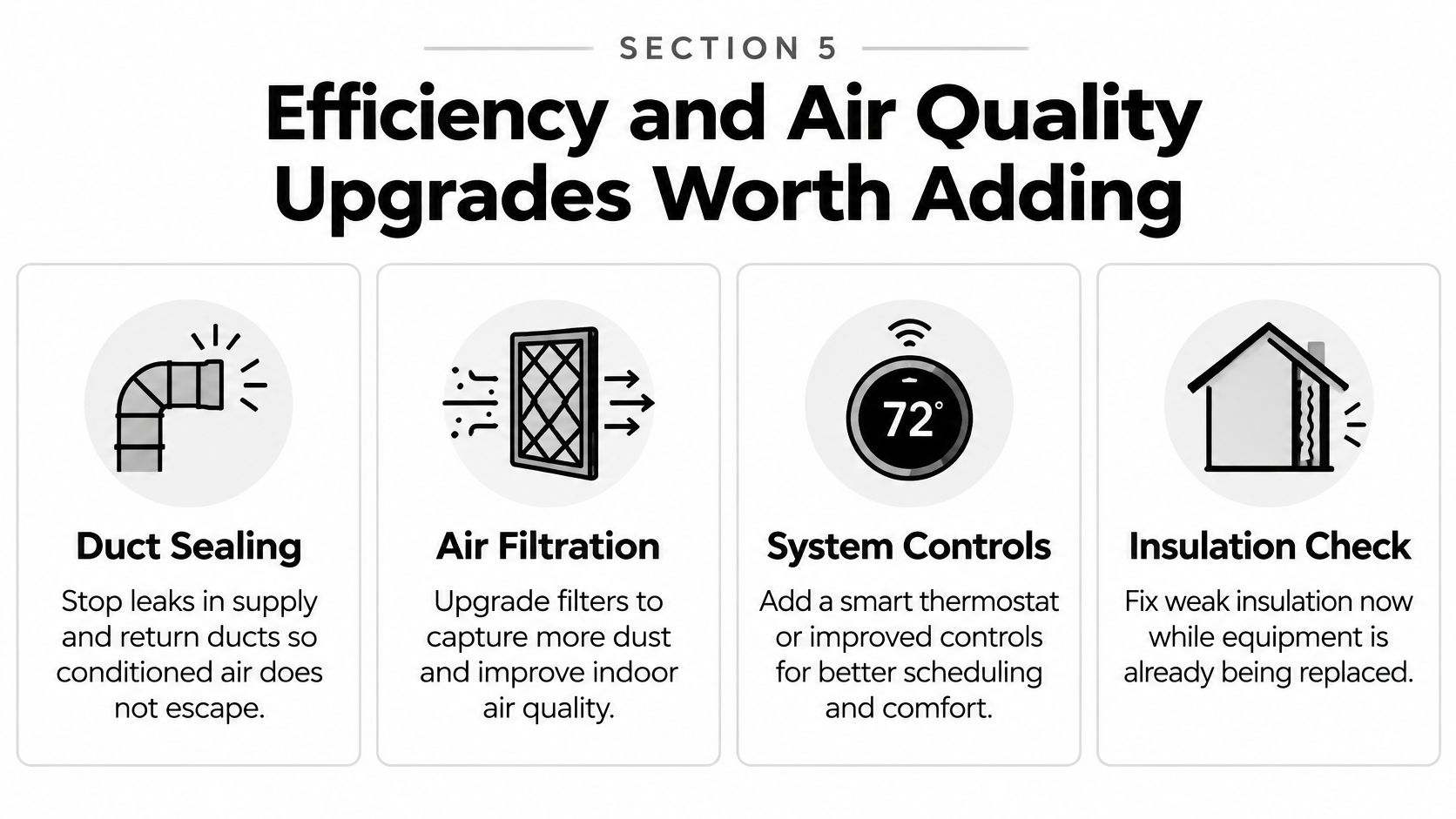
Duct sealing belongs in the payback group. Leaks in supply or return ducts spill conditioned air into the attic or crawlspace, and Tucson attics get hot enough to punish any duct that is thin, torn, or poorly hung. Seal with mastic or approved metal-backed tape while the equipment is already apart. Filtration pays back when it matches the blower. A thicker filter can catch more desert dust, but only if airflow and total external static pressure still meet the manufacturer's limits. Insulation on ducts and at weak spots in the envelope is the same kind of fix: do it now, while access is open.
Comfort items are worth buying when you know what they change. Humidity control matters in monsoon season because a unit that satisfies the thermostat and shuts off leaves the air clammy. Variable-speed equipment runs longer at a lower speed and pulls more moisture. Controls are the everyday lever: a programmable or smart thermostat with a real schedule cuts runtime when the house is empty, and a remote sensor can stop one hot room from driving the whole system. Air purification is an add-on. Judge it by pressure drop, filter or cell replacement, and whether you will maintain it. Skip it when the claim is stronger than the maintenance plan.
Sealing a house tighter without a planned fresh-air path can make indoor air feel stale. Controlled inlet ventilation, including trickle vent fitting services, is one way older or renovated homes keep a small, intentional air path instead of relying on random leaks.
Take this list to the installer:
Duct sealing: Scope supply and return leaks, then seal them before the new equipment is charged.
Air filtration: Name the filter size and confirm static pressure still passes.
System controls: Set the schedule and any room sensor on the day of start-up, not "later."
Insulation check: Repair crushed or missing duct insulation while the attic is already open.
I would spend first on ducts, airflow, and a control you will use. Purification can wait until those three are done.
Installer Selection and the Replacement Process
The equipment brand matters less than who sets it up. Improper installation can wipe out the efficiency you paid for, and an oversized unit feels worse in Tucson than a slightly modest one that runs long enough to dry the air.
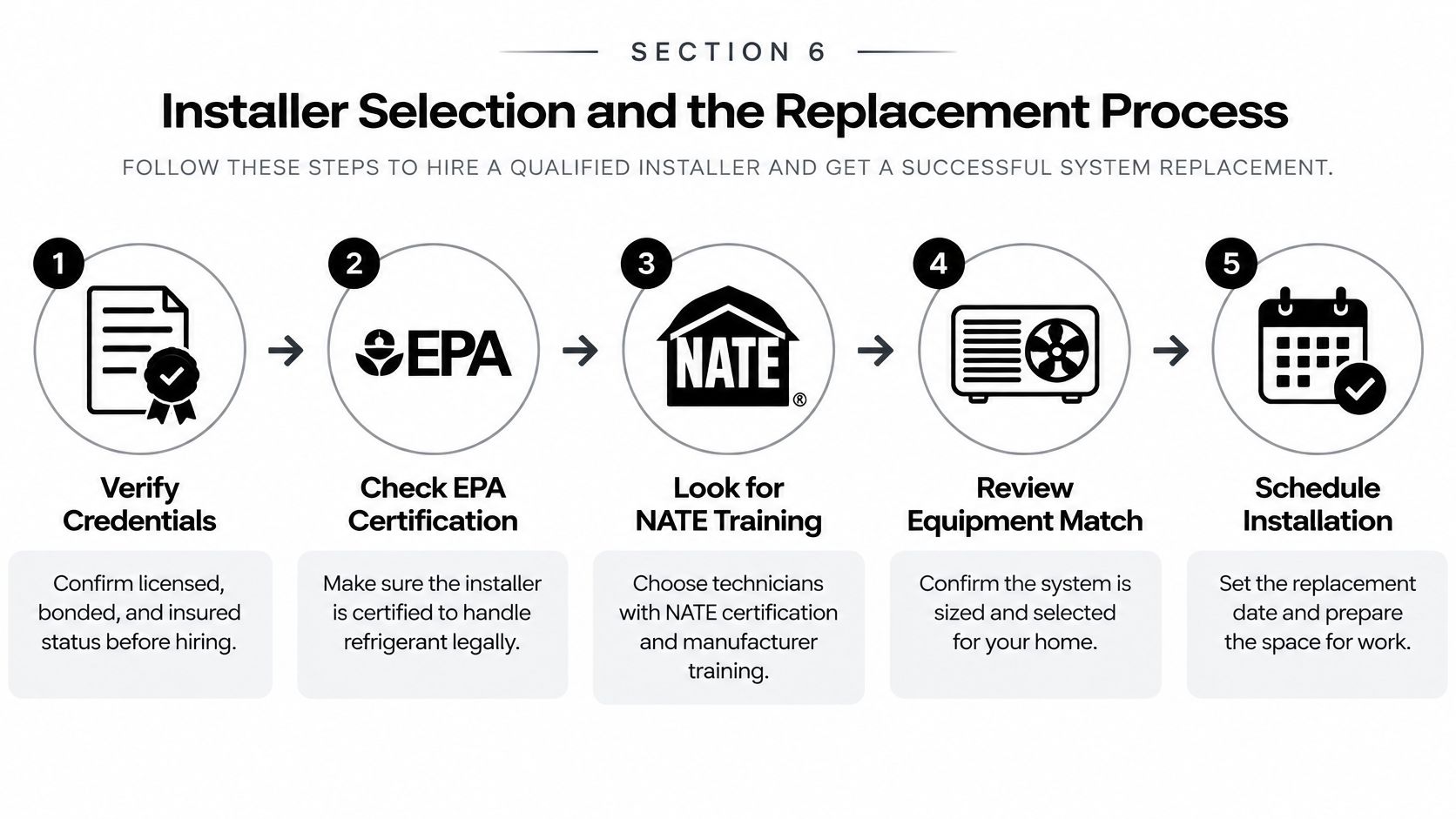
Vet the company before you compare tonnage. Confirm the firm is licensed, bonded, and insured. Confirm EPA certification for refrigerant handling. Prefer technicians with NATE certification and manufacturer training on the brand being installed. Danny Polangco holds EPA Certification, Trane Comfort Specialist credentials, and NATE Certification, which is the paperwork standard I want on the person designing the job, not only on the truck magnet.
ENERGY STAR heating and cooling guidance states that improper installation can reduce system efficiency by up to 30 percent, and that correctly installed high-efficiency air conditioners and heat pumps can save up to 20 percent on heating and cooling costs. Those are different effects. One is the penalty for a bad install. The other is the savings from a high-efficiency system that was installed correctly. ENERGY STAR's clean heating and cooling guidance separately reports that poorly sealed duct systems can cause up to 30% efficiency loss, and it tells contractors to start with ACCA Manual J, then select equipment under Manual S.
The order that keeps the tonnage honest
Schedule an in-home evaluation with a Manual J load calculation. Do not accept a match to the old unit's capacity.
Measure airflow, total external static pressure, and duct leakage, and check supply and return balance.
Select equipment under Manual S. For a heat pump, confirm heating capacity at the outdoor design temperature, not only the nominal cooling tonnage.
Collect at least three written proposals on the same basis. Each should list capacity, efficiency rating, refrigerant, warranty, permits, and duct sealing scope.
Compare installed price with any credit you have verified and with the financing terms in writing.
Approve payment and schedule removal and installation. A straightforward swap is often one to two days. Duct or electrical work takes longer. Order before peak summer, because scarce equipment slips schedules.
Commission the system. The acceptance list is documented Manual J results, capacity at local design conditions, measured static pressure, blower airflow within manufacturer limits, duct leakage corrected with mastic or approved metal-backed tape, refrigerant charge, thermostat operation, and safety controls.
Walk through operation and register the warranty before the crew leaves.
Oversizing is especially harmful in a cooling-dominant climate like Tucson. An oversized air conditioner reaches the thermostat setting quickly, cycles off before it dehumidifies, and takes more start-stop stress. That shows up as clammy rooms, short cycles, and a compressor that wears out early.
Do not pay the final invoice until the measured static pressure, airflow, and charge are written down. A start-up that "seems cold" is not commissioning.
What to Expect From Covenant Aire Solutions and Maintenance Plans
Covenant Aire Solutions is a Tucson HVAC company. We service all makes and models, for homes and commercial spaces, and we offer a free A/C unit check-up. Cooling work covers repair, maintenance, and replacement. Heating work covers gas furnaces and heat pumps. The first visit on a system you might replace should inspect that equipment, hand you a written report, and recommend capacity from a load calculation rather than from the old nameplate.
A maintenance plan is for the years after the install, not a substitute for a bad diagnosis. Ours is built around scheduled tune-ups ahead of cooling season and heating season, filter and airflow checks, and priority scheduling when something fails on a holiday weekend. A pre-summer visit is the one that matters most here. Dust loads the coil, monsoon humidity exposes a charge or airflow problem, and a long cooling season does not forgive a dirty system in July.
Get the agreement in writing before you sign. Confirm the visit count, what is included, what is excluded, the price, renewal terms, and how cancellation works. A hassle-free transfer is available if you are moving a maintenance contract from another contractor. Free diagnostics for eligible non-working or failing units are separate from the check-up, and materials and repairs are billed on their own.
Ask these questions on the first call:
Does the check-up cover the equipment I am considering?
What does the written report include, including age, refrigerant, and the load result?
Which visits and parts does the plan cover, and which are billed separately?
How are renewal and cancellation handled?
Book the in-home evaluation and ask for the written sizing report before the next peak season, while parts and calendar space are easier to get.
Covenant Aire Solutions handles heating and cooling system replacement in Tucson, including air conditioners, furnaces, and heat pumps, with load-based sizing instead of a copied nameplate. We service all makes and models and offer a free A/C unit check-up so you can see age, refrigerant, and condition before you choose repair or replacement. Visit Covenant Aire Solutions to schedule that evaluation before the next stretch of extreme heat.