
Exterior Heat Pump Guide: Costs, Sizing and Tucson Fit
It's late afternoon in Tucson, your thermostat says the house is climbing, and the cabinet outside is humming in full sun while you're wondering whether it can keep up, or whether you're about to pay for a repair that won't fix the core problem. That's the right question to ask here. In Tucson, an exterior heat pump isn't judged by a few cold mornings. It's judged by months of cooling and afternoons above 110°F.
What an Exterior Heat Pump Is and How It Works
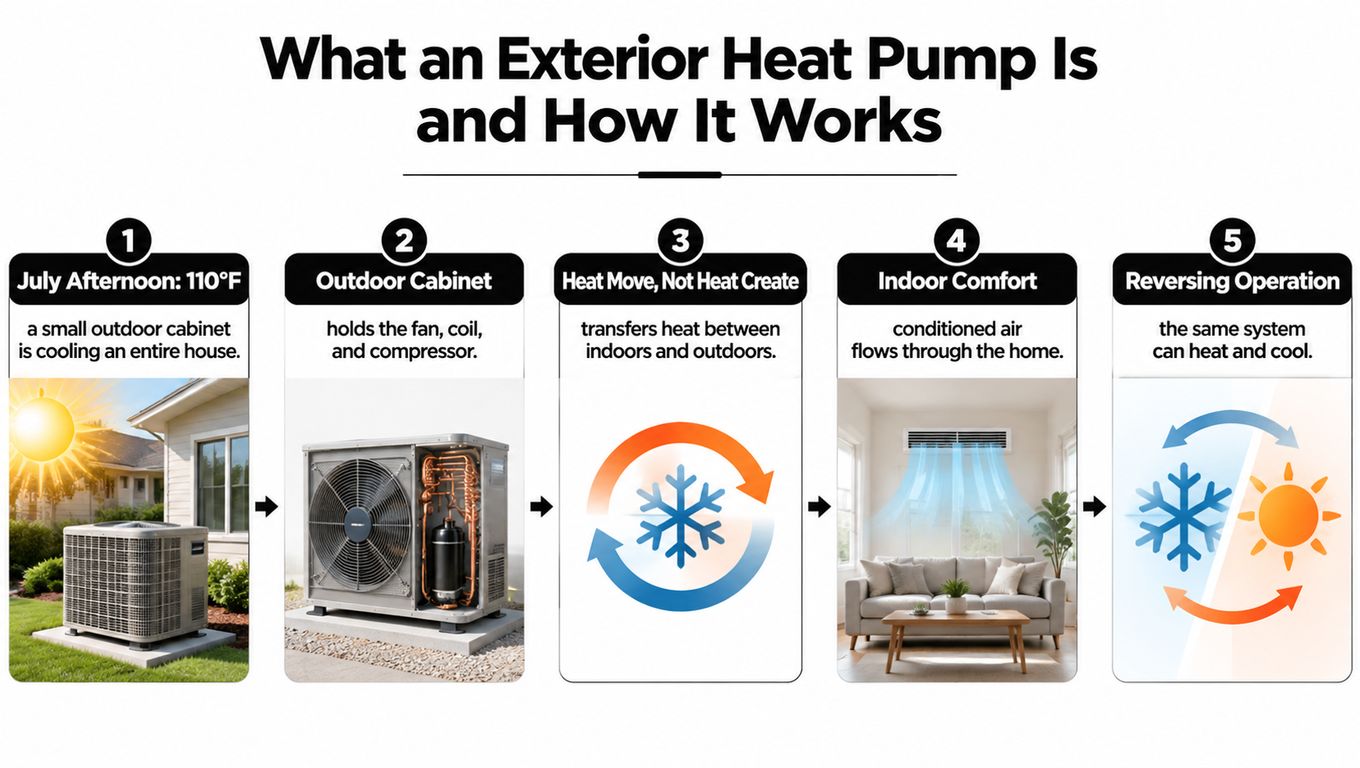
Say it's a July afternoon at 110°F and a small outdoor cabinet is cooling an entire house. That cabinet is the exterior heat pump. Inside it you'll find a fan, coil and compressor, and it's paired with an indoor coil or air handler that moves conditioned air through your home.
It doesn't burn fuel to make heat, and it doesn't glow like an electric resistance heater. It moves heat from one place to another. Think of a refrigerator running in reverse. Your fridge pulls warmth out of a cold box and releases it into the kitchen. In summer, a heat pump pulls warmth out of your house and releases it outdoors.
The Four Step Cycle in Cooling Mode
The loop runs the same way all afternoon, and each part has one job.
Indoor coil absorbs heat: Cool refrigerant passes through the indoor coil and picks up heat from the air blowing across it. That cooled air goes back into your rooms.
Compressor squeezes the refrigerant: The compressor in the outdoor cabinet compresses that refrigerant into a hotter, high pressure gas. Squeezing it concentrates the heat so it can be dumped outside, even when it's already hot out there.
Outdoor coil releases heat: The outdoor fan pulls air across the outdoor coil, and the refrigerant gives up its heat to that air. This is why the air blowing off the top of the cabinet feels so warm on a summer day.
Expansion valve drops the pressure: The refrigerant passes through an expansion valve, its pressure and temperature fall, and it's cold enough to go back indoors and absorb more heat.
One Cabinet for Heating and Cooling
A reversing valve flips the direction of that loop. In winter, the system absorbs heat from outdoor air and releases it indoors. In summer, it does the opposite. You aren't buying a separate furnace and air conditioner in two boxes. You're buying one outdoor unit that changes direction with the season.
That moving, rather than making, heat is where the efficiency comes from. The Connecticut Department of Energy and Environmental Protection page on air source heat pumps, citing the U.S. Department of Energy, states that air source heat pumps can deliver two to four times more heat energy than the electrical energy they consume. An electric resistance heater delivers about one unit of heat per unit of electricity, so the comparison shows why a heat pump can cost less to run for heating.
That two to four range describes energy delivered, not a promised bill. Your rate, duct losses, backup heat use and installation quality decide what you actually pay.
The advantage also shrinks as outdoor air gets colder. There's less heat to extract, the compressor works harder to squeeze what it can get, and delivered capacity falls. In Tucson that matters less than it does up north, but the same principle works in reverse in summer. The hotter it is outside, the harder the outdoor coil has to work to dump heat into that air.
So a heat pump is a heat mover with a reversing valve, not a heat maker. Which version of it belongs outside your house depends on ducts, space and how you use your rooms.
Heat Pump Types and Which One Fits Your Tucson Home
Start with how the system connects to the house, not with a brand name. The five configurations below cover nearly every Tucson replacement or addition.
Type | How it connects | Best fit | Tucson note |
|---|---|---|---|
Split ducted, single-stage | Outdoor unit with an indoor air handler on existing ducts | Homes with working ducts and a standard thermostat | Most common replacement path in Tucson; usually lower upfront cost than variable-speed |
Split ducted, variable-speed | Outdoor unit with a variable-speed air handler on existing ducts | Homes with ducts that need steadier humidity and quieter running | Runs longer at low speed, which suits a long cooling season |
Ductless mini-split | Outdoor unit linked to one or more wall or ceiling indoor heads | Room additions, converted garages and homes without ducts | Separate zones cool occupied rooms and avoid duct losses |
Packaged heat pump | Single outdoor cabinet with all components, ducts run to the home | Homes with no indoor space for an air handler | Check roof load, clearance and pad or curb requirements |
Dual-fuel hybrid | Heat pump paired with an existing gas furnace | Homes with gas service and occasional cold-snap needs | Rarely needed for Tucson winters but useful where gas is already in place |
Criteria That Actually Separate Them
Existing ducts come first. If your ducts are in decent shape and sized for the airflow the new system needs, a split ducted system is usually the cleanest replacement. You're reusing the distribution system you already paid for. If the ducts are crushed, undersized or run through a scorching attic with major leaks, that math changes, and duct repair or a ductless approach may beat forcing a new unit onto bad ductwork.
Independent room control comes second. A ductless mini-split puts a head in each zone, so a converted garage, a casita or a west facing primary bedroom can run on its own schedule. You aren't cooling empty bedrooms to keep one office comfortable, and there are no duct losses because there's no duct run. The trade-off is visible indoor heads and a line set route that has to work on your walls.
Physical space comes third. A packaged unit puts everything in one outdoor cabinet, often on the roof or beside the house. That helps when there's no closet or attic space for an air handler, or when access indoors is miserable. You do need to confirm the pad, curb or roof structure can carry it and that a technician can safely service it later.
Variable-speed equipment deserves a specific mention for Tucson. A variable-speed compressor and blower can run longer at low output instead of blasting on and off. In a cooling season that can stretch from spring into October, that longer, steadier run evens out room temperatures, pulls more humidity during monsoon weather, and is usually quieter at low speed. It costs more upfront and needs a compatible air handler and controls, so it isn't an automatic upgrade for every house.
Dual-fuel is the opposite case. If you're weighing that option, it helps to understand what a dual fuel heating system does and when it switches over before you pay to keep two heating systems alive. In Tucson's mild winters, a heat pump alone handles most heating hours. A hybrid makes sense mainly when a good gas furnace is already installed, gas service is already in place, and you want that furnace available for rare cold snaps or personal preference for hotter supply air.
My decision rule is simple. Match the new equipment to your existing ducts and air handler size unless the load calculation says otherwise. Don't change configuration just because a salesperson prefers selling it.
Pros, Cons and Limits in Tucson's Heat
One outdoor cabinet providing both heating and cooling is the clearest benefit. A single system can replace a separate furnace and air conditioner, which simplifies maintenance and frees you from keeping an aging furnace alive for a short heating season. The limit sitting right next to that benefit is upfront cost. A heat pump replacement often costs more than a like for like air conditioner swap, especially if electrical or duct work comes with it.
A variable-speed compressor running at low output for long stretches reduces start and stop cycling and the noise that comes with it. It also holds temperature more steadily through a long afternoon. The limit is that low speed can't create capacity the system doesn't have. On afternoons above 110°F, the condenser is trying to reject heat into extremely hot air, output drops, and run times stretch. A system that felt fine in May can fall behind in July if it was sized on a nominal rating instead of capacity at Tucson conditions.
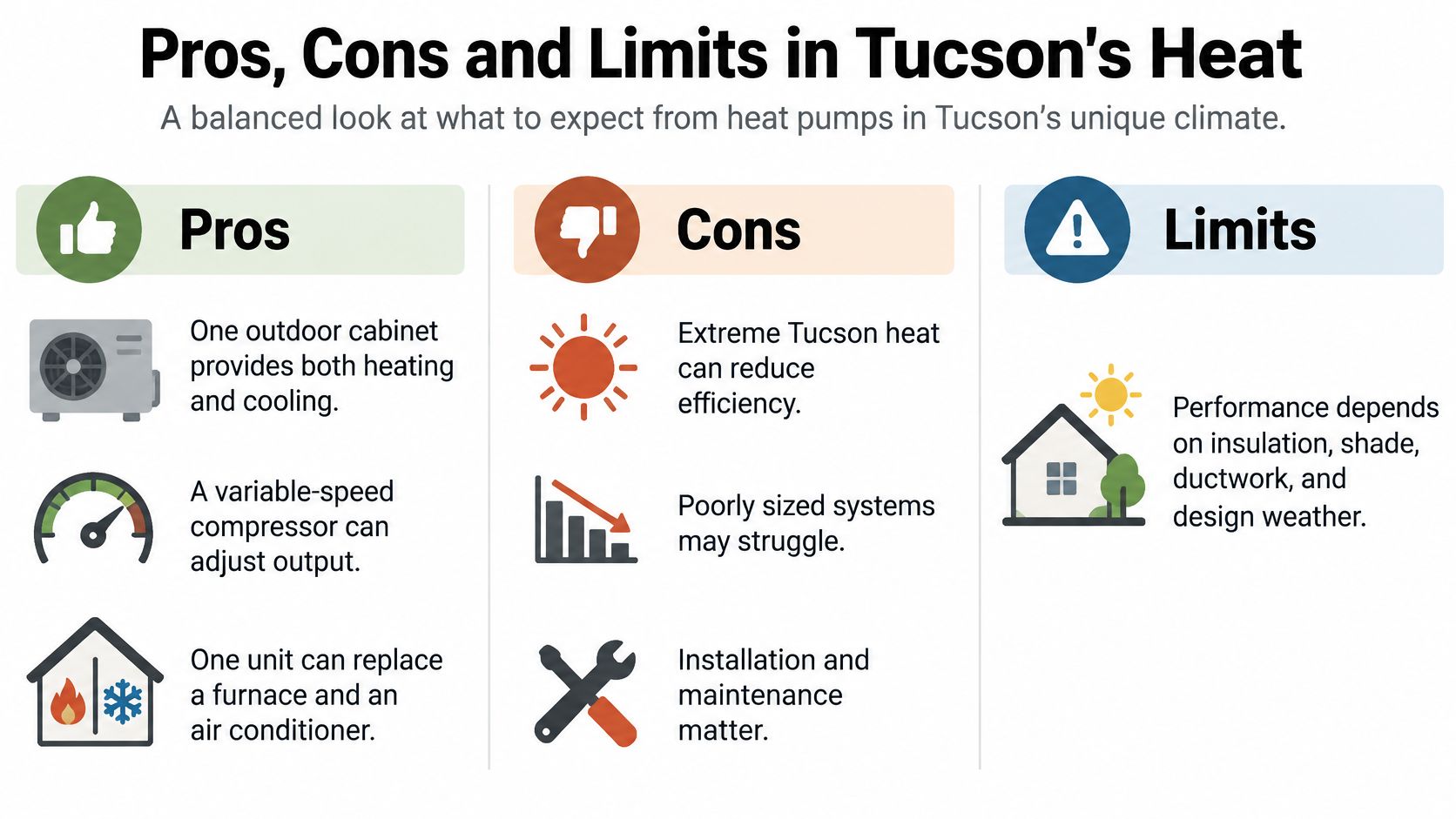
Running cost per unit of heating can fall below electric resistance heat because you're moving heat rather than making it with a heating element. In cooling mode, your cost depends on rated cooling efficiency, airflow and how clean the coil stays. Tucson works against that coil. Windstorm dust coats the fins, monsoon debris packs against the cabinet, and the unit often sits in direct solar exposure all afternoon. A dirty coil can't reject heat well, so the compressor draws more power to do the same job.
The Temperature Envelope Nobody Puts on the Brochure
An efficiency rating is a test condition. It isn't a promise of identical output at 3 p.m. in July. Ask your installer for capacity at Tucson's design temperature, not just the nominal tonnage on the box. Two systems with the same ton label can deliver different real cooling when it's extremely hot, and that difference is the one you'll feel.
Partial shade can help keep direct sun off the cabinet, but improvised covers and tight enclosures that restrict airflow reduce output. I'd take a clean coil with proper clearance in the sun over a shaded unit choking inside a tight fence box every time.
Cold climate labels deserve one brief note. The ENERGY STAR key product criteria for air source heat pumps require a cold climate unit to achieve a COP of at least 1.75 at 5°F and retain at least 70% of its heating capacity at 5°F compared with its rated capacity at 47°F. Tucson winters rarely approach that test point, so don't pay a premium for extreme cold performance you'll almost never use. Cooling capacity matters more here.
Strong fit: a home with working ducts, adequate electrical service and a load calculation that matches capacity to the house. Cautious case: poor insulation, limited panel capacity or heavily leaking ductwork. Fix those constraints first, or you'll blame the new heat pump for problems it inherited.
Sizing, Placement and Installation Requirements
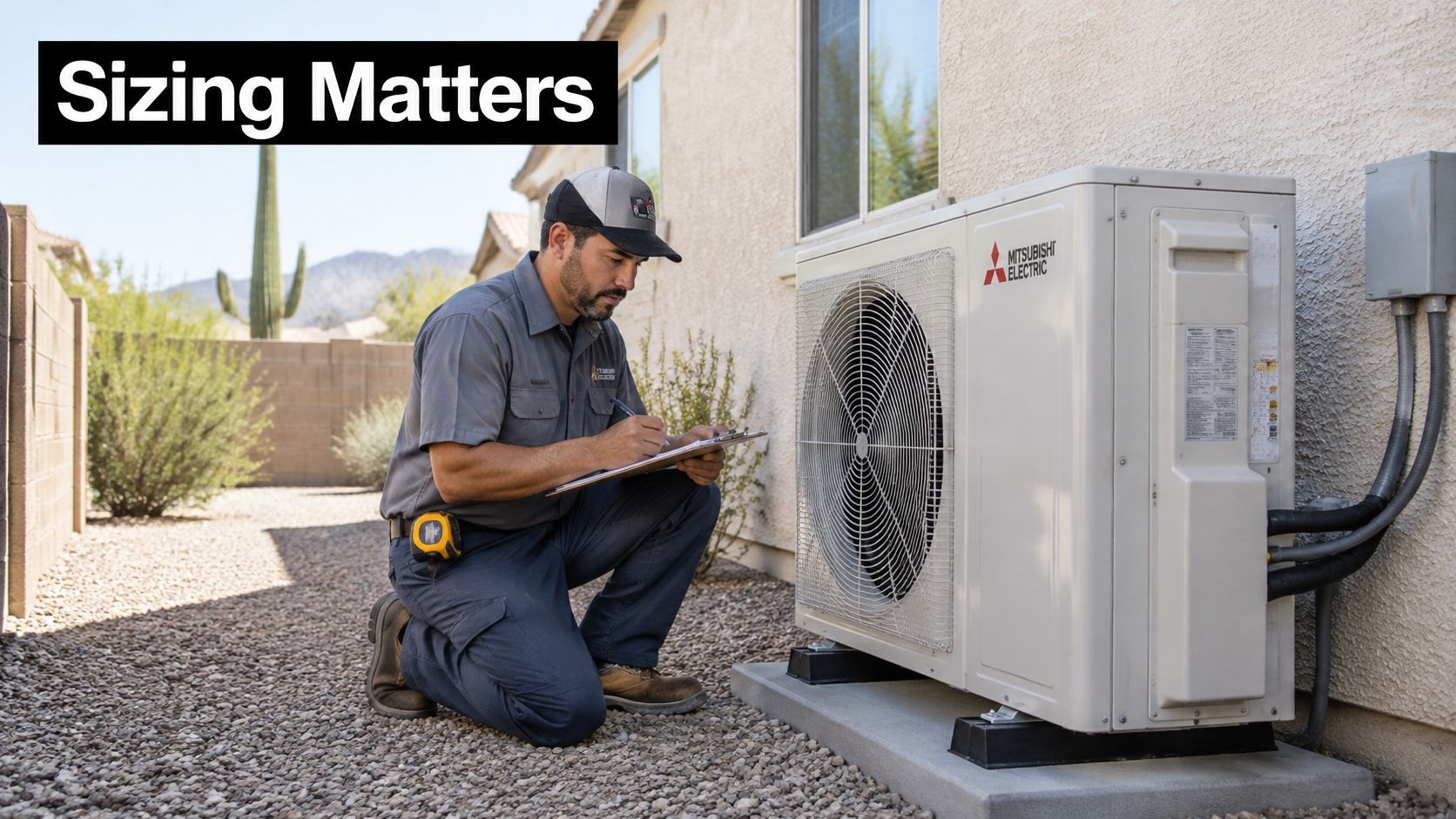
A heat pump that is too large or too small can struggle through Tucson's long cooling season, especially during afternoon peaks above 110°F. Proper sizing starts with a room-by-room load calculation, not a rule of thumb based on floor area. The ENERGY STAR guidance on clean heating and cooling recommends verifying capacity with ACCA Manual J, which accounts for insulation, windows, air leakage, building orientation, occupancy and local design weather. Two homes with the same floor plan may need different equipment if one has west-facing glass, a poorly insulated attic or substantial air leakage.
Ask the installer to show you the calculated heating and cooling loads and explain how the selected model meets them at local design conditions. Oversized equipment can start and stop too often, reducing humidity control and adding mechanical wear. An undersized system may fall behind on the hottest afternoons or rely more heavily on auxiliary electric heat in winter. In Tucson, cooling performance during extreme heat deserves particular attention. A nominal tonnage alone does not show how much capacity the unit can deliver when outdoor temperatures climb.
Installation details matter as much as equipment selection. Poor setup, incorrect refrigerant charge or leaky ducts can prevent a system from delivering its expected performance. Compare a properly commissioned mid-tier system with a premium unit connected to ducts that have not been checked: the higher equipment price cannot make up for air leaking into an attic or an installation that has not been tested. Ask for airflow and refrigerant-charge checks as part of the work.
Where the Outdoor Cabinet Should Sit
Check the proposed location before the installer sets a pad or bracket. The cabinet needs room to move air, and its position affects noise, service access and exposure to debris.
Keep discharge away from bedroom windows: Avoid aiming fan noise and hot discharge air toward sleeping areas or a neighbor's patio.
Preserve manufacturer clearance: Leave the specified space around the cabinet and above its fan. Restricted airflow can reduce capacity, particularly when the unit is working hard in Tucson's summer heat.
Use a level pad or bracket with vibration isolators: A tilted base or hard-mounted unit can transmit vibration through the ground or wall, where a low hum may carry indoors.
Avoid tight, reflective corners: Nearby walls can reflect sound and push hot discharge air back toward the coil. Both can make the location less suitable.
Plan shade without blocking airflow: A well-placed tree can shade parts of the yard or home without boxing in the heat pump. Keep branches and leaf drop clear of the cabinet. For ideas on tree placement, see a homeowner's guide to natural shade.
If you are comparing a larger replacement, this overview of a 3.5 ton heat pump package unit installation can help you ask about the pad, curb and duct connections included in the work.
Noise Is a Placement Problem
A sound rating does not tell the whole story. The same unit can seem quiet in an open yard and intrusive beside a bedroom window or between reflective walls. The heat pump placement and noise research report describes how placement and shielding affect sound measured near the unit and at the street. Compare ratings at the same operating condition, then consider what surfaces and rooms face the proposed location.
A moderately rated unit placed behind a solid wall with vibration isolation may be less bothersome than a quieter-rated unit bolted to a bedroom wall in a reflective corner. If two systems sit near a property line, consider their combined operation as well. An acoustic enclosure is only useful if it does not restrict airflow. In Tucson's heat, cutting off air to reduce noise can create a capacity problem.
Requirement | What to verify | Why it matters |
|---|---|---|
Manual J load calculation | Written heating and cooling loads for the home | Helps prevent oversizing or undersizing |
Electrical service | Dedicated circuit, correctly sized breaker and disconnect | Reduces the risk of tripped breakers and voltage problems |
Outdoor placement | Level pad or bracket, required clearance and discharge direction | Supports airflow and limits avoidable noise and coil stress |
Refrigerant line set | Length, insulation and connection quality | Helps limit capacity loss and refrigerant leaks |
Duct sealing and airflow | Duct condition and measured airflow across the coil | Identifies leakage and airflow problems before they undermine performance |
Charge and controls | Refrigerant charge and thermostat settings checked against manufacturer specifications | Helps the system operate as intended |
Get the calculation and commissioning checks in writing. A clear record of the load, airflow and refrigerant charge gives you something concrete to review if the system cannot keep up during a hot afternoon.
Costs, Permits and What Changes Your Quote
Treat every range below as an estimate to confirm with a written quote, not a price promise. Tucson projects move quickly once ductwork, electrical work or access problems enter the scope.
Project | Estimated installed cost | What moves the price |
|---|---|---|
Ductless mini-split, single zone | $3,500 to $6,500 | Number of indoor heads and line set length |
Ducted replacement, 2 to 3 tons | $6,000 to $10,000 | Ductwork condition and electrical upgrades |
Variable-speed upgrade | Adds $1,500 to $3,000 | Equipment tier and compatible air handler |
Permit and inspection | Fee set by your city or county office for the scope | City or county fees and inspection timing |
A larger ducted replacement in the 3.5 to 5 ton range commonly estimates higher, roughly $9,000 to $14,000, again before anyone has inspected your ducts and panel. Get that number in writing for your house rather than budgeting off a neighbor's invoice.
What Actually Moves the Number
Tonnage from the load calculation sets the equipment size, and bigger equipment costs more. Ductwork condition is the surprise line item. Sealing, resizing a return or replacing a crushed run adds labor, but skipping it leaves you paying to cool your attic. Electrical upgrades matter when the panel has no room for the required circuit or the existing disconnect and wiring don't match the new unit's requirements.
Line set length and access add time. A long run through a tight attic or a rooftop packaged unit that needs a crane costs more than a ground level swap next to the pad. Efficiency tier raises equipment cost, and variable-speed systems often require a matched indoor unit, so you can't always keep an old air handler to save money.
If you're deciding whether a heat pump should take over from your current cooling system entirely, it helps to read through when a heat pump can replace an air conditioner and then compare that scope against a straight air conditioner replacement quote.
Permits and the Quote Checklist
Many Tucson replacements and new installations require a permit, and whether the city or county office handles it depends on your property address. Ask your installer directly who pulls the permit and whether inspection is included. Unpermitted work can surface at resale when a buyer or appraiser asks for records, and it can complicate an insurance claim after an electrical or water problem.
Before you compare prices, confirm each quote lists the same scope:
Manual J results: The calculated load the equipment was selected for
Model and serial numbers: The exact outdoor and indoor equipment being installed
Efficiency ratings: The ratings for that matched combination, not a brochure maximum
Duct and electrical scope: What's included, and what's excluded as an extra
Warranty terms: Parts, labor and who registers the equipment
Startup and commissioning: Charge verification, airflow measurement and thermostat setup included in the price
Practical rule: Compare quotes on identical scope first and headline price last. The cheapest bid often excludes the duct or electrical work the other bid included.
Maintenance Habits and Common Fixes
Desert maintenance is mostly about airflow. Dust, monsoon debris and a coil baking in the sun will reduce capacity until a hot afternoon exposes it.
Monthly and Seasonal Checklist
Check the filter monthly: Do this during dusty months and after monsoon storms. Hold it up to light, and replace it if you can't see light through it. A clogged filter starves the indoor coil and lengthens run times.
Keep the cabinet clear: Maintain the manufacturer's clearance on all sides. Pull leaves, tumbleweed fragments and packed dust away from the base by hand.
Rinse the outdoor coil gently: With power off, use a garden hose from the outside at low pressure. Never use a pressure washer, because it folds the thin fins flat and makes airflow worse.
Trim vegetation back: Keep shrubs and grasses from growing into the coil face or dropping debris into the top fan grille.
Confirm the condensate drain runs clear: You should see water draining during humid cooling weather, not pooling at the indoor unit.
Schedule a professional tune-up before cooling season: A technician verifies charge, electrical connections, capacitors, airflow and controls while there's still time to order parts. If you're unsure about timing, how often a heat pump should be serviced lays out a sensible interval for a system that runs most of the year.
Each habit protects the same thing, heat transfer. Clean fins and strong airflow let the outdoor coil dump heat, which keeps compressor pressure and power draw where they belong.
Symptom | Likely cause | Safe first check | When to call a technician |
|---|---|---|---|
Weak cooling or airflow | Dirty filter or coil | Replace filter and inspect coil from outside | Airflow still weak after cleaning |
Ice on the outdoor coil | Low airflow, defrost or charge issue | Turn system off and confirm the fan turns freely | Ice returns after thawing |
Runs constantly without reaching setpoint | Dirty coil, undersizing or refrigerant leak | Check filter and clearance | Any sign of a leak or persistent shortfall |
Loud banging or rattling | Loose panel, debris in fan or failing mount | Power off at disconnect and inspect for debris | Noise continues with power off or fan is damaged |
Breaker trips repeatedly | Electrical fault, capacitor or compressor problem | Reset once and note the timing | Second trip after reset |
Water pooling near indoor or outdoor unit | Clogged condensate drain | Clear the drain line with a wet vacuum | Drain stays blocked or water leaks inside |
Short cycling | Thermostat placement, oversizing or airflow restriction | Check thermostat location and filter | Cycling persists after airflow is confirmed |
Auxiliary heat light stays on | Thermostat setting or low outdoor temperature | Check thermostat mode and setpoint | Light stays on during mild weather |
Those safe checks never involve opening refrigerant lines. The ENERGY STAR Version 6.2 heat pump specification requires manufacturers to report the refrigerant used, with examples including HFC-32 and R-454B. Your model documentation lists the exact refrigerant for your unit, and a technician must use equipment specific charging and safety procedures for it. Don't assume a refrigerant from a neighbor's similar looking cabinet, and don't let anyone top off a system without finding why it's low.
When a unit fails in the middle of summer or winter, we're typically there within 24 hours of the call. In July, that response window matters more than a small difference in a diagnostic fee.
Frequently Asked Questions About Exterior Heat Pumps
Can an exterior heat pump keep up in 115°F heat?
It can, if its capacity at that temperature still meets your house's load. Don't ask for the tonnage, ask for the delivered cooling capacity at Tucson's design temperature from the manufacturer's expanded performance data. If that number falls below your Manual J cooling load, the house will drift upward during the hottest hours no matter how new the unit is. That's a selection problem, not a defect, and no thermostat setting fixes it.
How long does an exterior heat pump last in Tucson?
Many units run roughly 10 to 15 years, and where yours falls in that range depends heavily on use and care. A Tucson system accumulates run hours fast because cooling season is long. Filter care, coil cleaning and proper clearance push you toward the long end. A dirty coil, restricted airflow and repeated short cycling pull you toward the short end. Age alone isn't a replacement order, but age plus rising repair frequency and falling capacity on hot afternoons is a strong signal to price a replacement before it fails outright.
Should I keep a gas furnace with a new heat pump?
Keep it when the furnace is in good condition, gas is already connected, and you value hot supply air on cold mornings or want a backup heat source that doesn't depend on outdoor temperature. Let it go when the furnace is near the end of its life, needs costly repairs, or you want to eliminate a gas appliance and its venting and combustion checks. In most Tucson homes, a heat pump alone handles winter fine, so keeping a furnace should be a deliberate choice with a reason, not a default.
Does a heat pump cost less to run than an air conditioner?
In cooling mode, compare like with like. Both systems move heat outdoors with a compressor, so the running cost difference comes from the rated cooling efficiency of the specific models and your utility rate per kilowatt hour on your bill. A high efficiency variable-speed heat pump can cost less to cool with than an older, lower efficiency air conditioner, while a basic heat pump and a basic air conditioner with similar ratings will cost about the same to cool. The clear operating cost win shows up in heating, where the heat pump replaces resistance heat or reduces furnace runtime.
General rules get you close. A load calculation and a local assessment of your ducts, panel and pad location answer the edge cases that decide whether you'll be comfortable at 4 p.m. in July.
Book a Local Assessment Before You Repair or Replace
Don't start by asking for a price on a new unit. Start by gathering what a technician needs to give you an honest answer. The photo below shows the kind of on site conversation that should happen before anyone recommends repair or replacement.
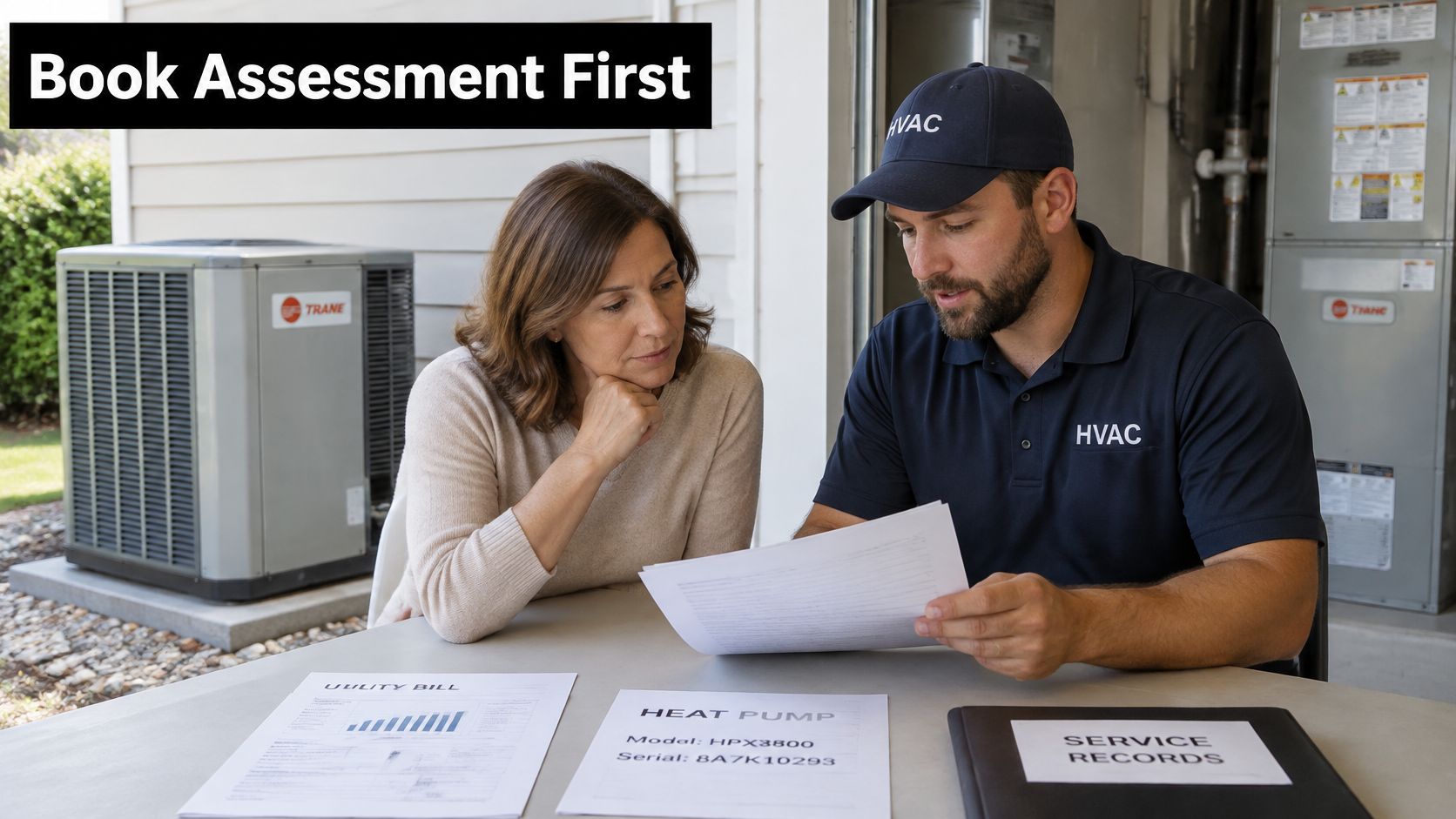
Gather equipment records: Photograph the model and serial numbers on the outdoor cabinet and indoor unit, note the installation date if you know it, and pull service records plus your last three utility bills.
Describe symptoms precisely: Note which problems you're seeing, how often the breaker trips, and how long the system runs without reaching setpoint on a hot afternoon.
Request a defined site visit: Ask for a load review, a capacity check at local design conditions, a duct and electrical inspection, and a written quote with a defined scope.
The right choice depends on the age and condition of your system, the load calculation and your ductwork, not on a general rule about repair versus replace. If you want a framework for vetting whoever does that visit, how to choose an HVAC contractor covers the questions worth asking before you sign anything.
The short video below walks through what a proper assessment looks like in practice, so you can compare it with what you're offered.
Covenant Aire Solutions is a Tucson option for this step. We offer heat pump repair, heat pump maintenance and heat pump replacement, and we service all makes and models of HVAC systems. Danny Polangco holds EPA Certification, Trane Comfort Specialist credentials and NATE Certification.
Before any work starts, use the quote checklist from the cost section. Confirm the Manual J results are included and confirm who pulls the permit. If either answer is vague, pause and get it in writing.
If your exterior heat pump is falling behind on hot afternoons, tripping breakers or due for a replacement decision, Covenant Aire Solutions can assess the load, ducts and electrical service at your Tucson home and quote repair, maintenance or replacement on a defined scope. Visit Covenant Aire Solutions to schedule that assessment before the next stretch of extreme heat tests your system again.