
AC Furnace Repair: Symptoms, Costs, and Next Steps
It's mid-afternoon in Tucson, the thermostat reads 78, and the living room keeps climbing anyway. Or it's a cold desert night, the furnace fires, stops, fires again, and the bedrooms never warm up. Either way, you don't need a sales pitch. You need to know what's likely wrong, what's safe to check yourself, and whether the failed part is worth fixing.
What AC and Furnace Repair Covers
Say the house won't cool even though you can hear something running. AC furnace repair starts with a simple point that confuses many owners: your cooling and heating equipment usually share one blower, one filter, one thermostat, and one duct system. A cooling complaint can trace back to a clogged filter or weak blower that also serves the furnace in winter. A heating complaint can trace back to a safety switch that shut the burners down while the blower kept moving cold air.
That shared layout is why a technician doesn't diagnose from the thermostat alone.
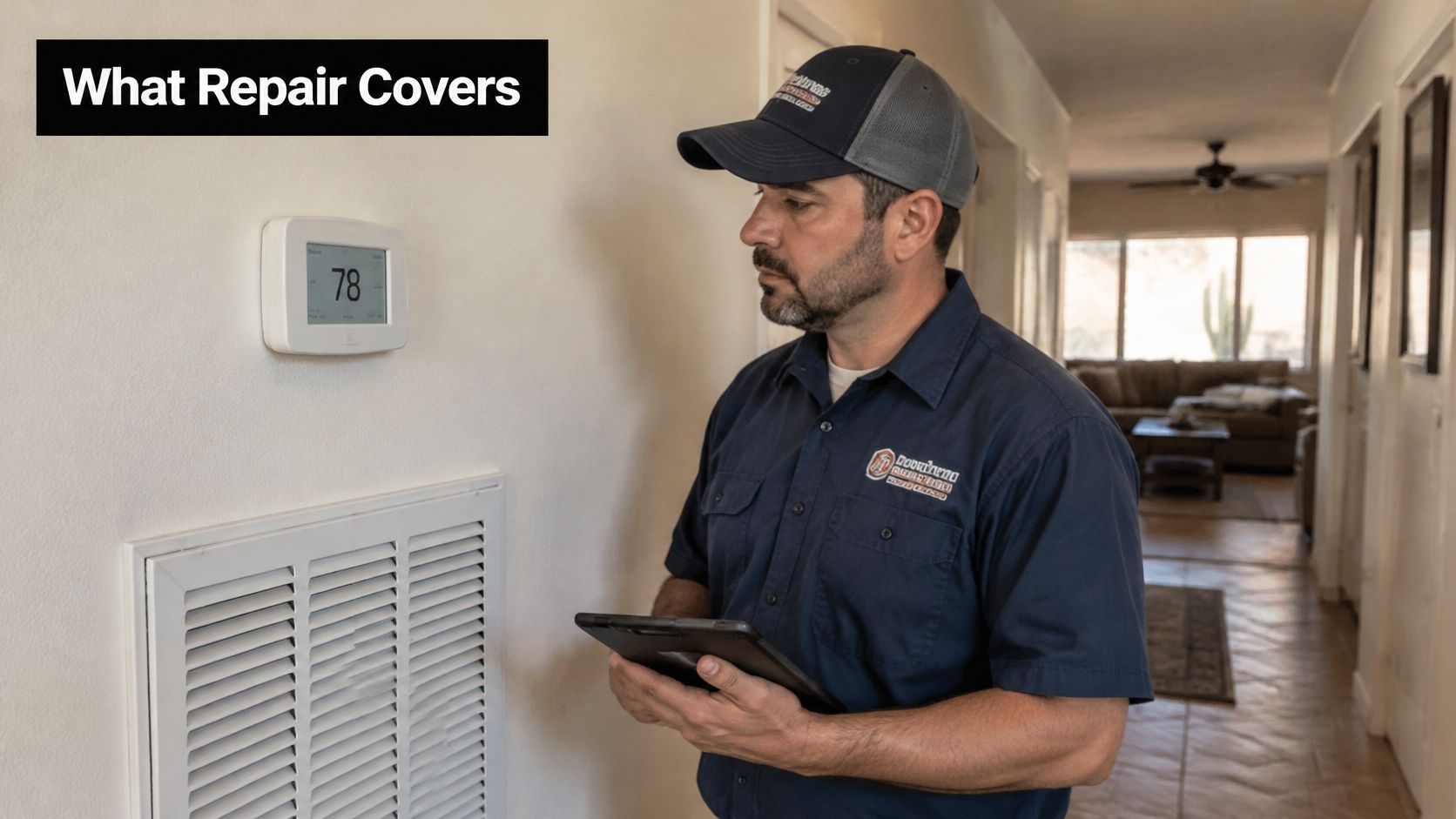
The Parts to Picture
Outside, there's the condenser and compressor, which move heat out of the house in cooling mode. Inside, there's the evaporator coil and condensate drain, plus the blower that pushes conditioned air through the ducts. On a gas furnace, add the burners, heat exchanger, flue, ignitor, and flame sensor. If you can name which group a symptom belongs to, you're already describing the problem more clearly than "it's broken."
What a Useful Visit Should Deliver
A good repair ends with three results. First, comfort returns and air reaches the rooms at the right temperature. Second, the equipment is safe to leave running, especially a gas furnace with combustion and venting parts. Third, you learn whether the failed part is worth fixing or whether age and fault type point toward replacement.
From here, you'll match symptoms to likely causes, try a few safe checks, see what a thorough visit inspects, weigh repair against replacement, and compare typical price bands before you approve any work.
Match Symptoms to Likely Causes
Start with three observations before you guess at a part. Note which mode failed, cooling or heating. Note whether air is moving from the registers. Note whether the outdoor fan or indoor blower is running. Those three answers narrow the table fast and give the technician something concrete to work with.
Symptom | System | Likely cause | First safe move |
|---|---|---|---|
No cool air while the unit runs | AC | Failed capacitor, low refrigerant, or dirty coil | Note filter and fan behavior, then call |
Warm supply air in cooling mode | AC or heat pump | Wrong mode, compressor not starting, or low charge | Confirm cool mode, then call if outdoor unit is silent or short cycling |
Furnace blower runs but air stays cold | Furnace | Ignitor, flame sensor, gas valve, or limit switch | If you smell gas, leave and call the gas utility; otherwise shut the furnace off and call |
Short cycling | AC or furnace | Dirty filter, high limit, oversized equipment, or failing control | Replace a due filter once; call if cycling continues |
Uneven rooms | AC or furnace | Closed registers, leaking or collapsed ducts, or weak blower | Open registers and check the filter before blaming the thermostat |
Water near the indoor unit | AC | Clogged condensate drain or pan | Turn cooling off to limit damage and call |
Ice on the lines or indoor coil | AC | Low airflow or low refrigerant | Switch cooling off, run fan only, and call |
Higher bills without more use | AC or furnace | Dirty coil, restricted airflow, or aging equipment | Compare with the prior season, then schedule diagnosis |
Bang, screech, or hiss | AC or furnace | Blower, contactor, or refrigerant leak | Shut the system off if the noise is grinding or metallic |
Soot, yellow flame, headache, or CO alarm | Furnace | Combustion, heat exchanger, or venting failure | Shut down, ventilate, leave, and get professional service |
Why So Many Rows Point to Airflow
Restricted airflow shows up again and again because one restriction creates several symptoms. The ENERGY STAR maintenance checklist notes that restricted airflow can reduce HVAC efficiency by up to 15%. A filter that looks only moderately dirty can still create excessive pressure drop, especially with a high-efficiency filter or an undersized return. That drop in air volume can trip a furnace high-limit switch, freeze the evaporator coil, leave rooms uneven, and stress the blower or compressor.
Airflow first: record the filter size and condition, blower behavior, and outdoor fan behavior before anyone replaces a control board or motor.
If your heat is blowing cold air, this guide to why an HVAC system blows cold air in heat mode walks through that one symptom in more depth.
Two Cases That Don't Fit the Pattern
A heat pump may blow cool-feeling air for a few minutes in heat mode during normal operation, so brief lukewarm air isn't automatically a failure. The opposite case skips diagnosis entirely. A gas smell or carbon monoxide alarm means shut the system down, get fresh air, leave the home, and call a professional. Don't keep testing the furnace to see if it happens again.
Checks You Can Do Before Calling
These checks are observations, not repairs. Each one either fixes a simple setting problem or gives the dispatcher a useful fact.
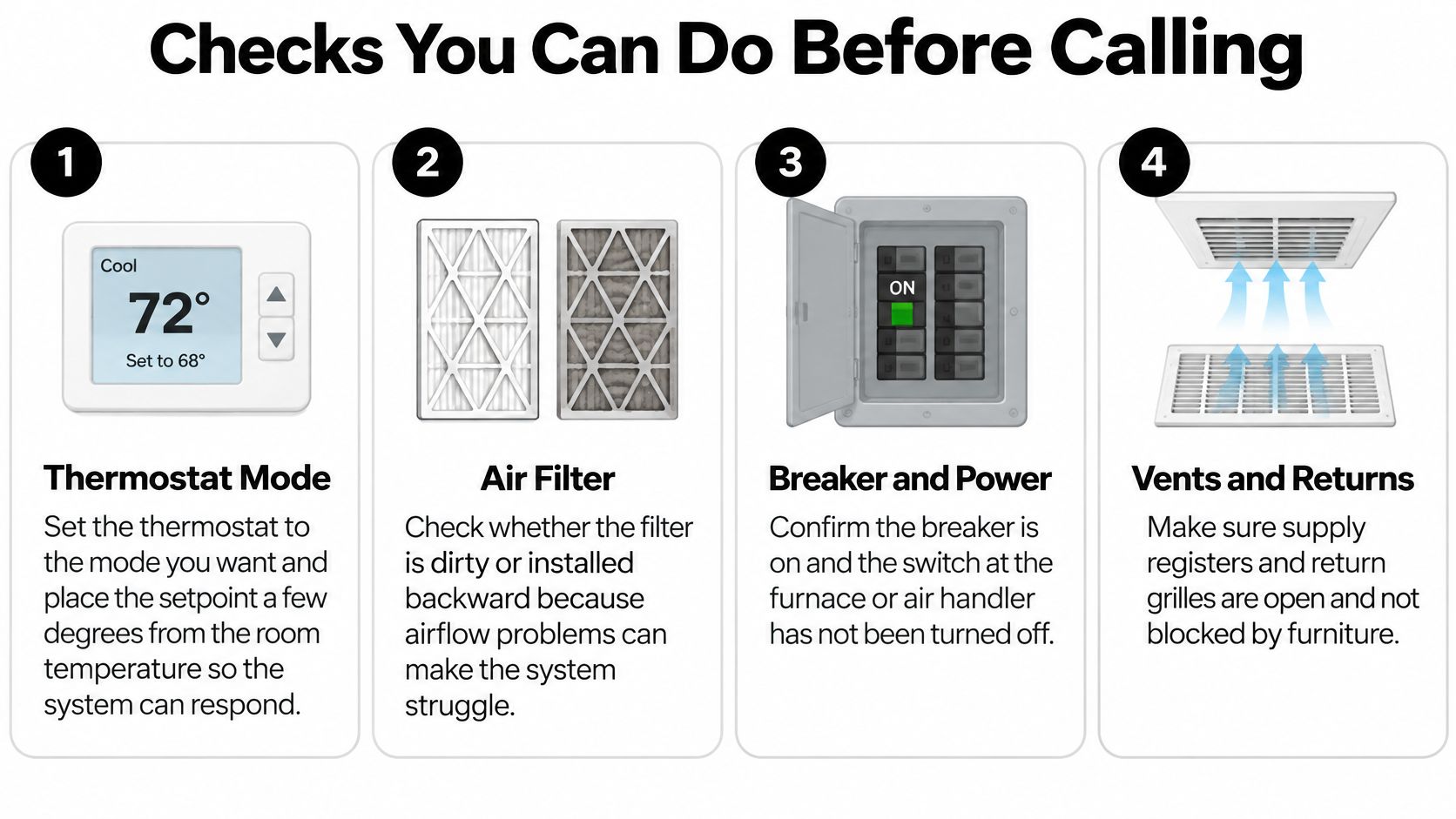
Set the thermostat correctly: choose heat or cool, set the temperature a few degrees past room temperature, and wait several minutes so the system can respond.
Look at power, don't force it: check the breaker and outdoor disconnect only if a tripped handle is visible. If a breaker trips again, stop. Repeated tripping is a symptom, not an inconvenience.
Replace a due filter: match the size printed on the old filter, point the airflow arrow the right way, and write the date on the frame.
Open the air path: open supply registers and pull furniture away from return grilles so the blower isn't starved.
Inspect the outdoor unit from outside the cabinet: look for debris packed on the coil and note whether the fan spins. Never push the fan blade by hand to get it started.
Melt ice before anyone tests cooling: if the coil or lines are iced, turn cooling off, run the fan only, and call once it's thawing.
Check furnace flame only through a sight glass: if your manual shows one, a steady blue flame is normal. A lazy yellow flame means stop and call.
Stop for safety signs: gas odor, soot, or an alarm ends troubleshooting. Follow the shutdown move from the symptom table.
Where Owner Checks End
Burners, the heat exchanger, and venting need instruments and training. The Consumer Product Safety Commission carbon monoxide fact sheet warns consumers never to service fuel-burning appliances without the necessary knowledge, skills, and tools, and it reports that more than 200 people in the United States die on average each year from carbon monoxide produced by non-automotive consumer products. That's why headaches, dizziness, unusual odors, or an alarm aren't prompts to open the furnace cabinet.
This short video shows the same kind of basic checks in action before a service call.
When you call, report the equipment age if you know it, what the thermostat display says, your last filter date, and any smell, water, ice, or noise. Routine care between breakdowns matters too, and this overview of AC repair and maintenance routines explains what regular upkeep covers.
What a Thorough Repair Visit Checks
Think of a proper repair the way you'd want a mechanic to work. You wouldn't want a shop to swap the one part you named without listening to the whole car. A furnace or air conditioner deserves the same approach, because one symptom often comes from a different circuit than the one you'd guess.
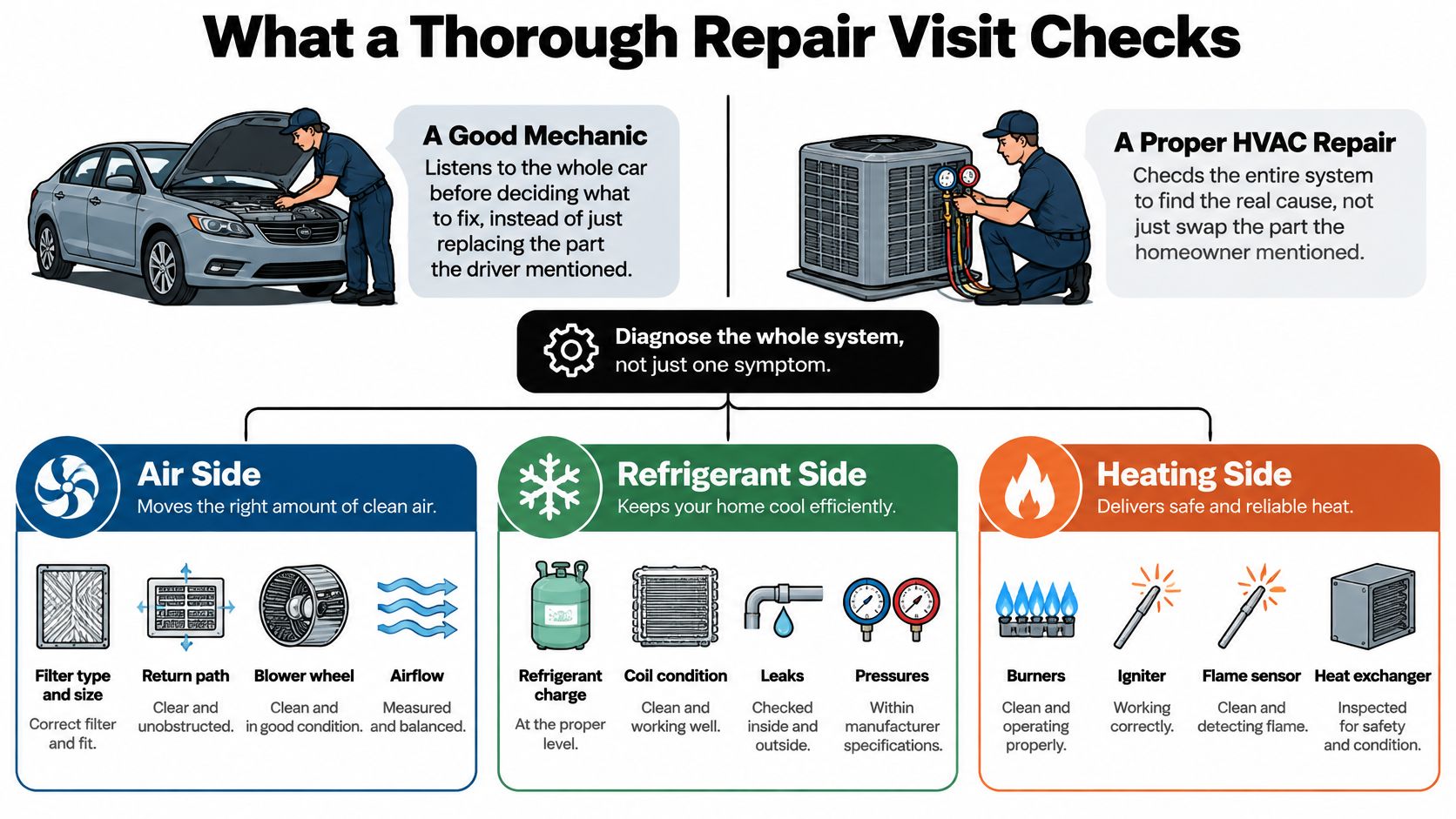
The Air Side
The technician checks filter type and size, the return path, the blower wheel, the evaporator coil, supply ducts, and static pressure. Low airflow can mimic a bad control board or a weak compressor, so guessing here wastes money. Cleaning a fouled coil or correcting a wrong-size filter may solve the complaint without a major part. If you also notice a sour smell from the registers, this resource on addressing musty odors from air vents explains when odor points to moisture or growth in the vent system rather than the equipment itself.
The Combustion Side on a Gas Furnace
The U.S. Department of Energy guidance on gas furnaces calls for inspection of the burners, heat exchanger, combustion chamber, and flue at least annually, along with a hard-wired carbon monoxide detector nearby. It identifies backdrafting as a pressure-driven release of exhaust gases into indoor living space, which can become a concern in a tightly sealed home.
Efficiency gets checked here too. That guidance identifies 78% AFUE as the minimum for natural-gas furnaces, 80% to 82% for medium-efficiency models, and more than 90% for high-efficiency condensing furnaces. Separate Department of Energy guidance on high-efficiency gas furnaces notes that a furnace operating at 4% carbon dioxide instead of a designed 5% level can lose roughly 1% to 1.5% of AFUE. Small combustion drift costs real efficiency, so flame, venting, and cycling all get tested, not just the thermostat.
The Refrigerant and Electrical Sides
On the cooling side, the technician reads pressures and temperature split and confirms the indoor coil and outdoor unit are matched to the same refrigerant and system design. Not every warm vent means a leak, and adding refrigerant without finding one isn't a repair. Electrically, expect tests on the capacitor, contactor, ignitor, flame sensor, and safety controls. Our page on HVAC system diagnostics describes how these readings fit together during a visit.
Before you pay, you should hear three things: the failed part, the test that proved it, and whether airflow or venting was corrected during the visit.
Repair or Replace by Age and Fault
A six-year-old furnace with a dirty flame sensor may need only a small repair. A much older system with a major failure calls for a closer comparison. The right choice depends on the fault, the equipment's remaining useful life, combustion safety, and whether replacement parts match the system.
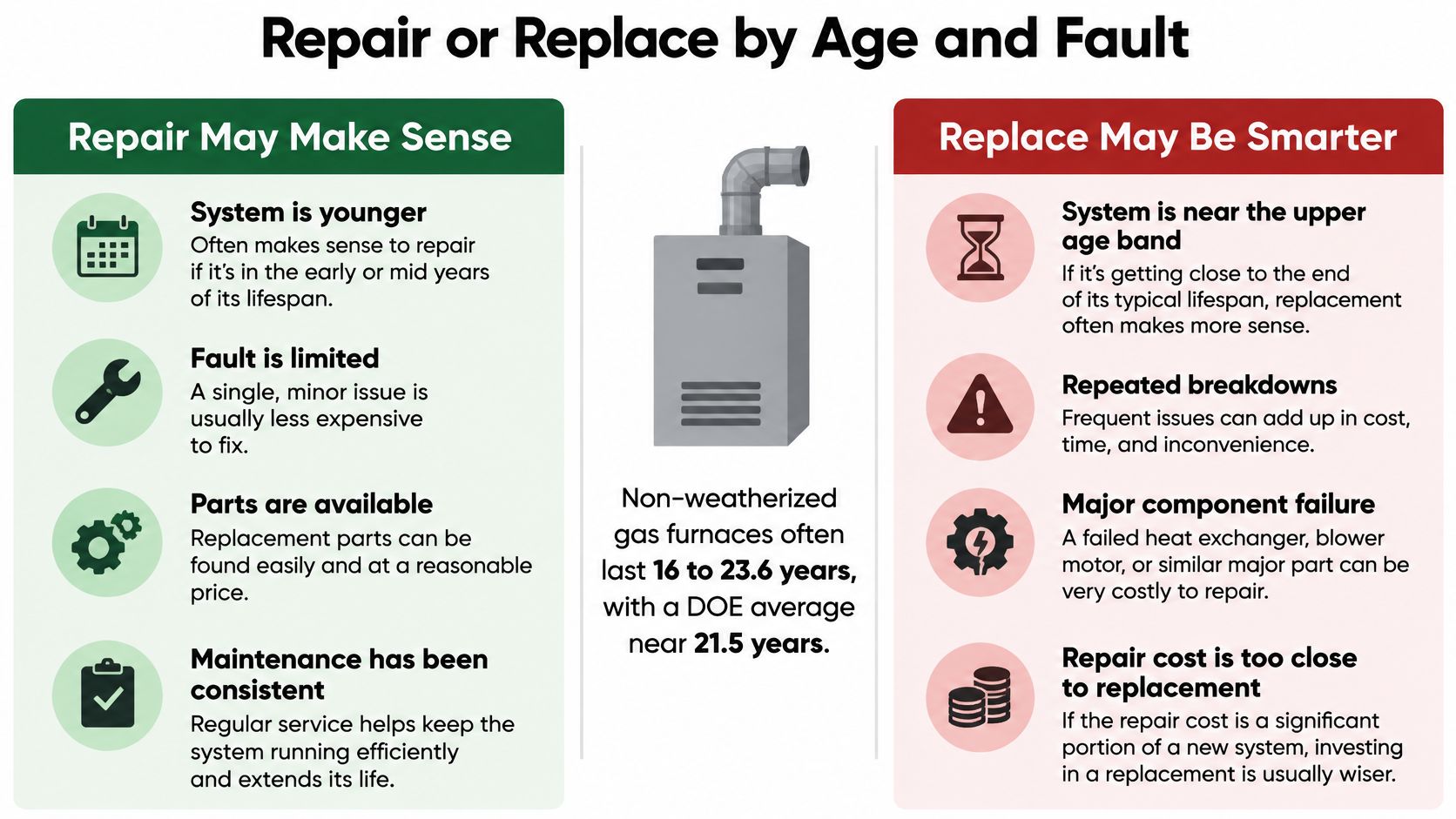
Age helps frame the decision, but it does not settle it. A single repair can make sense on an older system if the fault is limited and the rest of the equipment is in good condition. Repeated failures, rising bills, or a major repair on aging equipment strengthen the case for replacement. As a rough guide, replacement deserves more consideration when an AC or heat pump is over 10 years old or a furnace is over 15.
Situation | Age or context | Lean toward | Why |
|---|---|---|---|
Capacitor, contactor, drain, ignitor, or flame sensor | Any age while the system is otherwise sound | Repair | Small parts can restore function without replacing the refrigerant circuit |
Blower motor on a maintained system | Furnace under about 15 years, AC under about 10 | Repair | One major wear item may leave useful life in the rest of the system |
Repeated failures in two seasons | Any age | Replace | Repair costs are adding up while the system's remaining life may be limited |
Rising bills plus frequent service | AC or heat pump over 10 years, furnace over 15 | Replace | Age, operating costs, and repeated service point in the same direction |
Cracked heat exchanger | Any age | Replace | The decision is about combustion safety, not comfort |
Matched coil available and leak repaired | R-410A system under about 10 years | Repair can be rational | A compatible repair may make sense; newer equipment is not automatically better |
Compressor, coil, or leak on aging equipment | AC or heat pump over 10 years, or unmatched parts | Replace | A major refrigerant-circuit repair may not be worthwhile if compatible parts are unavailable |
Furnace near two decades with a major control, blower, or ignition failure | Near 20 years | Replace | Another major repair may be a poor investment if little useful life remains |
The Refrigerant Question Most Quotes Skip
Many existing R-410A systems remain serviceable, while newer residential equipment is being designed around lower-global-warming-potential refrigerants. Parts are not universally interchangeable. The indoor coil and outdoor unit must match the refrigerant and system design, so a failed compressor, coil, or leak calls for checking whether the circuit can be repaired with compatible components.
For example, a six-year-old Tucson furnace with a dirty flame sensor is a strong repair candidate. A 14-year-old R-410A condenser with a failed compressor and no matched coil available may be better replaced. The AC repair versus replacement guide explains how to compare the cooling-system options.
Compare the repair price, likely remaining life, efficiency, warranty, and refrigerant compatibility before deciding. Together, those details show whether a repair fits the system you have or whether replacement is the more practical choice.
Typical AC and Furnace Repair Costs
A $250 flame-sensor repair on an eight-year-old furnace may be reasonable. A $2,200 compressor repair on a 14-year-old air conditioner calls for a closer look at the system's remaining life, the fault, and whether compatible parts are available. The figures below are national residential planning ranges for 2026, not a Tucson quote. After-hours labor, refrigerant type, access, and warranty coverage can change the final bill.
Repair | Typical cost band | Usual timing | How to read it |
|---|---|---|---|
Run capacitor | $150 to $400 | Same day | Small AC electrical repair |
Contactor | $150 to $350 | Same day | Small AC electrical repair |
Condensate drain cleaning | $100 to $250 | Same day | Helps prevent water damage if the coil is not frozen solid |
Furnace ignitor | $150 to $400 | Same day | Common heating repair on a sound furnace |
Flame sensor service | $100 to $300 | Same day | Often cleaning rather than replacement |
Blower motor | $400 to $1,500 | About one day | Compare the cost with the system's condition and remaining life |
Inducer motor | $400 to $900 | About one day | Moves combustion gases through the furnace vent |
Compressor | $1,500 to $2,800 | Parts may delay it | Compare with replacement, especially on older units |
Evaporator coil | $1,200 to $2,500 | Often one to two days | Must match the refrigerant and outdoor unit |
Cracked heat exchanger | $3,500 to $7,500 installed | Replacement project | A safety concern that can require furnace replacement |
How to Read a Quote Against These Bands
Small electrical parts and drain cleaning often fit a same-day visit. Blower and inducer motors fall in the middle: their value depends on the condition of the rest of the furnace and its expected remaining life. Compressor and coil work affects the refrigerant circuit, so confirm that replacement parts match the system's refrigerant and design.
A cracked heat exchanger is a combustion-safety problem, not a repair to patch. Ask the contractor to explain the finding and the safe next step.
Request an itemized quote showing the part, labor, refrigerant quantity if applicable, and warranty. For more detail on what can affect a furnace quote, see this guide to furnace repair costs. If you're comparing other work for the home, you can compare furnace humidifier installation costs.
Book a Safe Repair With Covenant Aire
Order matters when you make the call. If there's a gas smell, soot, a carbon monoxide alarm, or anyone feels ill, leave the home first and call emergency services or the gas utility. Contact us after you're safe. For a no-cool or no-heat failure without those signs, book a diagnostic rather than naming a part you want replaced. You'll get a better answer and often a smaller bill.
We're Covenant Aire Solutions, founded in Tucson in 2019. We handle residential and commercial AC repair and gas and furnace repair on all makes and models, with 24/7 emergency service when a failure can't wait for business hours. For eligible non-working or failing systems, we offer free diagnostics and evaluations, with materials and repairs billed separately. That sequence matters: the visit confirms the fault before anyone sells you a part.
What to Ask Before Work Starts
Credentials in writing: ask for proof of licensing and the certifications held by the technician assigned to your job, confirmed in writing.
Findings, not just a price: ask the technician to report airflow results, combustion and venting condition on a furnace, and refrigerant match on an air conditioner.
Repair beside remaining life: ask for the repair cost set against likely years left before anyone recommends replacement.
A written estimate: request it free, with part, labor, and warranty listed, so you can compare it with the planning bands.
Our technicians arrive on time, keep the work area clean, and explain each step as they go. Once the current fault is fixed, we can talk through a maintenance plan if it fits your home. That conversation comes after the repair, not instead of it.
If your system won't cool, won't heat, or keeps shutting itself down, we'll diagnose the actual fault, explain whether AC furnace repair or replacement makes sense for its age, and price the work in writing before we start. Visit Covenant Aire Solutions to book a diagnostic or request emergency service in the Tucson area.