
Air Conditioner Replacement Service: Signs and Costs
New air conditioners use about 50% less energy than comparable equipment did in 1990, according to the U.S. Department of Energy. That gap is why an air conditioner replacement service is a sizing and matching job, not a search for the same tonnage with a newer badge. The Department of Energy first set conservation standards for residential central air conditioners and heat pumps in 1992, updated them in 2015, and put another major update in place on January 1, 2023. Those rules raised regional efficiency requirements and introduced SEER2, EER2, and HSPF2. Southwest rules matter in Tucson, where cooling loads stay high for months.
A like-for-like swap can fail. The old outdoor unit may have been the wrong size for the house. The indoor coil may be built for a refrigerant the new condenser cannot use. Leaky ducts can erase the rated savings. I would start with the nameplate, the repair history, and a load calculation, not the sticker on the box.
Signs That Your Air Conditioner Needs Replacement
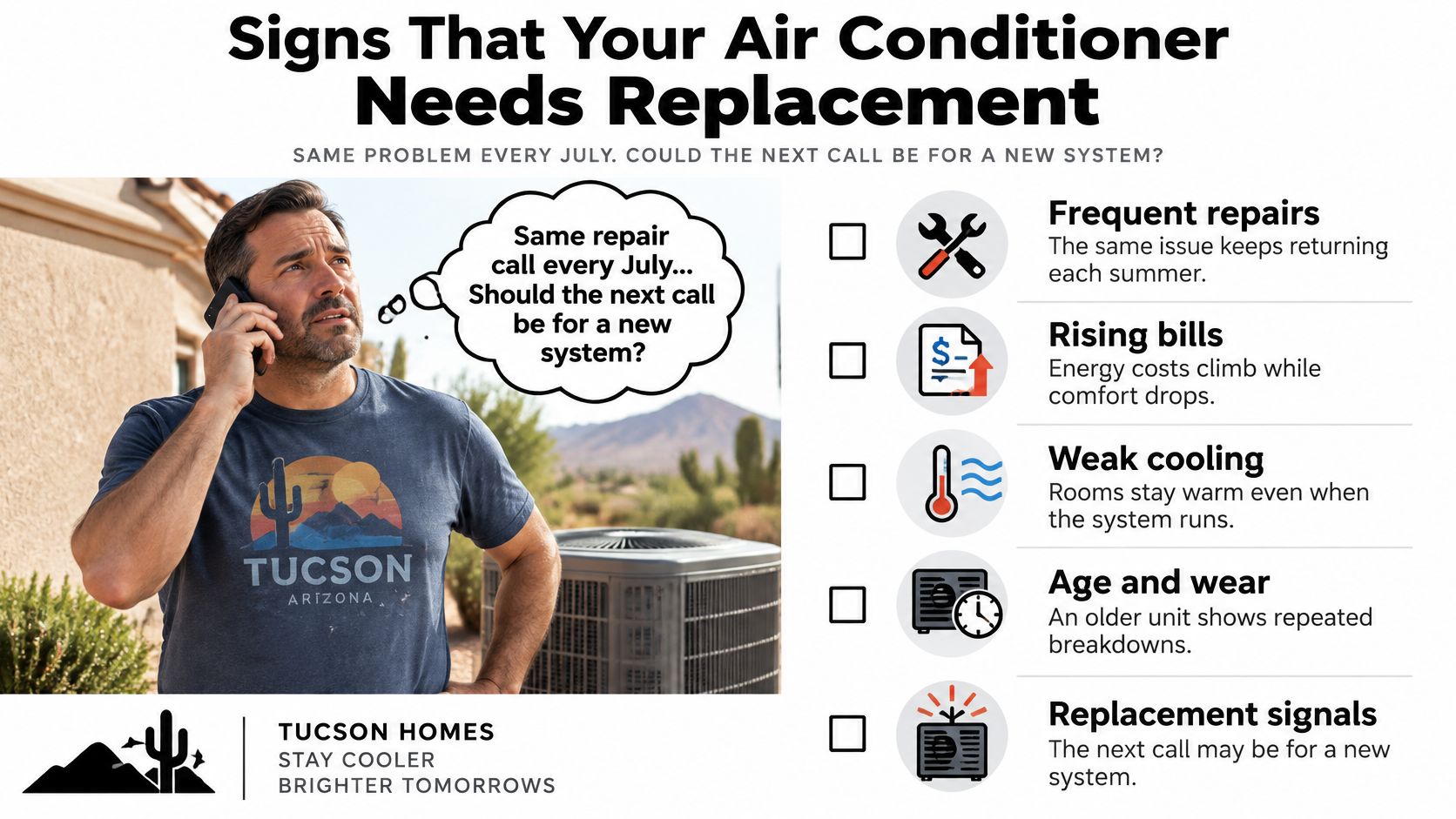
Say a Tucson homeowner calls for the same repair every July and wonders whether the next call should be for a new system. One hot-weekend failure is a repair. The same failure, stacked on age, refrigerant, and rooms that never catch the thermostat, is a replacement conversation.
Sign | Usual cause | Verdict |
|---|---|---|
Repair quote over half the cost of a new system | Repairs no longer pay off | Replacement |
R-22 refrigerant system | Phase-out, scarce parts, aging coils | Replacement or a full-system plan |
Breakdowns in consecutive seasons | Multiple worn components | Replacement |
Power bill rising with the same usage | Efficiency loss | Assess, often replacement |
Some rooms never reach set temperature | Undersized, worn, or leaking ductwork | Assess sizing and ducts |
Short cycling, frequent on and off | Oversizing or failing controls | Diagnosis first |
Banging, hissing, or ice on coils | Compressor issue, refrigerant leak, or airflow problem | Diagnosis first |
How to read the checklist
Age past 12 to 15 years usually means worn bearings, a tired compressor, and parts the manufacturer no longer stocks. Repair bills that keep adding up mean you are funding a system that has already lost its margin. An R-22 system is an old design with scarce refrigerant and aging coils, so a single failed part often becomes a full-system plan. Breakdowns across consecutive seasons point to several worn components, not one bad capacitor.
Rising power bills with the same usage usually mean efficiency loss: dirty coils, low charge, or a compressor working harder for less cooling. Rooms that never reach the set temperature are often undersized equipment, a worn blower, or leaking ducts, so the verdict is an assessment, not an automatic swap. Short cycling, where the unit starts and stops every few minutes, is often oversizing or failing controls. Banging, hissing, or ice on the coils can be a compressor, a refrigerant leak, or an airflow problem. Those last two call for diagnosis first.
A single sign rarely decides the question. Age plus one summer outage can still be a contactor. Age plus an R-22 nameplate, repeat failures, and a climbing bill is a different case. The U.S. Energy Information Administration reported that at least 33.7% of central air-conditioning equipment was 10 years old or older. Another 16.5% was at least 15 years old. In southern Arizona, long cooling seasons make that age show up as breakdowns and higher electricity use. How long equipment lasts here is covered in our note on how long AC units last in Arizona.
Practical rule: Write the age off the nameplate, count how many signs apply, and treat two or more as a reason to request a replacement estimate. One sign usually calls for a diagnosis first.
When the open question is whether this repair quote is worth paying, use the age-times-quote test rather than the symptom list alone.
Deciding Between Replacement and Repair
A repair quote alone rarely settles the decision. Compare it with the system's age, refrigerant, recent repair history, energy use, and how long you expect to keep the home. A like-for-like replacement can still be a poor choice if the equipment is mismatched to the house.
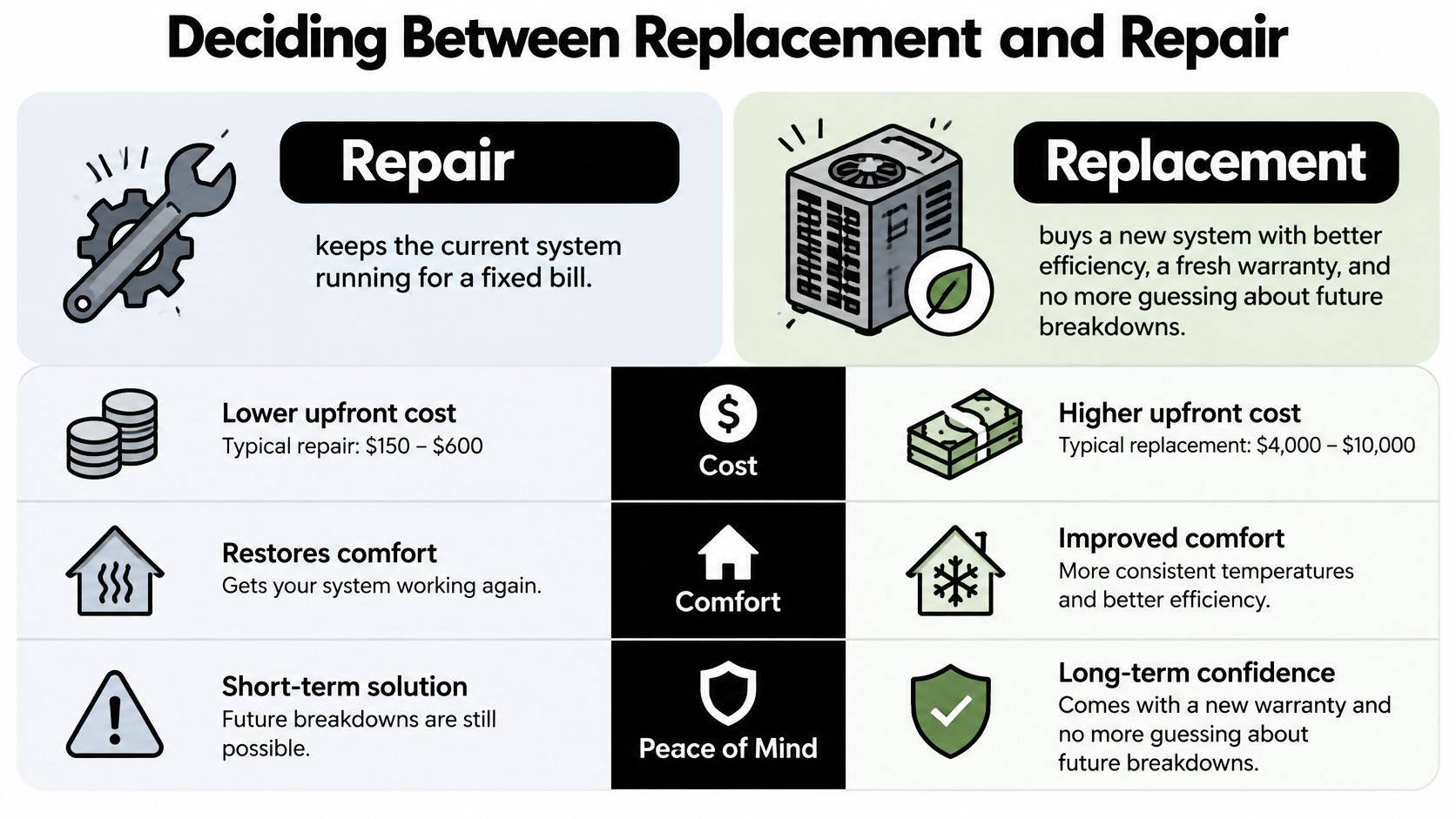
Criterion | Repair may make sense | Replacement may make sense |
|---|---|---|
Unit age | Under 10 years | 10 years or older |
Age multiplied by repair quote | Lower than 5,000 | Higher than 5,000 |
Refrigerant | Current refrigerant, one failed part | R-22 system or failed compressor |
Energy use | Bills steady for the same usage | Bills rising with the same usage |
Repair frequency | First or rare failure | Repeated failures in one season |
Time in the home | Less than 2 years | 5 years or more |
A quick age-times-quote check
Multiply the unit's age in years by the repair quote. The result is a rough planning guide, not an industry standard or a verdict. Use it alongside the system's condition, refrigerant, repair history, and replacement estimate.
A 14-year-old unit with a $450 repair scores 6,300 (14 times 450). That leans toward replacement, especially if other problems are present. A 6-year-old unit with a $600 repair scores 3,600 (6 times 600). That leans toward repair if the refrigerant is current and this is the first failure.
ENERGY STAR's guidance on replacing heating and cooling equipment says properly installed high-efficiency equipment can reduce heating and cooling costs by up to 20 percent. That is an upper estimate, not a promised saving. Results depend on the old unit's efficiency, runtime, sizing, duct condition, thermostat settings, and installation quality. Compare your utility use with the proposed system's certified efficiency rather than relying on a marketing name.
A young unit with a first failure is often worth repairing, particularly if a warranty may cover parts. An older system with repeated failures calls for a closer comparison: repair labor can add up while the equipment remains exposed to more breakdowns.
Compare the expected five-year cost of both options. Include likely repairs, the efficiency gap, and warranty coverage. A low repair quote may buy only one season, while replacement costs more upfront but may make sense if you expect to stay in the home.
A low age-times-quote result can still point to replacement if the equipment is poorly matched to the house or failing repeatedly. For rental properties, maintaining HVAC systems in rental homes helps keep routine upkeep separate from a replacement decision.
How the Replacement Process Works, Step by Step
A proper air conditioner replacement service leaves a paper trail you can check. Ask for the measurement or document at each phase, not a verbal "it's the same size."
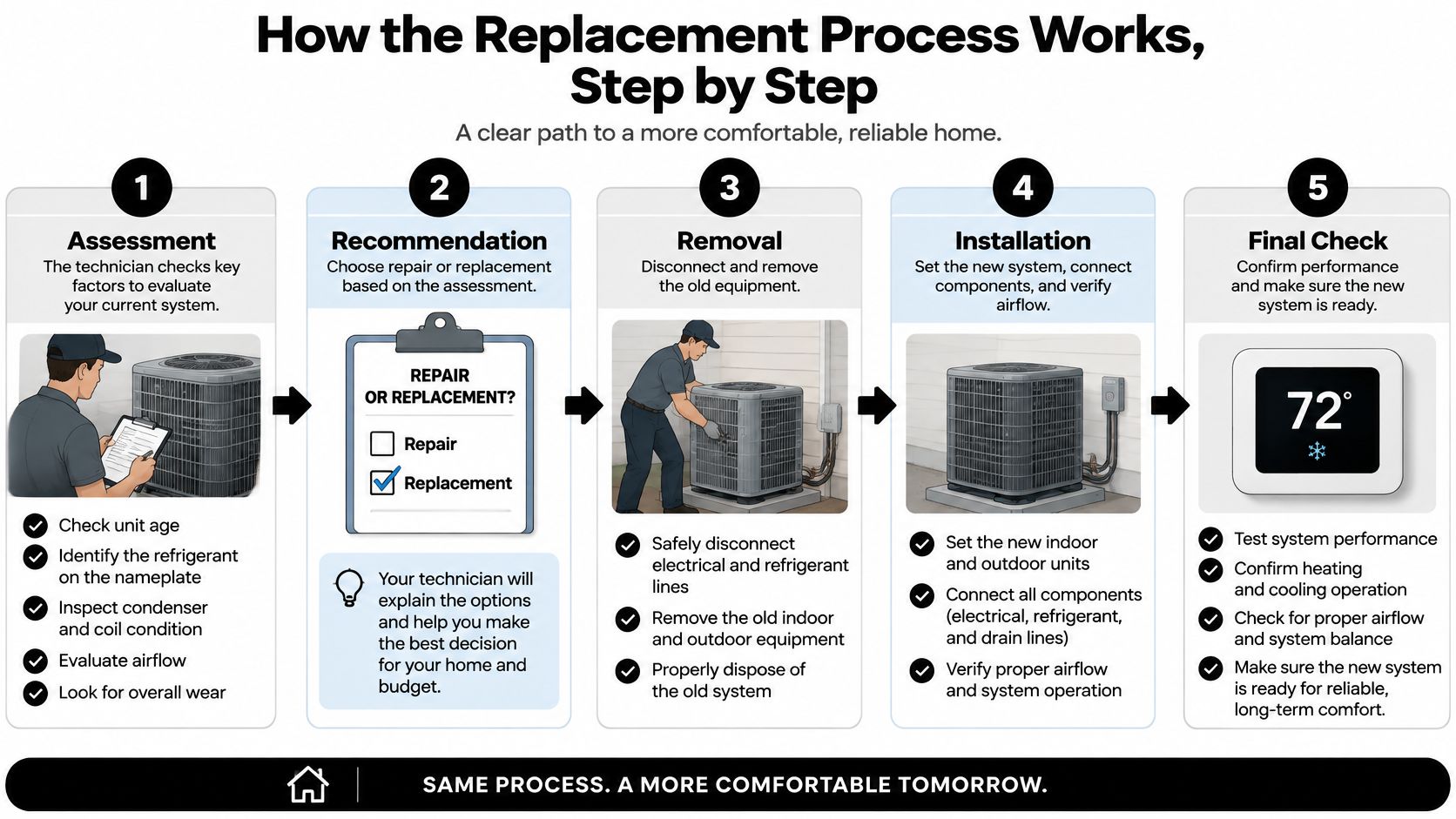
Five phases and what you should receive
Assessment. The technician records the manufacture date, the refrigerant printed on the nameplate, condenser and coil condition, measured airflow, and the state of the ducts. You should leave with notes, not a guess based on the old tonnage sticker.
Load calculation. A Manual J calculation measures how much heat the building gains and loses through glass, insulation, orientation, and occupancy. The new system is sized to the house. Copying the old tonnage repeats whatever mistake was made the first time, including a unit that is too big and short cycles.
Equipment selection. On the proposal, ask to see the Manual S match to that load, a Manual D check of the ducts, the outdoor and indoor model numbers as a matched pair, and the SEER2 rating. If someone offers a variable-speed air handler, the proposal should say which thermostat can control its stages. You are reviewing their selection, not running the calculation yourself.
Installation. The crew removes the old equipment, sets the new condenser and coil, and connects the line set, electrical disconnect, condensate drain, thermostat wiring, and refrigerant charge. Pad level, line-set condition, and drain slope are part of the job, not extras you discover after the truck leaves.
Testing. The crew measures temperature split, static pressure, superheat or subcooling, and airflow, then confirms the thermostat runs the system as designed. Ask for those readings on the invoice. A system that "feels cold" at the register can still be overcharged or starving for air.
What Pima County expects on the permit
Pima County requires heating and cooling equipment to be sized according to ACCA Manual S, using building-load calculations prepared under ACCA Manual J or another approved method. The replacement permit application needs the property address, PDF copies of Manual D, S, and J, and contact information for the person responsible for inspection. In Tucson and unincorporated Pima County, a contractor cannot properly select equipment only by matching the old unit's tonnage. That paperwork is what keeps an oversized system from cycling badly, missing humidity, and leaving rooms uneven.
We offer a free quote and a free estimate. Our technicians arrive on time, keep the work area clean, and explain each step, including what the load sheets say and what the final readings were. Before you sign, walk the proposal against those five documents and readings. If the load calculation is missing, the price is not comparable to a bid that includes it.
Sizing and Refrigerant Rules That Change a Like-for-Like Swap
Buying the same tonnage is the assumption that often ruins replacements. The old 4-ton condenser may have been oversized for a house that has since gained insulation, or undersized for a room addition. Tonnage on the label is not the load of the building.
Refrigerant makes a same-size swap even less safe. The U.S. Environmental Protection Agency states that R-410A cannot be used as a retrofit for an R-22 system because the different operating pressures make the existing indoor coil incompatible. Replacing only the outdoor condenser can create unsafe or unreliable operation. Systems also run most efficiently on the refrigerant they were designed for, so a conversion is not an efficiency upgrade by itself.
Check three things before anyone orders equipment. Read the refrigerant on the nameplate. Confirm the evaporator coil and metering device match the new condenser. Ask for the complete matched system approved for the application, in writing. On older Tucson homes that still run R-22, a failed condenser often becomes a full-system replacement, not an outdoor-unit swap. The refrigerant shift, and what it means for equipment still in service, is laid out in our note on the R-410A refrigerant phase-out.
Edge cases that break a simple swap
Oversized equipment. The unit short cycles and handles humidity poorly. Catch it by comparing the proposed capacity with the calculated load, not with the old nameplate.
Undersized or leaky ducts. New efficiency never reaches the rooms. Catch it with a static-pressure reading and a duct review before you accept the SEER2 number as your bill savings.
Heat pump instead of straight cool. Electrical requirements change. Catch it by confirming panel capacity, breaker size, and wire before the changeover is scheduled.
A basic thermostat on variable-speed equipment. The indoor unit never runs the stages you paid for. Catch it by matching the thermostat model to the control board on the proposal.
A pad or line set that cannot be reused. The new capacity or the new coil location needs a different line size or a level pad. Catch it during the assessment, not after the condenser is on the truck.
Do not sign until the matched-system ratings, coil model, and metering device are written on the proposal. A verbal "it'll work with what you have" is how mismatched pressures end up in the attic.
What Replacement Costs and Which Factors Move the Price
Installed replacement cost changes with region, tonnage, equipment type, and duct condition. The ranges below are typical estimates to set next to a written quote, not a bid for your house. A cheap number that skips the load calculation or the duct check is not the same product as a complete install.
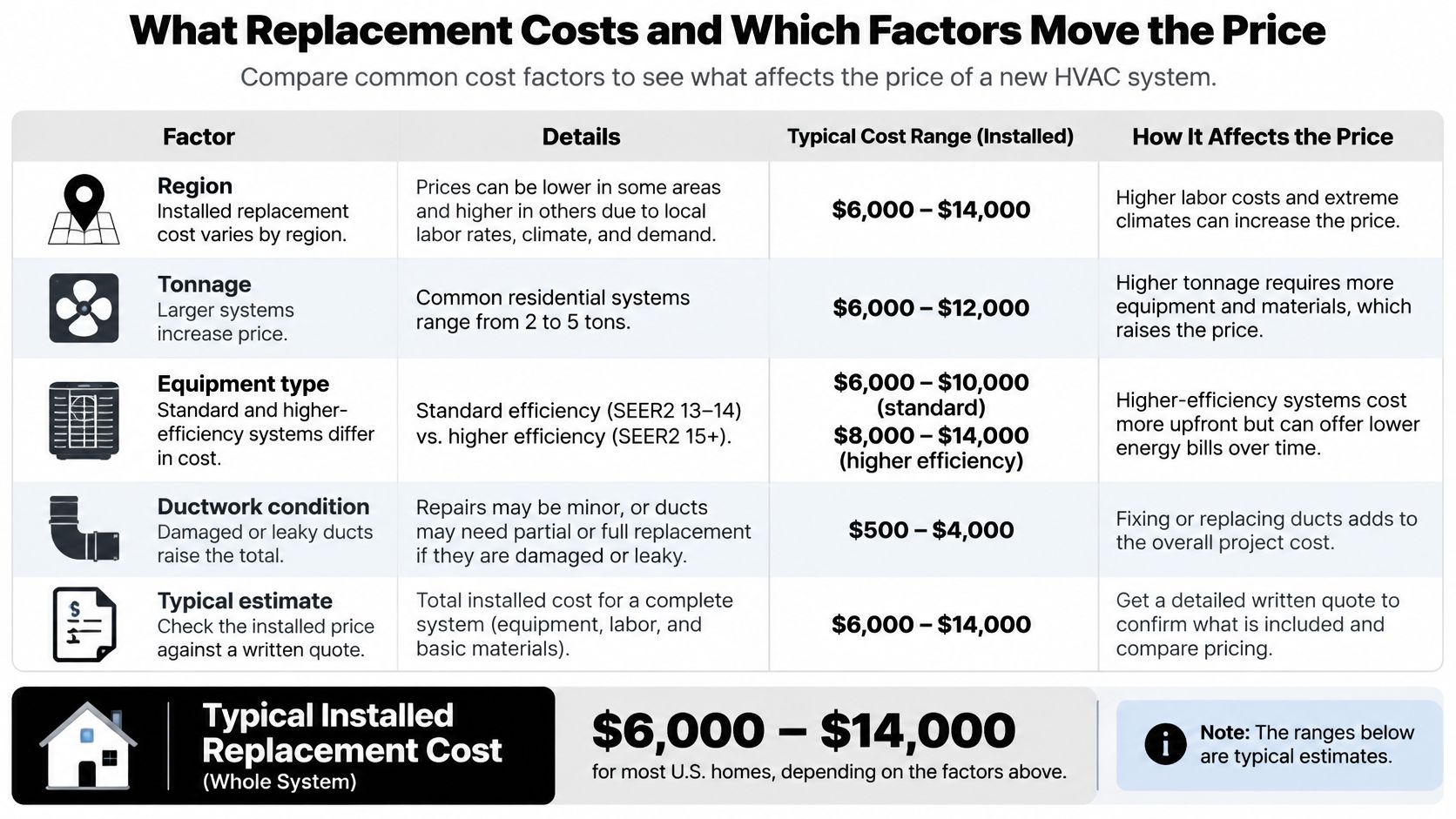
Cost factor | Typical range | What moves it |
|---|---|---|
Standard single-stage 2 to 3 ton system | $5,500 to $8,500 | Brand, warranty, installation complexity |
Two-stage or mid-efficiency 3 to 4 ton system | $8,000 to $12,000 | Efficiency tier, controls |
Variable-speed high SEER2 3 to 4 ton system | $11,000 to $17,000 | Efficiency rating, variable-speed controls |
Ductwork repair or replacement add-on | $1,500 to $5,000 | Duct condition, length, access |
Electrical or disconnect upgrade add-on | $250 to $1,500 | Panel capacity, wiring distance |
Smart thermostat add-on | $150 to $400 | Thermostat model, wiring compatibility |
Load calculation and permit work | $200 to $600 | Permit fees, documentation required |
What actually spreads the price
The equipment tier drives most of the spread. A standard single-stage 2 to 3 ton system sits at the low end. A two-stage or mid-efficiency system costs more because of the controls and the coil match. A variable-speed unit with a high SEER2 rating sits at the top, and it only earns that premium if the ducts and the thermostat can use the extra stages.
Add-ons move the total after the box is chosen. Duct repair or replacement is often the largest surprise on older Tucson houses. Electrical or disconnect upgrades show up when the new compressor needs a different breaker or a longer whip. A smart thermostat is a small line until the existing wire count cannot run the new board. Load calculation and permit work is real labor. If a quote leaves it out, you are comparing an incomplete scope.
Take a 3-ton house as a worked example. A single-stage match might land near the low band. Step up to two-stage and you move into the middle band before any duct work. Add a partial duct repair at the low end of that add-on and an electrical upgrade, and the installed total can pass a bare variable-speed price that assumed perfect ducts. That is why two "3-ton" quotes can be thousands apart and still both be honest.
Ask for line-item quotes so equipment, labor, permit, ductwork, and warranty sit on separate lines. Compare warranty the same way: parts coverage, labor coverage, and whether you must register the equipment for the longer term to apply. Two quotes for the same tonnage can differ as much on warranty as on price. For local context on what Tucson-area jobs tend to include, see our breakdown of the average cost to replace an AC unit in Arizona.
Financing and Savings Options That Lower Monthly Cost
You can pay cash, finance the installed price, or put the job on a card. Financing changes the monthly payment. It does not change the total price unless the offer is interest-free and you meet the terms. Compare the total you will have paid when the balance is gone, not the teaser payment.
We offer 15% off A/C unit replacement and 0% APR financing for 60 months on that replacement. Say the installed price is $8,000. Fifteen percent off brings it to $6,800. Spread over 60 months at 0% APR, the payment is about $113 a month (6,800 divided by 60), with no interest added if you meet the terms.
Questions to ask before you accept terms
Deferred interest: Is interest deferred and then charged on the original balance if you do not pay it off in time?
Early payoff: Can you pay the balance early without a penalty?
Minimum payment: What is the minimum monthly payment, and does paying only that minimum clear the balance before the promotional period ends?
Lower energy bills can offset part of that payment, but only if the system is sized, charged, and maintained. Filters, airflow, and setpoint discipline still matter after a new condenser is set. Practical AC guidance from Lighthouse Energy Services is a useful check on the habits that keep a new system from wasting the efficiency you just bought. Local utility or state rebates may apply to qualifying equipment. Confirm eligibility in writing before you subtract a rebate from the price.
Set the monthly payment next to the bill savings you expect and the repair costs you will stop paying. If the payment is close to what you already spend on repeat service plus extra electricity, replacement is the cleaner five-year number. How those payment plans are structured is spelled out in our guide to an air conditioner installation payment plan.
Get Written Estimates Before You Choose a Replacement
This week, request written estimates from at least two contractors. Each estimate should include a Manual J load calculation, Manual S equipment selection, a Manual D duct review, the refrigerant and coil match, warranty terms for parts and labor, and the permit. If one bid is missing the load sheets, it is not a lower price. It is a smaller scope.
Covenant Aire Solutions is one place to get that estimate. We offer a free estimate and quote, we service all makes and models, and we explain each step of the work. Use the replacement discount and the financing terms already laid out, then judge the quote against the checklist rather than the brand on the condenser.
"He only pointed out legitimate things that needed to be done on our AC system.", Joseph N
Contractors who price from a full scope, rather than a tonnage guess, are easier to compare. Tools such as Exayard HVAC estimating software are one way shops keep equipment, labor, and add-ons on separate lines so you can see them. What to look for in the company itself is covered in our guide on how to choose an HVAC contractor.
Before you sign with anyone, ask three questions. Which load calculation was used? Which refrigerant and matched coil are included? What is the total five-year cost once financing is included? The bid that answers all three in writing is the one worth comparing.
Covenant Aire Solutions replaces air conditioners across Tucson with a free estimate, matched equipment, and a walk-through of the load calculation before you commit. If your system is old, on R-22, or failing every summer, that estimate shows whether repair or a full replacement is the cleaner cost. Visit Covenant Aire Solutions to schedule the assessment and get the quote in writing.