
Air Conditioner Installation Payment Plan Options Compared
It's July in Tucson, your central AC has quit, and you're weighing a replacement against the money you've set aside for everything else. The salesperson offers a monthly payment that sounds manageable. What you need is the total bill, the borrowing terms, and a straight answer about whether any promised incentive will arrive.
An air conditioner installation payment plan can solve an urgent cash-flow problem. It can also turn an expensive replacement into a much more expensive replacement. I'd judge the offers by total repayment and net cost after confirmed incentives, then check whether the payment leaves your household enough breathing room.
Why a Payment Plan Can Beat Waiting for Savings
If your AC fails during a Tucson heat wave, waiting to save the full replacement cost can mean days of discomfort or a rushed purchase when repair is no longer practical. Financing may help you replace the system sooner, but compare its total cost with the cost and risks of waiting.
Paying cash avoids interest and fees. Yet using your emergency reserves for the installation can leave you exposed to another urgent expense. A payment plan preserves more cash upfront, but only makes sense if its payment fits alongside housing, utilities, and other regular costs.
Decision rule: Finance when replacement cannot wait, the payment leaves room in your budget, and you know the full repayment amount. If the system can safely last while you save, compare that option against the borrowing cost.
Start With the Installation, Not the Loan
Before comparing payment offers, confirm what the replacement includes with this affordable air-conditioning installation checklist. A clear installation scope helps you compare offers on the same job, rather than choosing based on a low monthly figure.
Then weigh the total repayment against the cash you would keep available and the risk of delaying replacement. Ask for the payment, fees, and repayment total in writing. Check whether the payment still leaves breathing room after your other expenses, and don't count on an incentive to cover a payment before you know when it will arrive.
Payment Plan Options Compared at a Glance
A Tucson installation can be financed in several ways, but the monthly payment alone is a poor basis for choosing. Compare each route by its total repayment, fees, and net cost after any incentives. Keep in mind that rebates and credits may arrive after your loan payments begin, leaving a timing gap to cover.
Option | Provider | Typical Term | How Interest Works | Best Fit |
|---|---|---|---|---|
Unsecured personal loan | Bank, credit union, or online lender | Confirm the lender's offered term | Fixed APR and payment when specified | Buyers seeking predictable repayment |
Contractor in-house plan | Installer directly | Set by the installer | Fixed rate or promotional terms, depending on agreement | Buyers who prefer dealing directly with the installer |
Contractor-arranged third-party loan | Outside lender introduced by installer | Set by the lender | Separate credit agreement with its own APR | Buyers who value coordinated installation and financing |
Promotional deferred-interest credit | Retailer or store card | Contract-specific promotional window | Interest may be imposed retroactively if conditions aren't met | Buyers with a reliable payoff plan |
Credit card | Card issuer | Revolving, without a fixed payoff date | Account APR and fees apply under card terms | Small balances that can be cleared promptly |
Home equity loan or line | Bank or credit union | Product-specific | Fixed or variable terms, secured by the home | Owners willing to accept property-backed borrowing |
Utility on-bill program | Local utility or partner | Unknown until a program is confirmed | Program-set terms | Customers in participating service areas |
These are routes to investigate, not guaranteed offers. Start with a fixed-payment bank or credit-union quote and compare it with the installer's written proposal. Ask for the amount financed, APR, fees, payment schedule, and total repayment in writing.
Who Each Route Actually Suits
Personal loan: A personal loan gives you a defined payoff schedule and a useful benchmark for other offers. Check fees and total repayment before accepting an approval that looks convenient.
Installer-managed financing: Direct administration can simplify communication, but it does not reduce the cost by itself. Confirm who receives payments and how financing issues are handled if installation or warranty work is disputed.
Installer-arranged lending: The contractor introduces an outside lender, but the two remain separate businesses. Review the installation contract and credit agreement independently, including their costs and responsibilities.
Deferred-interest credit: Consider this only if you have a dependable way to clear the balance before the promotional deadline. An expected bonus or a rebate that has not been approved is not a reliable payoff plan.
Credit card: Keep this option for a balance you can clear promptly. Revolving debt without a set payoff schedule can turn a necessary installation into an expensive, lingering balance.
Home equity borrowing: Compare the full cost, then weigh it against the risk of securing the debt with your home. A smaller payment does not justify putting your property at risk if the repayment plan is uncertain.
Utility on-bill financing: Ask your utility whether a qualifying program serves your address. An offer advertised in another service area may not apply in Tucson.
Keep a short-term cash gap separate from the decision about financing a major installation. If you're considering free instant cash advance apps, review their fees and repayment terms independently rather than treating a short-term advance as an installation plan.
For every route, compare APR and total repayment, then calculate the net cost after any incentives. The Consumer Financial Protection Bureau's explanation of borrowing costs explains how APR reflects interest and other borrowing costs, unlike the nominal interest rate alone. Keep the expected incentive amount separate from the loan offer, and budget for the period before that money arrives.
What the Monthly Payment Hides
A Tucson homeowner may be offered a lower monthly payment by stretching the same loan over more years. Judge that offer by its total repayment and the project's net cost after incentives, not by the first number a sales desk puts in front of you. In 2026, the gap between paying for the installation and receiving an incentive can also leave you covering the full loan payment in the meantime.
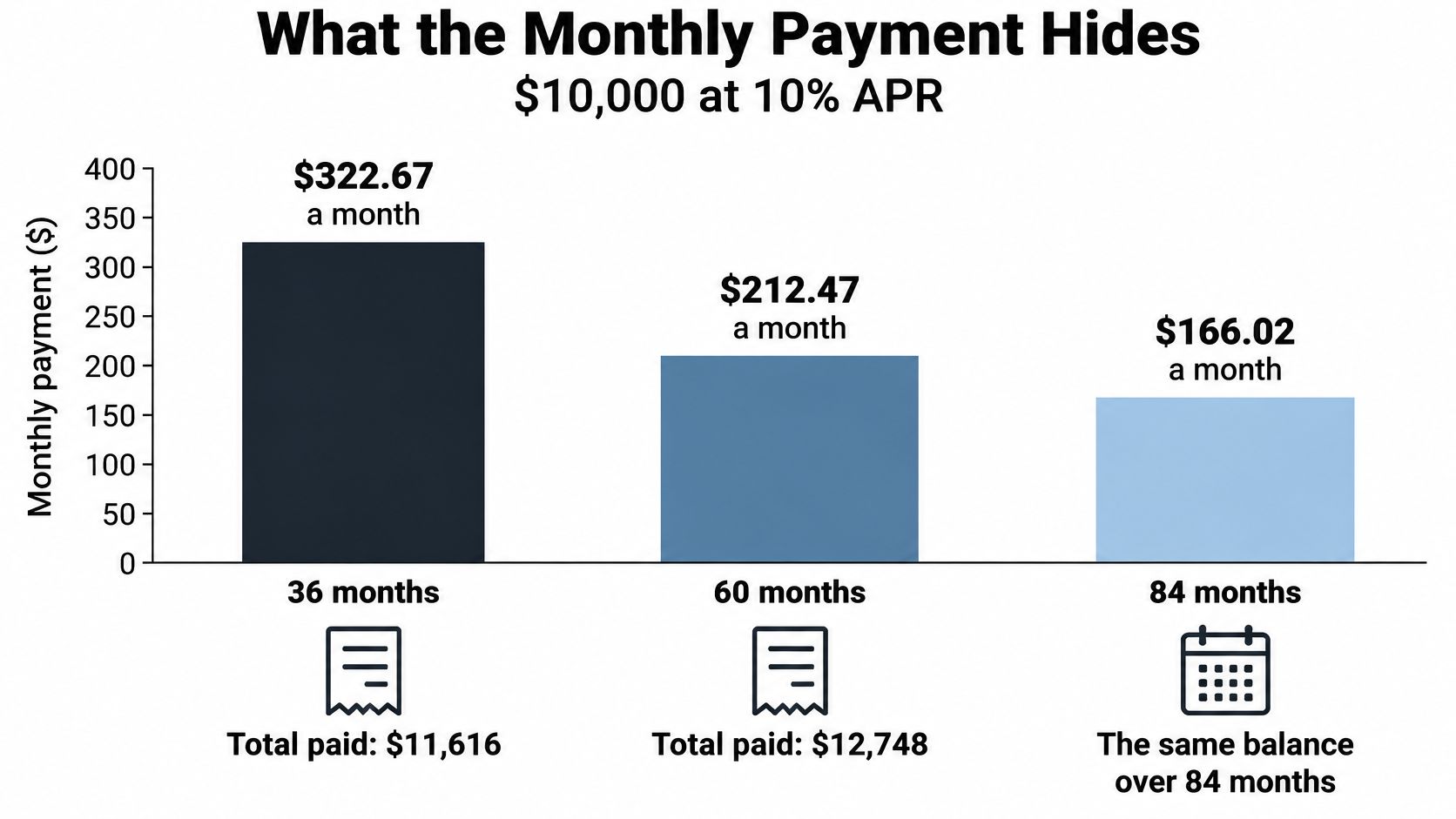
For a $10,000 balance at 10% nominal annual interest, the illustrated 60-month payment is about $212.47, with total repayment of $12,748. At 84 months, the payment falls to about $166.02, but total repayment rises to $13,946. These are example calculations, not figures provided by the American Bar Association's guidance on remodeling finance disclosures and consumer protections, and they exclude any additional fees.
Compare the Entire Repayment Schedule
The comparison below shows how the longer term lowers the monthly bill while raising the total borrowing cost. No quoted 36-month payment or repayment figure is available here, so get both in writing before comparing that option.
Term | Monthly Payment | Total Paid | Extra Cost Over $10,000 |
|---|---|---|---|
36 months | No quoted figure available | No quoted figure available | Cannot calculate without total repayment |
60 months | $212.47 | $12,748 | $2,748 |
84 months | $166.02 | $13,946 | $3,946 |
The 60- and 84-month examples use the same assumptions. They are not a financing offer or a Tucson installation price. A bar chart comparing monthly payments and total costs for a $10,000 loan at 10% APR makes the trade-off visible, but your lender's written disclosure determines what you owe.
Get the project scope and cash price from an AC installation cost breakdown, then request the financing terms separately. Your comparison sheet should list the cash installation price, amount financed, APR and finance charge, and total of payments. Include late-payment consequences, prepayment terms, and any security interest or property collateral. Check whether extended warranties or other optional products have been added, and compare their cost separately.
Demand Complete Disclosures
An incentive expected after installation does not reduce the lender's scheduled payments unless the loan terms explicitly say so. Plan for the timing gap: confirm when the incentive may arrive, and make sure you can cover payments without relying on it. Calculate net cost only after the incentive is approved and received.
Deferred Interest Requires a Different Question
Ask what balance the lender will use to calculate interest if you miss the promotional payoff deadline. Under a deferred-interest agreement, a remaining balance can trigger interest calculated from the purchase date, subject to the contract. An ordinary promotional rate may instead apply to the remaining balance after the offer ends.
A promotional offer is cheap only if you meet the conditions that keep it that way.
Write down the total repayment before deciding whether the monthly payment fits. The smaller payment can cost more overall.
Eligibility and What Lenders Check
Prepare for questions about credit history, income, existing debt, and employment history. Ask the lender which factors determine approval and pricing rather than relying on an installer's general assurance that financing should be easy.
A lender's approval isn't the same as a household budget recommendation. You still need room for ordinary expenses, seasonal changes in income, and another repair.
Assemble a Usable Application Folder
Ask for the lender's document list before submitting an application. A practical preparation folder includes:
Identity: Current government-issued photo identification.
Income: Recent pay records or applicable tax returns.
Banking: Recent statements requested by the lender.
Installation quote: Equipment model, documented cooling capacity, efficiency rating, and itemized price.
Property records: Ownership and mortgage information if you're considering home equity borrowing.
Authorization: Written owner approval if you're a renter arranging a permanent installation.
Your debt-to-income ratio compares monthly debt payments with gross monthly income. Ask the lender what it includes and how the proposed installation payment affects its assessment; don't assume every lender applies the same cutoff.
Don't Turn a Decline Into an Expensive Yes
If an application is declined, ask for the reason in writing. Then investigate whether a smaller financed amount, a suitable co-borrower, or a different lender addresses the actual issue.
Avoid applying indiscriminately because someone promises a quick approval. Ask whether each preliminary inquiry affects your credit before authorizing it.
If you're researching HVAC financing without a credit check, focus on the complete obligation, not just the absence of a credit inquiry. Ask about fees, payment frequency, security interests, and the final payoff amount.
Gathering paperwork before an emergency gives you time to compare rather than accept whatever is available at the sales desk. That preparation matters more than chasing a financing label.
How to Apply for an AC Payment Plan
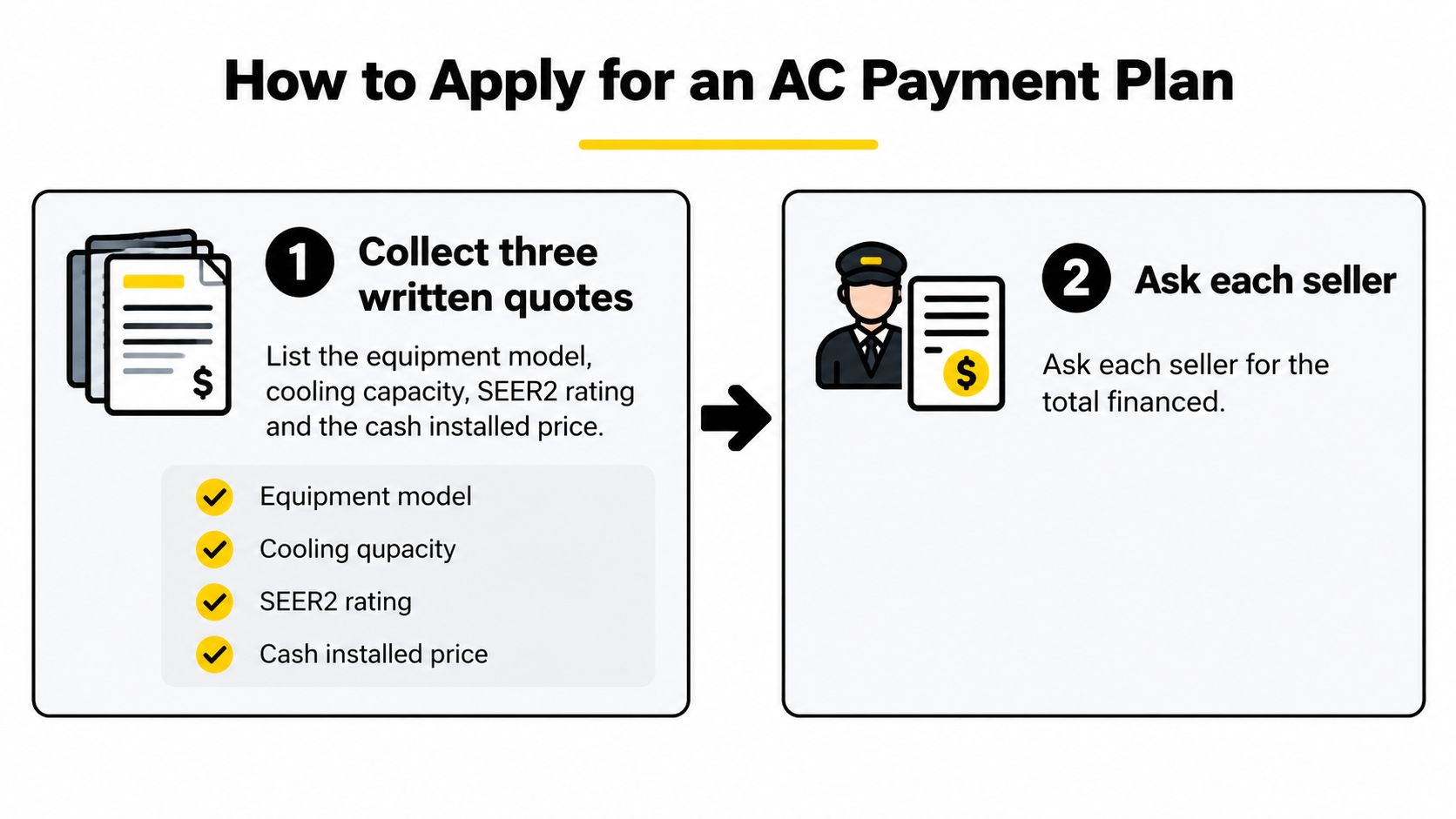
Collect three written quotes. Ask each contractor to list the equipment model, cooling capacity, SEER2 rating, and cash installed price. Use consistent project requirements so you aren't comparing different scopes disguised as different prices.
Ask each seller for the total financed cost. Request a complete repayment schedule for every option being proposed, not just the payment that fits the sales presentation. Don't sign while the total remains a verbal estimate.
Prequalify with a bank or credit union. Get an independent comparison before choosing the installer's financing. Ask whether prequalification uses a soft inquiry and when a formal credit application becomes necessary.
Compare the actual borrowing conditions. Review APR, origination or administrative charges, term, late charges, and prepayment rules together. A lower advertised rate doesn't settle the comparison if the fees or repayment schedule differ.
Confirm where the money goes. Ask whether the lender pays the contractor directly and whether the agreement creates a lien or security interest. Also establish when payment is released and how incomplete work is handled.
Read the contract and applicable cancellation notice. The consumer protections discussed earlier include cancellation requirements for qualifying in-home sales, but exceptions matter. Don't assume every emergency transaction or financing agreement has identical cancellation rights.
Set up payment controls. Arrange autopay only after checking the withdrawal amount, date, and account balance requirements. Keep the signed documents and set a separate reminder for any promotional payoff deadline.
Keep Installation Quality in the Decision
Financing approval doesn't establish whether the equipment or contractor is right for your home. Use a contractor-selection checklist alongside the credit comparison, especially when quotes differ in equipment or installation scope.
Before signing, you should hold the itemized installation contract, credit agreement, applicable cancellation notice, and payment schedule. Save copies somewhere you can access even if the original sales email disappears.
For seasonal residents, add a clear contact and access arrangement for installation and follow-up work. Don't leave the practical details unresolved just because the financing application is complete.
Tax Credits and Rebates Are Not Loan Discounts
A lower monthly payment does not make an incentive dependable. Judge an AC payment plan by its total repayment and the installation's net cost after incentives, while keeping those figures separate. For a standard central AC replacement, don't count heat-pump or geothermal tax credits as savings.
Incentive | Eligibility and relevance to standard central AC | How to treat it |
|---|---|---|
Energy Efficient Home Improvement Credit | Applies to qualifying heat pumps, not a standard central AC replacement. The credit rules use the date the property is placed in service to determine eligibility. | Do not subtract it from an AC quote unless the equipment and timing meet the rules. |
Residential Clean Energy Credit | Applies to qualifying geothermal heat pumps, not conventional central AC equipment. | Do not include it in the cost of a standard AC replacement. |
Income-qualified home energy rebates | Eligibility, availability, and rebate amounts depend on the program and its rules. | Confirm approval and payment timing before counting a rebate. |
Utility rebates | Terms depend on the utility's current program and the equipment installed. | Ask the utility to confirm eligibility, amount, and payment method. |
ENERGY STAR's heat-pump incentive guidance distinguishes heat-pump incentives from rebates governed by program rules. The IRS residential energy credit guidance addresses the residential credit rules, while the IRS Energy Efficient Home Improvement Credit rules explain the placed-in-service requirement. For geothermal qualification, see ENERGY STAR geothermal qualification guidance.
The Timing Gap Is the Risk to Watch
In 2026, scrutinize any quote that subtracts a tax credit from a standard AC replacement or treats an unapproved rebate as money already in hand. A sales estimate is not confirmation of eligibility or approval.
The historical Energy Efficient Home Improvement Credit generally equaled 30% of eligible costs, with a separate limit of up to $2,000. It was nonrefundable, so it could not create a refund beyond applicable tax liability. That tax benefit was not an upfront invoice discount. Check the rules and the property's placed-in-service date before including it in a cost estimate.
Equipment type matters. Qualifying geothermal equipment uses the ground or groundwater as its thermal source or sink. A conventional central AC replacement does not qualify as geothermal property.
Keep Separate Figures
Contract price: The full installation charge.
Amount financed: What you borrow after cash contributions and confirmed upfront reductions.
Estimated net cost: Your cost after eligible incentives. Compare borrowing charges separately, then include them in the overall plan comparison.
Reduce the amount financed only when an incentive is available upfront or a documented arrangement lowers the amount you must borrow. Otherwise, borrow only what you can repay without that benefit. Treat any later approved incentive as later cash.
Budget safeguard: If the plan works only when an uncertain incentive arrives on time, it doesn't work yet.
Ask what happens if approval is delayed or denied. Keep payments affordable without the expected benefit, and check the lender's prepayment rules before using a later rebate or tax benefit to reduce the principal.
Special Offers for Teachers, Military and First Responders
An occupational discount deserves a place in the comparison, but it doesn't deserve automatic preference. Ask whether it reduces the installation price, borrowing costs, or only a selected part of the job.
Teachers should ask their credit union and employer benefits office whether an applicable lending or employee program exists. Have employment identification available, but confirm the program's actual documentation requirements before applying.
Military households should ask the lender to identify applicable military consumer-credit protections in writing. Don't confuse a statutory protection with a contractor's voluntary discount, and don't assume an advertised military offer guarantees favorable financing.
Verify the Offer, Not Just Eligibility
First responders, including firefighters, police officers, and EMTs, can check agency, union, credit-union, and installer arrangements. A department ID may help establish eligibility, but the written offer should explain exactly what the benefit changes.
Use this first-responder discount overview as a starting point for questions, not as a substitute for a current quote. Availability and financing compatibility need confirmation at the time you buy.
Ask every seller these questions:
Does the discount reduce the installed price or the APR? Those benefits affect the comparison differently.
Can it be combined with promotional financing? Request both versions if accepting financing removes a cash discount.
Does it apply to the full installation? Confirm whether equipment, labor, and necessary related work are included.
When must it be claimed, and what proof is required? Get the eligibility conditions before signing rather than trying to add the benefit afterward.
My recommendation is simple: compare the discounted offer with the ordinary offer using the same equipment and scope. A special label doesn't excuse a higher repayment total.
Don't borrow more to qualify for a promotion. Choose the installation your home needs, then apply any legitimate benefit to that decision.
Choose the Plan That Fits Your Budget
Reliable promotional payoff: Consider deferred-interest financing only when your payoff money and deadline are dependable.
Longer repayment need: Favor a clearly priced fixed-payment offer over a promotion whose conditions you're unlikely to meet.
Tight cash flow: Choose the shortest affordable term, not the shortest term that leaves you stretched.
Available home equity: Compare the cost, but explicitly account for the property-backed risk.
Uncertain incentive: Make the decision using a budget that still works without it.
Next, subtract each finalist's payment from your monthly surplus after essential expenses. Reject any offer that leaves no safety margin for another emergency.
Test the Energy-Savings Claim
A more efficient system may reduce operating costs, but savings shouldn't be used as an unsupported excuse for a larger loan. ENERGY STAR advises considering rebates, tax credits, and special financing when evaluating major HVAC upgrades, while the installation and borrowing decisions still require their own cost comparison (ENERGY STAR clean heating and cooling guidance).
The Department of Energy's modeled example compares a 15.2-SEER2 ENERGY STAR system using 8,074 kWh annually with a 13.4-SEER2 system using 9,159 kWh, approximately 11.8% less electricity for the efficient option (Department of Energy central air-conditioner purchasing analysis). Those modeled results aren't a guarantee for a Tucson home.
Use this screening calculation:
Monthly energy savings: Estimated annual bill reduction divided by the months in a year.
Net monthly burden: Loan payment minus estimated monthly energy savings.
Ask whoever prepared the estimate to explain the cooling load, electricity rate, duct condition, thermostat assumptions, and installation requirements. If those assumptions aren't documented, don't count the projected savings as dependable payment money.
Ask for a Decision-Ready Quote
Request the SEER2 rating, documented cooling capacity, total installed price, APR, term, fees, and estimated annual electricity use. Keep the equipment estimate and lender disclosures together so you can assess the whole obligation.
The right air conditioner installation payment plan isn't necessarily the offer with the smallest payment. It's the affordable plan with a clear repayment total, realistic operating assumptions, and no dependence on money you haven't been approved to receive.
Covenant Aire Solutions offers Tucson-area AC installation and flexible financing options, subject to credit approval. Visit Covenant Aire Solutions to request an itemized replacement quote and current financing disclosures, then compare the cash price, total repayment, and confirmed incentives before deciding.