
What Is a Ductless AC System? How It Works in Tucson
A ductless AC system cools a building without ducts, using an outdoor compressor linked by refrigerant lines to one or more indoor heads. If you're asking what is a ductless AC system because one room in your Tucson home never cools down, that simple layout is the whole idea.
What a Ductless AC System Is in Plain Terms
Say it's 9 p.m. in Tucson and your bedroom is still hot. Your central system is running, but it's pushing cooled air through ducts that cross a sun baked attic, so the air warms up before it reaches you.
A ductless AC system, also called a mini-split, cools a building without supply and return ducts, using one outdoor compressor linked by refrigerant lines to one or more indoor heads. Each head delivers cooled air straight into its room, so there's no long trip through hot attic space.
Think of central air as a city water main feeding every tap through long pipes. A ductless system gives each room its own tap, filled from one source outside. The ENERGY STAR ductless heating and cooling guide describes this setup as an outdoor compressor and condenser connected to indoor air handling units, often called heads.
Why It Feels Different
The variable-speed compressor adjusts output to match demand instead of switching fully on and off. That steadier run is why a room can hold its setting instead of swinging warm, then cold, then warm again.
Ductless fits older homes without ductwork, room additions, garages, casitas, and small commercial spaces. It's also useful where cutting walls and ceilings for ducts would be disruptive.
The same equipment can run in reverse as a heat pump, so it can heat as well as cool.
From here, the useful questions are practical. What are the parts, how does the cooling loop work, and when does ductless beat the system you already have?
The Parts of a Ductless System and What Each Does
Walk a job the way a technician does, from outside in. You'll meet six parts, and each one has a single clear job.
Component | Location | Job |
|---|---|---|
Outdoor compressor and condenser | Outside the building on a pad or wall bracket | Compresses refrigerant and releases heat outdoors |
Refrigerant line set | Insulated lines through one small wall opening | Carries refrigerant between the outdoor and indoor units |
Indoor air handler (head) | Wall, ceiling or floor mounted in each room | Draws room air over the coil and blows cooled air back |
Condensate drain | Runs from each indoor head to a drain point outside | Removes moisture collected on the indoor coil |
Controls (remote, wall or app) | Inside the room or on a phone | Sets temperature and fan speed for each zone |
Branch box (multi-zone only) | Indoors, between outdoor unit and several heads | Splits refrigerant flow to multiple indoor heads |
The outdoor unit is the box on a pad or bracket. It compresses refrigerant and releases heat to outside air, which keeps the noisy work outside your bedroom.
Insulated copper lines carry refrigerant through one small wall opening to the head. Inside that head, a coil, blower, filter, and controls draw room air across the evaporator coil and discharge cooled air back into the zone, as described in the U.S. Department of Energy Building America ductless mini-split guide, which reports duct losses can average about 20% of the thermal energy delivered to ducts.
The condensate drain removes moisture that collects on the indoor coil. Controls may be wall mounted, ceiling mounted, a handheld remote, or an app.
With no ducts, capacity now depends on line-set length, insulation, joint integrity, drainage, and outdoor airflow. Those are the points to check at installation, not duct seams in an attic.
How a Ductless System Cools a Room, Step by Step
One cooling cycle is a loop. Refrigerant carries heat out of the room, drops it outside, and returns for more.
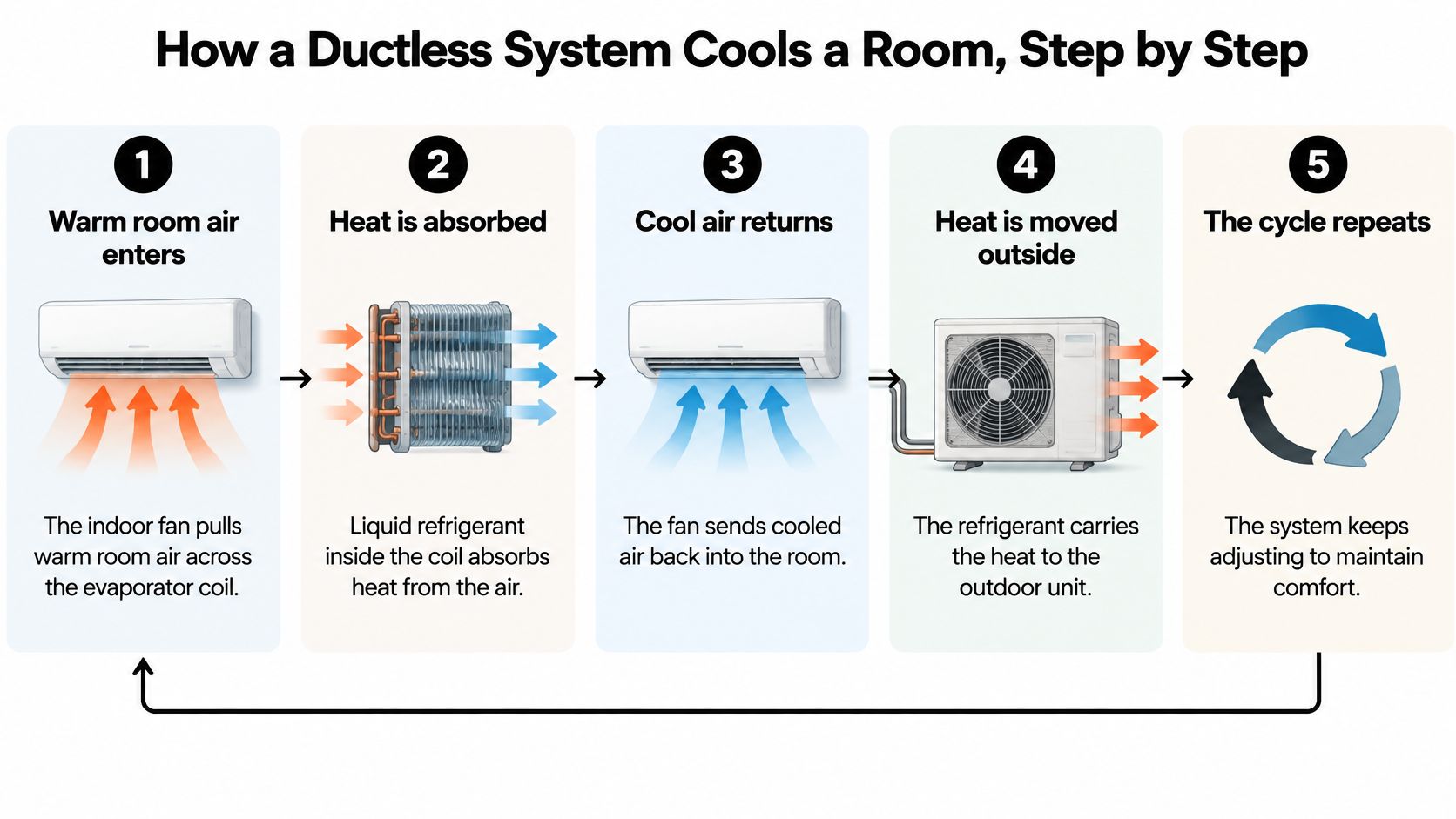
Warm air enters the head: The indoor fan pulls warm room air across the evaporator coil. The filter catches dust before air reaches that coil.
Refrigerant absorbs heat: Liquid refrigerant inside the coil absorbs heat from the air and turns into vapor. The air leaving the coil is now cooler.
Vapor travels outside: The line set carries the warm vapor to the outdoor unit. No room air travels with it, only refrigerant.
The compressor squeezes the vapor: Squeezing raises its pressure and temperature. That makes the refrigerant hotter than the outdoor air, even on a Tucson afternoon.
Heat is released outdoors: The outdoor condenser coil and fan release that heat into the outside air. This is the warm air you feel blowing from the outdoor unit.
Refrigerant turns back to liquid: It cools, passes through a metering device, and returns indoors at low pressure. Now it's ready to absorb heat again.
The inverter adjusts speed: It speeds or slows the compressor to match the room load. The system doesn't need full output for every small temperature change.
Why the Inverter Matters
An older on and off system runs at full blast, stops, then starts again. An inverter runs at part load for long stretches instead, which holds steadier temperatures and avoids constant starts.
At the vent, you should notice air that's clearly cooler than the room. The room should reach its set point and stay there without big swings.
In heating mode, the same loop runs in reverse. It absorbs heat outdoors and releases it inside.
Single-Zone, Multi-Zone and Heat Pump Setups Compared
You'll see three labels when you shop. They describe how many rooms you serve and whether the system also heats.
A single-zone setup pairs one outdoor unit with one indoor head. It's a clean fit for a single bedroom, garage, casita, or addition that your main system can't reach well.
A multi-zone setup connects several heads to one outdoor unit, and each head keeps its own setting. The ENERGY STAR mini-split factsheet notes controls can include wall mounted or ceiling installed controls, remote controls, and smartphone apps, and it cites a DOE example with one outdoor compressor-condenser connected to five indoor heads, reported at SEER 18.4 and HSPF 9.8. Those ratings belong to that example only, not to every system.
A heat pump model reverses the cycle to provide heating. That matters on Tucson's cooler winter nights, when you want warmth without firing a separate heater for one room. If you're mapping several rooms, our guide to a multi-zone HVAC system shows how the layout choices add up.
A Three-Bedroom Example
Say a home has a living room head and separate bedroom heads. Parents keep their room cool at night, a child prefers it warmer, and the guest room stays off until visitors arrive.
Each zone adds its own load, so the outdoor unit must be sized for the connected total. A west facing bedroom with big windows doesn't need the same capacity as a small interior office.
Practical rule: List the rooms that need different temperatures first, then count the heads.
Where Each One Wins
The core trade-off is simple. In central cooling, the ducts are often the weak point, especially when they run through a hot Tucson attic.
Criteria | Ductless mini-split | Central ducted AC |
|---|---|---|
Air delivery | Directly from each indoor head into its room | Through supply and return ducts |
Distribution losses | Minimal, since there is no duct network | Can exceed 30% of space-conditioning energy when ducts sit in attics or crawlspaces |
Zoning | Room-by-room control at each head | Whole-house by default; zoning needs dampers |
Installation disruption | One small wall opening per indoor head | Ducts need space in walls, floors or attic |
Best fit | Additions, older homes without ducts, rooms that need separate temperatures | Homes with sound existing ductwork and whole-house cooling |
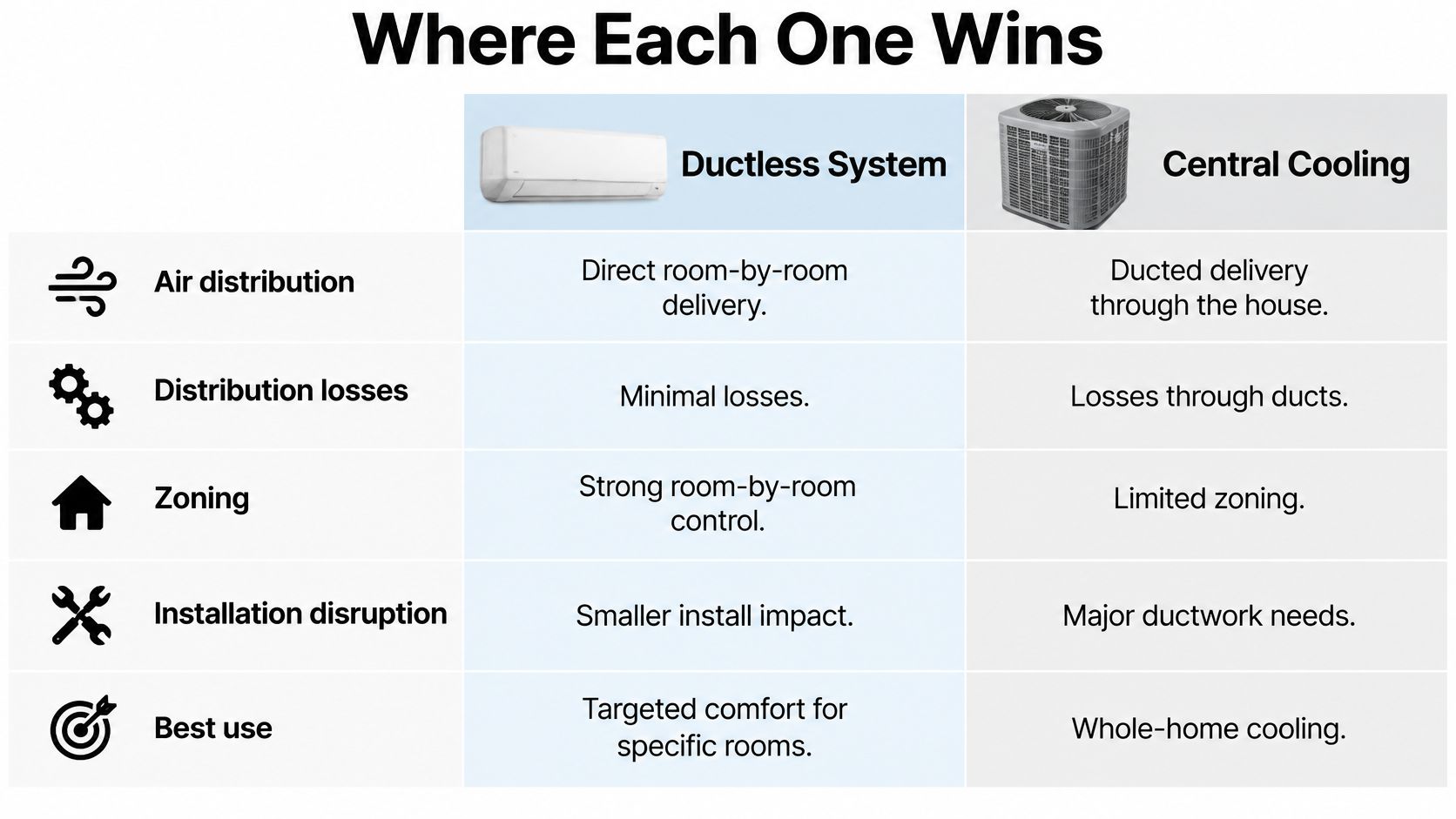
The ENERGY STAR 2025 mini-split factsheet reports duct losses can account for more than 30% of a home's energy used for space conditioning, particularly when ducts pass through unconditioned attics, crawlspaces, or garages. It also reports certified ductless mini-split heat pumps can cut cooling costs by approximately 30% compared with conventional room air conditioners.
Read those numbers with the caveat attached. Your savings depend on insulation, thermostat settings, sizing, electricity prices, solar exposure, and maintenance, so they aren't guaranteed in any one home.
Ductless wins for additions, older homes without ducts, and rooms that need separate temperatures. Central cooling stays strong where sound ductwork already reaches every room and whole-house cooling is the goal, a comparison we walk through in ductless vs central air for Arizona homes.
Don't overlook a middle path. Leaky existing ducts can often be sealed rather than replaced, and that repair can change the comparison before you buy new equipment.
Efficiency and Sizing for Tucson's Heat
Efficiency comes from how the system runs, not only from the hardware. A unit that sips power at part load for hours can beat a stronger unit that keeps starting and stopping.
This thermostat image shows the habit that matters most, setting a steady temperature and letting the system hold it.

The DOE case study on ductless mini-split heat pumps found a mini-split house operated with a constant temperature set point used roughly 54% as much energy as a comparable on-off operating strategy. In the same case-study testing, high-efficiency 1-ton ductless units rated at 25.5 SEER cut median cooling consumption by 10.9 kWh per day, or 37%, across six homes after installation.
Those homes weren't in Tucson, and results shift with envelope quality, thermostat behavior, climate, sizing, and interaction with existing equipment. Treat the findings as evidence for steady operation, not as a promise for your bill.
What To Require From a Quote
Room-by-room load calculation: Each head should match its room, not a rule of thumb based on square footage alone. Our guide to air conditioning unit sizing explains what that calculation covers.
Latent-capacity check: During monsoon season, the system must remove humidity as well as heat.
ENERGY STAR certification: It gives you a verified efficiency baseline for comparing models.
Installer verification: Airflow, refrigerant charge, condensate drainage, and line-set installation should all be checked at startup.
This short video shows how steady, modulated operation looks in practice before you judge a system by its first blast of air.
Sizing cuts both ways. An oversized unit short-cycles and dehumidifies poorly because it satisfies the thermostat before drying the air. An undersized unit runs at maximum output on afternoons above 105°F and still falls behind.
Use this test after installation. A well-sized system runs in long, steady periods, keeps rooms level, and leaves the air dry enough to feel comfortable.
Indoor Air Quality With a Ductless System
No ducts means no supply or return leaks pulling dust, insulation fibers, and hot attic air into your living space. Each head filters and conditions only the room air it draws in, and the refrigerant lines never move indoor air.
That benefit has a Tucson limit, and it's monsoon humidity. A correctly sized unit runs long enough to remove moisture, while an oversized unit cycles off before drying the air, leaving the coil and filter damp and inviting mold growth.
For broader habits beyond the equipment, the Renue Systems Four Points air quality guide is a useful companion, and our own overview of indoor air quality and ventilation covers how ventilation fits with filtration.
Run these checks in order:
Confirm drainage: Each condensate line should slope and drain outside, since standing water in the drain pan supports microbial growth.
Inspect the coil and pan: At each seasonal service, look for slime, odor, or visible growth.
Choose the right filter: Pick the highest rating the head accepts without starving airflow, because a restrictive filter starves the coil of air.
Ask about humidity control: In a tightly sealed home, ask the installer how the system manages moisture.
A clean coil and a dry room are your best everyday signs. If either one slips, the system isn't protecting your air the way it should.
Installation, Refrigerant and Air Quality Upkeep
Start with the refrigerant label, because the rules have changed and that label now shapes your repair options. Find the refrigerant type printed on the unit's nameplate before you authorize any refrigerant work.
The EPA SNAP Rule 27 fact sheet identifies R-32 and several R-454 refrigerants as alternatives for new residential and light-commercial air conditioners and heat pumps, acceptable only in equipment designed for the particular refrigerant. It also states R-32 has a global-warming-potential value below the 700 threshold for the relevant residential and light-commercial subsector.
Can a Technician Just Top It Off With the Newer Refrigerant
Generally, no. The refrigerant, components, charge procedures, detection, and safety requirements must match the equipment's design, so a technician can't top off or retrofit an existing unit with a newer refrigerant.
Mixing refrigerants is unsafe or impermissible for the same reason. Pressures, oils, and safety controls are built around one specific refrigerant, and the wrong charge can damage the compressor or create a safety risk.
Availability also shapes repair or replace decisions. If your older refrigerant or matching parts get harder to source, a major repair may cost more than it should, and replacement starts to make sense sooner.
A lower global-warming-potential refrigerant doesn't remove the need for care. Correct recovery and leak management still matter, because any leaked refrigerant is wasted charge and lost capacity.
Upkeep in Order
Clean or replace indoor filters monthly during dusty spring and monsoon periods. Each head's filter catches dust before it reaches the room, so filter care protects indoor air quality.
Keep the outdoor coil clear of dust, leaves, and debris so it can release heat.
Confirm each condensate line drains freely and doesn't drip inside the wall.
Keep the outdoor unit clear of obstructions so air can move through the coil.
Book a yearly professional check for charge, electrical connections, and drainage. Our notes on ductless air conditioning maintenance list what that visit should include.
Decide Whether a Ductless System Fits Your Home
Run four questions today, before you call anyone:
Do my rooms need different temperatures at the same time of day?
Do I lack ducts, or do my ducts lose energy through a hot attic?
Is my current equipment near the end of its service life, and does its refrigerant type affect repair choices?
Will the home need heating as well as cooling from the same equipment?
If you answered yes to two or more, ductless deserves a real quote. If your ducts are sound and every room is used all day, central cooling may still be the simpler answer.
One limit isn't negotiable. The guide to choosing and sizing a ductless mini split explains that adding or removing refrigerant, or connecting and disconnecting hoses or pre-charged lines, requires certification as a Section 608 technician. Mounting a head looks easy, but the refrigerant circuit makes this regulated work, not a weekend DIY task.
Your next steps are short. Request a room-by-room load calculation, ask which refrigerant the proposed system uses, and confirm the installer's certification.
Covenant Aire Solutions offers a free A/C unit check-up and services all makes and models of HVAC systems, so you can compare a ductless option against your current equipment. List the rooms that need separate settings, note the refrigerant on your current unit, then book the check-up.
If your Tucson home has one room that never cools or ducts baking in the attic, we can run a room-by-room load calculation, check your current refrigerant, and show you whether ductless or your existing system makes more sense. Book your free A/C unit check-up through Covenant Aire Solutions and bring your list of problem rooms, and we'll turn it into a clear, priced plan.