
HVAC Service Plans Near Me: What Plans Include and Cost
Air conditioning accounted for 19% of residential electricity consumption in 2020, according to the U.S. Energy Information Administration. That makes cooling equipment more than a comfort purchase. It's a major household operating expense, and in Tucson, losing it during hot weather creates a problem that can't always wait.
Searching for HVAC service plans near me should lead to more than a tune-up coupon. The useful comparison is what you're buying in writing: scheduled work, repair discounts, refrigerant coverage, access to parts, and a clear explanation of what happens when cooling stops.
What Every Service Plan Includes
Plan feature | What it means | Typical plan | Covenant Comfort Maintenance Plan |
|---|---|---|---|
Tune-up visits | Scheduled system checks each year | Usually 1 or 2 visits | 2 visits per year, one in spring and one in fall |
Inspection depth | Checklist covered on each visit | Contractor-specific checklist | 21-point inspection |
Priority scheduling | Your call moves ahead of standard requests | Usually included, sometimes extra | Free 24/7 priority service |
Repair labor discount | Reduction off standard labor rates | Often 10% to 15% | 20% off repair labor rates |
Parts discount | Reduction off replacement parts | Often 10% to 15% | 20% off replacement parts |
New unit discount | Reduction off a new system purchase | Only when expressly included | 10% off new unit purchases |
Condenser coil cleaning | Clears outdoor coil buildup | Often extra | Free condenser coil cleans |
Travel charges | Fee to reach your property | Often waived | No trip charges or fees for initial travel time |
Plan transfer | Moving a contract from another contractor | Written transfer policy controls | Hassle-free transfer policy and free program transfers |
Treat the typical-plan column as a shopping checklist, not a promise from every contractor. A maintenance agreement normally bundles scheduled inspections with repair benefits, but the contract determines which equipment, tasks, and charges qualify.
Our Covenant Comfort Maintenance Plan includes the benefits shown above. The important distinction is between work included in the membership and work that merely receives a discount. A free check-up doesn't mean every repair identified during that visit is free.
Read the rows that change the outcome
Priority scheduling matters most when the service calendar is full. During the hottest weeks, ask what happens after your call reaches dispatch, not just whether someone answers the phone. Moving ahead of standard requests isn't the same as a guaranteed arrival time.
Parts discounts deserve equally close attention. Check whether the agreement includes the components your system might need, such as a capacitor, contactor, blower motor, or control board. A discount on an excluded component has no value.
Labor savings also need a baseline. A larger discount can still produce a higher bill if the contractor's standard labor charge is higher, so compare the estimated final repair price rather than the percentage alone.
Practical rule: Compare the work and final charges, not the size of the membership discount.
For commercial owners, the same contract-reading habit applies across building systems. JMJ Plumbing's resource on scheduled plumbing upkeep for commercial properties is useful when organizing separate maintenance responsibilities for a property.
Moving an existing agreement
At Covenant Aire Solutions, we offer a hassle-free transfer policy for customers moving a maintenance contract from another HVAC contractor, with free program transfers. If you're already paying someone else, that gives you a transfer route rather than assuming you must start over.
Hold every table row against the quotes you receive. Request written terms for any feature you can't find, especially exclusions hidden behind broad phrases such as full service.
What Plans Cost and What They Save
Option | Total price | Per year | What it covers |
|---|---|---|---|
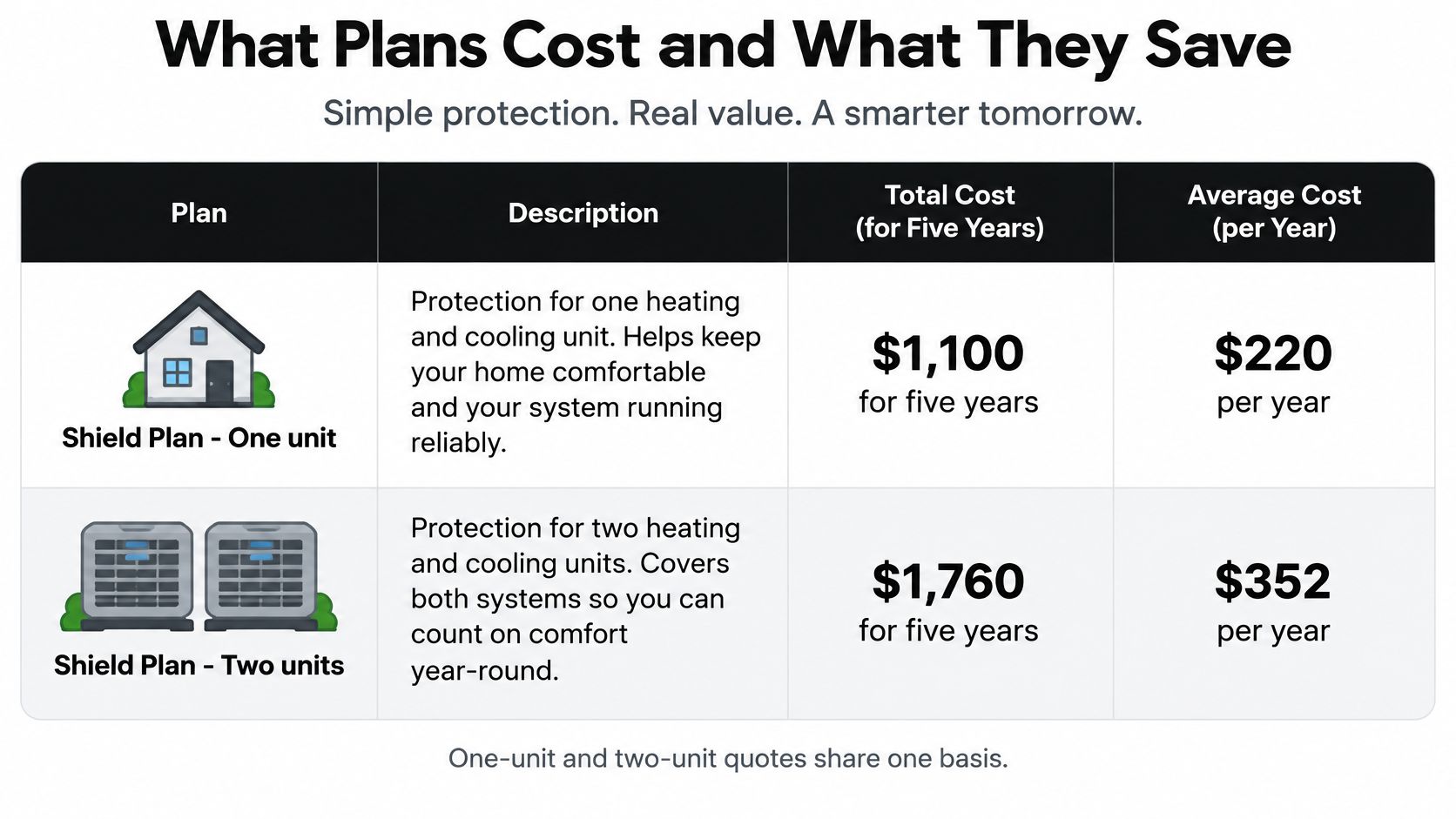
Shield Plan, 1 unit | $1,100 for 5 years | $220 | Five-year term for one system |
Shield Plan, 2 units | $1,760 for 5 years | $352 | Five-year term for two systems |
Covenant Comfort Maintenance Plan | Fee not stated in the listed benefits | Obtain written annual fee | Seasonal check-ups, inspection, coil cleaning, priority service, and listed discounts |
A/C replacement offer | 15% off unit replacement | 0% APR for 60 months, financing term rather than annual plan cost | Separate from the plan's 10% discount on a new unit |
The Shield figures are annualized costs, not a statement that annual installment billing is available. Dividing the full term price by its duration puts the options on a common basis, but you still need the payment schedule, renewal terms, and cancellation provisions.
This comparison keeps the system count visible alongside the yearly cost.
Separate stated value from cash savings
Our Comfort plan includes check-ups with a retail fee of $89.99 each, or $179.98 combined, and states $250 in instant yearly savings. Those figures aren't the plan fee, and the combined check-up value alone doesn't explain the full stated savings. Get the annual membership price and the savings breakdown before treating either amount as money you'll keep.
For broader budgeting context, Angi's State of Home Spending Report, summarized by Homepros, found that U.S. homeowners spent an average of $12,050 on improvements, maintenance, and emergency repairs in 2024, a 12% decrease from 2023. That's total home spending, not an HVAC maintenance price benchmark.
Use our A/C unit maintenance cost guide to identify the line items that belong in your quote.
Run a conservative break-even calculation
Write down the annual plan fee. Include mandatory charges and the correct number of covered systems.
Subtract realistic repair discounts. Apply the labor and parts reductions only to eligible work you reasonably expect, not an imagined worst-case repair.
Compare the remaining cost with an emergency visit. Use the contractor's actual diagnostic, dispatch, and after-hours prices.
Keep energy savings conditional. The Department of Energy's heating and cooling guide says regular maintenance can reduce household heating and cooling costs by 5% to 10%, but that isn't a guaranteed reduction for your home.
Price replacement separately. We offer 15% off A/C unit replacement and 0% APR financing for 60 months. That's separate from the maintenance plan's new-unit discount; don't assume offers combine.
A clean, healthy system may not generate repair discounts during a membership year. Ask every provider for the total yearly cost in writing, then decide whether scheduled service and emergency access justify the remaining expense.
What a Real Tune-Up Checks Each Season
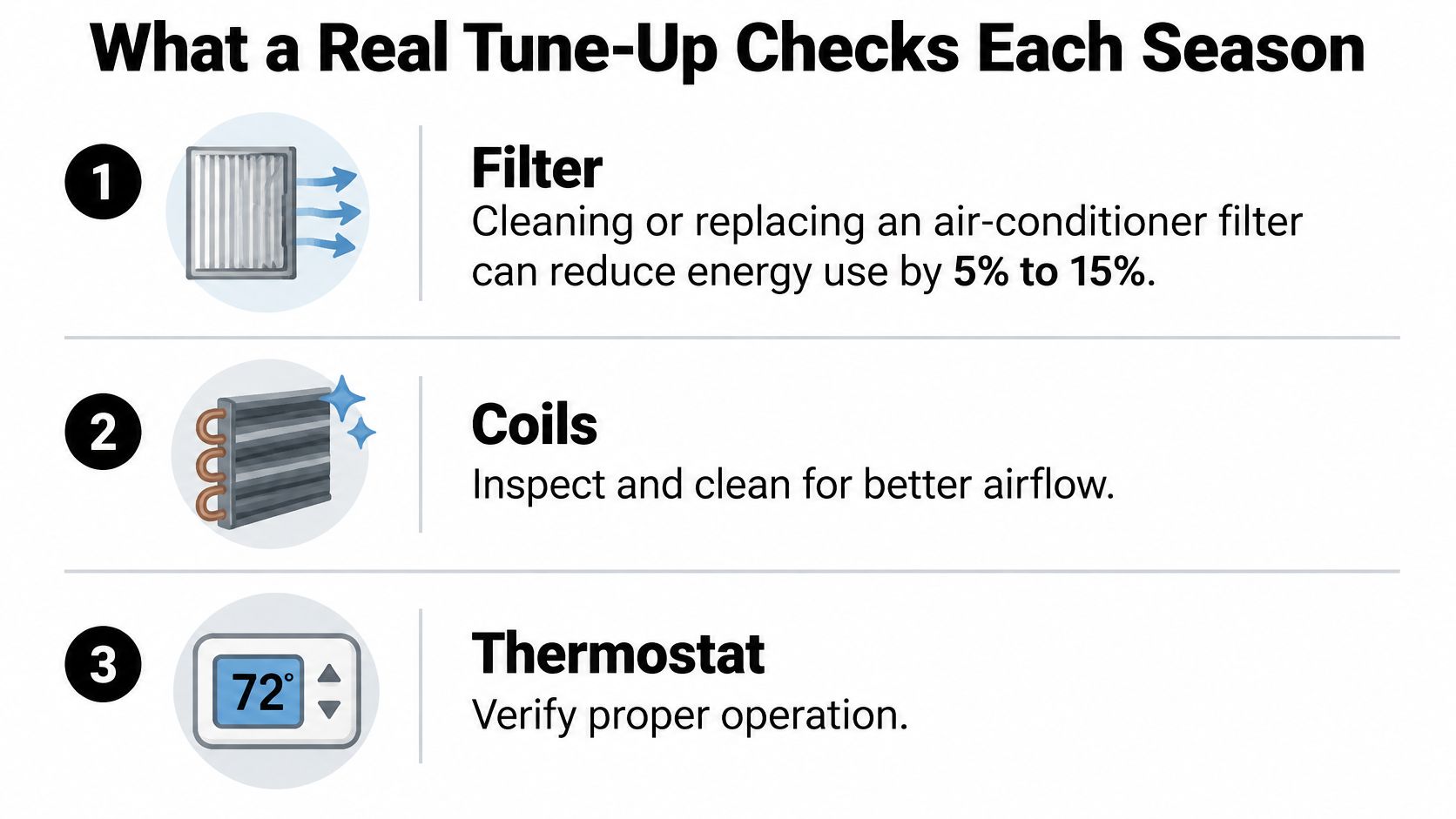
Start with the filter. DOE building-science guidance states that routinely cleaning or replacing air-conditioner filters can reduce the unit's energy consumption by 5% to 15%. A clogged filter restricts airflow, reduces cooling performance, and can increase runtime and motor wear.
The filter, coils, and controls are useful starting points, but they aren't the entire visit.
Require checks that produce useful findings
A meaningful checklist connects each inspection to a possible fault.
Filter size, rating, and seal: Confirm the filter fits, faces the correct direction, and doesn't allow air to bypass its edges.
Airflow and static pressure: Use a manometer and appropriate airflow checks to identify restrictions instead of guessing from air movement at a register.
Evaporator and condenser coils: Inspect for buildup that interferes with heat transfer, and distinguish included cleaning from separately priced cleaning.
Condensate drain and pan: Check drainage, standing water, and any installed overflow protection before a blockage causes water damage.
Electrical connections and amp draw: Inspect safely for damaged connections and compare motor readings with equipment specifications.
Refrigerant operation and charge: Evaluate operating conditions and take appropriate diagnostic measurements when a charge problem is suspected.
Ductwork: Look for accessible leaks, crushed sections, and disconnected runs that prevent conditioned air from reaching rooms.
Outdoor unit clearance: Remove accessible debris and identify vegetation or stored objects blocking airflow.
Thermostat and controls: Verify operating modes, settings, and system response rather than assuming the displayed temperature proves correct operation.
Connecting gauges isn't automatically necessary at every routine visit. The technician should choose diagnostics appropriate to the equipment and symptoms, then explain any suspected refrigerant problem before proposing corrective work.
Match filtration to the blower
A higher MERV rating isn't automatically a better choice for your equipment. Dense media in a small filter slot can create excessive resistance, so measure airflow and pressure before upgrading. The DOE residential HVAC literature review identifies filter resistance, coil condition, duct problems, and refrigerant charge as contributors to performance degradation.
A better filter is one that captures the intended particles while allowing the system to move its required air.
Spring work should prepare the cooling side; fall work should address heating operation, including combustion safety where applicable. Our HVAC system tune-up guide explains how a seasonal visit fits into ongoing care.
Between appointments, check the filter monthly during heavy use, keep debris away from the outdoor unit, and record unusual noise or longer operation. For a structured way to plan routine HVAC maintenance, Forge Reliability offers a useful scheduling resource.
The completed report should record filter specifications, pressure readings, temperatures, electrical measurements, observed defects, and corrective recommendations. Comparable readings are more useful than a checkbox marked system OK.
Who Gets the Most Value From a Plan
The best candidate isn't necessarily the homeowner with the oldest equipment. It's the person whose likely problem matches a benefit the agreement provides.
A technician's written record is especially useful when someone else must review or authorize the work.

Match the household to the benefit
Owners of aging systems. Say your equipment still cools adequately, but you don't know its service history. Scheduled measurements can establish a baseline and identify wear before you're making a repair decision under pressure. Age alone doesn't justify replacement, and membership shouldn't become permission to recommend one automatically.
Seasonal residents and snowbirds. An empty home needs more than appointment reminders. Arrange a check before departure and another around your return, with access instructions and a named repair approver. The valuable feature is a process that works while you're away.
Budget-conscious households. If a surprise bill would disrupt essential spending, compare the membership cost with the services you'd purchase anyway. Replacement financing can help manage cash flow, but financing doesn't turn an unaffordable total purchase into a cheaper one. Our discussion of whether HVAC maintenance is necessary can help separate useful preventive work from optional spending.
A useful follow-up is to identify which service responsibilities you want to manage yourself and which you want a contractor to schedule.
Give commercial properties an equipment-level scope
For a commercial owner or facility manager, a generic building-level membership description isn't enough. Each rooftop unit or split system needs an equipment identifier, service history, access procedure, and clear approval authority. Reports and invoices should let an owner or board understand what was inspected and why repairs were recommended.
We provide residential and commercial HVAC services and service all makes and models. Build the proposed scope around the number of units, building type, and response needs rather than assuming every property fits the same arrangement.
Downtime risk: Prioritize dispatch procedures and repair authorization.
Cost risk: Prioritize eligible repairs and transparent charges.
Absence risk: Prioritize access, communication, and documented findings.
The right plan addresses your biggest exposure, not the longest list of benefits.
Questions to Ask Before You Sign
Start with refrigerant coverage, because a maintenance plan can include an inspection while excluding nearly everything needed to correct a leak. Existing R-410A systems don't need automatic replacement and can continue receiving service; the EPA technology-transition fact sheet describes the 2025–2026 transition, a global-warming-potential limit of 700 for new residential and light-commercial equipment, and lower-GWP alternatives including R-454B and R-32.
Regulatory change alone isn't a diagnosis. A functioning legacy system deserves an equipment-specific repair-versus-replacement assessment, not a replacement recommendation based only on its refrigerant label.
Put refrigerant and parts through a written test
Request an itemized answer covering these tasks:
Diagnosis: Is evaluating a suspected refrigerant fault included, discounted, or separately billed?
Leak testing: Which testing methods and access work require additional authorization?
Recovery and repair: Does coverage extend to recovering refrigerant and repairing the leaking component?
Refrigerant itself: Is the material included, excluded, or charged separately?
Return visits: Who pays when diagnosis, parts ordering, and final repair require separate appointments?
Don't accept refrigerant service as a complete answer. A discount on material isn't the same as included leak detection, and adding refrigerant doesn't explain why the charge was low.
For equipment more than ten years old, ask how the contractor will check compatible-parts availability before you authorize a major repair. A plan can discount a control board without ensuring that board is available. Request the procedure for backorders, discontinued components, substitute parts, and deposits.
Before authorizing a major repair: Get the repair scope, expected parts availability, final price, and replacement alternative on the same written estimate.
The technician should explain what the repair is expected to accomplish and what unrelated risks remain. Replacing a failed motor doesn't renew the compressor, coils, or remaining electrical components.
Define priority service during extreme heat
The 2025 Southern Arizona Heat Summit report identifies loss of power as a severe limitation on access to air conditioning that increases the risk of heat-related illness and heat stroke. That distinction matters: an HVAC service agreement can arrange mechanical service, but it can't make the utility supply power.
Our plan states free 24/7 priority service and no trip charges or initial travel-time fees. Confirm which emergency charges those benefits remove and which remain, especially diagnostic labor, repair labor, materials, and any after-hours premium.
We also offer $55 off any service call. Price an emergency both with membership and without it, and don't assume separate discounts stack.
Use direct operational questions:
After-hours response: Does coverage mean answering the call, dispatching a technician, or completing the repair?
Dispatch charges: Are they waived under the agreement, including outside ordinary working hours?
Response target: Is there a stated target, and what happens when demand exceeds available technicians?
Vulnerable occupants: Is there a process for flagging households with heat-sensitive residents?
Service boundaries: Does your property fall inside the covered geography?
Unavailable parts: What communication and temporary options are offered while waiting?
A vague promise of fast service doesn't make competing agreements comparable. Written limits are more useful than reassurance.
Protect your ability to leave and authorize work
Read cancellation, renewal, refund, and transfer provisions before paying for a long term. Our service agreement terms guide provides a starting point for identifying the clauses that need clarification.
For a vacant seasonal home, name the person allowed to approve repairs, specify the authorization process, and provide access instructions. Don't leave a technician and property manager trying to determine spending authority during a failure.
Require a written visit record with readings, findings, and recommended action. Finally, keep a separate heat-emergency plan: safe backup-power planning where appropriate, professionally evaluated surge protection, a spare filter, saved contact details, and somewhere occupants can go if cooling becomes unavailable. Maintenance reduces some failure risks; it doesn't guarantee uninterrupted cooling.
Choose and Sign Up for Your Plan
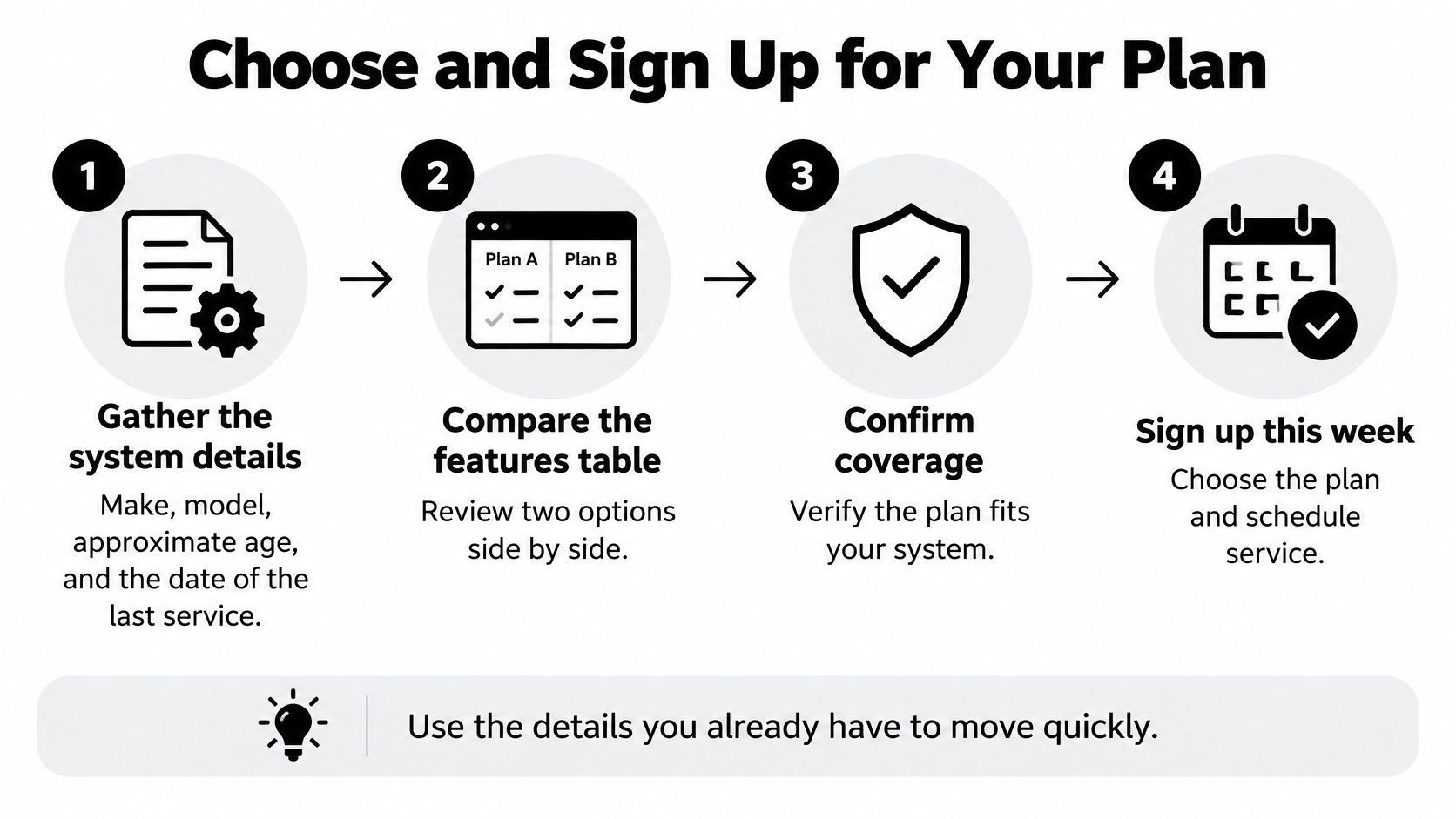
Use the equipment information you already have to begin comparing actual coverage rather than advertising headlines. This process keeps the decision tied to your system.
Follow a practical enrollment routine
Gather your system details. Photograph the make, model, and serial-number labels, note approximate age, and locate the last service record. Accurate equipment details prevent quotes built around the wrong scope.
Compare local quotes on the same basis. Put a small selection beside the feature table, then match system count, covered tasks, term length, and annualized cost. Use our guide to choosing an HVAC contractor to evaluate the company as well as the membership.
Request written answers to coverage questions. Mark refrigerant, emergency labor, parts, cancellation, and reporting provisions directly on each proposal. Missing terms create uncertainty precisely when you need a clear decision.
Have the actual equipment evaluated. We offer a free A/C unit check-up, along with a free quote and estimate for services. Use that opportunity to connect the recommendation to the system's condition before committing.
Call to enroll and schedule service. Our Covenant Comfort Maintenance Plans are signed up for by calling the business. Book cooling preparation before cooling season and heating preparation before heating season so the visits remain preventive.
Keep a service folder and filter log. Save readings, invoices, recommendations, and filter changes together. The next technician can then compare conditions rather than starting with an incomplete history.
Make the final decision on written value
Choose a plan when its terms clearly address refrigerant, emergency labor, parts, and documented visits, and its yearly cost is lower than the value of services you'd otherwise buy plus realistic discounts and expected emergency savings. Don't count a possible repair as a certain saving.
If an important provision is missing, request it before signing. If the numbers don't justify membership, scheduled maintenance without a plan may be the more sensible purchase.
Covenant Aire Solutions offers residential and commercial HVAC maintenance, a free A/C unit check-up, and free estimates to help you compare coverage against your equipment's needs. Visit Covenant Aire Solutions to request an evaluation, review the written plan terms, and call to enroll when the coverage and yearly cost make sense for your property.