
When to Replace Air Conditioner: Key Signs to Know
Deciding when to replace your air conditioner usually boils down to a few tell-tale signs. Is it getting old? Are repair bills becoming a regular thing? Have you noticed your energy bills creeping up? If your AC is over 10 years old and you're seeing a technician more often than you'd like, a replacement is almost always the smarter financial move.

Key Signs Your Air Conditioner Needs Replacement
Think of your air conditioner like a trusty old car. It serves you well for years, but eventually, you hit a point where the constant repairs and high running costs just don't make sense anymore. Instead of waiting for it to give out completely during a summer heatwave, you can learn to spot the warning signs and make a plan.
The biggest red flags are all connected. An older unit is naturally going to be less efficient, which shows up on your energy bills. At the same time, its aging parts are more likely to fail, leading to more frequent, and often expensive, repair calls.
A Quick Checklist for Your AC
To make it simple, here are the most common indicators that point toward a replacement:
System Age: Most air conditioners have a lifespan of 10 to 15 years. If yours is over a decade old, it’s running on outdated technology and is far less efficient than today's models.
Repair Frequency: Are you on a first-name basis with your HVAC technician? If you're calling for repairs more than once a year, you’re likely throwing good money after bad.
Rising Energy Bills: A sudden or steady climb in your summer electricity bills, without any change in your habits, is a classic sign your AC is working way too hard to cool your home.
Poor Performance: If some rooms are hot while others are cold, your home feels muggy, or the system just can't keep up on warm days, its performance is clearly on the decline.
This infographic breaks down the three most critical signals for a quick gut check.
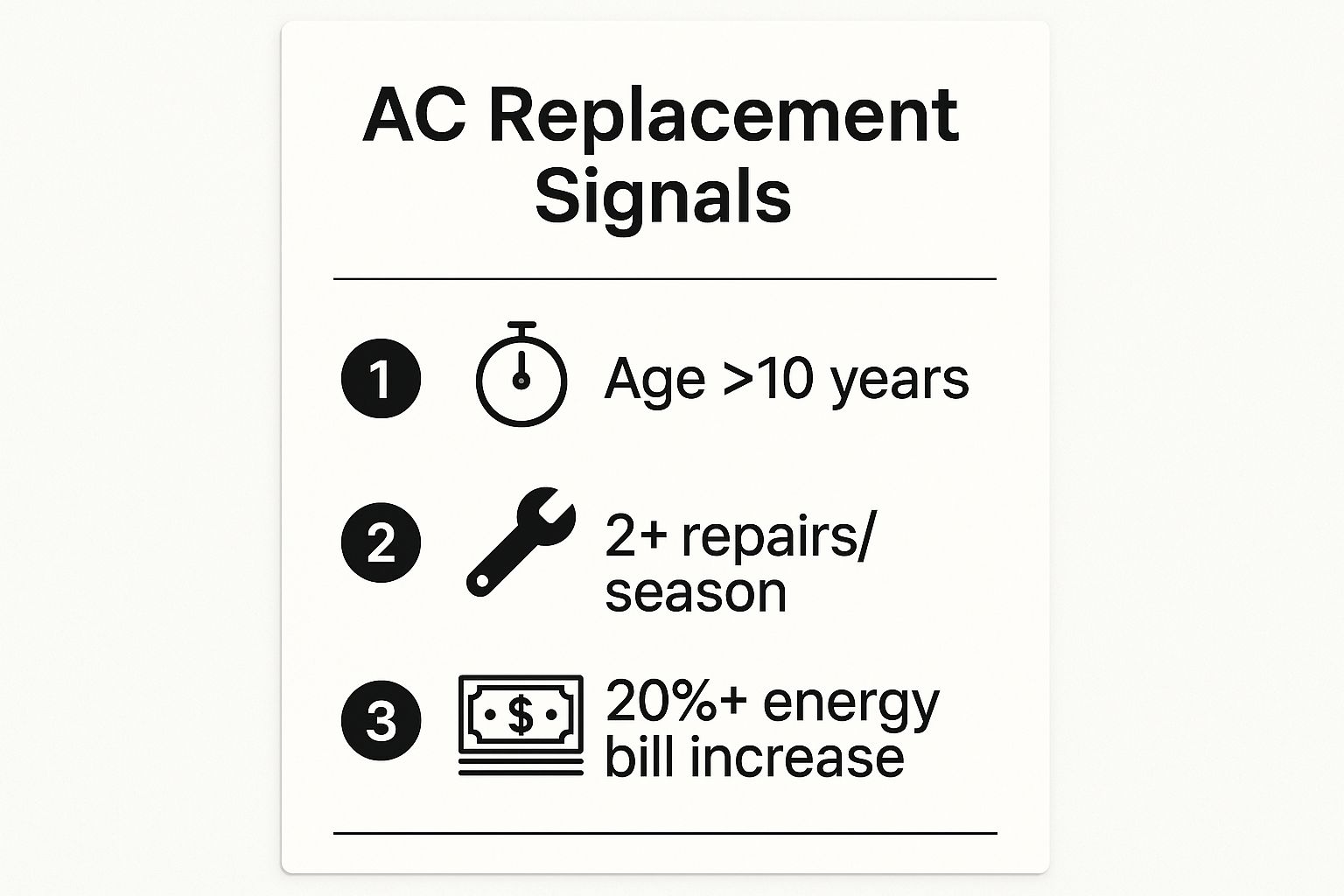
Sometimes, seeing the signs laid out visually makes the decision easier. When age, repair costs, and energy bills all start pointing in the same direction, you have a pretty compelling case for an upgrade.
To help you sort through this big decision, we've put together a simple table that summarizes the key replacement signals.
Quick Guide to AC Replacement Signals
Replacement Indicator | Sign It Is Time to Replace | What This Means for You |
|---|---|---|
Old Age | The unit is over 10-15 years old. | It's likely inefficient, less reliable, and may use phased-out refrigerant. |
Frequent Repairs | You're calling for service more than once or twice a year. | Repair costs are adding up and likely to continue, making a new unit more economical. |
High Energy Bills | Your summer cooling costs are steadily increasing. | The system has lost efficiency and is consuming more power to do the same job. |
Inconsistent Cooling | Your home has hot spots or feels humid. | The unit can no longer effectively cool or dehumidify your entire space. |
Constant Running | The AC runs almost non-stop to keep up. | It's struggling to meet the cooling demand, indicating a serious performance issue. |
Hopefully, this table gives you a clear snapshot of what to look for. Each sign on its own is a reason for concern, but when you start checking off multiple boxes, it’s a strong signal that it’s time for a change.
For a more detailed breakdown, you can learn more about whether it is time to replace your HVAC system or repair your AC in our complete guide.
How Age and Efficiency Impact Your AC
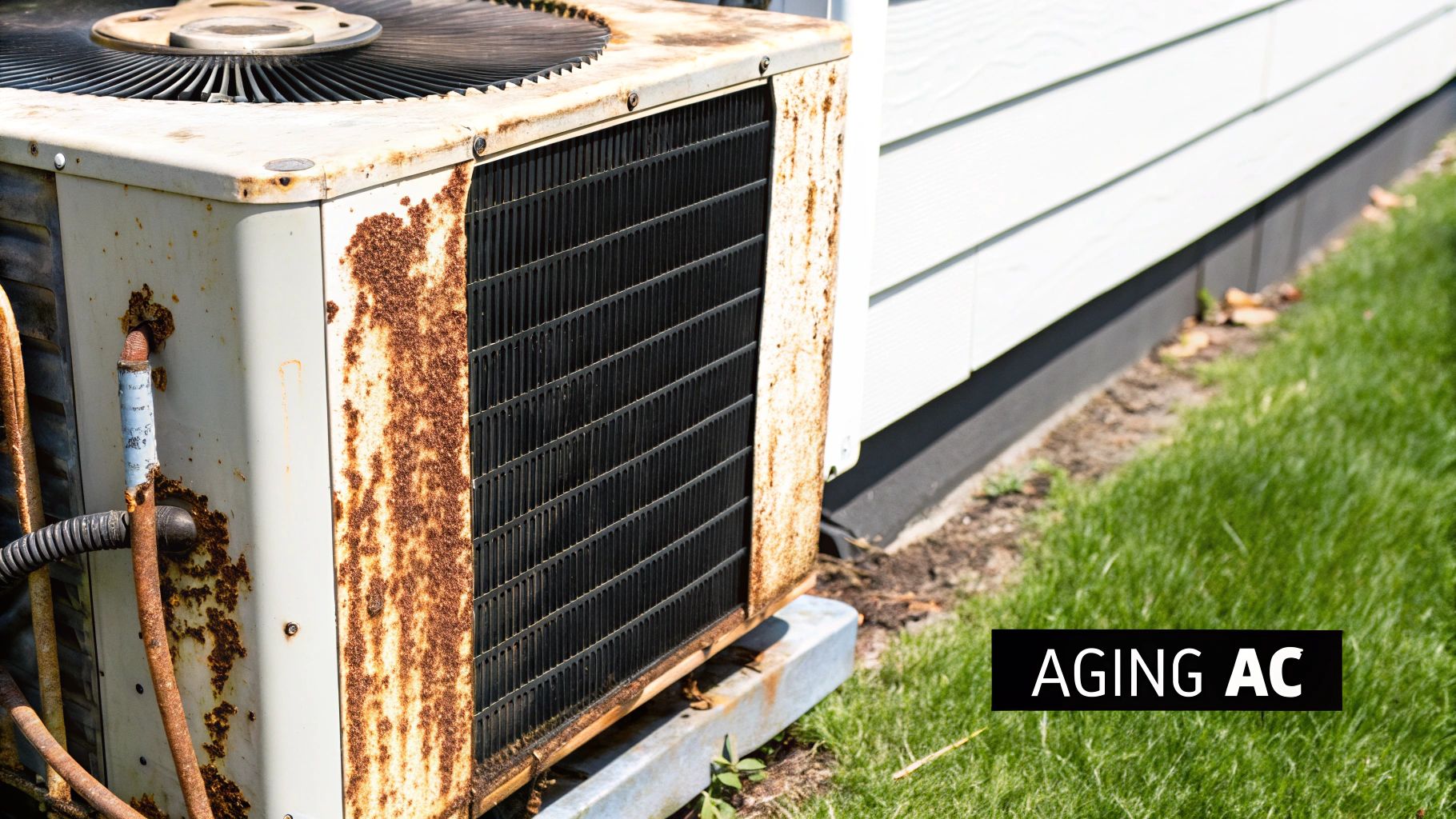
It helps to think of your air conditioner like a trusty old car. For years, it got you where you needed to go without a fuss. But as the miles add up, it starts burning more gas, breaking down more often, and just doesn't perform like it used to. An aging AC unit follows that exact same path. Its performance inevitably declines over time, making age one of the biggest clues that a replacement is on the horizon.
Generally, most air conditioning systems have a lifespan of about 10 to 15 years. Once you cross that threshold, even a well-maintained unit is living on borrowed time. The parts have simply worked too hard for too long, and both efficiency and reliability start to take a nosedive.
The Steady Decline of AC Efficiency
The efficiency of any air conditioner is measured by its Seasonal Energy Efficiency Ratio, or SEER rating. Your unit had a specific SEER rating when it was brand new, but a decade of battling the heat will cause its real-world performance to drop, sometimes dramatically.
This slow-but-steady decline forces your system to run longer and work harder just to produce the same amount of cool air. That extra effort translates directly into higher electricity bills every single month. After just 10 years, an air conditioner's efficiency can plummet by up to 30% compared to newer models on the market today.
In fact, studies have shown that swapping out a system older than a decade for a new Energy Star-rated unit can slash your cooling energy use by 15% to 40%.
An older air conditioner doesn't just cost you in potential repairs; it costs you every single month on your utility bill. This hidden expense is often the most compelling reason to invest in a modern, high-efficiency replacement.
To get the most out of every dollar you spend on cooling, it's also smart to look at other home improvements. For instance, you can boost home energy efficiency with solar window screens to reduce the heat load on your home.
The Problem with Outdated Technology
It's not just about simple wear and tear. The technology inside older AC units can become a major liability all on its own. Many systems manufactured before 2010 run on a refrigerant called R-22, which you might know by its brand name, Freon.
The U.S. government completely banned the production of R-22 in 2020 because of the damage it does to the ozone layer. What does this mean for you? If your old system springs a refrigerant leak, a technician can't legally top it off with new R-22.
While a small, expensive supply of recycled R-22 still exists, it makes what should be a simple repair incredibly costly and impractical. This refrigerant issue alone is often the final nail in the coffin, making a full replacement the only financially sensible choice.
To learn more about how different parts of your system age, check out our guide on the average lifespan of an HVAC system.
Weighing Repair Costs Against Replacement
It’s the classic dilemma every homeowner faces eventually: you're looking at a hefty repair bill, and you have to ask yourself, "Is this worth it, or am I just throwing good money after bad?" Deciding whether to fix an ailing air conditioner or replace it is one of the toughest calls to make.
Thankfully, there’s a simple guideline that can cut through the uncertainty. We call it the 50% Rule, and it’s a straightforward financial gut check. If a major repair costs 50% or more of what you'd pay for a brand-new, comparable AC unit, replacement is almost always the smarter long-term move.
When Repairs Become Too Expensive
Think about it this way. Spending $2,500 to fix a 12-year-old system is a massive gamble, especially when a new, more efficient unit might cost $5,000. That one repair doesn’t guarantee another major part won't fail next month, putting you right back in the same tough spot.
Certain repairs are so expensive they often trigger the 50% Rule all on their own. When one of these major components fails, it's a strong signal that your system's best days are long gone.
Compressor Failure: The compressor is the heart of your AC. When it dies, the repair cost is often so high that a full system replacement just makes more sense. We have a detailed guide that breaks down the AC compressor replacement cost.
Evaporator or Condenser Coil Leaks: This is a labor-intensive job. Replacing coils can easily run into the thousands, pushing the total cost right up to that 50% threshold.
Tracking Cumulative Repair Costs
But it’s not always one big, catastrophic failure. Sometimes, it’s death by a thousand cuts. A series of smaller, seemingly manageable repairs can be just as telling.
A $400 repair one summer followed by a $600 repair the next might not feel like a big deal at the time, but they’re adding up.
Try keeping a running total of your AC repair bills over the last season or two. When you realize you've already sunk $1,500 into patching up an old unit, investing that money in a new, reliable system suddenly looks like a much sounder financial strategy.
This approach helps you see the bigger picture. In the United States, homeowners spend over $10 billion every year on HVAC repairs and maintenance, a figure that's only expected to grow. This massive spending highlights a common trap: people keep pouring money into a failing system long after it stops making financial sense.
Making a smart call now can save you from becoming another statistic. You can find more insights on HVAC industry spending on ServiceTitan.com.
Decoding Your AC's Performance Signals
Forget the numbers on your bills for a moment. Your air conditioner is constantly talking to you through its day-to-day performance. These are the signals you can see, hear, and feel that something isn’t right. When you learn to tune into what it’s saying, you can catch major problems before they leave you sweating.
One of the loudest signals is inconsistent cooling. You know the drill: the living room is an icebox, but your bedroom is still muggy and warm. This means your system is no longer pushing air where it needs to go. While it could be a ductwork issue, on an older unit, it’s often a sign of exhaustion; the system just doesn’t have the strength it used to.
Strange Noises and Unpleasant Smells
A healthy AC should be a background hum, not the main event. If yours has started making loud or weird noises, it’s basically crying for help. These aren’t just quirks; they’re often the sound of critical parts failing. Ignoring them is a surefire way to end up with a complete breakdown.
Watch out for these warning sounds:
Grinding or Squealing: Those high-pitched, metallic sounds are often a problem with the motor’s bearings. It’s a major sign of strain, and pushing it could burn out the motor completely.
Banging or Clanking: This is a bad one. It usually means a part inside the compressor, like a piston pin or connecting rod, has broken loose. This is a critical failure that often spells the end of an AC’s life.
Smells are just as telling. If you’re getting a musty odor, there’s a good chance mold or mildew is growing deep inside the unit or your ducts, a serious issue for your home's air quality.
Your air conditioner shouldn't be a noticeable presence in your home; it should work quietly in the background. When it starts making strange noises or producing odd smells, it’s actively telling you that its internal components are failing.
To help you figure out what your system might be telling you, here’s a quick guide to some common performance signals.
What Your AC Noises and Smells Are Telling You
Performance Signal | What It Sounds Smells or Feels Like | Potential Problem |
|---|---|---|
Whistling or Hissing | A high-pitched whistle or a sharp hissing sound from the unit or vents. | Usually indicates a refrigerant leak. This is a serious problem that reduces cooling power and can damage the compressor. |
Banging or Clanking | Loud, metallic banging sounds, especially when the unit kicks on or off. | A loose or broken part, such as a connecting rod, piston pin, or crankshaft inside the compressor. Often signals imminent failure. |
Burning Smell | An odor like burning plastic, rubber, or gunpowder coming from the vents. | An overheating motor, frayed wiring, or other electrical failure. Turn the system off immediately to prevent a fire hazard. |
Musty or “Dirty Sock” Smell | A damp, moldy smell that’s strongest when the AC first turns on. | Mold and mildew buildup on the evaporator coil or in the drain pan. This is a significant indoor air quality concern. |
Grinding or Screeching | A loud, metallic grinding or a high-pitched squeal from the outdoor unit. | Worn-out motor bearings. If left unchecked, the motor will seize up and fail completely, requiring a major repair or replacement. |
Keep in mind that while some of these issues can be repaired, on an older unit they are often the first sign of a system-wide failure.
Humidity and Airflow Issues
A huge part of your AC’s job is pulling moisture out of the air. If your house feels sticky and damp even when the air conditioner is running full blast, it means the system can no longer dehumidify properly. This is a classic symptom of an aging unit that’s lost its edge.
This problem often walks hand-in-hand with weak airflow. If the air trickling from your vents feels weak, the first thing to check is a clogged filter. But if you’ve already done that and the problem persists, you’re likely looking at a more serious issue, like a dying blower motor.
For a deeper dive into diagnosing these types of issues, you can explore our ultimate AC troubleshooting guide.
The Long-Term Value of a Modern AC
It’s easy to look at the price of a new air conditioner and see only a major expense. But it's much more accurate to think of it as a long-term investment in your home. While the upfront cost is certainly real, a modern AC unit starts paying you back from the very first month through lower bills, better comfort, and even a bump in your home's value.
The most immediate and satisfying return you'll see is in your energy savings. This is where the unit's Seasonal Energy Efficiency Ratio, or SEER rating, takes center stage. A higher SEER rating isn't just a number on a sticker; it directly translates to lower electricity use, meaning your monthly utility bills are going to drop.
And we're not talking about a small change. Swapping an old clunker for a modern system can slash your cooling energy consumption by up to 50%. When you pair that new hardware with AI-driven smart controls, you can squeeze out an extra 20-25% in savings.
Modern Features That Maximize Savings
Today’s air conditioners are engineered from the ground up to optimize performance and eliminate waste. These aren't just flashy bells and whistles; they are powerful features that give you incredible control over your home's climate and your budget.
Here are a few of the key advancements:
Variable-Speed Technology: Old-school ACs were either all-on or all-off. Variable-speed systems are much smarter, running almost continuously at lower, steadier speeds. This completely avoids those energy-hungry startups and delivers far more consistent cooling.
Smart Thermostats: These clever devices actually learn your family's daily patterns and adjust the temperature on their own. They make sure you're not paying to cool an empty house and give you total control right from your smartphone.
When you think about how these units fit into the bigger picture of smart home innovations, it becomes even clearer why an upgrade is such a smart move for the long haul.
Lowering the Initial Cost
That initial price tag can still feel like a hurdle, but there are plenty of incentives out there designed to make the investment much more manageable. It’s always worth looking for programs that can significantly cut down the out-of-pocket cost for a new, energy-efficient system.
A new air conditioner is one of the few home improvements that actively pays for itself. The combination of lower monthly energy bills, available rebates, and enhanced home value creates a clear return on investment.
Many utility companies and government agencies offer financial perks to encourage homeowners to switch to greener technology. These can come in a few different forms:
Manufacturer Rebates: AC companies often have cash-back offers on their high-efficiency models.
Federal Tax Credits: Choosing an Energy Star-certified system might make you eligible for a credit on your federal income taxes.
Local Utility Rebates: Your local power company may offer a rebate for installing a unit that helps ease the strain on the electrical grid.
By stacking these incentives, you can bring that initial cost down substantially, making the decision to replace your old AC an even better financial decision. You can learn more about how SEER ratings impact your energy bills in our in-depth guide.
Is It Just You, or Is Everyone Replacing Their AC Unit?
If you're starting to wonder when to replace your air conditioner, you're definitely not alone. The decision you're weighing is part of a much bigger shift happening in homes all around the world. A couple of major forces are at play here: rising global temperatures and more people living in cities, both of which put a huge strain on our cooling systems.
On top of that, governments are stepping in with stricter energy efficiency standards. These new rules are pushing older, less efficient AC models out the door. What this means for homeowners is that upgrading is quickly becoming less of a choice and more of a necessity.
Technology Is Forcing the Issue (In a Good Way)
At the same time, the HVAC industry is moving at lightning speed. New innovations, especially in core components like compressors, are making today's units vastly better than the ones from even a decade ago. Modern systems are engineered to be quieter, last longer, and, most importantly, be incredibly energy-efficient.
This leap in technology means a new AC isn't just a replacement; it's a genuine upgrade in performance, comfort, and sustainability.
Your personal decision to replace an aging air conditioner aligns with a global movement toward smarter, more sustainable cooling technology. Many homeowners are making the same choice, driven by the clear benefits of modern systems.
The numbers back this up. We're seeing a massive surge in demand for the parts that make these new systems tick. The global market for air conditioning compressors, valued at USD 30 billion in 2025, is expected to jump to USD 48.9 billion by 2035.
Even more telling, the replacement market for certain HVAC systems is projected to more than double from USD 10.2 billion in 2024 to a staggering USD 21.8 billion by 2033. This huge growth spurt tells us one thing loud and clear: countless AC units installed over the last 15-20 years are finally reaching the end of the line. You can find more insights about this growing market on FutureMarketInsights.com.
Of course, even after you’ve decided a new AC is in your future, a few practical questions usually pop up. Thinking through the logistics, like the best time to schedule the job and what to expect on installation day, makes the whole process feel much less overwhelming. It also helps you get the most out of your investment right from the start.
Let’s walk through some of the questions we hear most often from homeowners.
What Is the Best Time of Year to Replace an Air Conditioner?
This is probably the biggest question on everyone's mind. While you can't exactly plan for a sudden breakdown, if you have the chance to be proactive, scheduling a replacement during the off-season is a smart move. Think spring or fall.
During these milder months, HVAC companies aren't slammed with emergency calls. This often means you'll have more flexibility in scheduling and might even find better pricing. If you wait until the first major heatwave of summer, demand skyrockets, and you could be looking at longer waits and premium rates. A little planning can save you a lot of headache and money.
How Long Does an AC Replacement Take?
Another common concern is how much disruption the installation will cause. The good news? For a typical, straightforward replacement, it’s a surprisingly quick process.
Most standard installations can be wrapped up by a professional team in a single day, usually within four to eight hours. Now, if your project involves complex changes to the ductwork or you're installing a unit where there wasn't one before, it might stretch into a second day. But for the vast majority of homeowners, it’s a one-and-done job with minimal impact on your daily routine.
A professional installation is all about being both efficient and meticulous. While the goal is often to finish in a single day, the real priority is ensuring your new system is installed perfectly for peak performance and a long, reliable life.
Should I Replace My Furnace and AC Together?
This is a fantastic question, and the answer is usually yes. If your furnace and air conditioner are around the same age, replacing them at the same time is almost always the most practical and cost-effective decision.
Here’s a quick rundown of why it makes so much sense:
Matched Systems Work Better: Modern furnaces and ACs are engineered to function as a cohesive, matched system. They "talk" to each other, which leads to better performance and maximum energy efficiency.
Save on Labor Costs: The installation crew is already at your home. Bundling the jobs means you only pay for one major installation visit instead of two separate ones down the road.
Total Peace of Mind: Getting a new AC is great, but you don't want to spend the next year or two worrying that your old furnace is about to give out. Replacing both gives you a completely new, reliable HVAC system.
Taking this coordinated approach ensures all the pieces of your home comfort system are designed to work in perfect harmony from day one.
When you're ready to explore your options and get expert advice tailored to your home, Covenant Aire Solutions is here to help. Contact us today to schedule a no-obligation consultation and find the perfect cooling solution for your needs at covenantairesolutions.com.