
airflow of a furnace: Boost Efficiency and Comfort at Home
When we talk about furnace airflow, we're talking about the journey heated air takes from your furnace, through the maze of ductwork, and finally into the rooms of your home. The easiest way to think about it is as your home's respiratory system; it has to "breathe" properly to keep everything running smoothly.
When that breath is strong and steady, your home feels consistently warm, and your furnace operates just like it's supposed to.
Why Furnace Airflow Is Your Home's Lifeline
Picture your furnace as the heart of your home and the ductwork as the circulatory system. That makes the airflow the lifeblood, responsible for carrying warmth to every last corner. A healthy, unobstructed flow means the entire system can do its job without breaking a sweat, delivering the comfort and efficiency you paid for.
But when that flow gets choked off, it triggers a chain reaction. Suddenly, you're dealing with problems that touch everything from your monthly utility bills to the very air you breathe. Proper airflow truly is the foundation of a comfortable home; without it, you're just not getting the full benefit of the heat your furnace is working so hard to produce.
The Triple Impact of Healthy Airflow
When your furnace's airflow is dialed in just right, it delivers three key benefits that all tie together. A problem with one almost always creates a problem with the others.
Comfort: This is the most obvious one. Balanced airflow is what gets rid of those frustrating hot and cold spots. No more freezing bedrooms while the living room feels like a sauna, just consistent, even warmth where you want it.
Efficiency: A furnace that doesn't have to fight to push air through a restricted system is a happy furnace. It uses less energy, which translates directly into lower monthly utility bills and more money in your pocket.
Air Quality: All that moving air has to pass through your furnace filter, which is your first line of defense against dust, allergens, and other junk floating around. Strong airflow means more of your home’s air gets scrubbed clean, which is a huge part of your overall indoor air quality.
It helps to think of your furnace’s airflow as a vital sign for your home's overall health. Just like a doctor checks your pulse, keeping an eye on your home's airflow can help you spot issues before they snowball into serious, costly emergencies.
Decoding and Measuring Furnace Airflow
To really get a handle on your furnace's health, we have to go beyond just the temperature on the thermostat. We need a way to translate the invisible movement of air into solid, measurable numbers. Think of it like a doctor checking your vital signs; we use specific tools and metrics to tell the real story of your system's performance.
Key Airflow Metrics
The most fundamental unit we use is CFM, which stands for Cubic Feet per Minute. This number tells us exactly how much air your furnace's blower is pushing through your home every single minute. For example, a furnace that’s properly sized for an average Tucson home might need to move around 1,200 CFM to heat the space evenly. Too little CFM, and rooms stay chilly. Too much, and you're dealing with noise and wasted energy.
While CFM measures the volume of air, static pressure measures the resistance that air runs into along its journey. Picture trying to blow air through a tiny coffee stirrer versus a wide-open garden hose. The stirrer creates a ton of resistance: that's high static pressure.
Your furnace's blower fan faces the same kind of pushback from things like dirty filters, poorly designed ductwork, or even just too many closed vents. High static pressure forces the blower motor to work overtime, burning more electricity and leading to premature failure. We measure this "blood pressure" of your HVAC system with a tool called a manometer to make sure it's within the safe, efficient range set by the manufacturer.
To give you a quick reference for these crucial concepts, here’s a simple breakdown.
Understanding Airflow Metrics
Metric | What It Measures | Real-World Analogy |
|---|---|---|
CFM (Cubic Feet per Minute) | The volume of air moving through the system. | The gallons of water flowing through a hose per minute. |
Static Pressure | The resistance or friction the air encounters in the ducts. | The pressure buildup in a hose when you put your thumb over the end. |
Velocity (Feet Per Minute) | The speed at which the air is moving out of the vents. | How fast the water is spraying out of the hose nozzle. |
This table helps connect the technical terms to everyday ideas, making it easier to see how they all work together to define your system's health.
This visual shows perfectly how proper airflow is the foundation for your home's overall comfort, efficiency, and even the quality of the air you breathe.
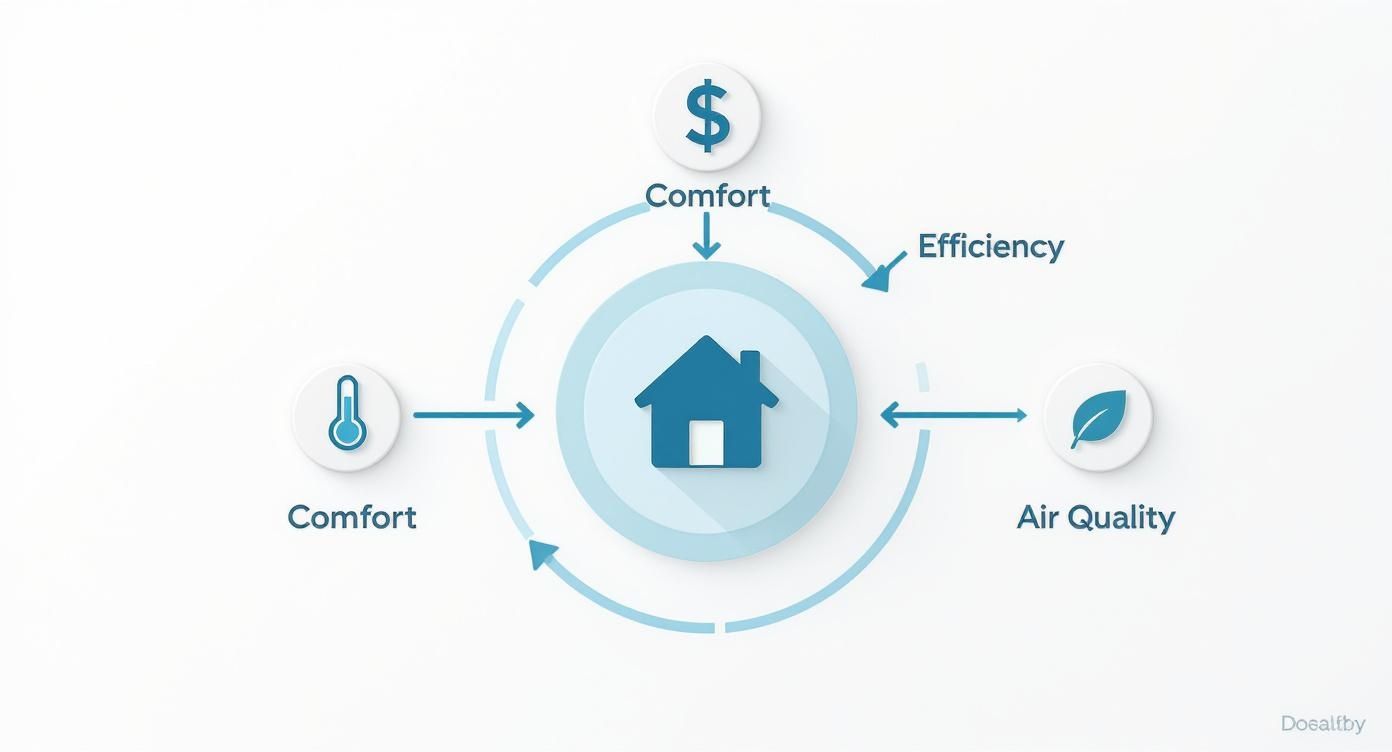
It’s clear these aren't separate issues. They are all directly supported by the strength and consistency of your furnace's airflow.
How The Pros Get The Real Numbers
A skilled technician from Covenant Aire Solutions isn't just going to guess if your airflow is right. We use specialized tools to get precise readings, turning abstract ideas into data we can actually use to solve stubborn comfort problems or track down the cause of high energy bills.
A couple of essential tools we always have on hand include:
Manometer: This is what we use to measure static pressure. By taking readings at different spots in your ductwork, we can pinpoint exactly where the bottlenecks and restrictions are hiding.
Anemometer: This tool measures the speed (velocity) of the air blowing out of your vents. When we combine that speed with the size of the vent opening, we can calculate the CFM for that specific room.
Taking these measurements allows a technician to build a complete, accurate picture of your system's performance. We can see if the total CFM matches what your furnace was designed to produce and, just as importantly, make sure that conditioned air is being delivered evenly throughout your home, not just blasting one room while another stays cold.
Modern furnaces have made this process even more precise. Newer systems with smart controls can monitor and adjust airflow in real time. In North America, the average residential furnace with these smart controls can hit an airflow accuracy within ±5% of the target. That’s a huge leap from the ±15% accuracy of older, traditional models.
Ultimately, these numbers are about ensuring the air is moving correctly to keep your home comfortable and your system healthy. Understanding the rate of air exchange is a big piece of that puzzle, which you can learn more about in our guide on how to calculate air changes per hour accurately. A professional diagnosis turns guesswork into a science, making sure your furnace delivers exactly what it promises.
Recognizing the Symptoms of Poor Airflow
Your home has its own way of telling you when something’s not right with your furnace's airflow. These signs usually pop up as small annoyances at first, but they’re really early warnings that your system is struggling to breathe. If you can learn to spot these symptoms, you’re one step closer to fixing the root problem before it snowballs into a major breakdown.

Often, the most obvious clue is a simple dip in comfort. You might find yourself fiddling with the thermostat constantly, yet some rooms in your house just never seem to get warm enough. This isn't just a quirk of an old house; it's a classic sign that heated air isn't reaching every room the way it should.
Hot and Cold Spots Across Your Home
One of the most common complaints we hear from homeowners dealing with poor airflow is uneven heating. The living room might feel toasty and comfortable, but the bedroom down the hall stays stubbornly cold, no matter how high you crank up the heat.
This happens when the airflow is weak or out of balance. The warm air leaving your furnace just doesn't have enough muscle to make it all the way to the furthest vents. The result? Some rooms get plenty of heat while others are left out in the cold, creating those frustrating temperature swings from one part of the house to another.
The Problem of Short Cycling
Have you ever noticed your furnace kicking on, running for just a couple of minutes, then shutting right back off, only to repeat the process again and again? That's called short cycling, and it's a serious red flag for restricted airflow.
Here’s a play-by-play of what's happening inside your system:
Airflow gets blocked, usually by a dirty, clogged filter.
The furnace can't push out the heat it's creating, causing its internal temperature to skyrocket.
A built-in safety sensor detects this dangerous heat level and shuts the whole system down to prevent overheating.
Once it cools down a bit, the cycle starts all over again.
Short cycling puts an incredible amount of stress on critical parts like the blower motor and the heat exchanger. It doesn't just send your energy bills through the roof; it can drastically shorten the lifespan of your furnace.
An Unexplained Spike in Energy Bills
If your heating bills have suddenly shot up without a big change in your habits or a major Tucson cold snap, your furnace's airflow is a prime suspect. A system with choked-off airflow has to work much, much harder and run longer to heat your home to the temperature you've set.
It's a straightforward equation: more work equals more energy burned. In fact, studies show that having an HVAC system professionally cleaned to improve airflow can cut fan and blower energy use by 41% to 60%. That really shows you just how much energy is wasted when your system is fighting against a blockage.
Other Telltale Warning Signs
Beyond comfort and cost, poor airflow can show up in a few other ways. Keeping an ear, and an eye, out for these clues can help you catch a problem early.
Strange Noises: Do you hear whistling or humming sounds coming from your vents or the furnace itself? This often means air is being squeezed through a space that's too small, kind of like when you whistle by forcing air through your lips.
Weak Air Pressure: Go hold your hand up to a supply vent. Does the air feel weak or like it’s barely moving? That's a direct, physical sign your system isn't moving enough air.
Increased Dust: If you feel like you're dusting more often than usual, it could be a sign that your system isn't circulating enough air through the filter to trap dust and other particles effectively.
Furnace Not Blowing Hot Air: Sometimes, the problem isn't that your furnace isn't making heat, but that it can't deliver it. If the system is running but the air feels lukewarm, that’s a strong indicator of an airflow issue. For more on this, check out our guide on what to do when your furnace is not blowing hot air.
Recognizing these symptoms is key. They are your home’s way of letting you know that the vital airflow of a furnace is compromised, and it’s time to find out why.
Uncovering the Common Causes of Airflow Problems
So, you've noticed the signs of poor furnace airflow. Now it's time to play detective and figure out what's really going on. Just like a persistent cough can signal anything from a common cold to something more serious, airflow issues can stem from a quick fix or a deeper, systemic problem in your HVAC system.
The good news? The most frequent offender is also the easiest one for any homeowner to resolve.
The Number One Culprit: A Dirty Air Filter
Imagine trying to breathe through a thick, dusty blanket. That’s exactly what you’re asking your furnace to do when its air filter gets clogged with dust, pet dander, and everything else floating around your home. A dirty filter is, by a huge margin, the most common cause of poor airflow.
The filter's job is to trap all those airborne particles, but eventually, it gets completely saturated. This blockage forces your furnace's blower motor to work much, much harder just to pull air into the system. This not only tanks the airflow of a furnace but also puts a ton of strain on its most important parts.
A severely clogged filter doesn't just make you uncomfortable or drive up your energy bills; it can actually cause the furnace to overheat and shut itself down as a safety measure. Simply checking and changing your filter regularly is the single most effective piece of preventive maintenance you can do.
Blocked or Closed Vents: The Misguided Efficiency Trick
Another common and thankfully easy-to-fix issue is simply having obstructed vents. This goes for both the supply vents blowing warm air out and the return vents that pull room air back into the furnace. It's amazing how often furniture, rugs, curtains, or even the dog's bed can end up blocking these openings, effectively cutting off circulation to entire rooms.
There’s also a persistent myth that closing vents in unused rooms saves energy. In reality, this usually does more harm than good. Your HVAC system was designed and balanced to handle a specific volume of air, and closing off vents throws that balance out of whack, creating pressure problems.
Increased Static Pressure: This makes the blower motor work harder, which actually increases energy use and causes extra wear and tear.
Potential Duct Leaks: The extra pressure can force air out through small, unsealed cracks and seams in your ductwork.
System Overheating: Without enough air moving across the heat exchanger, it can get dangerously hot and trigger a shutdown.
Mechanical Failures and Incorrect Settings
Sometimes, the problem isn't something you can see from the outside; it's deeper within the furnace itself. The blower motor is the heart of your furnace's air distribution system. If it starts to fail, airflow will obviously suffer. You might hear strange noises like screeching or buzzing, which are often tell-tale signs of a motor in distress.
Fan speed settings can also be the culprit. A furnace blower usually has several speed settings that are configured by a technician during installation to match your home's unique ductwork and size. If this speed is set too low, it will never move the right amount of air, leading to weak airflow no matter what else you do. A professional can quickly verify and adjust these settings to get things back on track.
Systemic Design Flaws: Ductwork Issues
Beyond simple blockages and failing parts, the very design of your ductwork can be the root cause of chronic airflow problems. These are almost always the most complex issues to diagnose and require a professional's touch.
A major issue we see is undersized ductwork. If the ducts are too small for your furnace's capacity, it’s like trying to drain a swimming pool through a garden hose. The system is physically incapable of achieving proper airflow because the pathways are too restrictive.
Another huge problem is leaky ductwork. Gaps, cracks, and disconnected sections mean all that precious heated air is escaping into your attic, crawlspace, or behind walls before it ever gets to you. The principles of good airflow are universal for a healthy home; for instance, you can learn more about the crucial role of ventilation in preventing household issues like mould.
Leaky ducts force your furnace to run constantly just to keep up, wasting a staggering amount of energy and money. Sealing these leaks is absolutely critical for restoring both efficiency and comfort. If you suspect your ducts are losing air, we have a helpful homeowner's guide on how to seal air ducts you can check out.
From a simple dirty filter to a complex ductwork design, finding the specific cause is the key to restoring the healthy, powerful airflow your home deserves.
How to Improve Your Furnace Airflow Yourself
Believe it or not, you don't always need to call a pro to make a big difference in your furnace's airflow. Many of the most common issues are things any homeowner can tackle in just a few minutes. Taking a little time for some proactive checks can seriously boost your home's comfort, improve your system's efficiency, and might just save you a service call.
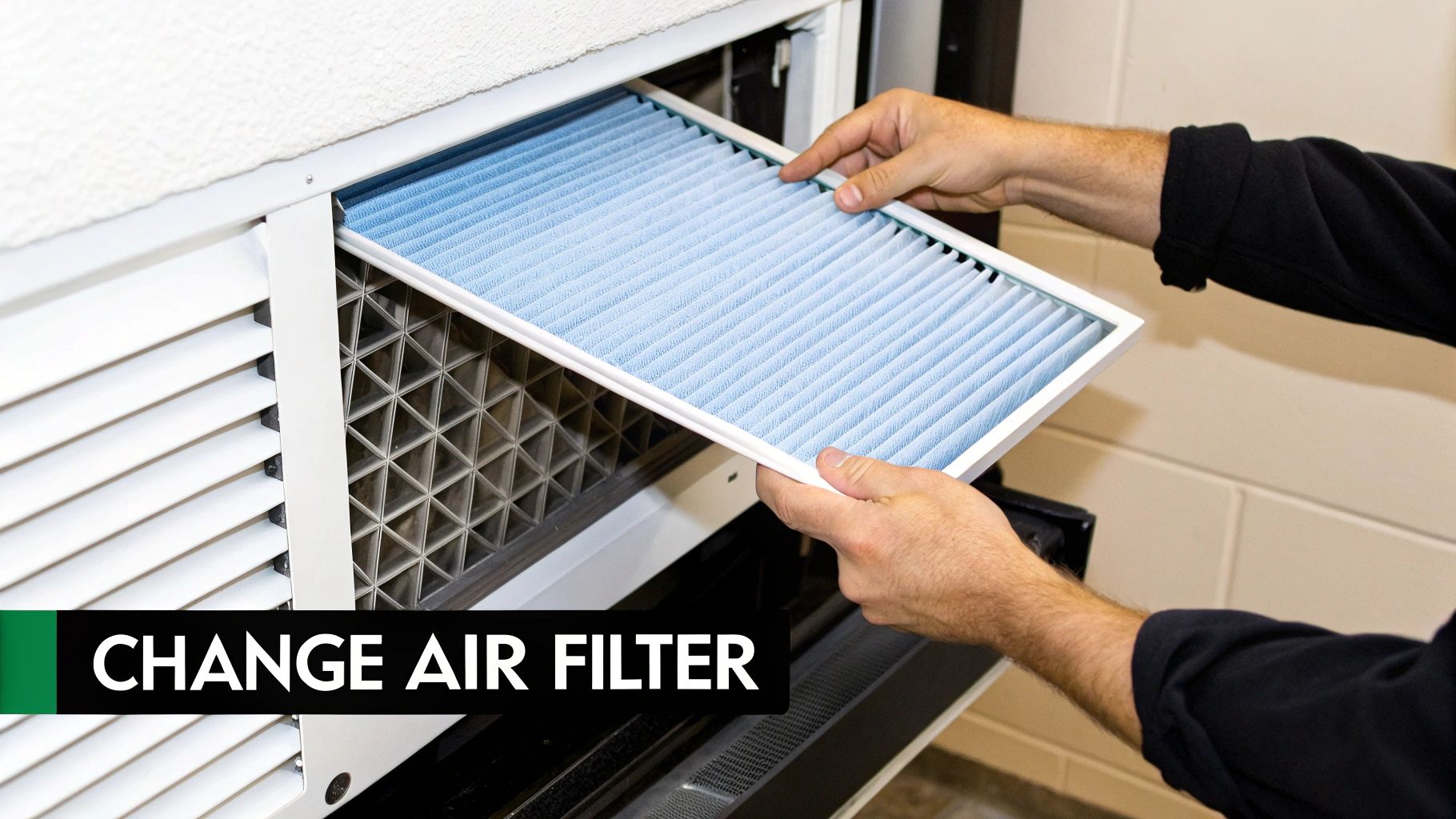
Let’s walk through the simple, hands-on tasks that have the biggest impact on keeping that warm air moving exactly where it needs to go.
Start with the Air Filter
If you do only one thing on this list, make it this one. The single most effective way to improve furnace airflow is to regularly check and change your air filter. Think of a clogged filter as a roadblock for air; it forces your system's blower motor to work much harder just to pull air through. This simple, inexpensive part is your first line of defense.
Here's how to tackle it:
Find your filter. It's usually in a slot right on the furnace or inside the main return air duct.
Give it a look. Slide the old one out and hold it up to a light. Can't see the light? It's time for a new one. No question.
Grab the right replacement. The size is printed right on the filter's cardboard frame. When you buy a new one, look at the MERV rating. For most homes, a MERV between 8 and 11 is the sweet spot. It provides great filtration without choking off the airflow.
A word of caution: higher isn't always better. A filter with a super-high MERV rating can be so dense that it's almost as bad as a dirty one. It can restrict airflow and put a real strain on your furnace. When in doubt, stick with what your furnace manufacturer recommends.
Conduct a Home-Wide Vent and Register Check
Okay, filter's done. Now, let's make sure the air has a clear path to get to you. This just involves a quick walk around your house to inspect every single supply and return air vent. You’d be surprised how often these get blocked, completely throwing off your system's balance.
As you walk through, check for these common culprits:
Are all the vents actually open? It sounds basic, but vents get closed and forgotten. Make sure the little levers (louvers) on your supply registers are fully open, especially in rooms you use often.
Is anything blocking them? Look for furniture, rugs, curtains, or a sneaky pile of toys pushed over a vent. Both supply and return vents need space to breathe.
Are the return grilles clean? Those larger return vents are magnets for dust and pet hair. Giving them a quick wipe-down or a pass with a vacuum can make a real difference.
Keeping all these pathways clear is the key to even heating and getting rid of those frustrating hot and cold spots.
Perform a Basic Visual Duct Inspection
Most of your ductwork is out of sight, but you can usually see sections of it in your basement, crawlspace, or attic. A quick visual scan can sometimes uncover obvious problems that are killing airflow to parts of your house.
Keep an eye out for ducts that have been crushed or kinked, or even worse, have come completely disconnected. A separated duct joint is a huge energy waster, pouring all that precious heated air into an empty space while leaving your rooms feeling chilly.
While serious damage needs a professional touch, spotting a simple disconnection early can save you a ton of trouble. It's also worth noting that keeping your home sealed is just as important; tasks like repairing ceiling holes can stop other air leaks that make your furnace work harder.
If you’re interested in a more thorough cleaning and inspection, our guide on how to clean air ducts dives deeper into what that involves. These simple steps put you in control, helping you solve common airflow problems and keep your system running strong.
When to Call a Professional for Airflow Diagnosis
While changing a filter or unblocking a vent are simple, effective DIY tasks, some furnace airflow problems are just too complex or risky for a weekend warrior. Knowing when to put down the tools and pick up the phone is the key to protecting your HVAC system, your home, and your wallet.
If you’ve already diligently swapped out the filter and made sure all your vents are open, but the furnace is still acting up, that’s your cue. Persistent issues like the furnace kicking on and off constantly (short cycling), uneven heating from room to room, or strange noises that just won't quit are red flags. These aren't just minor quirks; they're symptoms of a deeper problem that could be a failing component or a major flaw in your ductwork. Letting them go can turn a manageable repair into a catastrophic failure.
Signs That Demand an Expert Eye
Certain airflow issues are impossible to diagnose, let alone fix, without specialized tools and years of training. Trying to tackle these can easily make the problem worse or even create dangerous situations with electrical components or gas lines. If you suspect any of the following, it's time to bring in a pro.
Suspected Duct Leaks: Are your energy bills creeping up while certain rooms get dustier than others? You could be leaking a significant amount of heated air into your attic or walls. Technicians use tools like a duct blaster system to pressurize the ductwork and measure the exact amount of air loss, something you simply can't eyeball.
Malfunctioning Blower Motor: A grinding, screeching, or whining noise often points to a blower motor that’s failing or configured incorrectly. A professional needs to safely diagnose the motor, test its electrical connections, and verify its speed settings. This involves working directly with high-voltage components and is not a DIY job.
Static Pressure Testing: As we’ve covered, high static pressure is a silent killer for furnaces. A certified technician uses a manometer to take precise pressure readings throughout your system. This allows them to pinpoint exactly where the airflow chokepoints are, whether it’s a hidden blockage or a fundamental flaw in your duct design.
The Value of a Local Tucson HVAC Expert
When you call Covenant Aire Solutions, you’re getting more than just a technician; you’re getting crucial local expertise. We live and work here, so we know exactly how Tucson’s dry, dusty climate batters an HVAC system. We’ve seen how quickly filters clog with our fine desert dust and understand the unique strain our weather puts on equipment.
This on-the-ground knowledge means our diagnosis is never generic. It's tailored to the real-world challenges your furnace faces right here in Southern Arizona, ensuring we find the right solution, not just a temporary fix.
Calling a professional isn’t giving up; it’s making the smart move toward a permanent solution. It ensures your furnace runs safely, efficiently, and reliably for years to come, protecting your investment and keeping your family comfortable when it matters most.
Furnace Airflow FAQ's
We've gone over the signs, causes, and fixes for furnace airflow problems. To wrap things up, here are some quick answers to the questions we hear most often from our customers here in Tucson.
How Often Should I Change My Furnace Filter for Good Airflow?
For those standard one-inch filters, a good rule of thumb is to check them monthly and definitely replace them at least every 90 days. But let's be realistic: this is Tucson. With the dust, pets, or any smokers in the house, you'll probably need to swap it out every 30 to 45 days to keep things running right.
If you have one of those thicker, four- to five-inch pleated filters, you get a bit more breathing room. They can often last anywhere from six to twelve months. Keeping that filter clean is the single most important thing you can do yourself for healthy furnace airflow.
Is Closing Vents in Unused Rooms a Good Idea?
It feels like common sense, right? Close the vents, save some money. Unfortunately, it doesn't work that way. Your HVAC system is designed to be a closed, balanced loop. When you start closing off vents, you throw that balance off and dramatically increase the pressure inside your ductwork.
This puts a huge strain on your furnace’s blower motor. It can slash your efficiency, create new leaks in your ducts, and in serious cases, cause the whole furnace to overheat. For a happy, healthy system, it’s always best to leave all your vents open.
Can Poor Airflow Actually Damage My Furnace?
Yes, absolutely. When airflow is constantly restricted, say, from a filter that hasn't been changed in months, it forces the blower motor to work much harder than it's designed to. This can lead to it burning out way ahead of its time.
Even more critical is what happens to the heat exchanger. It can overheat, and when it gets too hot, it can crack. A cracked heat exchanger is a major safety hazard, creating a serious risk of carbon monoxide leaking into your home. Proper furnace airflow isn't just about efficiency; it's about keeping your family safe.
If you've tried the DIY fixes and you're still dealing with weak or uneven airflow, it's time to bring in a professional. For a real diagnosis and solutions built for our unique Tucson climate, trust Covenant Aire Solutions to get your home's comfort and safety back on track. Visit us online or give us a call today to schedule a complete system evaluation at https://www.covenantairesolutions.com.