
What Is the Best Temperature for AC for Comfort & Savings
Updated: Oct 6, 2025
If you ask a dozen people what the perfect temperature is for their AC, you'll probably get a dozen different answers. But if you're looking for a solid, expert-backed starting point, the magic number is 78°F (26°C) for when you're home.
This recommendation comes straight from the U.S. Department of Energy, and for good reason. It strikes that ideal balance between keeping you comfortable and preventing your energy bills from skyrocketing. At 78°F, your AC isn't constantly straining to hit a super-low temperature, but it's still doing its job to keep your home cool and pleasant.
Finding the Best AC Temperature for Comfort and Savings
Of course, that 78°F is just a guideline. The real secret to optimizing your cooling is to think less about a single number and more about your daily routine. Why keep your house at a perfect 78°F when nobody's there to enjoy it? That's just throwing money away.
Most experts agree that a comfortable and efficient range for your home is somewhere between 75°F to 81°F (24°C to 27°C). The official 78°F recommendation fits right in that sweet spot, prioritizing energy conservation while still delivering plenty of comfort.
The smartest approach is to have different settings for different scenarios: when you’re home, when you’re away, and when you’re sleeping. This tiered strategy means your AC is only working hard when you actually need it to, which is the cornerstone of saving money on your cooling costs. For a deeper dive into this, check out our guide on what temperature to set your thermostat for big savings.
Recommended AC Temperatures for Different Scenarios
To make things simple, here’s a quick-reference table. Think of these as your go-to settings to get the best of both worlds: a comfortable home and a healthier energy bill.
Scenario | Recommended Temperature (Fahrenheit) | Recommended Temperature (Celsius) |
|---|---|---|
When You Are Home | 78°F | 26°C |
When You Are Away | 85°F | 29°C |
When You Are Sleeping | 82°F | 28°C |
Using these settings, especially with a programmable or smart thermostat, takes the guesswork out of efficiency. You get to come home to a cool house without paying to chill it all day long.
Why the “Perfect” AC Temperature Is a Myth
Have you ever walked into a room and felt perfectly comfortable, only to have someone else complain it’s freezing? Or set the thermostat to what should be a pleasant temperature, but still feel sticky and warm? If so, you've experienced a fundamental truth of home cooling: a single "perfect" temperature setting is a total myth.
Finding the sweet spot for your home isn't about landing on one magic number. It's more like being a chef trying to perfect a recipe. Your thermostat setting is just one ingredient. To get it right, you also have to account for other crucial factors like humidity, the local climate, and even how many people are in the room. Each of these variables can completely change how a specific temperature actually feels.
Key Factors That Change How Your AC Feels
Several moving parts work together to create that feeling of comfort. High humidity, for instance, is a big one. It can make the air feel much warmer than the thermostat says, almost like a damp, heavy blanket is draped over everything. Your body cools itself by sweating, but when the air is already saturated with moisture, that sweat can't evaporate properly, leaving you feeling hot and clammy.
Other important things to keep in mind include:
Your Local Climate: A dry 78°F here in Tucson feels worlds away from a humid 78°F in a city like Houston. The lack of moisture in our Arizona air makes a huge difference.
How Many People Are Home: A crowded living room for a get-together generates a surprising amount of body heat. That often means you'll need a cooler setting than you would for a quiet evening alone.
What You're Doing: The ideal temperature for kicking back on the couch to watch a movie is going to be very different from the right setting for a busy afternoon of cleaning the house.
It's not just in your head; the need for smarter, more personalized cooling is growing everywhere. As global temperatures rise, the demand for air conditioning is surging. In fact, since 1970, the average cooling demand has shot up, with the U.S. seeing an increase in annual Cooling Degree Days in 97% of the locations measured. You can dig into the data in the full Climate Central report on cooling demand.
This infographic is a great visual for how different rooms and energy goals call for different cooling strategies.
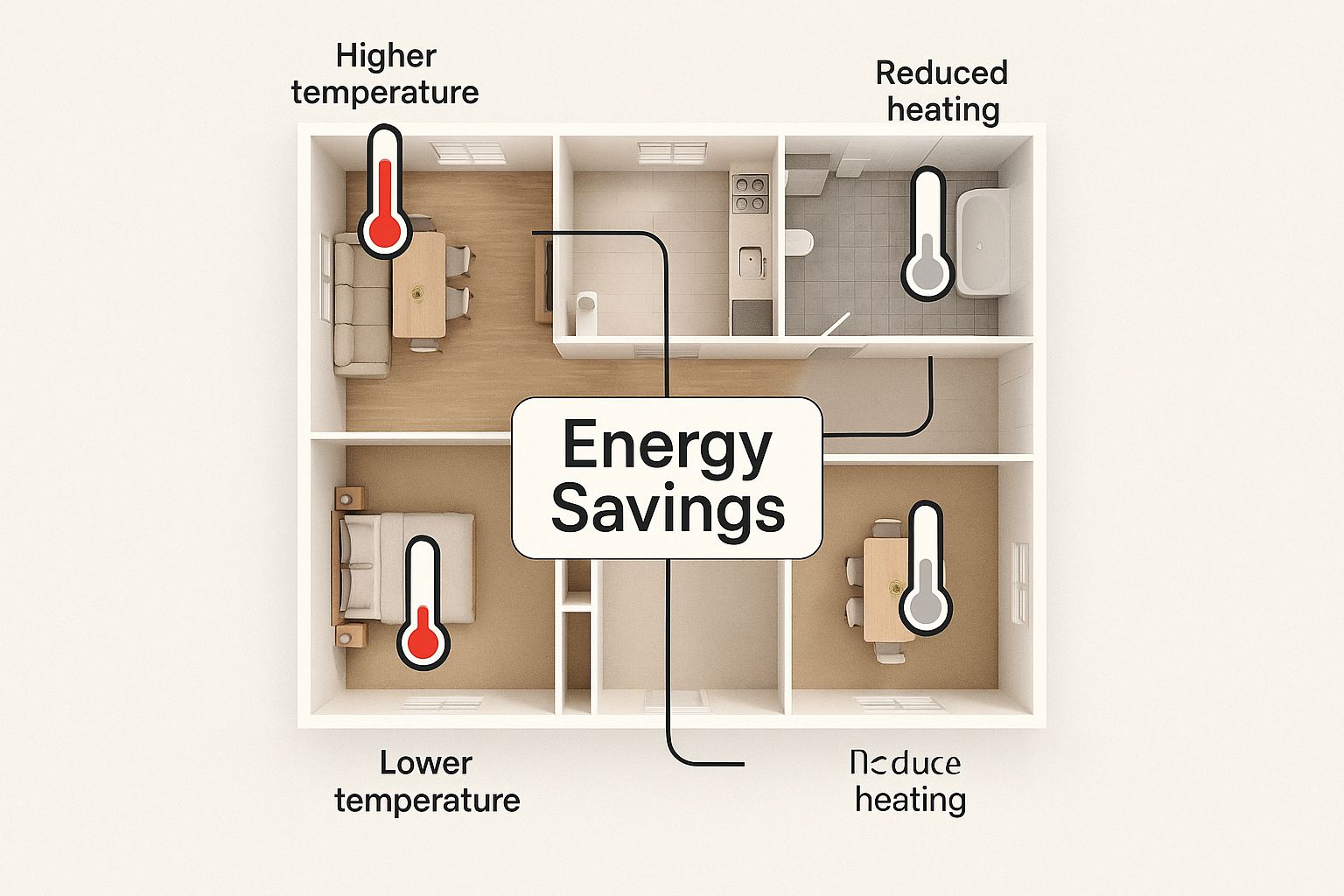
As the graphic shows, real energy savings come from adapting your AC settings to how you use each space, not by forcing one temperature on the entire house. Getting a handle on these variables is the first step toward tailoring your AC for your family's actual needs. Of course, the size of your space is just as important, and you can learn how to calculate BTU per sq ft for air conditioning over in our detailed guide.
Finding Your Sweet Spot Between Comfort and Cost
Every single degree you lower your thermostat during a blazing Tucson summer takes a direct bite out of your wallet. Think of it this way: the cooler you want your home, the harder your AC has to work, and the more electricity it gulps down. This is why finding your personal "comfort sweet spot" is an absolute game-changer for your budget.
This isn't about sweating it out to save a few bucks. It’s about discovering that perfect temperature where you feel cool and relaxed without sending your energy bill through the roof. You'd be surprised how a small tweak can lead to big savings over the season.
The Financial Impact of a Single Degree
It might not feel like a big deal, but nudging your thermostat up by just one degree can cut your energy use by up to 3%. When you start doing the math, the real cost of keeping a home ice-cold becomes crystal clear.
Let's walk through a real-world example. Say you're someone who loves to keep the thermostat cranked down to a chilly 72°F.
Your Current Setting: 72°F
A More Wallet-Friendly Setting: 78°F
The Difference: 6 degrees
By raising that setpoint to the recommended 78°F, you could slash your cooling costs by a massive 10-18%. For an average family, that simple adjustment can easily add up to hundreds of dollars in savings every single year. When you combine this with other ways to reduce your air conditioning costs, the impact gets even bigger.
This all comes down to the battle your AC fights against the outside heat. The bigger the temperature gap between inside and outside, the harder your system has to run. Even the most powerful commercial AC units only hit about 14% of their theoretical maximum efficiency, which is why tiny adjustments on your thermostat can cause such huge swings in energy use. You can read more about AC efficiency research on Nature.com.
At the end of the day, that small change from 72°F to 78°F proves you don't have to make huge sacrifices to see huge savings. It’s all about finding that smart, sustainable balance.
Go Beyond the Thermostat with Smarter Cooling Strategies
Nailing that perfect thermostat setting is a huge first step, but if you want to unlock true cooling efficiency, you need to think bigger. It's about combining smart technology with some simple, practical habits you can start today. Modern thermostats have evolved way beyond those old, simple dials; they're now powerful tools that can automate your cooling and seriously cut down on waste.
Think of a programmable or smart thermostat as the brain of your AC operation. These devices let you create a cooling schedule that actually fits your life. For instance, you can tell it to ease up on the cooling while you're at work and then have it kick back on just before you walk in the door.
Many of the newer models even use geofencing, tracking your phone's location to automatically adjust the temperature. That means you’ll never waste a dime cooling an empty house again. To really dive into what these gadgets can do, check out the unmissable benefits of smart thermostats in our detailed guide.
Pair High-Tech with Low-Tech
While a smart thermostat is a game-changer, you can make it even more effective by adding a few low-tech strategies to your playbook. These simple adjustments work in tandem with your thermostat to reduce your AC's workload, which means even better energy savings and a more comfortable home.
Give your cooling efforts a boost with these easy tactics:
Embrace Ceiling Fans: A good ceiling fan creates a wind-chill effect that can make a room feel up to 4°F cooler. This little trick allows you to bump up the thermostat a few degrees without feeling any warmer. Just remember a key rule: fans cool people, not rooms, so switch them off when you head out.
Block That Brutal Tucson Sun: During the peak heat of the day, direct sunlight pouring through your windows can turn your home into an oven. Using thermal curtains or blinds on sun-facing windows acts as a powerful barrier, stopping a huge amount of that solar heat from ever getting inside.
Stick to a Maintenance Routine: A clean AC is an efficient AC. It's that simple. Swapping out your air filter every 1-3 months and scheduling regular professional tune-ups ensures your system is running in top form, using far less energy to keep you cool.
When you combine the brains of a smart thermostat with these practical, everyday habits, you create a powerful, multi-layered approach to home cooling. It’s not about finding one magic bullet; it's about making several smart choices that work together to maximize your comfort and minimize your costs.
Optimizing Your AC for Tucson's Desert Climate
Living in Tucson means you’re dealing with a unique brand of heat. The intense, dry air of the Sonoran Desert creates cooling challenges that are worlds apart from what people experience in humid regions. Understanding our climate is the absolute key to figuring out the best temperature for your AC, because a 78°F setting here feels far more comfortable than it ever would in a damp, muggy environment.
The secret weapon is our low humidity. Since there’s less moisture in the air, your body's natural cooling system, sweat, evaporates almost instantly. This process is incredibly efficient, which means a slightly higher thermostat setting can feel surprisingly pleasant. It's the perfect way to save a good chunk of change on your energy bill without sacrificing comfort.
Taking Advantage of Tucson's Climate
To truly master desert cooling, you have to learn to work with the environment, not against it. The massive temperature drops we see from day to night are a golden opportunity for smarter, more efficient AC use.
Here are a few strategies that are tailor-made for Tucson residents:
Pre-Cool Your Home: First thing in the morning, before the sun really starts beating down, run your AC to bring your home’s temperature down. A well-insulated house will hold onto this coolness for hours, dramatically reducing the strain on your system during the blistering afternoon heat.
Embrace Cooler Evenings: Once the sun sets and that blessed cool air rolls in, turn off your AC and open up the windows. This simple move flushes out all the heat that built up during the day and lets you cool your home for free.
Maintain Your System: Regular upkeep is simply non-negotiable in our climate. The combination of dust and extreme heat can be brutal on an AC unit. You can learn more about the top benefits of HVAC maintenance for Tucson homes to keep your system in fighting shape.
Your home’s exterior plays a massive role in managing what happens inside. By strategically planting native, drought-resistant trees and shrubs, you can create natural shade that significantly cuts down on the solar heat your home absorbs.
When you're thinking about optimizing your AC, don't forget that your own yard can be a powerful ally. Exploring some effective desert landscaping design ideas for your Tucson home is a great way to minimize heat gain and give your cooling efforts a major boost.
Putting It All Together for a Cooler, More Efficient Home
Ultimately, finding the "best" temperature for your air conditioner isn't about hitting a magic number. It's a personal journey to discover that sweet spot where your family is comfortable, your energy bills aren't terrifying, and your home is an efficient escape from the Tucson heat.
The key is to experiment. Think of yourself as the captain of your home's climate. By making small, intentional tweaks based on your daily schedule and our local weather, you can truly optimize your living space.
Your Actionable Checklist for a Cooler Home
To bring it all home, here are the most important steps for finding your ideal settings and boosting your AC's efficiency:
Start at 78°F: Use this as your baseline. It’s the Department of Energy's recommendation for a reason. From there, adjust up or down until it feels just right for you.
Cool for You, Not an Empty House: Set the temperature higher when you’re out. There’s no sense in paying to cool a space no one is in.
Let Technology Do the Work: A programmable or smart thermostat is your best friend here. It automates your cooling schedule, so you get effortless savings without even thinking about it.
Give Your AC Some Help: Use your ceiling fans to create a wind-chill effect that makes the room feel cooler. And be sure to close your blinds and curtains during the hottest parts of the day to block out the sun.
Remember, your AC is just one player on the team. For a truly holistic approach to keeping your home cool and efficient, understanding how to improve home insulation is crucial. Think of it as your home's first and best line of defense against the relentless heat.
Answering Your Top AC Temperature Questions
Even after you've got a good handle on the basics, a few specific situations always come up. What's the best move when you head out for the day? Or when you go to bed? What about ceiling fans, do they really help?
Getting these practical questions sorted is the last piece of the puzzle. Let's tackle the common queries we hear from homeowners right here in Tucson.
Is It Cheaper to Leave the AC on All Day or Turn It Off?
This one surprises a lot of people. It’s almost always more efficient to just turn the thermostat up, say, to 82-85°F, when you're gone, rather than shutting it off completely. Think of it this way: your AC has to work much, much harder to bring a sweltering house back down to a comfortable temperature from scratch.
When you turn the system off, heat and humidity don't just creep in; they build up. This forces your AC into overdrive the moment you switch it back on, a brutal process that completely wipes out any savings you thought you were banking.
What Is the Best Temperature for Sleeping at Night?
For the best possible sleep, most experts point to a cooler room, somewhere in the 65-72°F range. But let's be realistic: keeping your AC cranked that low all night during a Tucson summer will send your energy bill through the roof.
The smart play is to find a happy medium. Try setting the thermostat just a few degrees cooler than your usual daytime setting. Even better, use a programmable thermostat to automatically drop the temperature an hour before bedtime and then nudge it back up right before you wake up.
Ceiling fans are your secret weapon for nighttime comfort. By creating a wind chill effect, a fan can make a room feel up to 4°F cooler than it actually is. That means you can raise your thermostat by four degrees and feel just as comfortable.
Just remember the golden rule of fans: they cool people, not rooms. Always turn them off when you leave to avoid wasting electricity. This simple one-two punch of a slightly higher thermostat setting plus a fan is a fantastic way to save energy while you sleep soundly.
Finding that perfect sweet spot between comfort and efficiency is what we do best. If you’re ready to get your home’s cooling system perfectly tuned for the Tucson climate, trust the experts at Covenant Aire Solutions. Schedule your service today and feel the difference professional care can make.