
A Homeowner's Guide to Air Vents in House Systems
The air vents in your house are the unsung heroes of home comfort. They're the critical gateways for your entire heating, ventilation, and air conditioning (HVAC) network. While they might just look like simple grilles on your walls, floors, or ceilings, they’re essential for circulating air and have a direct impact on your comfort, energy bills, and even your health.
The Overlooked Importance of Home Ventilation
Think of your home's air vents as its respiratory system. This network is constantly at work, "breathing" conditioned air into your living spaces and "inhaling" stale air to be filtered and renewed. Without a properly functioning system of vents and ducts, your home would struggle to maintain a comfortable temperature, manage humidity, and keep the air you breathe clean.
A well-designed ventilation system is vital for good indoor air quality. It's a surprising fact, but people spend about 90% of their time indoors, where the air can be up to five times more polluted than outside. Properly maintained vents are your first line of defense, channeling air through filters that capture dust, allergens, and other contaminants. This crucial role is why the global ventilation industry hit a staggering $26.4 billion in 2023.
Connecting Vents to Your HVAC System
Air vents don't work alone; they're the visible endpoints of a complex web of ductwork hidden behind your walls. This system connects directly to your central HVAC unit. When your air conditioner or furnace kicks on, it pushes temperature-controlled air through the ducts, which then exits into your rooms through specific vents.
Your vents and ducts work together like arteries and veins. The ducts are the hidden pathways, while the vents are the points of exchange that allow your home to "breathe" efficiently.
This integrated relationship is why a problem in one area can ripple through the entire system. A blocked vent or a leaky duct forces your HVAC unit to work much harder, leading to inefficient performance and higher energy bills. Understanding how these components are all connected is the first step toward better home comfort. You can explore our homeowner's guide to the parts of ductwork to see how everything fits together.
The Three Core Types of Vents
To really get a handle on your home's airflow, you need to know about the three main types of vents. Each one has a distinct job to do.
To help you quickly identify the different vents in your home, here’s a simple breakdown of their functions and where you’ll typically find them.
Quick Guide to Home Air Vent Types
Vent Type | Primary Function | Common Location |
|---|---|---|
Supply Vent | Delivers conditioned (heated or cooled) air into a room. | Walls, floors, or ceilings. |
Return Vent | Pulls stale air from a room back to the HVAC system. | Walls or ceilings; usually larger than supply vents. |
Exhaust Vent | Expels moisture, odors, and pollutants directly outside. | Bathrooms, kitchens, and laundry rooms. |
Knowing the difference between these vents is more than just trivia: it empowers you to spot issues, ensure your home has balanced airflow, and maintain a healthier living environment.
Here’s a closer look at what each one does:
Supply Vents: These are the "exhalers." They deliver freshly conditioned air, whether it's heated or cooled, from your HVAC system directly into each room.
Return Vents: Think of these as the "inhalers." They pull used, stale air out of your rooms and send it back to the HVAC system to be filtered and reconditioned.
Exhaust Vents: These are specialized vents designed to remove specific things. They expel moisture, odors, and pollutants from targeted areas like bathrooms and kitchens, venting them directly outside.
The Three Main Types of Air Vents Explained
It’s easy to look at the different air vents in house systems and feel a bit lost, but it all makes sense when you think of your home’s HVAC system like it's breathing. It has to exhale fresh air, inhale used air, and get rid of the stuff you don’t want. Each vent has a very specific, critical job in that cycle.
Your HVAC system relies on three distinct types of vents working together to keep your home comfortable and your air clean: supply, return, and exhaust. One of the most common homeowner mistakes is mixing them up, which can lead to accidentally blocking a crucial part of your home's airflow.
The diagram below gives you a great visual of how these three vents work together in a typical home.
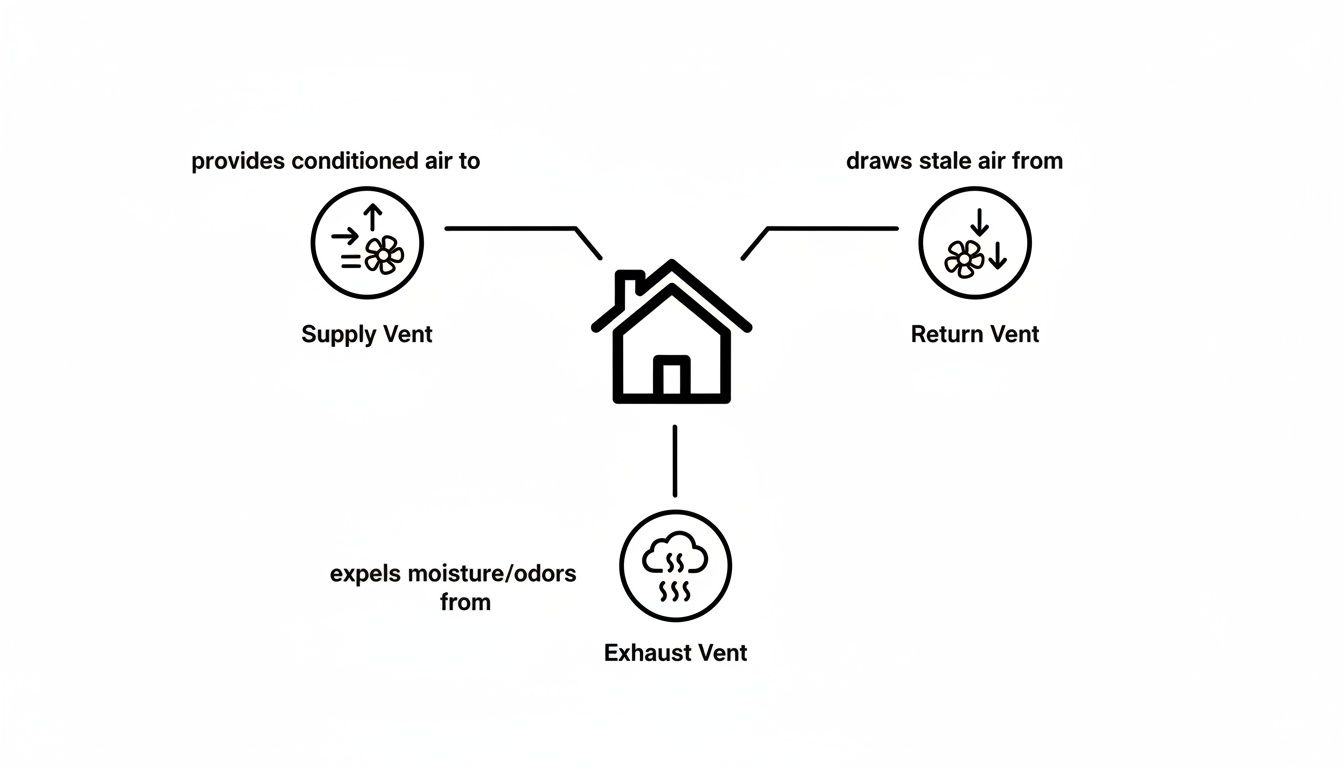
As you can see, it's a continuous loop, with each vent type handling a different part of the process, from delivering conditioned air to pulling out moisture and stale odors.
Supply Vents: The Mouth of Your HVAC System
Think of supply vents as the delivery drivers for your HVAC system. Their one and only job is to push temperature-controlled air, whether it's heated or cooled, from your furnace or air conditioner directly into your rooms. They are the "mouth" of the system, actively delivering fresh air everywhere.
You can usually spot a supply vent by its design. Most have louvers, which are those little adjustable slats that let you aim the airflow. These are the vents you feel a gentle breeze coming from when your system kicks on.
You’ll typically find supply vents in a few key places:
Floors: Very common in homes with ductwork running through a basement or crawlspace.
High on walls: Great for delivering cool air, since cold air naturally sinks.
Ceilings: A popular choice in modern homes for really even air distribution.
Because they actively push air out, it is absolutely vital that supply vents are never blocked by furniture, rugs, or drapes. Blocking even a single supply vent can throw off the air pressure balance in your entire home, forcing your system to work harder and less efficiently.
Return Vents: The Lungs of the System
While supply vents push air out, return vents do the complete opposite: they pull air in. They are the lungs of your HVAC system, sucking stale air out of your living spaces and sending it back to the main unit through the ductwork. Once there, the air gets filtered, re-conditioned (heated or cooled), and sent back out through the supply vents.
Unlike their supply counterparts, return vents don't have adjustable louvers. They just have a simple, fixed grille pattern and are usually much larger. You won't feel air blowing out of them; instead, you might feel a slight suction if you put your hand near one while the system is running.
A huge misconception is that return vents aren't as important as supply vents. The reality is, your HVAC system is a closed loop; it needs to pull in the same amount of air that it pushes out. A blocked return vent literally starves your system for air, which tanks its performance and puts a massive strain on the components.
This continuous cycle is what allows your system to maintain a steady temperature and scrub pollutants out of your air. An undersized or blocked return is a recipe for an inefficient system and higher energy bills.
Exhaust Vents: The Specialized Problem-Solvers
Finally, we have exhaust vents, which play a totally different and highly specialized role. They aren't connected to the main circulation loop of your HVAC system at all. Their job is to capture and expel moisture, odors, and pollutants directly outside your home.
Think of these vents as dedicated problem-solvers for specific areas. They are essential in rooms where humidity and airborne particles are a real issue, helping to prevent things like mold growth and lingering smells.
You'll find them in very specific spots:
Bathrooms: To suck out all that steam from a hot shower.
Kitchens: Usually as part of a range hood to vent smoke and cooking smells.
Laundry Rooms: To get rid of the hot, moist air coming from the dryer.
These vents use a fan to actively push the bad air out of the house for good. They’re a crucial part of any whole-house ventilation strategy, making sure problem air is removed right at the source before it gets a chance to spread.
How Air Vents Affect Your Energy Bills and Air Quality
The air vents in house systems do way more than just move air around; they're the gatekeepers of your home's energy efficiency and the very quality of the air you breathe. It's easy to ignore them, but doing so can lead to surprisingly high utility bills and a less healthy living space.
When a vent is blocked or caked with dust, it forces your HVAC system to work much, much harder. Think of it like trying to breathe through a clogged straw. Your system has to strain just to do its basic job.
That extra effort shows up directly on your energy bill. The system runs longer and pulls more power to force air past the blockage, causing a noticeable spike in costs. This is a huge deal here in Tucson, where an air conditioner fighting against clogged vents during a 110°F heatwave can become a serious financial drain.
A struggling HVAC system doesn't just cost more to run; it also wears out faster. The constant strain on parts like the blower motor can lead to breakdowns way ahead of schedule, turning a simple cleaning issue into an expensive, unexpected repair.
The Link Between Clean Vents and Healthy Air
Your home’s ventilation network is also your first line of defense for good indoor air quality. As air gets pulled into the return vents, it travels through a filter that’s designed to trap dust, pollen, pet dander, and all the other gunk floating around. When your vents are working correctly, this whole process runs like a well-oiled machine.
But when those vents and the ductwork behind them get clogged with debris, they turn into a breeding ground for allergens and pollutants. Instead of delivering fresh, clean air, your system starts circulating dust and other irritants all over your home. This can make allergies and respiratory issues a lot worse, creating a frustrating cycle where the system meant to clean your air is actually making it dirtier.
Sometimes, your home's built-in system needs a little help, which is where equipment like air scrubbers for cleaner indoor air can make a big difference.
When your vents are clean and clear, your air filter can do its job effectively. Think of it this way: your vents ensure the "bad air" gets to the filter, and the filter stops it from coming back.
This direct connection shows just how critical regular vent maintenance is for a healthier home. If you're looking to dive deeper into creating a better indoor environment, our guide to HVAC indoor air quality is packed with more detailed strategies.
Vent Problems and Their Hidden Costs
It's easy to overlook a dusty or blocked vent, but the consequences are real and measurable, hitting both your wallet and your well-being. The table below breaks down how seemingly small vent issues can lead to bigger problems.
Common Vent Issue | Impact on Energy Bill | Impact on Indoor Air Quality |
|---|---|---|
Blocked Supply Vents | Significant increase; HVAC runs longer to reach thermostat temperature. | Stagnant air in blocked rooms; uneven temperature distribution. |
Dirty Return Vents | Moderate increase; restricts airflow, making the system work harder. | More dust and allergens circulate; filter clogs faster. |
Leaky Ductwork | High increase; conditioned air is lost in walls, attics, or crawlspaces. | Pulls in dust, insulation fibers, and pollutants from unconditioned spaces. |
Neglecting these issues creates a domino effect. What starts as a simple blockage can strain your system, pollute your air, and ultimately cost you more than just a higher utility payment.
Did you know the home ventilation market, driven by efficient vents and ductwork, is projected to grow from $29.23 billion in 2026 to $41.12 billion by 2031? Even more locally, the U.S. ventilation market hit over $5.8 billion in 2023. For Arizona families battling our notorious desert dust, clogged vents can slash system efficiency by up to 40%, causing cooling costs to soar. A good preventive maintenance plan, however, can often recover 15-25% of those energy losses. You can find more insights on the growing home ventilation market on Mordor Intelligence.
How to Troubleshoot Common Air Vent Problems
Sooner or later, even the best HVAC systems hit a snag. Often, the first place you’ll notice something is off is right at the air vents. Before you dial up a pro, there are a handful of simple checks you can run through yourself. Catching these common problems early can save you a world of discomfort and keep repair costs from spiraling.
Most issues you'll encounter with your vents boil down to a few usual suspects: weak or nonexistent airflow, weird noises, or funky smells. By playing detective and methodically checking for the source, you can often land on a surprisingly simple fix.
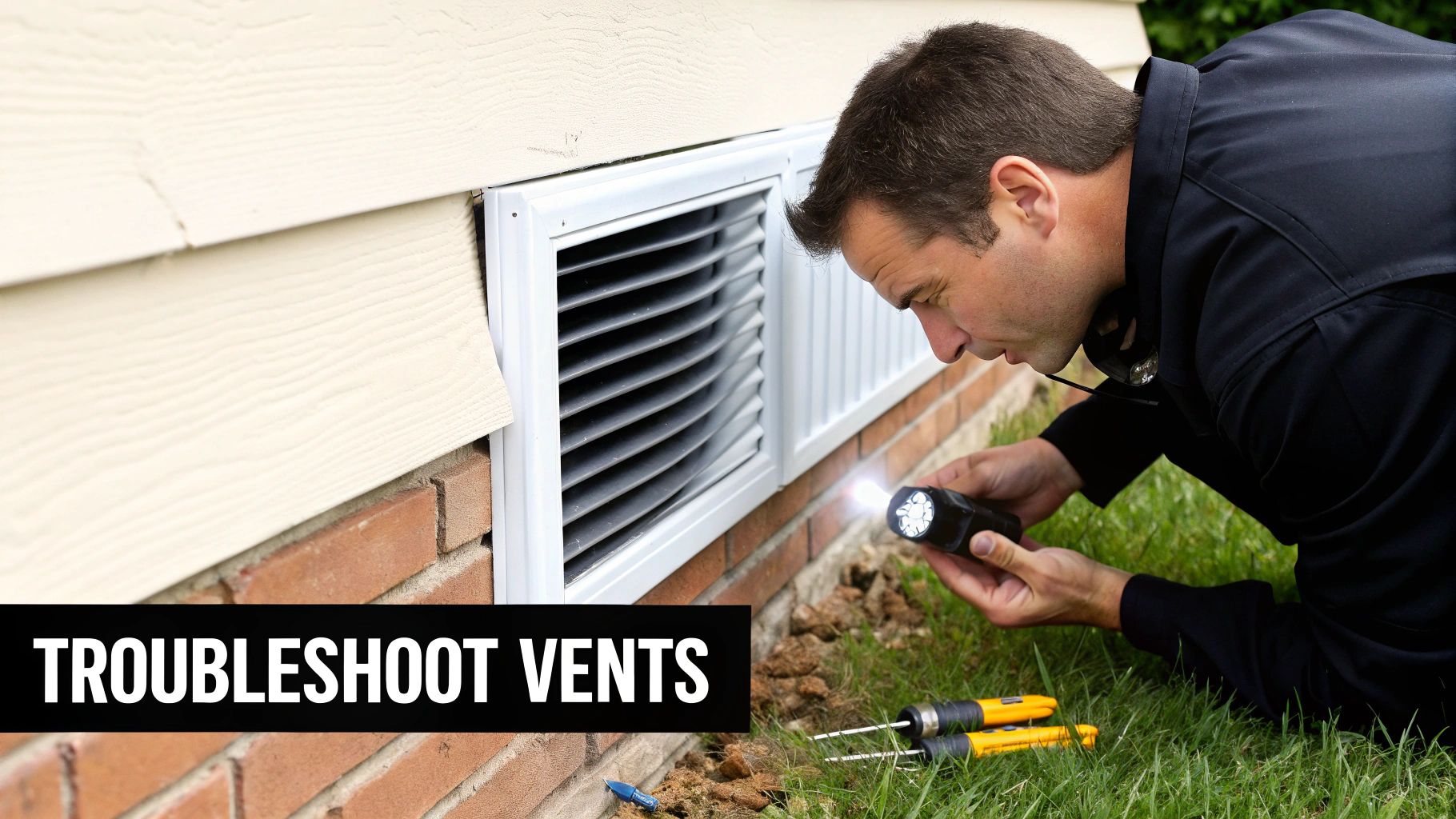
This guide will walk you through how to pinpoint and solve these frequent complaints safely and effectively.
Investigating Weak or No Airflow
Is one room always stuffy while the rest of the house feels great? A weak supply vent is the number one culprit. When a room isn’t getting as cool or warm as it should, it's time to investigate.
Start with the easiest thing first: the vent cover. Most supply vents have a small lever to open and close the louvers (the angled slats). It’s incredibly common for these to get bumped closed by furniture, a vacuum cleaner, or a stray foot. Make sure it's wide open.
If the vent itself is open, your next step is to hunt for blockages.
External Blockages: Look around. Is a new couch, a thick rug, or even the dog's bed sitting right on top of the vent? Anything covering the opening is going to kill your airflow.
Internal Blockages: Grab a flashlight and peek inside the vent. You’d be surprised what can fall in there, from kids' toys to construction debris, creating a dam that blocks the air.
Closed Dampers: Your ductwork itself has controls. In your attic, basement, or crawlspace, you might find manual dampers: levers located directly on the ducts. These are used to balance airflow to different parts of the house. Make sure the damper for the problematic area hasn't been accidentally closed.
Diagnosing Strange Noises from Vents
Your HVAC system should be more of a gentle background hum than a symphony of strange sounds. If you're hearing whistling, rattling, or banging from your vents, that’s your system telling you something isn't right. These noises aren't just annoying; they can be early warnings of bigger problems.
A high-pitched whistle almost always means there's an airflow restriction somewhere. Think of the sound you make when you force air through pursed lips, it's the same principle. The cause could be a filthy air filter making the system gasp for air, or a vent or damper that's only partially open.
A rattling or vibrating sound is often just a loose part. Check the screws on the vent cover. If they're not snug, the force of the air pushing through can make the cover vibrate against the wall, floor, or ceiling. It's a simple fix with a big impact on your sanity.
Deeper banging or popping sounds coming from inside the ductwork can just be the metal expanding and contracting with temperature changes. But if the sounds are loud and constant, it might point to duct pressure or design issues that really need a professional's diagnosis.
Tracing and Eliminating Foul Odors
Nothing makes a home feel less inviting than a bad smell wafting from the vents. The good news is that the type of odor is a great clue to what’s causing it.
A musty, moldy smell is a major red flag for moisture. It could be from condensation building up in your ducts or a leak in the system. If you smell this, you need to act fast. Mold can pose serious health risks. Getting familiar with how to stop mold around air vents with proven solutions is a great next step for this specific issue.
Here are a few other common vent odors and what they likely mean:
Dusty or Burning Smell: This is very common the first time you fire up the heat for the season. It’s just dust burning off the heat exchanger. If the smell sticks around, though, it could mean you have a severely clogged filter or a problem with the motor.
Rotten Egg or Sulfur Smell: Stop what you're doing. This is the classic warning sign of a natural gas leak. Leave your house immediately, and once you're a safe distance away, call your gas company. Do not turn any lights or appliances on or off.
Stale or Stagnant Odor: This usually means your ducts are just plain dirty, filled with years of accumulated dust, pet dander, and other debris. A professional duct cleaning is likely in order to clear the air.
While you can solve many vent issues with these simple checks, it’s just as important to know your limits. If you’ve cleared all the blockages and still have weak airflow, or if you’re hearing loud, mechanical grinding or banging, it’s time to call an HVAC pro. They have the specialized tools to diagnose complex problems like duct leaks or a failing blower motor that are well beyond a DIY fix.
Your Guide to Cleaning and Maintaining Vents
Keeping your air vents in house systems clean is one of the easiest wins for boosting your HVAC's performance and protecting your indoor air quality. Think of it as essential housekeeping for your home's respiratory system. Simple, consistent cleaning stops small issues like dust bunnies from snowballing into bigger headaches like lousy efficiency and polluted air.
The good news? Basic vent maintenance isn't a huge chore and doesn't require a workshop full of specialized tools. A few straightforward steps, done regularly, make a world of difference in how well your system runs and how fresh your home feels.
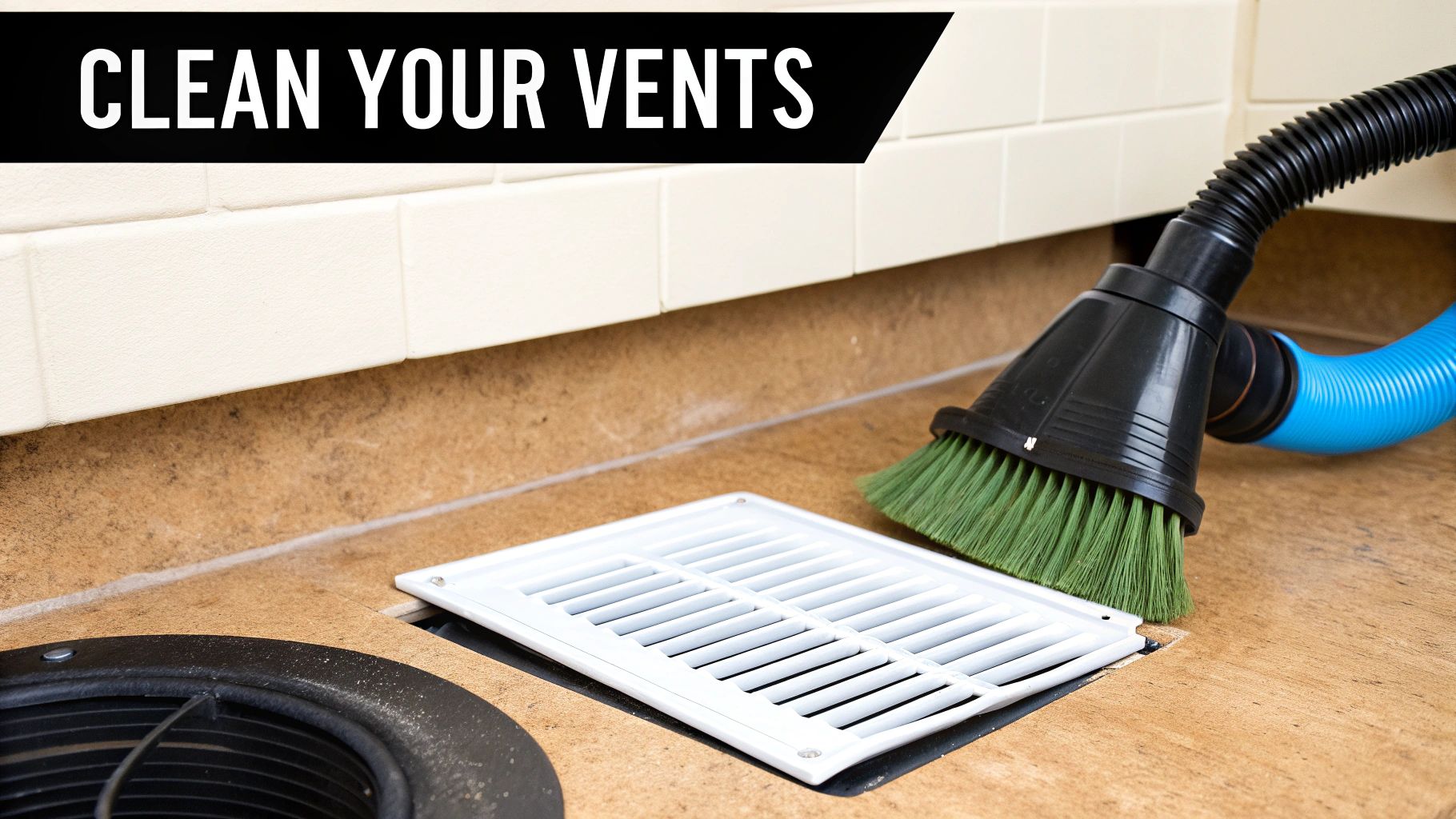
This guide gives you a simple playbook for the upkeep you can tackle yourself, keeping your system humming along smoothly between professional tune-ups.
Easy DIY Vent Cleaning Steps
Keeping your vent covers and the parts of your ducts you can actually reach clean is a simple job. A little bit of effort every few months prevents the buildup of dust, pet dander, and other gunk that can choke off airflow.
Here’s a simple routine to follow:
Shut Down the HVAC System: First things first, head to your thermostat and turn the system completely off. This keeps it from kicking on mid-clean and blowing dust everywhere.
Remove the Vent Covers: Grab a screwdriver and carefully take off the vent covers (also called grilles or registers). Find a safe spot for the screws so they don’t get lost.
Wash the Covers: Take the covers to a sink or tub and give them a good wash with warm, soapy water. A soft brush is great for scrubbing any stubborn grime out from between the slats. Rinse them well and set them aside to air dry.
Vacuum Out the Duct Opening: While the covers are drying, use your vacuum’s hose and brush attachment to clean inside the duct opening. Reach in as far as you can to suck up any dust, cobwebs, and debris.
Reinstall the Covers: Once the covers are bone-dry, screw them back on. Now you’re clear to turn your HVAC system back on.
This quick cleaning routine is your best first line of defense for maintaining healthy air vents in your house.
The Critical Role of Your Air Filter
Cleaning the vents is important, but it’s only half the battle. Your central air filter is the real gatekeeper for your entire HVAC system, trapping pollutants before they ever make it into your ductwork.
A clogged filter is like trying to breathe through a straw during a workout; it starves your system of the air it needs. This makes the blower motor work overtime, burning more electricity and putting a ton of strain on your equipment.
A clean air filter is the single most important thing you can do for both HVAC efficiency and indoor air quality. Letting it get filthy is a guaranteed way to see higher energy bills and circulate junk throughout your home.
Checking your filter every month and replacing it every 1-3 months (or whatever the manufacturer suggests) is a non-negotiable part of keeping your vents and ducts healthy.
Knowing When to Call a Professional
DIY cleaning is great for surface-level dust, but it just can't get to the contaminants hiding deep inside your ductwork. Over the years, things like allergens, dust mites, and even mold can build up far beyond the reach of a standard household vacuum.
You should seriously consider professional duct cleaning if you notice:
Visible mold growing inside ducts or on other HVAC components.
Signs of pests, like droppings from rodents or insects in your ductwork.
Excessive dust and debris blowing out of your supply vents.
Professional technicians use powerful, specialized vacuums and brushes to scrub the entire system clean. If you're worried about what might be lurking in your ducts, our team can give you a clear picture of what's going on. For a deeper dive, check out our guide on AC duct cleaning in Arizona.
This kind of upkeep is more important than ever. The global market for residential ventilation systems, where air vents in houses play a huge part, grew from $13.22 billion in 2021 and is projected to hit $16.54 billion by 2025. Here in Arizona, where the intense heat can trap pollutants inside, dirty vents can spike energy bills by 20-30% simply from poor airflow. For Tucson homeowners, getting biannual vent inspections from certified pros can prevent roughly 80% of common HVAC problems. You can see more findings on the residential ventilation market here.
Frequently Asked Questions About Home Air Vents
Even after getting the basics down, you’ll probably still have some specific questions about the vents in your house. It happens to every homeowner. You run into a weird situation, hear some conflicting advice from a neighbor, and suddenly you’re not sure what to do.
This section is designed to give you clear, straightforward answers to the most common questions we hear. Think of it as your quick-reference guide for those everyday vent-related puzzles.
Is It Okay to Close Air Vents in Unused Rooms?
This is probably one of the most persistent myths in home energy savings: closing the vents in rooms you don’t use. It sounds logical on the surface, why send perfectly good conditioned air into a room nobody is in? But in reality, this is one of the worst things you can do for your HVAC system.
Your system is a balanced, closed-loop circuit. It was engineered to handle a specific volume of air, pushing a certain amount out through the supply vents and pulling that same amount back through the returns.
When you slam a supply vent shut, you throw that entire balance out of whack. The pressure inside your ductwork skyrockets. It's like kinking a garden hose, the pressure builds up and the air has to force its way out somewhere else, often through small, hidden leaks in your ductwork.
Closing vents in unused rooms doesn't save a dime. Instead, it creates pressure imbalances that can lead to duct leaks, wreck your system's efficiency, and put a ton of strain on expensive parts like the blower motor.
So instead of saving money, you might be setting yourself up for some costly repairs down the road. If you really want better temperature control in specific areas, a professionally installed zoning system is the right way to go, not just closing vents.
How Often Should I Have My Vents Professionally Cleaned?
There’s no single, one-size-fits-all answer here, but a good rule of thumb is to have your entire duct system professionally inspected and cleaned every 3 to 5 years. That said, your specific situation might demand a different schedule.
You'll want to consider more frequent cleanings if any of these apply to you:
You have pets. Our furry friends are family, but their dander and hair get sucked right into the HVAC system, clogging things up much faster than normal.
Someone has allergies or respiratory issues. For family members with allergies or asthma, regular duct cleaning can make a world of difference for indoor air quality.
You just finished a renovation. Construction and remodeling projects kick up an incredible amount of fine dust, and a lot of it ends up circulating through your ductwork.
You live in a dusty climate. Here in Tucson, dust is just a fact of life. That alone can be reason enough to have your ducts cleaned more often.
Beyond these guidelines, there are some clear red flags that mean you should call a pro right away. If you can see visible mold growth, notice signs of pests in your ducts, or see puffs of dust coming out of your vents when the system kicks on, don't wait.
Can I Paint My Air Vent Covers?
Absolutely! You can definitely paint your vent covers to match your walls or trim for a cleaner look. You just have to do it the right way to avoid causing airflow problems. A quick, sloppy paint job can easily seal the louvers shut or clog the grille, which restricts air and hurts your system’s performance.
Here’s how to do it right:
Remove the Cover: Always take the vent cover completely off the wall, floor, or ceiling first.
Clean It Thoroughly: Give it a good wash with soap and water to get rid of all the dust, grease, and grime.
Prime the Surface: Use a coat of primer made for metal. This helps the paint stick and last longer.
Paint with Care: Heat-resistant spray paint will give you the most even, professional finish. The trick is to apply several light coats instead of one thick one to prevent drips and clogs.
The main goal is to make sure any moving parts can still move freely and that all the air passages are completely clear when you’re done.
What Causes Black Streaks Around My Supply Vents?
Those dark, sooty-looking stains that sometimes appear on the ceiling or wall around a supply vent are a super common issue. It's often called "ghosting" or "carbon tracking." While it definitely looks alarming, it’s usually not mold.
Most of the time, ghosting is caused by tiny airborne particles sticking to the wall surface. It's a combination of air movement and slight temperature differences that makes these particles cling right around the vent.
The most common culprits are everyday household things:
Burning Candles or Incense: Soot from burning candles, especially scented ones, is a primary cause of these black marks.
Poor Air Filtration: A dirty or cheap, low-quality air filter lets more of these tiny particles circulate through your system. Sometimes, just upgrading your filter can help solve the problem. You can learn more by reading our complete guide on the best HVAC filters for allergies.
Leaky Ductwork: If your ducts have leaks, they can pull in dirty, unfiltered air from your attic or crawlspace and then deposit that grime on the surfaces right around your vents.
Your first move should be to change your air filter and cut back on burning candles. If the black marks keep reappearing, that’s a strong signal that you should have a professional come out and inspect your ductwork for leaks.
If you're dealing with stubborn vent issues or just want a professional to take a look at your home's airflow and air quality, the certified experts at Covenant Aire Solutions are here to help. From in-depth cleanings to advanced diagnostics, we make sure your system runs perfectly and keeps your family comfortable. Visit us at https://www.covenantairesolutions.com to schedule a service today.