
A Homeowner's Guide to the Evaporator Coil AC Unit
- Jan 25
- 17 min read
If you've ever wondered how your air conditioner actually makes the air cold, a big part of the answer lies with a component you probably never see: the evaporator coil.
Think of it like the ice-cold drink on a hot summer day. As warm air from your house blows across it, the coil absorbs the heat, leaving you with refreshingly cool air. It's the hardworking, hidden engine of your home's cooling system.
The Unsung Hero of Your Home Cooling System
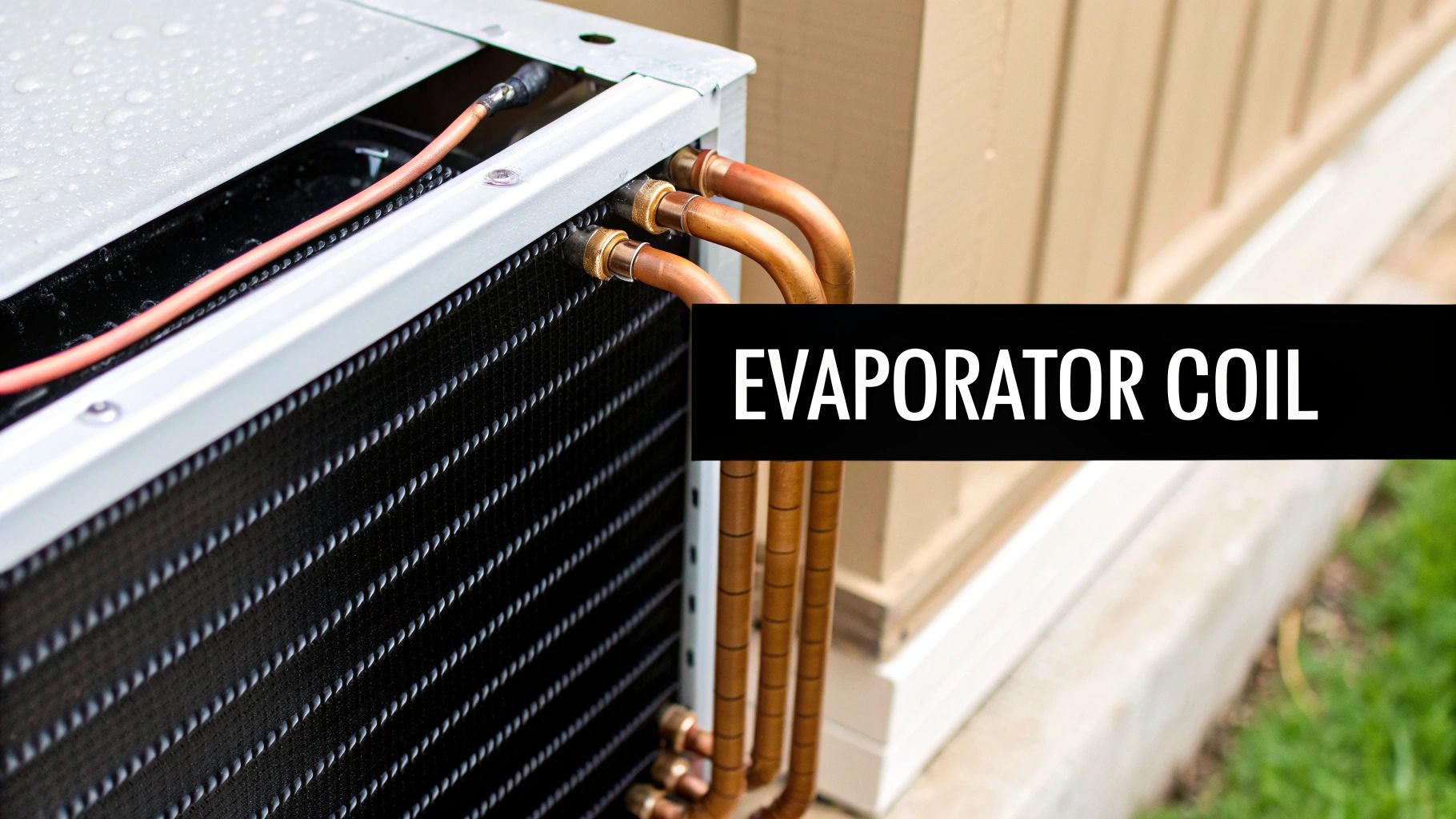
Tucked away inside your indoor air handler unit, the evaporator coil is doing the heavy lifting. While the outdoor condenser unit is more visible, it’s the indoor coil that performs the real magic of heat absorption.
This crucial part is a maze of copper tubes covered in thin aluminum fins, all designed to create as much surface area as possible. When you turn on the AC, super-chilled liquid refrigerant flows into these tubes. Your system’s blower fan then pulls in warm, humid air from your rooms and pushes it directly over the coil's frosty surfaces.
This is where the cool science happens. The heat from your air is instantly transferred to the refrigerant, causing it to boil and vaporize into a gas. In the process, moisture from the air condenses onto the coil, just like a glass of iced tea sweating on a Tucson afternoon, which effectively dehumidifies your home.
Why Its Role Is So Important
In a climate like ours, the performance of this heat exchange is everything. A healthy evaporator coil isn't just a nice-to-have; it's absolutely critical for reliable home comfort.
Cooling Power: The coil's ability to absorb heat directly determines how cool your air gets. If it's dirty or damaged, it just can't do its job, leading to weak airflow and an AC that runs forever without cooling the house.
Energy Efficiency: A clean, efficient coil makes the heat transfer happen fast. This means your AC hits the target temperature quickly and shuts off, which saves a ton of energy and keeps your utility bills from skyrocketing.
Humidity Control: By pulling moisture out of the air, the coil is your first line of defense against that sticky, humid feeling. A properly functioning coil makes your home feel more comfortable even at a higher thermostat setting.
This core principle dates all the way back to 1902, when Willis Carrier invented modern air conditioning. He first solved a humidity problem at a printing plant by blowing air over chilled coils, creating a system that managed both temperature and humidity: the great-grandfather of the evaporator coil in your home today.
The evaporator coil is where the most critical part of the cooling cycle happens inside your home. Its ability to absorb heat dictates your air conditioner's overall performance, efficiency, and ability to keep you comfortable during peak summer heat.
Connecting the Coil to Overall System Health
The evaporator coil doesn't work alone; it's a key player in a much larger system. Its performance directly affects other major components, especially the compressor. For a bigger picture, you can explore our complete overview of the parts of a central air conditioner unit in our detailed guide.
While your coil is central to your AC's performance, it's just one piece of the home efficiency puzzle. To take a broader approach, check out these additional proven HVAC and energy tips. Keeping this single component in top shape is the first and most important step toward a cool, efficient, and reliable HVAC system.
Decoding the Warning Signs of a Failing Evaporator Coil
Your evaporator coil is one of those hard-working parts you never think about, until something goes wrong. It works silently behind the scenes, so its distress signals can be easy to miss. But learning to spot these early warnings is the key to stopping a minor hiccup from turning into a major, expensive breakdown right in the middle of a Tucson heatwave.
Think of these symptoms as your AC system’s way of waving a red flag about one of its most vital components. Catching them early means a quicker, less expensive fix. If you ignore them, you risk a domino effect of failures that can take out your compressor, the single most expensive part of your entire air conditioning system.
Your AC Is Running but Not Cooling
This is the most unmistakable sign something is off. The AC is humming along, the fan is blowing, but the air coming out of your vents is lukewarm, or maybe just a little cool. If you hold your hand up to a vent and don't feel that crisp, cold air you’re used to, the evaporator coil is the number one suspect.
More often than not, this points directly to a refrigerant leak inside the coil. When your system is low on refrigerant, the coil simply can't absorb enough heat from your home's air to cool it down. This forces your AC to run nonstop, trying and failing to reach the temperature you set on the thermostat. The first place you’ll notice this problem? Your skyrocketing energy bills.
Weak or Reduced Airflow
Does the air coming out of your vents feel more like a weak sigh than a steady breeze? If the airflow is noticeably weaker than it used to be, you might be dealing with a frozen evaporator coil. When the coil gets too cold, the condensation on its fins can freeze solid, creating a block of ice that chokes off the airflow.
A frozen coil is almost always a symptom of a deeper issue, like a clogged air filter starving the system for air or, again, low refrigerant. We have a whole guide that dives into the common causes of frozen AC coils in Arizona homes. This isn't just about weak cooling; it puts a massive amount of strain on your system's blower motor, risking another expensive repair.
A significant drop in cooling power or airflow isn't just an inconvenience; it's a direct signal that the heat exchange process is failing. Addressing it promptly is crucial to protect your system from severe damage.
Unexplained Puddles or Water Damage
Part of the evaporator coil’s job is to pull humidity out of your air, which creates condensation. This water is supposed to flow harmlessly out of your home through a dedicated drain line. So, if you suddenly find a puddle of water around your indoor air handler or see water stains on the ceiling below it, that drainage process has failed.
This usually happens for one of two reasons connected to the coil:
Frozen Coil Meltdown: When a completely frozen coil finally thaws, it can release a sudden gush of water that overwhelms the drain pan and spills over.
Clogged Drain Line: A dirty coil sheds grime, algae, and debris that can get washed into the condensate drain line. Over time, this gunk forms a clog, causing water to back up and overflow.
Ignoring a leak like this is a recipe for serious water damage, rot, and even hazardous mold growth inside your walls and ceilings.
Strange Noises from the Indoor Unit
Your HVAC system should be a familiar background hum. Any new, strange sounds are your cue to pay close attention. If you start hearing a distinct hissing or bubbling noise from the indoor unit, it’s a classic, tell-tale sign of a refrigerant leak in the evaporator coil.
The hissing you hear is the sound of high-pressure refrigerant gas escaping from a tiny crack or pinhole leak. The bubbling sound can happen as the last bits of refrigerant boil off unevenly inside the damaged coil. These aren't just weird sounds; they are definitive proof that your system is losing its refrigerant charge and needs a professional inspection right away.
The Root Causes of Common Evatorator Coil Problems
Knowing the symptoms of a bad evaporator coil is one thing, but understanding why they fail is how you can actually prevent problems. These issues don't just pop up overnight. They’re usually the slow-burning result of underlying conditions that gradually wear down the health of your AC's evaporator coil. Once you see what's really going on, you can be more proactive about protecting your system.
One of the sneakiest culprits is a process called formicary corrosion. This happens when common household chemicals, think volatile organic compounds (VOCs) from new carpet, furniture, or even cleaning supplies, mix with the moisture on your coil. This chemical reaction creates formic acid, which slowly eats away at the copper tubing, creating pinhole leaks that are almost impossible to see but are devastating to your system's refrigerant levels.
Airflow Starvation and Its Domino Effect
Probably the most common, and most preventable, cause of evaporator coil failure is restricted airflow. Think of your AC system like a living thing; it needs to "breathe in" a certain amount of warm air to work properly. When you choke off that airflow, a whole cascade of problems kicks off.
The number one offender here? A dirty, clogged air filter. When a filter gets packed with dust and grime, it essentially becomes a wall, blocking air from ever reaching the coil. Without that warm air to absorb heat from, the coil's temperature plummets below freezing.
When an evaporator coil can't absorb enough heat because of poor airflow, its surface temperature drops dramatically. This causes the condensation on the coil to freeze solid, creating a block of ice that completely obstructs airflow and puts immense strain on the entire system.
This isn't just a small hiccup; it’s a full-blown system emergency in the making. A frozen coil sets off a chain reaction:
Weak or No Cooling: Ice literally blocks air from passing through the coil's fins.
Blower Motor Strain: The fan motor works overtime trying to force air through a solid block of ice, which can cause it to burn out prematurely.
Potential Compressor Damage: The whole refrigerant cycle gets thrown off, which can send liquid refrigerant back to the compressor, a part that’s only designed to handle gas. This is a catastrophic, system-killing failure.
This flowchart walks you through the diagnostic process for these common issues. It helps connect a symptom, like warm air or a water leak, back to a potential problem with the coil.
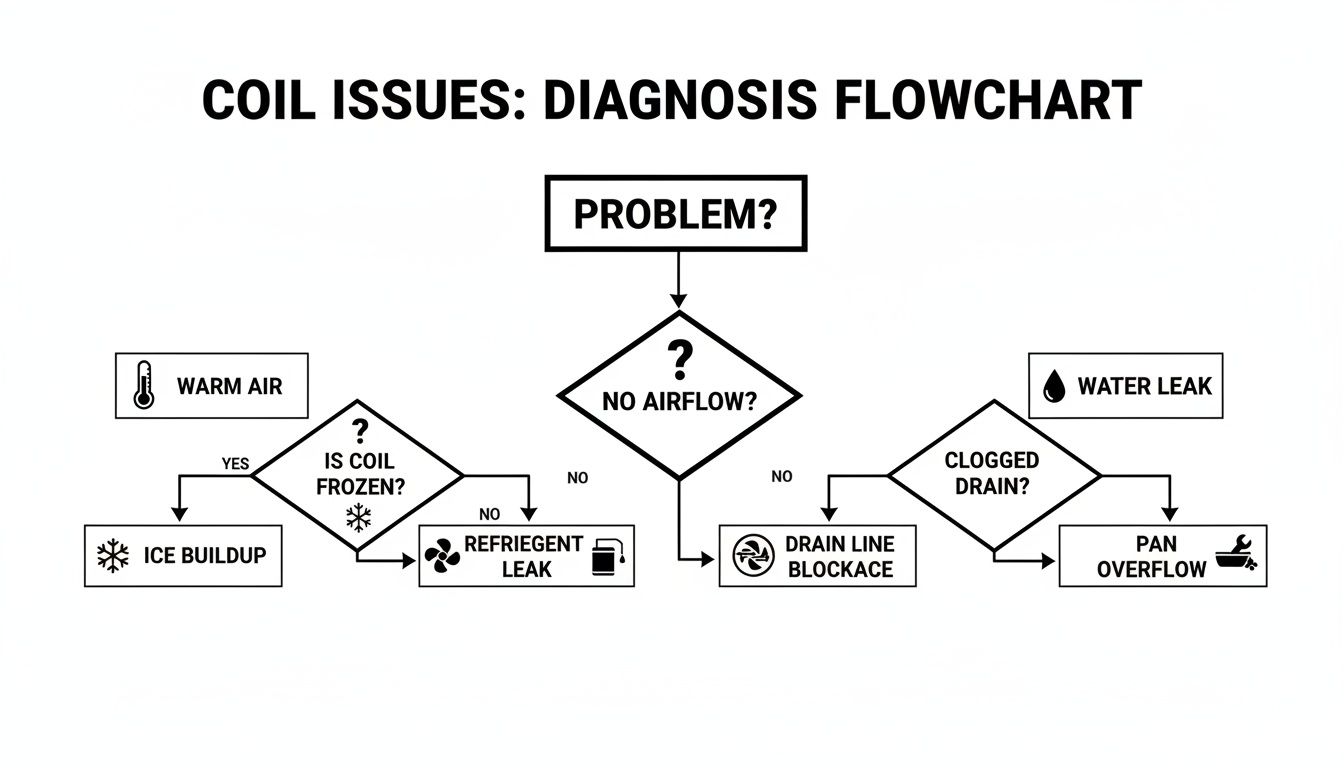
As you can see from the chart, different symptoms can point to several underlying causes. That's why getting a professional diagnosis is so important to nail down the exact problem.
Drainage Failures and Water Damage
Another frequent headache begins with the condensate drain line. As your evaporator coil pulls all that humidity out of the air, the water has to go somewhere. It drips down into a collection pan and then flows outside through a small PVC pipe.
But over time, all the gunk from a dirty coil gets washed down into that drain line. Here in Tucson's warm, damp environment, this creates the perfect breeding ground for algae and sludge, which eventually form a solid clog. Once that drain is blocked, the water has nowhere to go but back up and into your home.
This kind of overflow can lead to thousands of dollars in property damage, wrecking ceilings, drywall, and floors. Worse, the constant moisture creates the perfect environment for mold and mildew to take hold inside your air handler and ductwork, posing a serious threat to your home's air quality and your family's health. What starts as a simple clog can quickly escalate into a massive home repair nightmare.
Now that we've covered the common causes, it's time to talk troubleshooting. When your AC acts up, it helps to have a quick guide to connect the dots between what you're experiencing and what might be wrong.
Evaporator Coil Troubleshooting Guide
Symptom | Potential Cause | What You Can Do | When to Call a Professional |
|---|---|---|---|
AC is blowing warm or cool (not cold) air | Dirty air filter, low refrigerant (leak), frozen coil, dirty coil | Check and replace the air filter if it's dirty. | If the filter is clean, the issue is likely a refrigerant leak or a more complex problem requiring a technician. |
Reduced or weak airflow from vents | Frozen evaporator coil, clogged air filter, dirty coil fins | Immediately turn off the AC to let the coil thaw. Replace the air filter. | If airflow doesn't improve after thawing and filter change, the coil or blower motor needs professional service. |
Visible ice or frost on the coil | Restricted airflow (dirty filter/vents), low refrigerant | Turn off the system to thaw. Replace the air filter and ensure all vents are open. | If ice returns after taking these steps, it signals a deeper problem like a refrigerant leak. Call for service immediately. |
Water leaking around the indoor unit | Clogged condensate drain line, cracked drain pan | Check the drain line for a visible clog near the outlet. Use a wet/dry vac to try and clear it. | If you can't clear the clog or suspect a cracked pan, call a pro to prevent major water damage. |
Musty or moldy smells from vents | Mold or mildew growth on the coil or in the drain pan | This is not a DIY fix due to health risks. | Immediately. Mold in the HVAC system requires professional cleaning and sanitation to ensure it's fully removed. |
Hissing or bubbling noises | Refrigerant leak from the evaporator coil | None. This indicates an active leak. | Turn off the system and call a technician right away. Leaking refrigerant can damage the system and is a health concern. |
This table is a great starting point, but remember that AC systems are complex. When you’ve done the basic checks and the problem persists, or if you suspect a refrigerant leak, it’s always best to bring in an expert.
Taking Care of Your Evaporator Coils: Cleaning and Maintenance
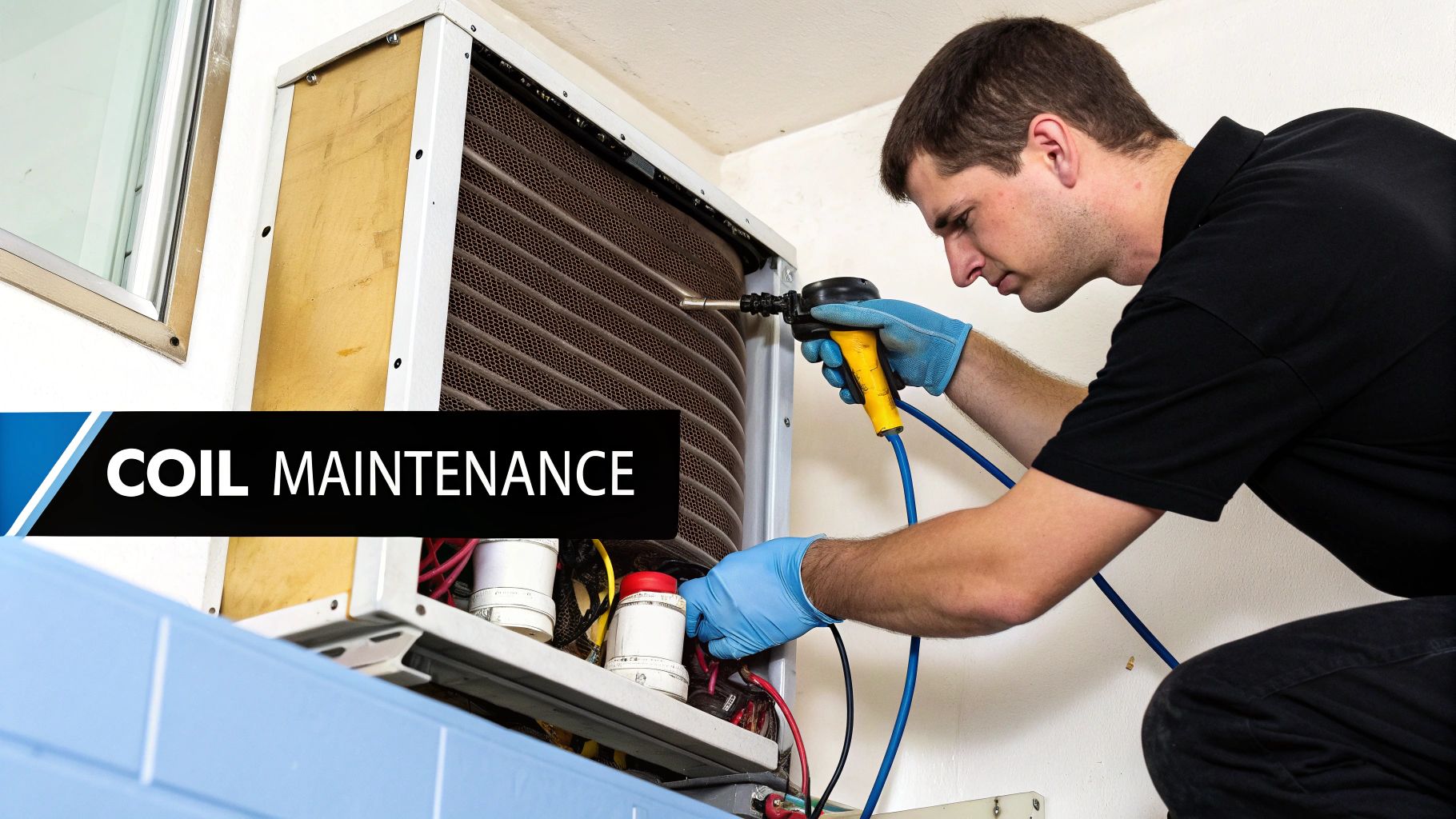
Being proactive is the single best defense for your AC's evaporator coil. Think of it like a car: you wouldn't skip oil changes and expect the engine to last. In the same way, your evaporator coil needs consistent attention to keep it running efficiently and reliably. A clean coil is truly the foundation of a healthy, long-lasting HVAC system.
This isn't an all-or-nothing deal. Proper maintenance is a partnership between simple tasks you can handle yourself and the essential work that only a professional should tackle. Knowing your role, and when to call us in, is the key to preventing a costly breakdown right in the middle of a Tucson summer.
What You Can Do Safely at Home
Your part in keeping the coil healthy is straightforward but has a huge impact. These tasks are all about one thing: ensuring clean, unrestricted airflow, which is the coil's lifeblood.
Change Your Air Filter Religiously: This is, without a doubt, the most important DIY task. A clogged filter is enemy number one, leading directly to a dirty, frozen evaporator coil. Check it monthly and plan on replacing it every 1-3 months.
Keep Vents and Registers Clear: Take a quick look around your home. Is furniture, a rug, or a stray curtain blocking any supply or return air vents? Proper circulation is non-negotiable for system health.
Maintain a Clean Indoor Unit Area: The space around your indoor air handler should be kept free of dust, debris, and general clutter. This simple step prevents extra contaminants from getting sucked into the system in the first place.
These habits make a massive difference in how hard your system has to work. They directly improve energy efficiency and help keep all the internal parts, especially that delicate evaporator coil, much cleaner.
While we strongly discourage DIY cleaning of the coil itself, you risk bending the fragile aluminum fins or dealing with high-voltage parts, managing your home's airflow is the best preventative step any homeowner can take.
The Professional Cleaning Process
When it's time for the deep cleaning an evaporator coil needs, you have to call in a pro. Our technicians have the specialized tools, the right training, and the proper cleaning solutions to get the job done safely and effectively without damaging your system. This is a lot more involved than just wiping it down.
A professional cleaning service from a team like ours typically includes:
System De-Energization: First things first, safety. The technician will shut off all power to the HVAC unit at the circuit breaker.
Coil Access: Next, they'll carefully remove the access panels on your air handler to get a clear view of the evaporator coil.
Thorough Cleaning: Using a soft-bristled brush and special, no-rinse coil cleaning foams, they gently work away the built-up layers of dirt, dust, and grime from between the fins.
Condensate System Flush: The job isn't done yet. The technician will also clean out the drain pan and flush the condensate line to clear any sludge or algae blockages, which prevents future water backups and leaks.
This meticulous process brings both your coil and its drainage system back to peak condition. You can learn more about the benefits in our guide on expert cleaning of air conditioning coils for better efficiency. For a whole-home approach, consider regular professional HVAC system cleaning to keep everything in top shape.
Why Coil Maintenance Is More Important Than Ever
The entire HVAC industry is placing more emphasis on the critical link between coil health and your home's indoor air quality. It's a big deal. Global demand for HVAC evaporator coils is surging, with the market expected to jump from USD 9.1 billion in 2025 to USD 14.9 billion by 2035.
We're seeing this trend right here in Tucson. Nearly 50% of new projects now include things like antimicrobial coatings and advanced filtration to meet homeowner demands for healthier air. These advancements go hand-in-hand with solutions we offer, like the NASA-certified ActivePure technology. Regular professional maintenance is simply the best way to protect this vital, and increasingly advanced, part of your AC system.
Navigating Evaporator Coil Repair and Replacement Costs
Nothing puts a knot in your stomach quite like hearing there’s a problem with your AC’s evaporator coil. The first question that usually pops into your head is, "What's this going to cost me?" Getting a handle on the financial side of things is the best way to cut through the stress and make a smart decision for your home. The final bill really comes down to whether we can perform a targeted repair or if the whole coil needs to be replaced.
Patching a small, easy-to-reach refrigerant leak is the most straightforward, budget-friendly fix. However, a full evaporator coil replacement is a different beast altogether. It's a much more involved job, and the national average cost can run anywhere from $800 to $3,500. That range covers both the new coil itself and the intensive labor needed to get it installed just right.
Key Factors That Influence Your Final Cost
No two HVAC jobs are ever the same, and a few key variables can really move the needle on the final price. Knowing what they are ahead of time will help you make sense of the quote your technician provides.
Warranty Status: This is the big one. If your AC system is still under its manufacturer's warranty, the part itself should be covered. You'll still be on the hook for labor costs, but it takes a huge chunk out of the bill.
System Age and Refrigerant Type: If your system is creeping past the 8-10 year mark, just finding a compatible coil can be a challenge. Slapping in a mismatched coil is a recipe for disaster: it kills efficiency and puts a ton of strain on the rest of your system. Plus, older units often use phased-out refrigerants like R-22, which can make a simple coil swap impossible.
Coil Accessibility: Where is your indoor unit hiding? If the air handler is tucked away in a cramped attic, a tight crawlspace, or a tiny closet, our technicians will need more time and effort to get in there. That extra labor will be reflected in the cost.
Brand and Model: Just like with cars, parts for high-end, high-efficiency HVAC brands tend to cost more than their standard counterparts. The specific size and design of your unit’s coil will also play a role in the price of the part.
It's absolutely critical to understand that a new, modern evaporator coil is almost never a good match for an old outdoor condenser. Mismatched components will lead to poor performance, sky-high energy bills, and will likely cause the whole system to fail prematurely.
Repair or Replace: The Value Proposition
When a coil fails in an older AC system, you're at a crossroads: do you sink money into fixing the old unit, or is it time to replace the whole thing? While a coil replacement might seem like the cheaper option upfront, it’s often not the best value in the long run.
Think of it this way: replacing just the coil on a 12-year-old system is like putting a brand-new transmission in a car that has a failing engine. Sure, it might get you down the road for a little while, but you just know another expensive breakdown is right around the corner.
As a rule of thumb, if your system is over eight years old, it’s almost always wiser to replace both the indoor and outdoor units at the same time. This guarantees that all the components are perfectly matched for peak efficiency, performance, and long-term reliability. For a deeper dive, check out our article explaining evaporator coil replacement options in Tucson.
Making the Expense More Manageable
We get it; a major HVAC expense is almost never in the budget. Here at Covenant Aire Solutions, we believe every family in Tucson deserves to be comfortable in their own home without breaking the bank.
That’s why we offer flexible financing options. We can help spread the cost of a major repair or a full system replacement over time, turning a large, unexpected bill into predictable, manageable monthly payments. Don’t let cost be a barrier to comfort. Our team is here to walk you through the plans and find one that works for you.
Why Professional Service Is Essential for Your AC Coil
When you’re staring at a problem with your evaporator coil ac unit, the temptation to try a DIY fix can be strong. After all, how hard can it be? But when it comes to HVAC systems, a little bit of knowledge can be a very dangerous thing. These aren't simple machines; they’re complex systems running high-pressure refrigerant and sensitive electronics.
Making one wrong move can turn a small problem into a massive one. For example, the aluminum fins on the coil are incredibly delicate; just bending them by mistake can permanently cripple your AC’s efficiency. An even bigger mistake could lead to a major refrigerant leak or fry the electrical components, damaging the entire system beyond repair.
Attempting a DIY repair on an evaporator coil often voids your manufacturer's warranty. What starts as a cost-saving measure can quickly turn into an expensive mistake, leaving you responsible for the full replacement cost of a major system component.
The Value of Certified Expertise
A licensed HVAC technician from Covenant Aire brings a lot more to your home than a toolbox. They show up with years of hands-on training, specialized diagnostic equipment, and a deep understanding of how every part of your system works in harmony. That expertise is the difference between a quick fix and a lasting solution.
Here’s what a professional brings to the table that you just can’t replicate:
Safe Refrigerant Handling: Our technicians are EPA-certified. They know how to handle high-pressure refrigerants safely, protecting you, your system, and our Tucson environment.
Accurate Diagnostics: Guesswork doesn't cut it. We use advanced tools to pinpoint the exact location of a leak or figure out why a coil is freezing over, saving you money on unnecessary parts and labor.
Correct Tools and Parts: Professionals come equipped with the right tools and access to manufacturer-approved parts, ensuring the repair is done right and built to last.
Your air conditioner is one of the most significant investments in your home’s comfort. Entrusting it to a certified professional is the best way to protect that investment. Consistent upkeep is the key, and you can learn more about what that involves by reading our guide on how often you should service your air conditioner. Don't risk your comfort, or your warranty.
Of course. Here is the rewritten section, crafted to sound like a human expert from Tucson, following your specific style and formatting guidelines.
Frequently Asked Questions About Evatorator Coils
Even with all this info, you probably still have a few questions rolling around in your head. That’s completely normal. Here are some of the most common questions we get from Tucson homeowners about evaporator coils, with straight-to-the-point answers to help you feel more confident about your AC system.
How Long Should an Evaporator Coil Last?
An evaporator coil is built to go the distance, typically lasting 10 to 15 years, right in line with the lifespan of the entire air conditioner. But that’s not a guarantee. Its actual longevity really hinges on regular professional maintenance and, frankly, the air it breathes.
Here in Tucson, factors like dust and other corrosive elements in our air can cause it to fail much faster, especially if it's neglected. Sticking to a consistent service schedule is the single best thing you can do to get the most years out of your coil and dodge a premature, expensive replacement.
Can I Replace Just the Coil?
Technically, yes, you can replace just the evaporator coil. But is it a good idea? Rarely. Especially if your AC system is already over 10 years old. Putting a brand-new coil inside an older system is like putting a new engine in a car with a rusted-out frame; it creates a serious mismatch.
This imbalance tanks your system's efficiency, puts a ton of strain on the other aging parts (like the outdoor condenser), and often leads to more breakdowns. On top of that, many older systems use the now-phased-out R-22 refrigerant, which won't even work with modern coils. A certified technician can give you an honest look at the situation, helping you weigh the short-term savings of a coil replacement against the much better long-term value of a new, fully matched system.
Ignoring a leaking evaporator coil is a recipe for system failure. The resulting stress on the compressor, a very expensive component, often leads to catastrophic damage that could have been prevented with a timely repair.
What Happens If I Ignore a Leaking Coil?
Putting off a refrigerant leak is one of the riskiest gambles a homeowner can take with their AC. For starters, the leak forces your system to run constantly without actually cooling your home, which means your energy bills will shoot through the roof. This nonstop operation puts an incredible amount of stress on the compressor, the heart of your AC.
Worse yet, the refrigerant leak often causes the coil to freeze into a solid block of ice. As it melts, the overflowing water can cause serious damage to your walls, ceilings, and floors. All that moisture also creates a perfect breeding ground for mold and mildew, which is a major health hazard. Getting a leak fixed right away is absolutely critical to prevent a small problem from turning into a disaster.
For an expert diagnosis of your evaporator coil or any other HVAC concerns, trust the certified professionals at Covenant Aire Solutions. We provide honest assessments and reliable service to keep your Tucson home comfortable year-round. Contact us today for a consultation or emergency repair.