
A Homeowner’s Guide to the Parts of a Central Air Conditioner Unit
Ever feel like your central air conditioner is just some magic box that conjures cold air out of thin air? While it might seem complicated, the whole process is really just a clever heat-transfer operation. Your system doesn't create cold; it moves heat.
Think of it like this: your AC is essentially a heat taxi service. Its main job is to pick up unwanted heat from inside your house and shuttle it outside.
The Two Halves of a Whole System
A central AC is what we call a "split system" because it’s literally split into two main units that are constantly working together.
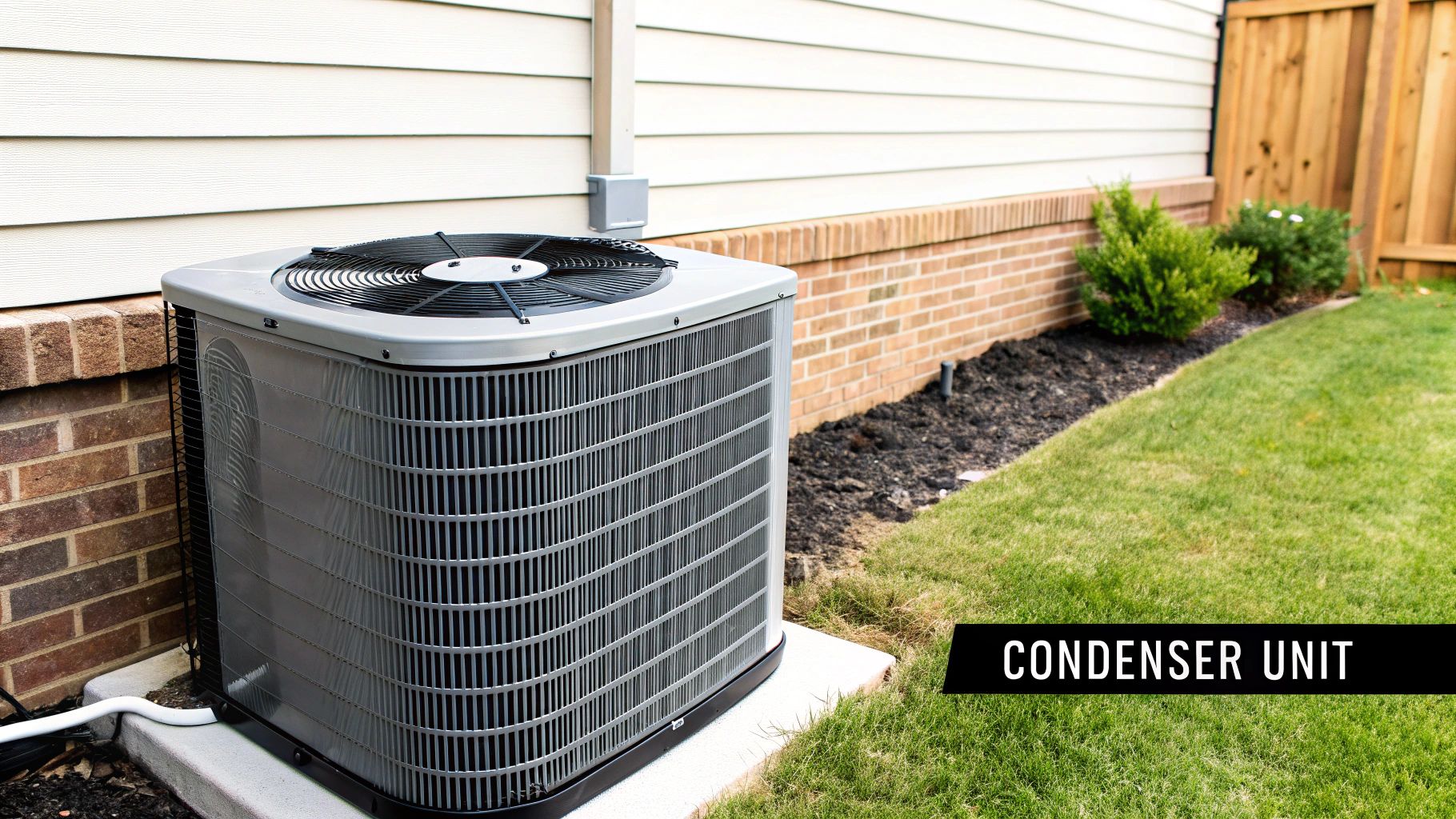
The Outdoor Unit: This is the big metal box humming away in your yard, technically called the condenser unit. Its entire purpose is to release all the heat it has collected from inside your home into the outside air.
The Indoor Unit: Usually tucked away in a basement, attic, or utility closet, this is the air handler. It's the part that absorbs the indoor heat and then pushes the newly cooled air back into your home.
This simple infographic gives you a bird's-eye view of how your AC system moves heat from inside your home to the outside.
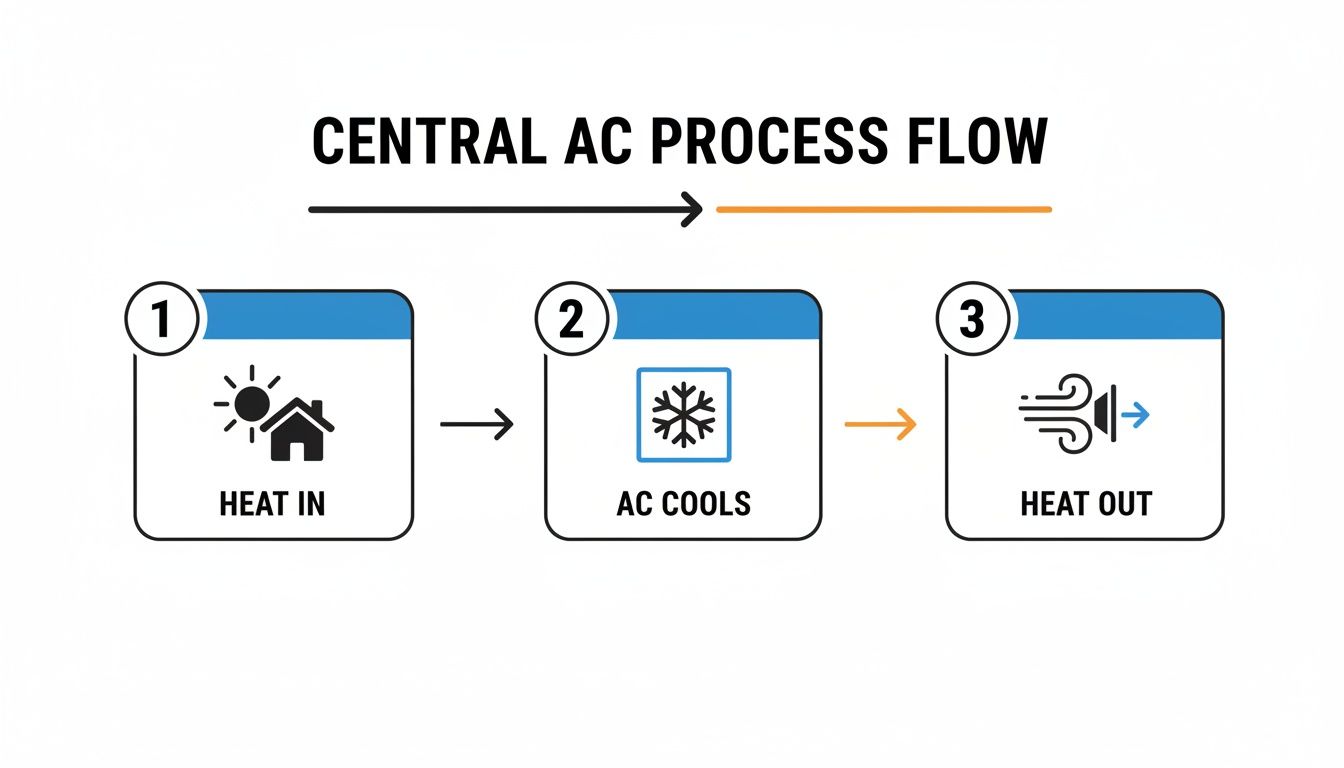
As you can see, it’s a continuous cycle. Heat gets absorbed, the air gets cooled, and the heat gets kicked outside, keeping your home comfortable. Understanding this basic two-part structure is the first step. For a deeper dive, check out our guide explaining what central air is and how it's defined.
Your Central AC System at a Glance
To make it even clearer, let's quickly break down where the main action happens in this split system.
Component Location | Key Part | Primary Function |
|---|---|---|
Outdoor Unit | Condenser Unit | Releases captured heat into the outside air. |
Indoor Unit | Air Handler/Evaporator | Absorbs heat from indoor air and blows cooled air back into the home. |
This table shows the fundamental division of labor. Now that we have the big picture, we can start looking at the specific parts inside each unit that make the magic happen.
Exploring the Outdoor Unit: The Heat-Removal Hub
That big metal box humming away outside your house is the undisputed workhorse of your entire air conditioning system. This is the outdoor condenser unit, and it's where the real magic of heat removal happens. Think of it as the final stop for all the warmth and humidity your system has pulled out of your home before it gets kicked to the curb for good.
Inside this unit are three of the most critical parts of your central AC system. They work together as a powerful team with a single mission: dumping heat. It's a system that works incredibly well, which is why central air conditioning makes up about 56% of the revenue share in the AC market. If you're interested in market trends, gminsights.com has some deep dives into the industry.
Getting to know these components is the key to understanding how your AC keeps you cool. Let’s pull back the curtain on the big three players in your outdoor unit.
The Compressor: The Heart of the System
If your AC has a heart, it's absolutely the compressor. This is a powerful motor that does one thing: it pressurizes and pumps the refrigerant through the entire system, almost exactly like how your heart pumps blood through your body.
The compressor's job starts when it receives low-pressure refrigerant gas that has just finished soaking up heat from inside your house. It then squeezes, or compresses, that gas, which dramatically cranks up its temperature and pressure. This superheated, high-pressure gas is now primed and ready to get rid of all that heat it's carrying.
A happy compressor has a smooth, steady hum. If you start hearing loud buzzing, clanking, or rattling sounds, that’s your system screaming for help.
Key Takeaway: The compressor doesn't actually create any "cold." Its main job is to put the refrigerant under intense pressure, which is the necessary first step to force the heat out of it.
A failing compressor is one of the biggest and most expensive AC repairs you can face, so catching weird noises early can save you a world of hurt. For a complete look at the outdoor unit, you can learn more about what a condenser unit is in our detailed guide.
The Condenser Coil: The Heat Radiator
Once the hot, high-pressure refrigerant gas leaves the compressor, it immediately flows into the condenser coils. These are the rows and rows of twisting tubes, usually made of copper, that are covered in thin aluminum fins. This design is all about creating a massive amount of surface area for heat to escape.
You can think of the condenser coil a lot like the radiator in your car. As the super hot refrigerant zips through these coils, its heat radiates out from the tubes and into all those little fins. But the job isn't done yet. The system needs a way to get rid of that heat, and fast.
Common signs of a condenser coil problem include:
Weak Cooling: Dirty coils can't release heat properly, which means your AC just won't cool as well as it should.
Spiking Energy Bills: An inefficient coil forces the whole system, especially the compressor, to work overtime, and you'll see it on your power bill.
Ice Buildup: In some cases, severely clogged coils can choke off airflow so badly that other parts of your system start to freeze up.
This is exactly why regular maintenance is so important.
The Condenser Fan: The Heat Disperser
The final piece of this outdoor puzzle is the condenser fan. You can usually see its large blades right through the top grate of the unit. Its role is simple, but absolutely essential. It pulls a huge volume of outdoor air through the condenser coils.
This constant blast of air strips the heat away from the coil's fins and blows it out into the atmosphere. This process rapidly cools the refrigerant inside the coils, allowing it to condense from a hot gas back into a warm liquid. Now, it's ready to head back inside to grab another load of heat.
If you peek at your outdoor unit when the AC should be running and that big fan isn't spinning, you've got a problem. It could be a dead fan motor or a bad capacitor. Either way, a fan that isn't working will cause your system to overheat and shut itself down in a hurry.
Simple Maintenance and a Critical Safety Note
You can give these outdoor components a major helping hand with just a little bit of simple upkeep.
Give It Room to Breathe: Make sure you have at least two feet of clear space all the way around the outdoor unit. Trim back bushes, pull weeds, and cut any tall grass that could block airflow.
Clear Out the Gunk: Regularly sweep away leaves, twigs, cottonwood, and any other debris that can get sucked against the coils and clog them up.
A Gentle Rinse: You can use a regular garden hose (but never a pressure washer!) to gently spray down the outside of the coils. This washes away the finer layers of dirt and dust. Just be sure to turn the power off at the breaker first!
Safety Warning: Your outdoor unit contains high-voltage electrical parts like capacitors and contactors that can hold a dangerous charge even when the power is off. Never open the service panel or try to work on these components yourself. For any electrical issues, always call a certified professional at Covenant Aire Solutions.
Inside Your Home: The Indoor Cooling Components
Once the refrigerant has done its job outside, it travels back into your home, where the real magic happens. This is the heat exchange that actually cools your air. The indoor unit, often part of your furnace or a standalone air handler in a closet, attic, or basement, is where this crucial step takes place.
A handful of key parts work in perfect harmony here to pull heat and humidity out of your air, delivering that cool, comfortable relief you're looking for.
Think of it this way: the outdoor unit is all about dumping heat. The indoor unit, on the other hand, is all about absorbing it. This is where your warm, muggy indoor air gets transformed into that refreshing cool breeze that flows from your vents. Let's break down the components that make it all possible.
The Evaporator Coil: The Heat Sponge
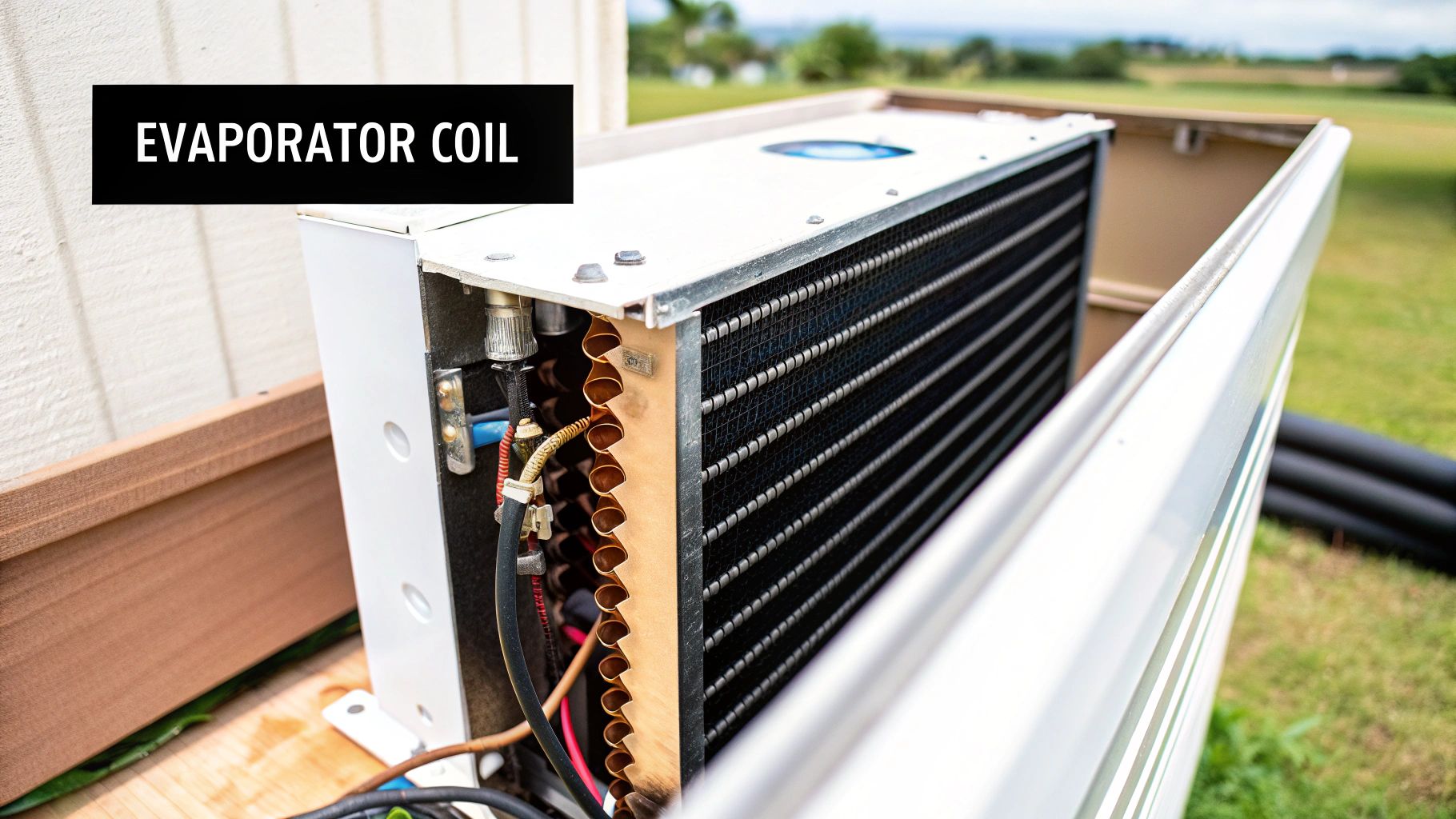
The undisputed champion of the indoor unit is the evaporator coil. If you picture the outdoor condenser coil as a radiator pushing heat away, the evaporator coil is its polar opposite. It’s essentially a super-chilled sponge designed to soak up heat like a magnet.
As that now-cool liquid refrigerant snakes its way through this network of copper tubes and aluminum fins, it starts to evaporate and turn back into a gas. This change, what engineers call "phase conversion," has a powerful cooling effect, making the coil's surface temperature drop dramatically.
When your system's blower pushes warm indoor air across this frigid coil, two things happen at once. First, the coil absorbs heat from the air. Second, it wrings out excess moisture, effectively dehumidifying your home. This is the heart of the whole cooling process.
The Expansion Valve: The Gatekeeper
Just before the refrigerant gets to the evaporator coil, it has to pass through a critical checkpoint: the expansion valve (sometimes a simpler device called a capillary tube is used). This small but mighty component acts as a gatekeeper, precisely controlling how much refrigerant enters the coil.
Its main job is to force a sudden, massive drop in the refrigerant's pressure. It's a lot like letting the air out of a pressurized can; the air feels cold as it expands in a rush. The expansion valve does the same thing to the refrigerant, which is what allows it to get intensely cold right at the entrance of the evaporator coil, maximizing its power to absorb heat.
A malfunctioning expansion valve can starve the evaporator coil, leading to poor cooling. Or, it can flood it, sending liquid refrigerant back to the compressor, which is a recipe for catastrophic damage.
Proper function here is absolutely essential for the entire system's efficiency and longevity.
The Condensate Drain System: The Moisture Manager
All that humidity pulled from your air has to go somewhere, right? As moisture condenses on the cold evaporator coil, it drips down into a condensate drain pan. From there, it flows into a condensate drain line, which is just a simple PVC pipe that channels the water safely outside.
This little system is your AC's built-in dehumidifier, and it can remove several gallons of water from your air on a sticky summer day. These components also work closely with your furnace's heat exchanger in the winter. To see how that system works, check out our guide to your air conditioner heat exchanger.
If you get a problem here, it can lead to serious trouble. A drain line clogged with algae, mold, or debris will cause the pan to overflow. Before you know it, you could have significant water damage to your ceilings, walls, and floors, creating a messy and expensive situation.
Common Indoor Unit Problems and Simple Fixes
Knowing what to look for with your indoor components can save you from major headaches down the road. Here are a few common trouble signs.
A Frozen Evaporator Coil: If you notice weak airflow from your vents or the air just doesn't feel very cold, you might have a frozen coil. This is almost always caused by dirty air filters restricting airflow or low refrigerant levels.
Water Leaks: Puddles of water around your indoor unit are a dead giveaway. You likely have a clogged condensate drain line or, less commonly, a cracked drain pan.
Musty Odors: A dirty, moldy evaporator coil or a backed-up drain line can create nasty, musty smells that your blower will happily spread throughout your entire home.
For a simple clog, you can sometimes clear the drain yourself by carefully pouring a mix of one part bleach and sixteen parts water down the line to kill the gunk. But for a frozen coil or any issue that keeps coming back, it's time to call the professionals at Covenant Aire Solutions.
The Air Delivery System That Circulates Cool Air
Making cold air is only half the battle. To actually feel that comfort, your central air conditioner needs a powerful delivery network to move that chilled air all through your home. Think of it as your home's circulatory system: it's responsible for pushing cool relief into every room while pulling the warm, stuffy air back to be re-chilled.
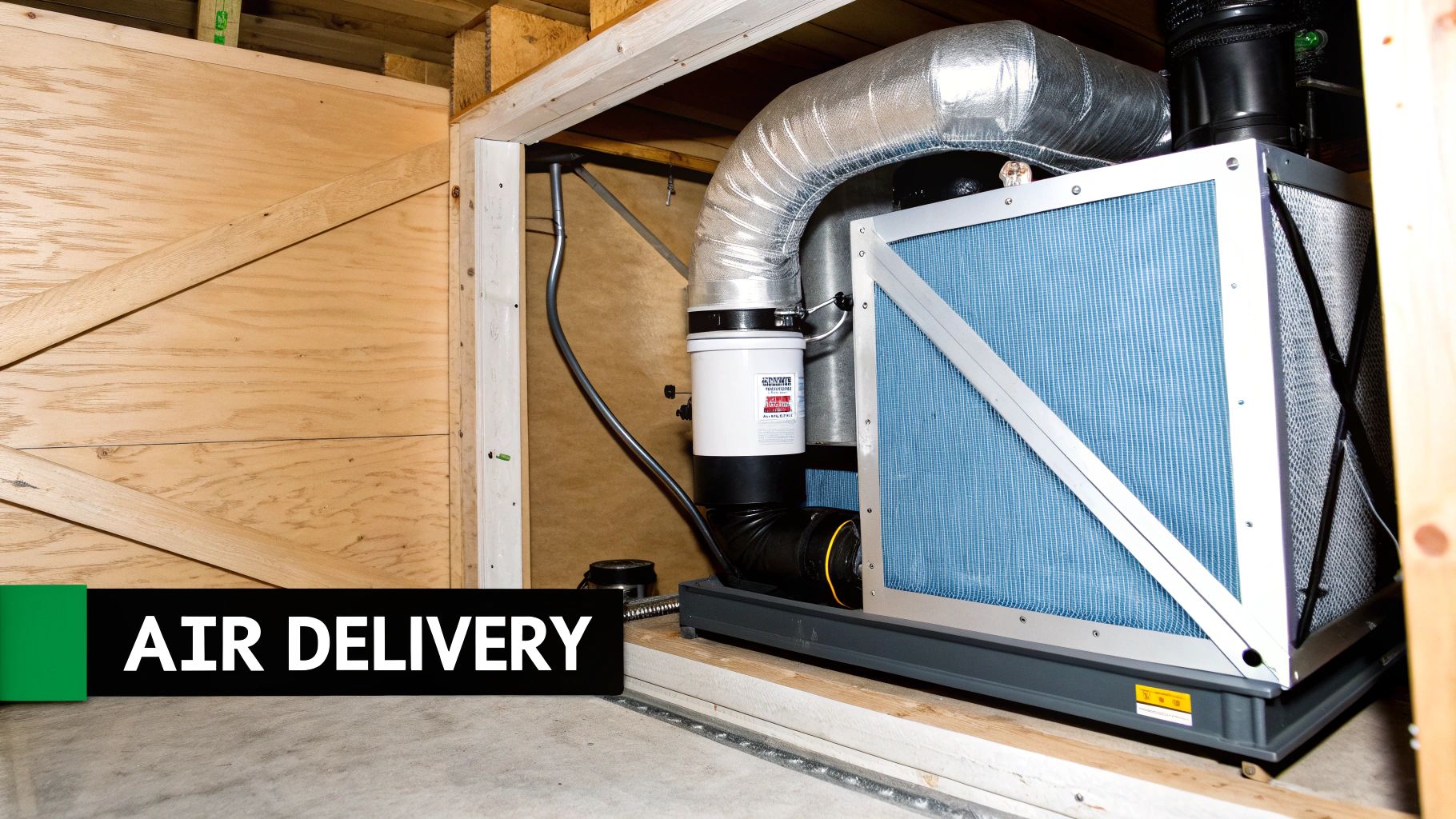
This whole operation hinges on three key parts of a central air conditioner unit working together. If any one of them fails, that wonderfully cold air created by your evaporator coil gets stuck in the attic or basement, never reaching you.
Let's break down the powerful fan, the hidden highways, and the essential bodyguard that make up this critical system.
The Blower Motor and Fan
Tucked away inside your indoor air handler is the blower motor, which is the engine that drives a large, hamster-wheel-like fan. This is the muscle behind the airflow you feel coming from your vents. The moment your thermostat calls for cooling, this motor kicks into action.
It has two critical jobs. First, it pulls warm, humid air out of your living spaces through the return ducts. Then, it powerfully pushes that air across the icy-cold evaporator coil, where all the heat and moisture get stripped away. This freshly chilled, dehumidified air is then sent out through the supply ducts to cool down your home.
A blower motor that's on its way out usually doesn't fail silently. If you start hearing loud squealing or screeching sounds, or if the airflow from your vents feels weak and pathetic, the motor is likely crying for help.
The Ductwork Air Highways
If the blower is the engine, then your home's ductwork is the massive network of highways hidden behind your walls, in the attic, and under the floor. This system of metal or flexible tubing is the transportation network for all that air.
It’s a two-way street:
Supply Ducts: These are the channels that carry the cool, conditioned air from the air handler out to every room in your house, ending at the supply vents you see on your floors, walls, or ceilings.
Return Ducts: These are the larger ducts that pull warm, stale air out of your rooms through return vents, sending it back to the air handler to get cooled all over again.
Leaky ductwork is a notorious energy waster. According to ENERGY STAR, the average home can lose 20% to 30% of the conditioned air moving through its ducts because of leaks, holes, and bad connections.
That’s a huge chunk of money spent cooling air that never even makes it into your living spaces. Properly sealed and insulated ducts are absolutely vital for both efficiency and comfort. To get a closer look at these hidden components, check out the parts of ductwork in our comprehensive guide.
The Air Filter: The System’s Bodyguard
Before any air can reach the blower and pass over that precious evaporator coil, it has to get past one of the most important parts of a central air conditioner unit: the air filter. Its main job is to act as a bodyguard for your expensive HVAC equipment.
The filter’s sole purpose is to trap dust, pollen, pet dander, and all the other gunk floating around in your air. Without it, those contaminants would plaster themselves all over the delicate fins of the evaporator coil and clog up the blower fan, choking your system's efficiency and setting it up for a complete breakdown. As a bonus, a clean filter also dramatically improves your home's indoor air quality.
Changing your air filter is, without a doubt, the single most important maintenance task you can do as a homeowner. A clogged filter suffocates your AC, forcing it to work way harder, which drives up energy bills and shortens its lifespan.
Comparing Common Air Filter Types
Not all filters are created equal. Choosing the right one for your home and lifestyle makes a big difference in both performance and how often you need to change it.
Here’s a quick breakdown of the most common types you’ll find.
Filter Type | Pros | Cons | MERV Rating | Replacement Frequency |
|---|---|---|---|---|
Fiberglass | Very inexpensive; allows for maximum airflow. | Captures only the largest particles like dust and lint. | 1-4 | Every 30 days |
Pleated | Balances good airflow with better filtration. | Costs more than fiberglass; can restrict airflow if it gets too dirty. | 5-13 | Every 60-90 days |
Electrostatic | Reusable and washable, saving money over time. | Higher initial cost; requires regular cleaning to be effective. | 4-10 | Monthly cleaning |
HEPA | Captures over 99% of airborne particles. | Very expensive; severely restricts airflow and often requires system modification. | 17-20 | Every 6-12 months |
Sticking to a regular replacement schedule based on the filter type and your home's specific conditions (like having pets or smokers) is the key to keeping your whole air delivery system running like a well-oiled machine.
If you suspect issues with your ducts or just want a professional to handle your system's maintenance, give Covenant Aire Solutions a call. We’ll make sure everything is clean, sealed, and ready to keep you cool.
The Brains and the Brawn: Thermostat and Refrigerant
While the big mechanical parts like the compressor and coils do the heavy lifting, two other elements are just as critical to making the magic of cooling happen. One is the brain of the operation, telling everything what to do and when. The other is the system’s lifeblood, the special fluid that physically carries heat out of your home.
These two parts, the thermostat and the refrigerant, are the unsung heroes that control and enable the entire system. Without them, even the most powerful AC unit would just be a very expensive, very useless collection of metal.
Let's dive into how this command center and its magical fluid work together to deliver cool comfort.
The Thermostat: Your AC's Mission Control
Your thermostat is the brain. It's that little box on your wall, but it’s in charge of the whole show. It constantly monitors your home's indoor temperature and acts as the central command hub for your entire HVAC system.
When the room gets warmer than the temperature you’ve set, the thermostat sends a signal to the air conditioner: "Time to get to work." Once the AC has run long enough to cool your home back down to that target temperature, the thermostat sends another signal telling it to shut off. This simple on-off cycle is the fundamental job of every thermostat, from old-school mercury dials to the newest smart devices.
Of course, modern smart thermostats have evolved way beyond that basic function. They can learn your family's schedule, automatically adjust temperatures when you’re away, and even be controlled from your smartphone, no matter where you are. Learning how to program a thermostat to save money and boost efficiency is one of the easiest ways to get a handle on your monthly energy bills.
The Refrigerant: The Heat-Absorbing Lifeblood
If the thermostat is the brain, then refrigerant is the system’s circulatory system. This remarkable substance flows through your AC's coils in a continuous, sealed loop, and it has a unique ability to absorb and release massive amounts of heat as it changes from a liquid to a gas and back again.
Think of refrigerant as a super-efficient heat sponge. As it flows through the indoor evaporator coil as a cold liquid, it soaks up heat from your home’s air. This causes it to boil and transform into a gas. From there, the compressor pumps this hot gas to the outdoor condenser coil, where it releases all that captured heat into the outside air and condenses back into a liquid, ready to start the journey all over again.
This constant phase-change cycle is the core of how your air conditioner physically moves heat from inside your house to the outside.
Critical Fact: Refrigerant operates in a closed, pressurized loop. If your system is low on refrigerant, it doesn't mean it got "used up." It always means there is a leak somewhere in the system that must be found and repaired by a professional.
Because refrigerant is a substance regulated by the EPA, it can only be handled by a licensed and certified technician. A leak not only cripples your AC's cooling power but also poses a risk to the environment. If your system isn't cooling well or you hear a hissing sound near your unit, turn it off and call Covenant Aire Solutions right away for professional leak detection and repair.
Key Electrical Parts That Power Your AC
Your AC’s powerful motors and fans don’t just turn on by themselves. Behind the scenes, a few small but mighty electrical parts manage the flow of energy that brings your system to life. Think of them as the unsung heroes that respond to your thermostat's call, kicking the whole cooling process into gear.
Without these components, your air conditioner is nothing more than a big, silent metal box. Two of the most important players are the capacitor and the contactor, both housed in the outdoor unit. Knowing what they do can help you troubleshoot, but fixing them is a job that absolutely must be left to the pros.
The Capacitor: A Powerful Kickstart
Imagine the capacitor as a short-term, high-powered battery. Its one and only job is to store and then instantly release a massive jolt of electricity to get the compressor and condenser fan motors spinning from a complete stop. Just like a car engine needs a big burst of power to turn over, these motors need a serious kick to overcome inertia, and the capacitor delivers it every single time.
A failing capacitor is easily one of the most common reasons we get a service call. If you hear a humming or buzzing noise coming from your outdoor unit but the fan and compressor just won't start, a bad capacitor is the prime suspect.
The Contactor: The High-Voltage Switch
The contactor acts as a high-voltage switch, basically an electrical gatekeeper. When your thermostat sends a low-voltage signal asking for cool air, it energizes a tiny electromagnet inside the contactor. This magnet then pulls a set of contacts together, closing the circuit and letting powerful 240-volt electricity surge to the compressor and fan motor.
When a contactor starts to go bad, you might hear a loud chattering or buzzing noise from the outdoor unit. That's the sound of the switch struggling to make a solid, clean connection. Understanding these electrical parts is key, and for a deeper dive into how these kinds of control systems work, learning about relays and their wiring can be really helpful.
CRITICAL SAFETY WARNING: High Voltage RiskBoth the capacitor and the contactor handle extremely high voltage. A capacitor can hold a dangerous electrical charge even after the power is turned off. Never attempt to handle, test, or replace these components yourself. This is a job that must be left to a qualified HVAC technician from Covenant Aire Solutions to avoid serious injury or electrocution.
Frequently Asked Questions About AC Parts
Even after breaking down all the components, we get a lot of the same questions from homeowners. It makes sense; knowing what the parts do is one thing, but knowing what to do when they act up is another. Here are some straightforward answers to the questions our technicians hear the most.
What Is the Difference Between Condenser and Evaporator Coils?
The biggest difference comes down to location and function. Your condenser coil lives in the outdoor unit, and its entire job is to release heat into the outside air. Because of this, it gets hot when the AC is running.
On the flip side, the evaporator coil is tucked away inside your home (usually in the air handler) and gets ice-cold to pull heat out of your indoor air. The easiest way to remember it is: the evaporator absorbs indoor heat, and the condenser releases that heat outside.
Why Is My Outside AC Unit Fan Not Spinning?
A fan that won’t spin almost always points to an electrical problem. More often than not, the culprit is a bad capacitor, a small part that gives the fan motor the jolt it needs to start up. The fan motor itself could have also just burned out.
Before you panic, take a quick look at your circuit breaker to see if it’s tripped. If the breaker is fine, then the issue is inside the unit and you’ll need a pro. The high-voltage components in there are not something you want to mess with.
Important Takeaway: If you see the fan isn't spinning, turn the whole AC system off right away. Leaving it on risks overheating the compressor, which can turn a small repair into a very expensive replacement.
For your own safety, this is one of those repairs that should always be left to a certified technician.
How Often Should I Really Change My Air Filter?
Honestly, it depends entirely on your filter and your home. If you're using a basic, one-inch fiberglass filter, you should be swapping it out every month, no exceptions. The thicker, pleated filters can usually go up to 90 days, and some of the high-end media filters might last six months or even a year.
But those are just benchmarks. If you have pets, smokers, or family members with allergies, you need to be checking that filter monthly, regardless of what the package says. Keeping that filter clean is the single most important thing you can do to keep your AC running efficiently and for a long, long time.
When the parts of your central air conditioner need an expert eye, you need a team you can count on. The technicians at Covenant Aire Solutions have the tools and experience to diagnose and fix any component, making sure your system runs safely and efficiently. Contact us today for service you can trust.