
What Is Central Air Explained For Homeowners
At its heart, a central air conditioning system is designed to do one thing really well: cool your entire home from a single, central point. It works by pulling the warm, stuffy air out of your rooms through a network of ducts, rapidly cooling that air using a refrigerant, and then pushing the fresh, chilled air right back out. The result is a consistent, even temperature everywhere, a huge step up from window units that can only tackle one room at a time.
Your Guide to Understanding Central Air
Think of a central air system as your home’s circulatory system, but for comfort. Instead of clunky, loud units humming away in every window, this setup is fully integrated and works quietly behind the scenes. It relies on an outdoor unit and an indoor unit, all connected by ductwork tucked away in your walls and ceilings. This design doesn't just deliver superior cooling; it also pulls humidity out of the air and filters out airborne particles, giving you a noticeable boost in air quality.
The real magic is a process called the refrigeration cycle. A special chemical refrigerant absorbs the heat from your indoor air and carries it outside to be released. Your thermostat is the command center for all of this, telling the system exactly when to kick on and off to keep your home at that perfect temperature you set. It’s this automated, whole-home control that makes central air the gold standard for modern houses.
For a quick reference, here's a look at the core features of a central air system.
Central Air at a Glance Key Features
Feature | Brief Description |
|---|---|
Cooling Method | Uses a split system (indoor & outdoor units) to circulate refrigerated air. |
Distribution | Delivers cool air through a network of ducts to multiple rooms simultaneously. |
Control | Managed by a central thermostat for consistent temperature control. |
Air Quality | Filters air as it circulates, removing dust, pollen, and other allergens. |
Operation | The loudest components are outside, resulting in much quieter indoor operation. |
This table gives you the basics, highlighting why this type of system is so popular for complete home comfort.
The Benefits of a Central System
While the initial installation is definitely more involved than just popping a unit in a window, the long-term advantages for your comfort and home's value are massive. A well-maintained central air system delivers powerful, efficient cooling that’s as discreet as it is effective.
The key benefits really speak for themselves:
Whole-Home Comfort: It pushes cool air to every single room connected to the ductwork. No more hot spots or rooms you have to avoid in the summer.
Improved Air Quality: As air moves through the system, built-in filters go to work trapping dust, pollen, and other allergens. You're left with cleaner, healthier air to breathe.
Quieter Operation: The parts that make all the noise, the compressor and condenser fan, are in the outdoor unit. Inside, you just get the gentle whoosh of cool air.
Energy Efficiency: Modern central air conditioners are engineered to be far more efficient than older models and especially more so than running multiple window units, which can lead to lower utility bills.
A clean, well-maintained HVAC system is scientifically proven to save money on energy. Studies show that keeping components like ducts and filters clean can result in fan and blower energy consumption reductions ranging from 41% to 60%.
Getting a handle on these fundamentals is the first step. If you want to go a little deeper into how your own system works, exploring some air conditioning basics for homeowners is a great way to get more familiar with your setup. From here, this guide will walk you through the rest of what you need to know.
The Surprising History of Home Cooling
To really appreciate the cool comfort we so often take for granted, it helps to rewind the clock. The story of central air doesn't start in a sweltering suburban home, but in the sticky, humid air of a Brooklyn printing plant way back in 1902. The constant shifts in humidity were an absolute nightmare for the printing process, messing with the paper and ink and ruining entire print runs.
A seriously frustrated publisher needed a fix, and a young, sharp engineer named Willis Carrier got the job. His mission wasn't to make the workers more comfortable; it was all about controlling the environment so the machinery could work properly. This purely industrial problem was the spark that ignited an invention that would completely change how and where we live.
An Industrial Solution Finds a New Home
Carrier’s clever device did more than just cool the air; it pulled moisture out by passing it over chilled pipes. This ability to control both temperature and humidity was a game-changer for industries far beyond printing: think textiles, manufacturing, and even movie theaters, which quickly became the go-to summer escape for the public.
The core idea was simple but profound. Instead of just blowing air over a block of ice, Carrier’s system used mechanical refrigeration to precisely manage a building's indoor atmosphere. This was the leap from basic cooling to true "air conditioning," and it laid the foundation for every modern system we use today.
For decades, this tech stayed locked in the commercial and industrial worlds. The systems were gigantic, outrageously expensive, and way too complicated for an average house. The idea of putting one in a private home was pure science fiction for most people.
The first real breakthrough into residential life happened in 1914, when the very first home central air conditioning system was installed in a Minneapolis mansion. But "home system" is a bit of an understatement; these early units were monstrous, often over 6 meters long and 2 meters high, making them a luxury only the absolute wealthiest could even dream of. You can dive deeper into the history of central air conditioning systems at Berico.com.
While that first installation was a milestone, it was an outlier. For the average family, beating the summer heat still meant open windows, lazy afternoons on the porch swing, and maybe a handheld fan if you were lucky. The technology was there, but it was nowhere near accessible.
The Post-War Boom and Suburban Spread
Everything changed after World War II. The American economy was roaring, and a massive housing boom created the sprawling suburbs we know today. As families flocked to these new homes, architects started doing something revolutionary: designing houses with central air conditioning in mind right from the blueprint stage.
This era brought a few key developments that finally made central air a household name:
Smaller, More Efficient Units: Manufacturers figured out how to shrink the technology, making the units more compact and, crucially, more affordable.
Rising Incomes: With the post-war boom, more families had the disposable income to invest in home comfort.
Architectural Integration: Designing new homes with ductwork built-in from the start made installation much easier and cheaper.
By the 1960s, central air was shedding its status as a rich-person's toy. It was becoming a standard feature in middle-class homes, especially in the rapidly growing Sun Belt. This one invention made previously unbearable climates far more livable, directly fueling the population explosion in states like Arizona, Florida, and Texas.
What began as a simple fix for a Brooklyn printing press had fundamentally redrawn the map of America and completely changed our definition of a comfortable home.
How a Central Air System Actually Cools Your Home
Ever wonder how that box outside your house manages to fill your home with cool, refreshing air on a sweltering day? It’s not magic, but it is a clever and continuous process called the refrigeration cycle.
Think of it this way: your AC system is basically a dedicated heat taxi. Its only job is to pick up the unwanted heat from inside your house and shuttle it outside, leaving you with nothing but comfort. The key to this whole operation is a special substance called a refrigerant, a fluid that can easily switch between liquid and gas. This quick-change ability is what lets it absorb and ditch massive amounts of heat.
The Thermostat: Your Command Center
It all starts with a simple flick of the wrist. When you set your thermostat to a cooler temperature, you're giving the system its marching orders. The thermostat acts as the brain, constantly monitoring the room's temperature. The moment it creeps above your set point, it sends out the signal: "Time to get to work."
Step By Step Through the Refrigeration Cycle
Once the thermostat gives the green light, the different parts of your central air system jump into action in a perfectly timed sequence. This four-step cycle runs on a loop until your home reaches that perfect temperature you set.
Compression (The Pressure Cooker): The journey begins in the outdoor unit. Here, the refrigerant shows up as a cool, low-pressure gas. The compressor, the real heart of the system, squeezes this gas, cranking up its pressure and temperature. By the time it leaves, it’s a super-hot, high-pressure gas.
Condensation (Releasing the Heat): This hot gas then flows into the condenser coils, which are also in the outdoor unit. A big fan blows outside air across these coils. As the air passes over, it pulls heat away from the hot refrigerant inside. This causes the refrigerant to cool down and condense back into a liquid, kind of like how steam fogs up a cool mirror. This is the moment all that unwanted heat from inside your home is finally dumped outside.
Expansion (The Pressure Drop): Now a high-pressure liquid, the refrigerant travels back towards the indoor unit. Right before it enters the evaporator, it gets squeezed through a tiny device called an expansion valve. This valve does the exact opposite of the compressor, causing a massive pressure drop that turns the liquid into an ice-cold, low-pressure mist.
Evaporation (Soaking Up the Heat): This frosty refrigerant mist now flows into the evaporator coil, tucked away inside your home (usually in an attic, closet, or basement). Your indoor fan, or air handler, pulls warm air from your living spaces and blows it across these frigid coils. Just like a sponge soaking up water, the refrigerant inside the coil absorbs the heat from the air. This heat absorption makes the refrigerant boil and turn back into a cool, low-pressure gas. The newly chilled air is then pushed through your ducts to cool your rooms, and the refrigerant gas heads back outside to start the cycle all over again.
This timeline shows how the technology that powers this cycle went from an industrial workhorse to a staple of modern homes.
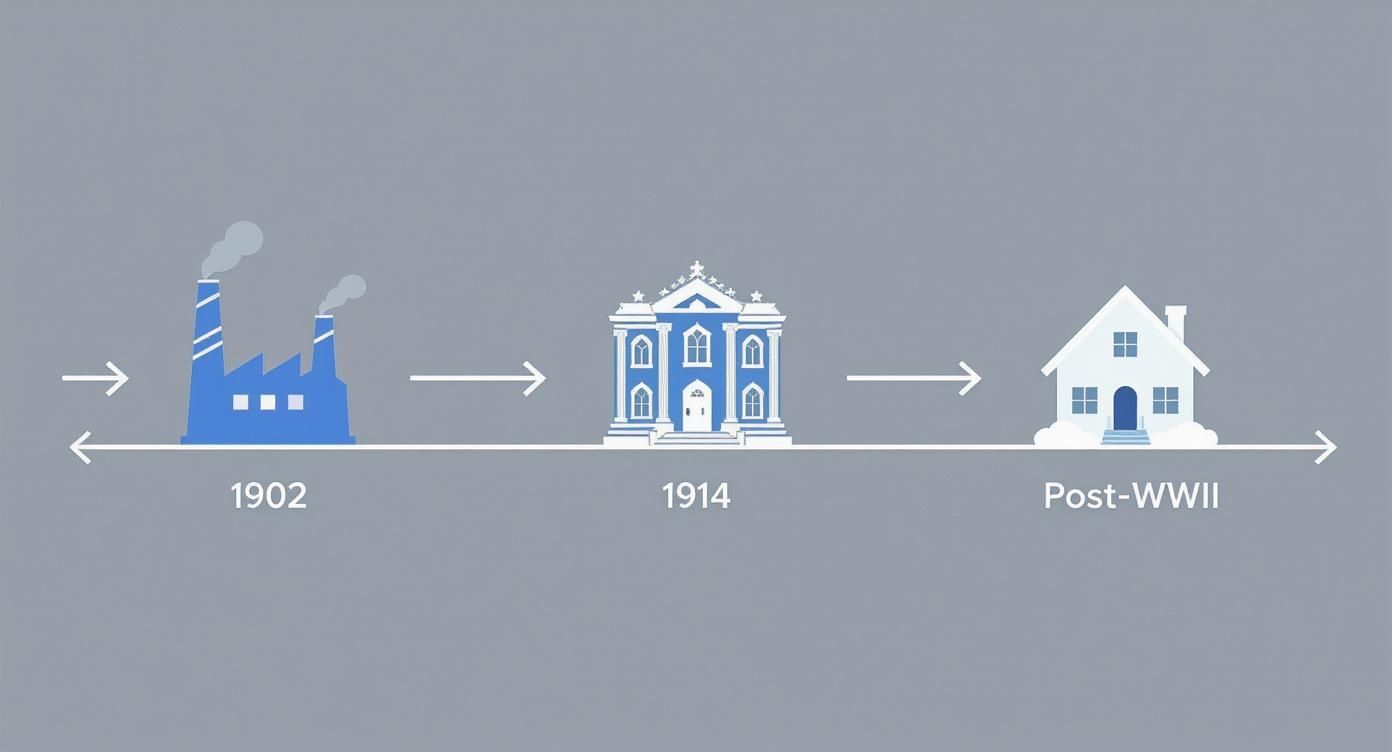
As you can see, what started as a way to improve manufacturing processes became a luxury for the rich before finally becoming something the average family could afford, completely changing how we live.
The real genius of the refrigeration cycle is that it's not "making cold." It’s just moving heat energy from where you don’t want it (your living room) to a place where it doesn’t matter (the great outdoors). This simple heat exchange is the foundation of all modern air conditioning.
This same core process is at work in almost any cooling appliance you can think of, from the fridge in your kitchen to more complex HVAC setups. If you're curious about different system types, you can see how this cycle is used by exploring what a split-system HVAC is and how it works for your home.
From the thermostat's simple command to the intricate dance of pressure and temperature changes, every component works together seamlessly. The end result? That wonderfully cool air that provides sweet relief on the hottest days of the year.
The Key Components of a Central Air Unit
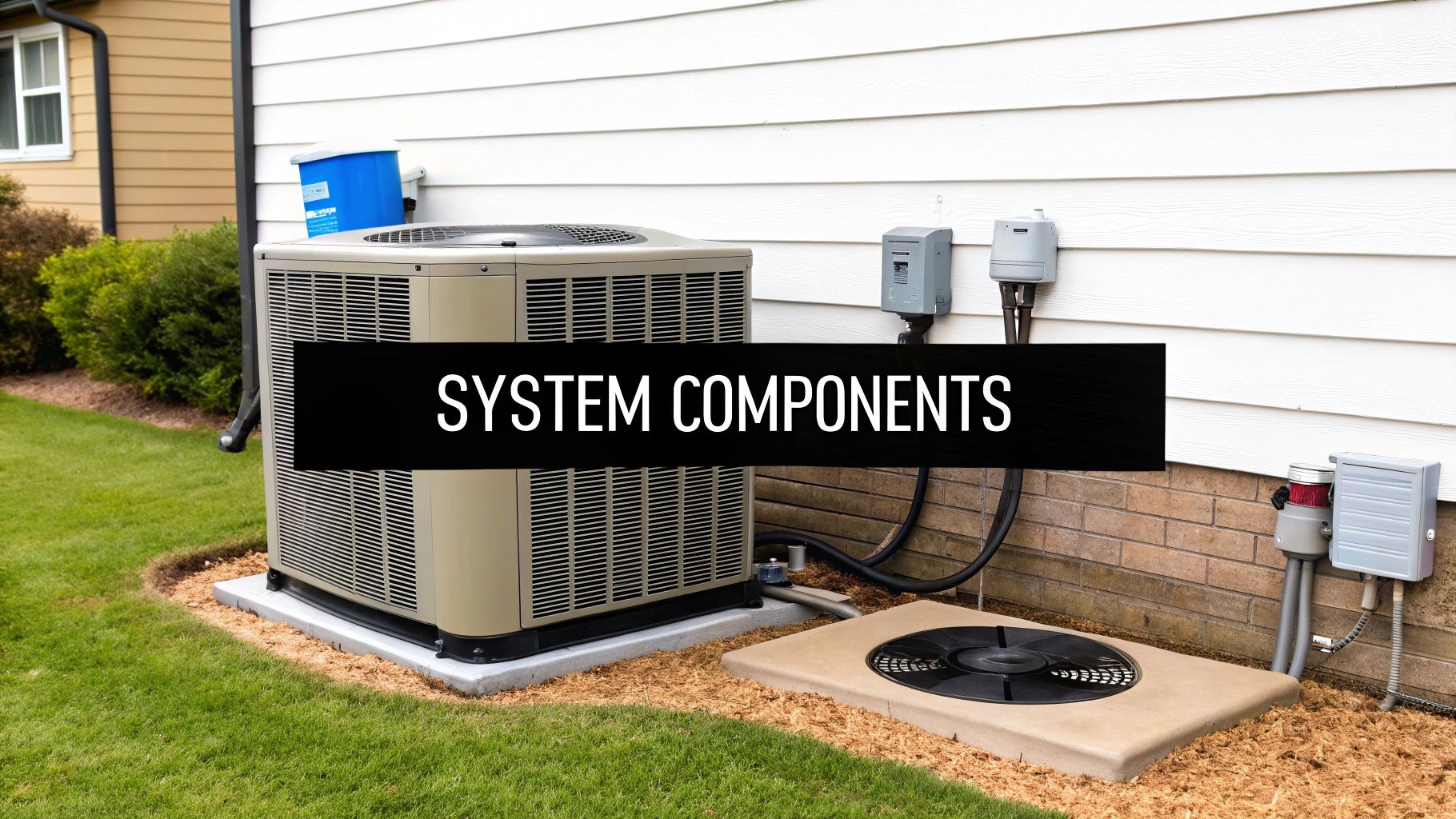
To really get what central air is all about, you need to meet the key players. Think of the whole system as a well-rehearsed team, where every member has a specific and vital job. When they all work together in harmony, the result is a perfectly cool and comfortable home.
This team is generally split into two main sections: the parts that live outside your house and the parts that live inside. Let’s break down the anatomy of a typical central air conditioner and get to know the hardworking components that make the magic happen.
The Outdoor Unit: A Heat-Expelling Powerhouse
You know that big metal box sitting next to your house? That's the outdoor unit, often called the condenser unit. This is where your system dumps all the heat it has pulled out of your home’s air. This outdoor workhorse contains two of the most critical parts of the entire operation.
The Compressor: This is the heart of your central air unit. Its one job is to pressurize the refrigerant, a special fluid that absorbs and releases heat. By squeezing the refrigerant, the compressor cranks up its temperature and pressure, getting it ready to release its stored heat into the outside air.
The Condenser Coil: After getting squeezed by the compressor, the hot, high-pressure refrigerant flows through these coils. A huge fan pulls outside air across the coils, and just like that, heat transfers from the refrigerant to the air. This allows the refrigerant to cool down and turn back into a liquid.
The Indoor Unit: The Cooling Core
Tucked away in a closet, basement, or attic is the indoor unit. This is where the actual cooling and circulation of air happen. This unit is the other half of the "split-system" design and works hand-in-hand with its partner outside.
Its main components are:
The Evaporator Coil: This is where the real cooling magic happens. The now-liquid refrigerant from the outdoor unit flows into this coil and becomes intensely cold. The indoor fan, or air handler, blows your warm household air across this freezing coil, which sucks the heat right out of the air, leaving it cool and crisp. As it absorbs all that heat, the refrigerant turns back into a gas and heads back outside to start the cycle all over again.
The Air Handler: This is the powerful fan that gets the air moving. It pulls warm air from your rooms through return ducts, pushes it over the ice-cold evaporator coil, and then sends the newly chilled air out through supply ducts to the rest of your home.
Together, the outdoor and indoor units are the backbone of what's called the refrigeration cycle. The outdoor unit’s job is to get rid of heat, while the indoor unit's job is to absorb it. This continuous exchange is what keeps your home so comfortable.
The Brain and The Nervous System
Beyond the main indoor and outdoor units, two other elements are absolutely essential for the system to work. These parts control and connect everything, making sure cool air gets exactly where it needs to go.
The ThermostatThis is the command center for your entire system. You tell it your perfect temperature, and it keeps a constant watch on the indoor air. The moment the temperature creeps above your set point, the thermostat signals the system to kick on. Once it reaches your desired coolness, it signals it to turn off. Simple as that.
The DuctworkIf the compressor is the heart, then the ductwork is the circulatory system. This network of channels, hidden in your walls, ceilings, and floors, is responsible for moving air. Return ducts pull warm air into the system to be cooled, while supply ducts distribute that refreshing, conditioned air back into every room.
Understanding what each part does makes it much easier to see how the system works as a whole. For a more detailed look, check out our homeowner's guide to the parts of a central air conditioner. Knowing these components empowers you to better understand your system's health and talk shop with technicians when you need to.
Central Air Compared To Other Cooling Methods
While a central air system is the gold standard for seamless, whole-home cooling, it’s not the only game in town. Understanding how it stacks up against other popular methods is key to figuring out if it’s the right fit for your home, your budget, and your family's needs.
Let's put central air in a head-to-head comparison with some common alternatives you’ll see around, like window units and ductless mini-splits. Each one has its own set of strengths and weaknesses when it comes to cooling power, cost, and overall convenience.
The Classic Window Unit
We all know the window air conditioner. These self-contained boxes are designed to cool a single room by pushing hot air directly out of the window they occupy. They're easy to find and relatively cheap to buy, which makes them a go-to choice for apartments or for giving a boost to one specific hot spot in a house.
But their limitations are pretty significant. Window units are often noisy, they block your view, and they can even be a security risk. More importantly, their cooling power is stuck in one space. Trying to cool a whole house with multiple window units can get surprisingly inefficient, often driving up your electricity bill far more than a single central system would.
The big trade-off with window units is the upfront cost versus long-term performance. The initial price tag is low, but you sacrifice the efficiency, quiet operation, and whole-home comfort that really define central air.
The Flexible Ductless Mini-Split
A more modern alternative is the ductless mini-split system. Just like central air, it has an outdoor compressor and an indoor air-handling unit. The key difference? It doesn't need a network of ducts. Instead, a small conduit connects the two components, making installation much less invasive.
This design makes mini-splits a fantastic solution for older homes that were built without ductwork, for new additions, or for creating specific temperature "zones" throughout a house. When looking at different cooling systems, it's smart to understand the financial side of things, like exploring the complete air source heat pump costs, since many ductless systems are heat pumps that handle both heating and cooling.
Ductless systems are incredibly efficient and run very quietly, but the initial cost can be higher than traditional central air, especially if you need several indoor units to cover the whole house. For a detailed breakdown, check out our guide on ductless vs. central air for Arizona homes to help you weigh the pros and cons for our unique climate.
Home Cooling Systems Comparison
Sometimes, seeing everything laid out side-by-side makes the decision crystal clear. This table breaks down how each cooling system performs on the factors that matter most to homeowners, helping you see the full picture at a glance.
Cooling Method | Best For | Typical Cost | Energy Efficiency | Pros & Cons |
|---|---|---|---|---|
Central Air | Cooling an entire home with existing ductwork uniformly. | High initial cost, lower long-term operating costs. | High | Pros: Quiet, even cooling, improves air quality.Cons: Requires ductwork, expensive installation. |
Ductless Mini-Split | Homes without ducts, room additions, or zoned cooling. | High initial cost, especially for multiple zones. | Very High | Pros: No ducts needed, very efficient, quiet.Cons: Higher cost per zone, visible indoor units. |
Window AC Unit | Cooling a single room or supplementing central AC. | Low initial cost. | Low to Medium | Pros: Inexpensive, easy to install.Cons: Noisy, cools only one room, inefficient for whole-home use. |
As you can see, there isn't one "best" answer for everyone. The right choice really depends on your home's unique layout, your budget, and what you're hoping to achieve with your cooling system.
The Last Resort: Portable ACs
Finally, we have portable air conditioners. These are standalone units that sit on your floor and use a big, clunky hose to vent hot air out of a window.
While they offer the flexibility of being moved from room to room, they are generally the least efficient and noisiest option available. They’re best thought of as a temporary fix or a solution for a space where a window unit just isn’t possible. For consistent, powerful cooling, they simply can't compete.
At the end of the day, central air remains the superior choice for delivering quiet, efficient, and truly comprehensive comfort throughout your entire living space.
Decoding Energy Efficiency and SEER Ratings
When you're figuring out what central air is all about, energy efficiency is a huge piece of the puzzle. It’s what directly connects your comfort to your monthly utility bills and your home's environmental impact. The main way we measure this is with the SEER rating, which stands for Seasonal Energy Efficiency Ratio.
Think of a SEER rating like the miles-per-gallon (MPG) rating on a car. The higher the number, the more efficient the machine. It tells you how much cooling an AC unit can deliver for every unit of electricity it uses over a typical summer. A system with a high SEER rating needs less energy to cool your home, which translates directly into lower energy bills for you.
What Is a Good SEER Rating
What we consider a "good" SEER rating has definitely changed over the years. When the SEER metric was first introduced back in the 1970s, it wasn't uncommon to see systems with ratings as low as 6. Today, the standards are much, much higher.
As of 2023, the U.S. government requires a minimum SEER rating of 14 for new central air conditioners installed in most parts of the country. While 14 is the starting point, you'll find plenty of high-efficiency models on the market with ratings of 20 or even higher.
Choosing a unit with a higher SEER rating often means a greater upfront investment. However, the long-term savings on your energy bills can frequently offset this initial cost over the lifespan of the system, delivering a strong return on your investment.
To really get a handle on this important number, you can learn more about what a SEER rating is and how it impacts your energy bills in our detailed guide. It'll help you feel much more confident when you're comparing different models.
Balancing Cost and Efficiency
Finding the sweet spot between the initial purchase price and the long-term running costs is the name of the game. A basic, minimum-efficiency unit might look appealing on the price tag, but it will cost you more every single month it runs. On the flip side, a top-of-the-line, ultra-high-efficiency model will give you the lowest operating costs but comes with the biggest upfront investment.
Here are a few things to consider when you're picking a SEER rating:
Your Local Climate: If you live in a hot climate like here in Arizona, your AC is going to be working hard for months on end. In that case, investing in a higher SEER unit (16 or above) usually pays for itself much faster through major energy savings.
Your Budget: Figure out what you can comfortably afford right now, but don't forget to factor in the potential for smaller monthly bills down the road.
System Lifespan: A central air system is a major home investment, typically lasting 15-20 years. When you calculate the potential energy savings over that entire period, the initial cost starts to look a lot different.
Beyond just the SEER rating, there are tons of practical ways to cut down on your energy use. For a deeper dive, check out these advanced HVAC energy-saving tips. Making an informed choice on efficiency is the key to getting a system that keeps you comfortable without breaking the bank.
Your Top Questions About Central Air
Alright, let's wrap things up by tackling some of the most common questions homeowners have about their central air systems. Getting a handle on these key points can make a huge difference in how you manage your system, from simple upkeep to knowing when it's time for an upgrade.
Think of this as our final chat to clear up any last-minute curiosities.
How Long Does a Typical Central Air System Last?
Generally speaking, a well-cared-for central air conditioning system will give you 15 to 20 years of reliable service. But that number isn't set in stone. The lifespan really depends on a few things: the quality of the original installation, the intensity of your local climate, and just how hard it has to work day in and day out.
The biggest factor by far? Consistent maintenance. Getting regular professional tune-ups and being diligent about changing your air filters is the secret to a long, efficient life for your unit. If you let that slide, you're likely looking at early breakdowns and a much shorter run.
What Are the Signs My Central Air Unit Needs Replacement?
It can be tough to decide between another repair and a full replacement, but your system will usually start dropping some pretty clear hints when it's on its last legs. If your unit is already past the 15-year mark, that's your first big clue.
Beyond age, keep an eye out for these tell-tale signs:
Frequent and Costly Repairs: Are you and your HVAC technician becoming best friends? If you're constantly calling for service, you might be throwing good money after bad.
Skyrocketing Energy Bills: When your utility costs suddenly jump with no other explanation, it's often because your AC is losing its efficiency and guzzling energy just to keep up.
Inconsistent Performance: Strange noises, funky smells, or a stuffy, humid feeling in your home are all signs that your system is failing to do its job properly.
When you start seeing a combination of these issues, investing in a new, high-efficiency system often makes more financial sense than continuing to patch up an old, tired one.
A modern system doesn't just solve these nagging problems. It also brings major improvements in energy efficiency, which can translate into serious savings on your monthly bills for years to come.
Can I Install Central Air in an Older Home Without Ductwork?
Absolutely! You can definitely bring the comfort of modern central air into an older home, even if it wasn't built with ducts. While you could retrofit traditional ductwork, it's often a major, expensive, and messy project. Thankfully, there are some fantastic alternatives available today.
High-velocity systems, sometimes called "mini-duct" systems, use small, flexible tubes that are much easier to snake through existing walls and ceilings with minimal disruption. Another incredibly popular option is a ductless mini-split system. These units deliver powerful, room-by-room cooling and don't require any ductwork at all, making them a perfect, efficient fit for historic homes or unique architectural spaces.
Navigating the world of central air can seem complex, but you don't have to do it alone. Whether you're considering a new installation, need urgent repairs, or want to schedule routine maintenance to extend your system's life, the certified experts at Covenant Aire Solutions are ready to help. Visit us at https://www.covenantairesolutions.com to schedule your service today.