
AC Blows Hot Air? A Practical Troubleshooting Guide for Homeowners
- Jan 28
- 13 min read
When your AC starts blowing hot air in the middle of a Tucson summer, it’s not just an inconvenience, it's a full-blown emergency. But before you panic, know that the cause is often something surprisingly simple. I've seen it countless times: a wrong setting, a tripped breaker, or a filter that's seen better days.
These are issues you can usually spot and fix yourself in minutes, getting that cool air flowing again without having to make a service call.
First Steps When Your AC Blows Hot Air
That first blast of warm air from your vents is always a frustrating moment, especially when the temperature outside is climbing into the triple digits. Before you assume the worst (and a massive repair bill), a few quick checks can often solve the problem right then and there.
Let's walk through the most common culprits you can safely investigate on your own. Think of this as your initial diagnostic checklist to rule out the easy stuff first.
Check Your Thermostat Settings
It might sound too simple to be true, but the thermostat is the brain of your entire HVAC system, and a simple mistake here is the number one reason for a "broken" AC. Settings get bumped by kids, pets, or even just by accident. It happens.
Here’s what to look for:
Is it actually set to "Cool"? Make sure the system mode is on "Cool" and not "Heat," "Fan," or "Off." If it's on "Fan," the system will circulate air, but it won't be cooled, which will definitely feel warm on a hot day.
What's the temperature set to? The set temperature needs to be lower than the current temperature in the room. If you have it set to 80°F and your house is already 78°F, the cooling cycle simply won't turn on.
Are the batteries dead? Many digital thermostats run on batteries. If that screen is blank or flashing a low battery icon, a fresh set of batteries could be all you need to get things working again.
A quick thermostat check should always be your first move. It costs nothing, takes only a few seconds, and might just save you the time and expense of a professional visit for a problem that wasn't really a problem at all.
Inspect the Circuit Breaker
Your air conditioner is a powerful piece of equipment that pulls a lot of electricity, so it has its own dedicated circuits. Typically, one circuit powers the indoor unit (the air handler) and a separate, high-voltage circuit powers the outdoor unit (the condenser). If either of these trips, a key part of your system loses power and stops working. To learn more about the outdoor unit, check out our guide on what a condenser unit is.
A tripped breaker is a safety mechanism designed to cut power during an overload to prevent damage. Head to your home's main electrical panel and look for any breaker switches that are flipped to the "Off" position or are stuck in the middle.
If you find one, push it firmly back to the "On" position. If it immediately trips again, do not reset it a second time. This is a clear sign of a more serious electrical problem that needs a professional technician to diagnose and fix safely.
Your DIY AC Troubleshooting Checklist
When your AC starts blowing hot air, especially during a Tucson summer, it’s easy to jump to the worst-case scenario. But before you panic and assume a major system failure, take a deep breath. More often than not, the culprit is something surprisingly simple you can fix yourself.
Walking through a few key checkpoints can often isolate the problem and get the cool air flowing again without a service call. This is the same process we’d start with.
This simple decision tree can help guide your initial checks.
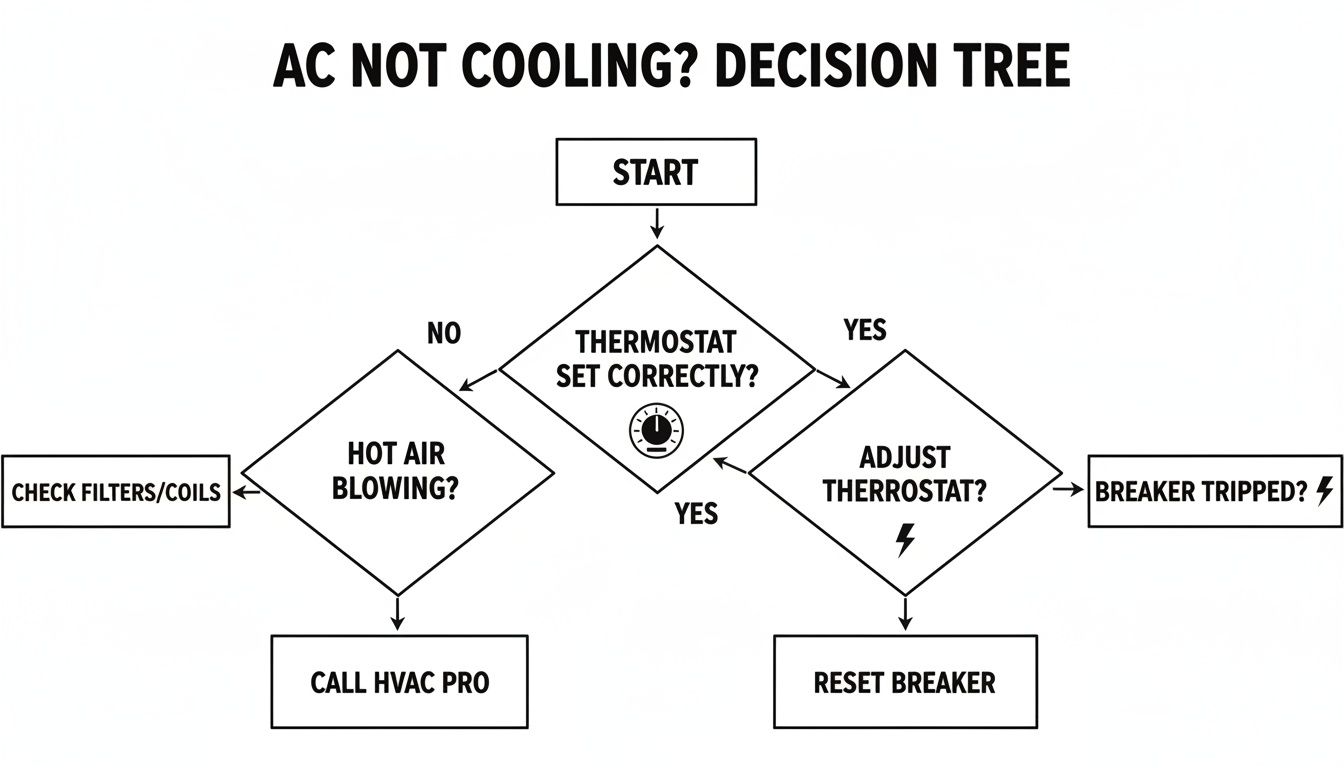
As the flowchart shows, the most logical first steps are always the easiest ones: the thermostat and the breaker.
First, Check the Air Filter
Think of your AC system like an athlete: it needs to breathe. A clogged air filter is like forcing it to run a marathon while breathing through a straw. It suffocates the system, severely restricting airflow and forcing it to work way too hard. This strain can cause internal parts to overheat and, eventually, shut down the cooling process completely.
Here in a dusty climate like Tucson, filters get dirty fast. Honestly, a neglected filter is one of the top reasons we get called out for an AC blowing hot air.
Make it a habit to check your filter once a month. Here’s how:
Find your filter. It’s usually in a slot right on your indoor air handler or tucked inside a return air vent in a wall or ceiling.
Give it a look. Hold it up to a light source. If you can’t see the light through it, it’s way past due for a change.
Swap it out. Slide the dirty one out and pop the new one in. Just be sure the arrows on the filter's frame point in the direction of the airflow (toward the furnace/air handler).
Safety First: Always kill the power to your HVAC system before you open any panels. Turn it off at the thermostat and flip the corresponding circuit breaker. This simple step prevents the risk of electrical shock and protects your equipment.
Next, Check and Reset Your Circuit Breakers
We mentioned breakers, but it’s important to know there are usually two of them. Your HVAC system has an indoor unit (the air handler) and an outdoor unit (the condenser), and they’re often on separate circuits. If the outdoor unit's breaker trips, the fan inside will still run and blow air, but that air won't be cooled because the condenser isn't running.
Head to your home’s main breaker box and look for two breakers, likely labeled "AC," "HVAC," "Condenser," or "Air Handler."
If one is tripped, it’ll be in the "off" position or stuck in the middle, so flip it firmly back to the "on" position. If it trips again right away, do not reset it a second time. This is a clear sign of a more serious electrical problem that requires a licensed technician. For more detailed instructions, our homeowner’s guide to troubleshooting AC problems has you covered.
Finally, Inspect the Outdoor Condenser Unit
Your outdoor unit has one critical job: to eject all the heat it pulled from inside your house. To do that, it needs plenty of room to breathe. Overgrown bushes, stacked-up lawn furniture, or a thick blanket of leaves and dirt can completely block airflow.
When the unit can't get rid of that heat, pressure builds up inside the system, putting a massive strain on the compressor. The result? Your system starts blowing hot air.
Take a quick walk outside and give your condenser a visual inspection. You’re looking for a few things:
Debris: Clear away any leaves, grass clippings, or dirt piled up on the unit's metal fins.
Obstructions: Make sure there is at least two feet of clear space around the entire unit. Trim back any shrubs or weeds that are getting too close.
Dirty Coils: Look closely at the fins. If they’re caked in dirt or that classic Tucson cottonwood fluff, they can't transfer heat properly.
Knowing When It's Time to Call in a Pro
So, you've gone through the basic checklist. You’ve checked the thermostat, flipped the breaker, and even peeked at the air filter. But your AC is still stubbornly blowing lukewarm air. What now?
While many AC hiccups are simple fixes, there comes a point where the DIY approach can do more harm than good. Some problems are just too complex, or downright dangerous, to tackle without the right training and specialized tools. Knowing how to spot these red flags is crucial for protecting your family, your home, and that expensive piece of equipment sitting outside.
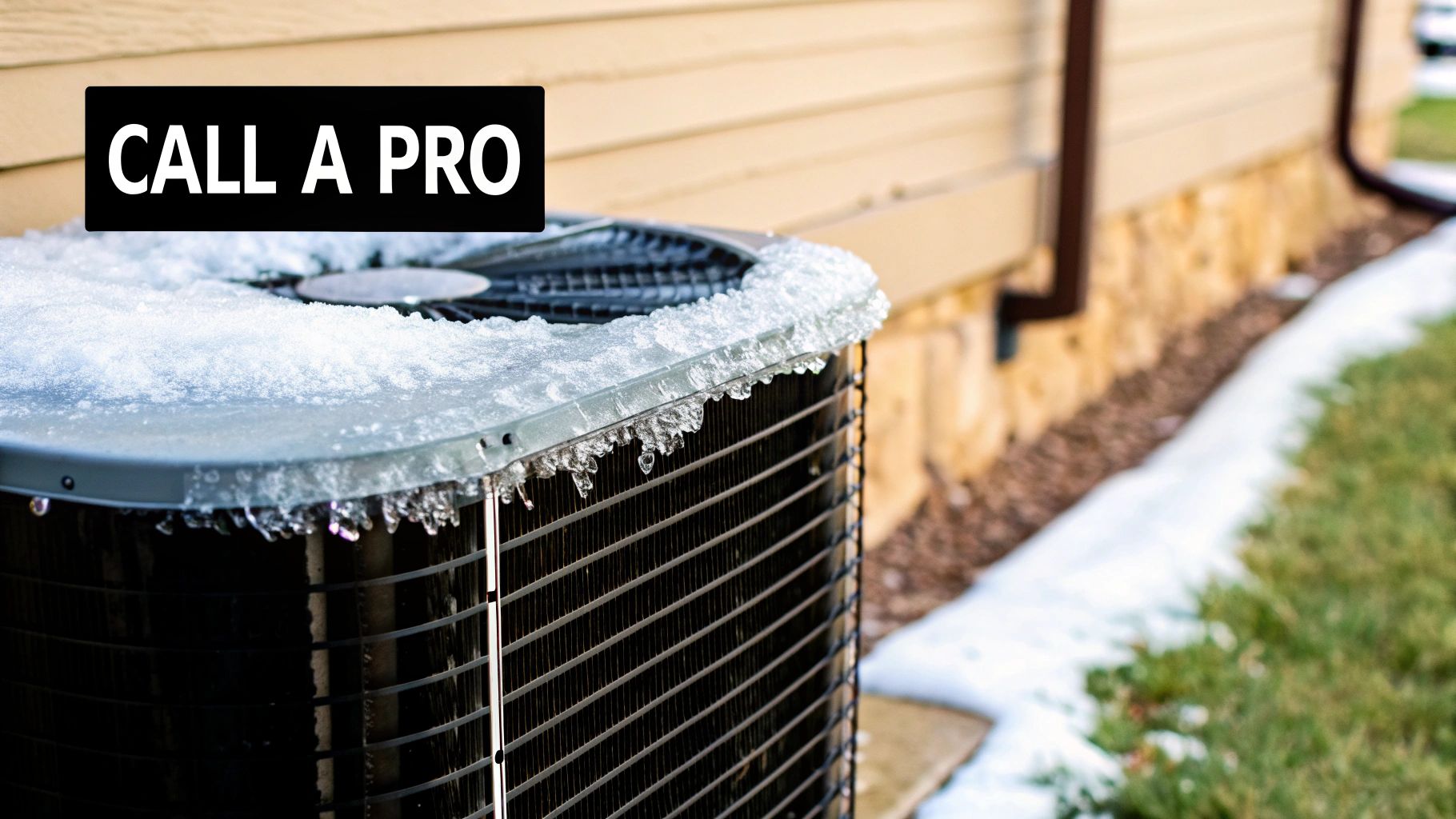
This is where your job description shifts from "homeowner-mechanic" to "smart-decision-maker." Certain symptoms aren't just quirks; they’re clear signals of a deeper mechanical or electrical failure that needs an expert eye.
Telltale Signs of a Refrigerant Leak
Refrigerant, you might know it by the brand name Freon, is the absolute lifeblood of your air conditioner. It circulates in a closed loop, which means it should never run low or need a "top-off." If it's low, you have a leak. Period. And that’s a serious issue, not just for your comfort but for the environment, too.
Keep an eye (and an ear) out for these dead giveaways:
Hissing or Bubbling Sounds: That distinct hissing noise coming from your indoor or outdoor unit is a classic sign of refrigerant gas escaping under high pressure. You might even hear a faint bubbling sound along the copper refrigerant lines.
Ice Buildup on the Coils: If you see a coating of frost or solid ice on the copper lines or the evaporator coil (inside your air handler), something's wrong. Low refrigerant causes the coils to get intensely cold, freezing the moisture right out of the air.
It Just Won't Cool Down: Your AC runs and runs, but the house never seems to reach the temperature you set on the thermostat. Without enough refrigerant to absorb heat from your indoor air, the system is just spinning its wheels.
Heads Up: A refrigerant leak is not a DIY job. Handling refrigerant requires an EPA certification by law. A licensed tech has to find the leak, properly repair it, and then recharge the system with the exact amount of refrigerant specified by the manufacturer.
Complex Electrical Failures
Beyond a breaker that just needs to be reset, your AC has several electrical components that can fail, causing it to blow hot air. These parts are under high voltage and are incredibly dangerous to mess with unless you know exactly what you're doing.
It’s time to call a professional if you think one of these parts is the culprit:
A Faulty Capacitor: Think of the capacitor as a small battery that gives the compressor and fan motors the powerful jolt they need to start up. When it fails, your outdoor unit might just hum without actually starting, or the fan may spin sluggishly.
A Bad Contactor: This is basically a heavy-duty switch that controls the flow of high-voltage power to the outdoor unit. If the contactor burns out or gets stuck, it can’t complete the circuit to get things running.
A Failing Compressor: This is the heart of your entire AC system. It's responsible for pumping refrigerant through the lines. A compressor on its last legs might make loud, ugly grinding or rattling noises. If the compressor dies completely, your system has zero ability to cool.
These repairs involve working with live, high-voltage circuits and replacing parts that have to be an exact match for your system. Trying to do this yourself creates a serious risk of severe electrical shock and can easily cause permanent, costly damage to your unit. When it comes to electrical issues, the answer is always the same: pick up the phone and call a pro.
Breaking Down AC Repair Costs in the Tucson Area
Let's be honest, nobody enjoys getting an AC repair bill. But knowing what to expect can really take the sting out of the process. When your air conditioner starts blowing hot air, the final cost to fix it can swing wildly depending on what's actually broken. It’s never just about a single part; a few key factors always come into play.
Your final invoice will really hinge on the specific problem, the age and model of your AC unit, and even when you call for help. An emergency service call on a holiday weekend, for instance, is naturally going to cost more than a standard appointment during the week.
What Goes Into Your Final Bill?
The first thing a technician will do is diagnose the problem, and that's what sets the stage for the cost. A simple fix, like replacing a bad capacitor, is usually quick and won't break the bank.
But if you're dealing with a bigger issue, like a dying fan motor or a tricky refrigerant leak, you’re looking at more labor time and more expensive parts. That’s when the costs start to climb.
Older AC units can also be a headache financially. Parts can be harder to track down, and if your system still uses the old R-22 refrigerant (which is being phased out), a recharge service will be significantly more expensive than it would be for a modern system.
Finding an HVAC company that gives you upfront, honest pricing is non-negotiable. You should always get a clear, itemized estimate before any work starts. That way, there are no nasty surprises on the final invoice. It’s all about transparency and making sure you can make a decision you're comfortable with.
Estimated AC Repair Cost Ranges in Tucson
To give you a ballpark idea of what you might be looking at, we've put together a table of common AC repairs we see here in the Tucson area. Think of this as a general guide, as your actual cost will depend on the specifics of your system and the problem at hand.
Common AC Repair | Estimated Cost Range | Factors Affecting Price |
|---|---|---|
Capacitor Replacement | $150 – $400 | The specific size and type of capacitor your AC unit requires. |
Refrigerant Recharge | $250 – $750+ | Depends heavily on the refrigerant type and the size of the leak that needs repair. |
Condenser Fan Motor | $400 – $900 | Price varies based on the motor's brand and whether it's a universal or OEM part. |
Condenser Coil Cleaning | $175 – $450 | Cost is influenced by how dirty the coils are and how accessible the outdoor unit is. |
When it comes to the major league components like the compressor, the costs can jump significantly. To get a better handle on those bigger expenses, it’s worth reading our detailed AC compressor replacement cost guide. It can help you weigh the pros and cons of a major repair versus replacing the whole system.
Preventive Maintenance to Keep Your AC Running Cold
Let’s be honest, the best way to deal with an AC blowing hot air is to make sure it never happens in the first place. Being proactive is always less stressful, and a whole lot cheaper, than making a frantic emergency call during a brutal Tucson heatwave.
Think of it this way: regular maintenance isn't just a suggestion from an HVAC guy. It’s the single best investment you can make for your home’s comfort and your system's lifespan.
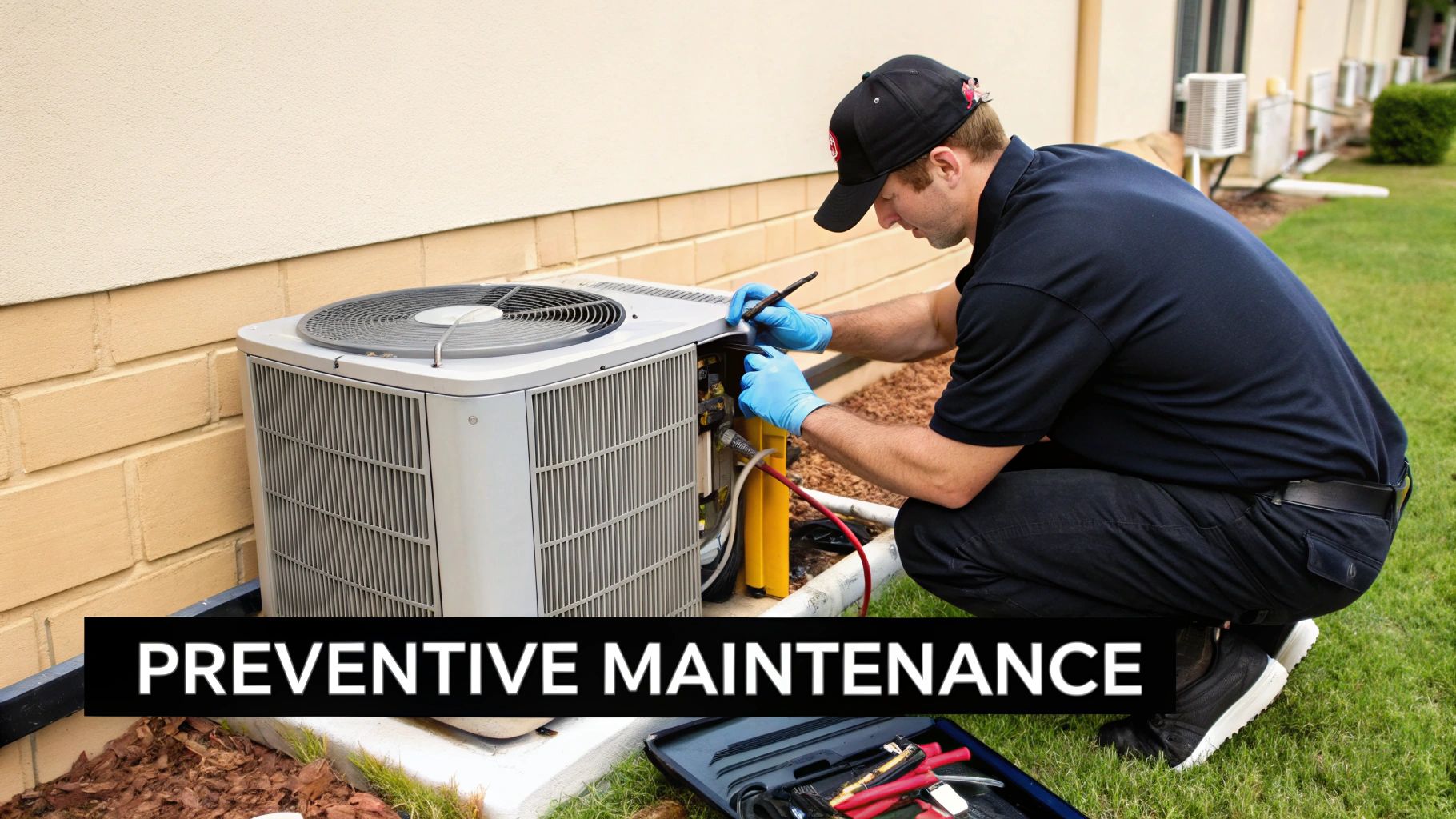
It’s just like getting an oil change for your car. That small, routine service is what prevents a catastrophic engine failure down the road. An annual or biannual AC tune-up works exactly the same way, keeping all the critical parts clean, lubricated, and running at peak performance.
What a Professional Tune-Up Really Involves
A professional maintenance visit is much more than a quick glance. It’s a detailed inspection and cleaning process designed to catch the small, nagging issues before they snowball into major breakdowns.
When a certified technician comes out for a tune-up, they’re doing a few key things to get your system ready for summer:
Thorough Coil Cleaning: They'll deep clean both the indoor evaporator and outdoor condenser coils. When these are caked with dirt and debris (a common problem here in Tucson), your AC can't transfer heat properly.
Refrigerant Level Check: The tech will verify your system has the correct refrigerant charge. If it’s low, that points to a leak that needs to be found and fixed.
Electrical Component Testing: They inspect all the capacitors, contactors, and wiring for wear and tear. This is crucial for preventing those sudden electrical failures that always seem to happen on the hottest day of the year.
Lubricating Moving Parts: Key components like fan motors are lubricated to reduce friction, which helps the system use less energy and prevents parts from overheating and failing.
A well-maintained air conditioner can run up to 20% more efficiently than a neglected one. That efficiency boost translates directly to lower monthly utility bills and a longer life for your HVAC system, saving you money in both the short and long run.
The True Value of Proactive Care
Investing in maintenance pays for itself by helping you sidestep those expensive, unexpected repair bills. The global air conditioning market has skyrocketed to $124.6 billion, largely because rising temperatures are pushing older, unmaintained units past their breaking point. You can read more about air conditioning market trends on imarcgroup.com.
For those of us in Tucson, where seasonal dust and debris love to build up in neglected systems, proactive care isn't just a good idea, it's essential.
Ultimately, a scheduled tune-up is your best defense. If you're not sure what the ideal schedule is for your specific system, check out our guide on how often you should service your air conditioner. It’s the key to keeping your AC running cold, efficient, and reliable all summer long.
When your AC conks out, a million questions probably race through your mind. Getting straight answers is the first step toward figuring out how serious the problem is and what to do next. Here are a few of the most common questions we get from homeowners in the thick of it.
How Often Should I Change My Air Filter in Tucson?
Here in the desert, dust is just a fact of life. That’s why you should be checking your air filter every month, especially when the monsoon storms kick up or the winds are howling.
Some filters might say they last for three months, but our Tucson dust can choke them out much faster. A clogged filter is one of the most common culprits behind an AC blowing hot air because it literally suffocates your system. Keeping that filter clean is your best and easiest first line of defense.
Can I Just Add More Refrigerant Myself?
The short answer is a hard no. Refrigerant (you might know it by brand names like Freon) is a federally regulated chemical, and you need an EPA certification to handle it safely and legally.
But there's a bigger reason: if your system is low on refrigerant, it means you have a leak. Just topping it off is like putting a tiny bandage on a big problem. It doesn't fix the source of the leak, and you'll just lose that expensive refrigerant again. It's an inefficient, temporary fix that delays a real solution.
A buzzing or humming sound often points to an electrical issue, such as a failing capacitor or contactor trying to start the unit. Turn off the power at the breaker and call a technician, as these components carry a dangerous electrical charge.
Is It Worth Repairing an Old AC Unit?
This is the big question, and it really comes down to simple math: the cost of the repair versus the unit's age and efficiency.
A good rule of thumb we use is this: if the repair cost is getting close to 50% of the price of a brand-new system, it usually makes more financial sense to replace it. Pouring a lot of money into an old, inefficient unit is often just delaying the inevitable.
As global demand for cooling skyrockets, the world is projected to have 5.6 billion air conditioners by 2050, and the strain on every single unit, including yours, is only going to increase. You can see more about this incredible energy demand on YouTube. Understanding this bigger picture can help you decide when it's time to invest in newer, more efficient technology. For a deeper dive, check out our article on why your AC unit is not blowing cold air.
When your AC needs more than just a quick fix, trust the experts at Covenant Aire Solutions to restore your comfort quickly and affordably. Visit us at https://www.covenantairesolutions.com to schedule your service today.