
Balance Dampers HVAC: What They Do and When to Adjust
At 7 p.m. in July, a Tucson homeowner checks the thermostat and sees 74°F. The living room is getting a strong blast of cold air, yet the back bedroom still feels close to 80°F. The first suspects are usually the thermostat, a dirty filter, or low refrigerant. Sometimes those are the problem. But when one room stays hot while another is overcooled, the issue may be inside the ductwork, where balance dampers control how air is distributed.
Why One Room Is Cold and Another Is Warm
Supply ducts branch from the main trunk much like rivers splitting away from a lake. Air naturally favors the branch with the least resistance, often the shortest or straightest path. Without a way to restrict that easy path, the nearby room can receive too much conditioned air while a distant bedroom, upstairs space, or room over a garage receives too little.
That's why uneven temperatures often point to an airflow-balancing problem, not an equipment failure. The air conditioner may be producing cold air correctly, but the duct system may not be delivering that air where the home needs it. A residential HVAC ductwork overview can help homeowners understand how the trunk, branches, registers, and return paths work together.
A balancing damper is a movable plate or valve installed in a duct branch. A technician adjusts its position to redistribute airflow. The goal isn't to stop air completely. It's to reduce flow through an over-supplied branch so more conditioned air can reach a branch that needs it.
Practical rule: A room-by-room temperature difference is a reason to investigate airflow before assuming the compressor or furnace has failed.
Consider the common Tucson layout: the living room is close to the air handler, while the back bedroom has a longer run with more turns. The living room branch offers less resistance, so it can receive a larger share of the available airflow. A properly adjusted damper adds controlled resistance to that branch, allowing the system to serve the distant bedroom more effectively.
Balancing also matters for ventilation and operating cost. Industry guidance warns that over-ventilation can increase energy costs, while under-ventilation can hurt indoor air quality (Greenheck's balancing damper guidance). A comfortable room is only part of the result. The duct system, blower, coil, furnace, and indoor air quality all respond to the way airflow is distributed.
What Balance Dampers Actually Do
Think of a faucet connected to several hose lines. The water supply creates pressure, but each faucet handle controls how much water reaches its outlet. Turning one handle down doesn't create more water. It changes the distribution among the available outlets.
HVAC balance dampers work on the same basic principle. The blower creates the system's pressure, while the dampers regulate how much airflow enters individual branch ducts. A manual damper is generally a movable plate or valve inside the duct, often positioned near the branch takeoff from the main trunk. Turning the shaft changes the blade angle, which changes the resistance in that branch.
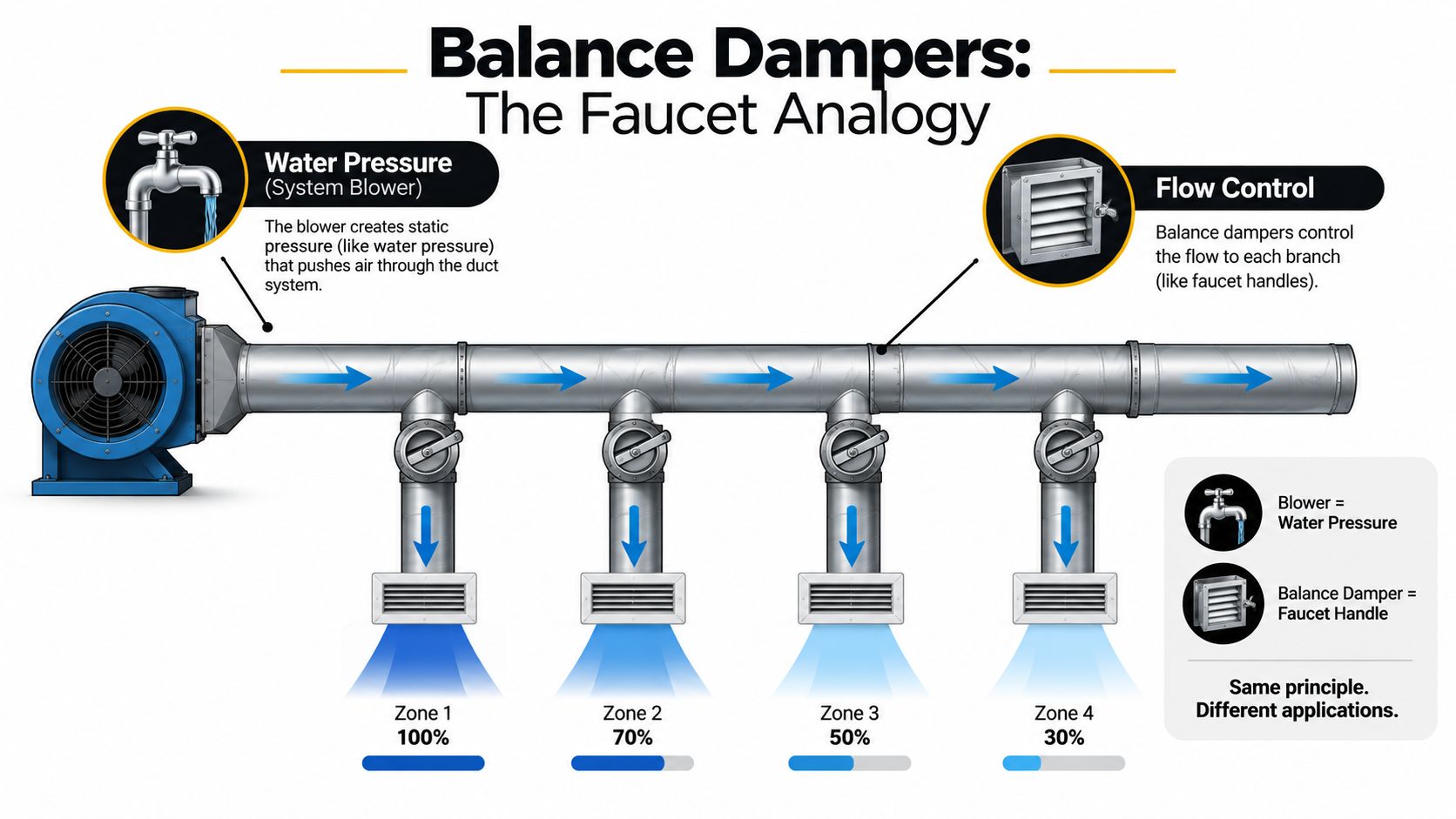
The adjustment changes distribution
A damper doesn't make the blower stronger, and it doesn't repair a crushed duct, disconnected flex run, dirty filter, or undersized return. It fine-tunes the portion of airflow reaching a branch. That distinction helps explain why damper adjustment should follow inspection and measurement, rather than replace them.
Balancing dampers are also different from zone dampers. A balance damper is normally set during commissioning or service to even out the system. A zone damper works with controls and opens or closes in response to a thermostat or zone demand. Homeowners researching separate temperature control can compare this function with a broader HVAC zoning systems guide from Pipeline On.
Where the part belongs
The damper belongs in the ductwork, not merely at the room register. Register dampers can influence the air entering a room, but a branch damper controls the duct run closer to the trunk. That location lets a technician redistribute airflow across the system instead of masking a branch problem at the grille.
A properly balanced system can make room temperatures more consistent and may reduce rushing air or register noise in rooms that were receiving too much flow. It also helps the equipment operate closer to the airflow conditions intended by its design. For homeowners considering separate zones, a multi-zone HVAC system explanation provides useful context, because zoning and balancing solve different control problems.
One important limitation remains: a balancing damper is not a positive shutoff device. Manufacturer guidance describes balancing dampers as devices for airflow regulation, not positive shutoff or automatic control applications (Greenheck's manual balancing damper information).
Manual Cable and Automatic Damper Types
A technician may find the right damper behind a ceiling panel, inside a mechanical room, or near a branch takeoff. That access difference affects which adjustment method makes sense. The choice also depends on duct layout, appearance, control needs, and whether the system serves one home zone or a larger commercial installation.
Damper Type | How It's Adjusted | Best Application |
|---|---|---|
Manual | A technician moves an exterior quadrant or handle and locks the setting | Single-zone residential systems and accessible branch ducts |
Cable-operated | A remote cable connects the internal damper to a ceiling or wall dial | Finished spaces and retrofit situations where the duct itself is difficult to reach |
Remote balancing | A remote mechanism allows adjustment away from the duct location | Installations where direct access is limited but periodic adjustment is needed |
Automatic | An actuator or pressure-responsive mechanism changes the damper position as conditions change | Larger systems, supply or exhaust applications, and systems needing self-adjusting airflow |
Manual and cable-operated options
Manual balancing dampers are commonly butterfly dampers enclosed in a sleeve. The technician rotates an exterior shaft, checks airflow, and locks the blade in position. In a straightforward single-zone home, that fixed setting may work well after commissioning.
A cable-operated damper keeps the blade inside the duct while moving the control to a ceiling or wall dial. It can suit a finished basement, remodeled room, or any location where opening a ceiling or wall would be impractical. The dial changes access, not the damper's basic purpose, so it should not be treated like a thermostat.
Remote balancing systems use the same general idea. A mechanism allows adjustment away from the duct, although its design varies by manufacturer and installation. This arrangement helps when the duct is concealed or repeated access would be difficult.
The blower and air handler still determine how the system responds to any damper setting. A useful residential air handler guide can help explain that relationship, but changing a hidden damper remains a commissioning task when airflow or pressure is uncertain.
Automatic balancing
Automatic balancing dampers respond to changing pressure and are designed to maintain constant airflow as pressure changes (Greenheck's automatic balancing damper category). A manual damper stays where the technician leaves it, while an automatic model changes position within its designed operating range.
Manual dampers are often practical in a home with one air handler and fairly stable branch demand. Larger multi-zone commercial systems may use automatic equipment to keep branch airflow more predictable as other sections open or close. The equipment still requires correct selection, installation, and commissioning. Automatic does not mean self-diagnosing, and it does not remove the need to check static pressure and overall system performance.
For a homeowner, a visible handle does not identify the component by itself. Confirm whether it is a balancing damper, zone damper, access control, or register adjustment. These parts can look similar while serving different jobs.
How Throttling One Branch Changes the Whole System
A garden hose with several nozzles makes the pressure relationship easier to understand. If one nozzle is partially closed, the hose doesn't stop producing pressure. The resistance changes, and the remaining open outlets may experience a different pressure and flow pattern.
Ductwork behaves similarly. Closing a branch damper adds resistance to that branch. The blower must work against the altered resistance, and the system's total airflow can change even while air is redirected toward other branches. The result isn't a simple one-room adjustment. It's a system response.
Long duct runs, multiple stories, sharp turns, and uneven branch sizes make this response harder to predict by feel. A homeowner may reduce airflow at a cool room and then discover a new whistle, weak airflow elsewhere, or a system that runs longer without solving the original comfort complaint.
Automatic balancing dampers were developed for pressure-sensitive applications. Their purpose is to hold a branch at a target airflow as system pressure changes, rather than leaving a fixed blade position to handle every operating condition. That can make airflow more stable when other branches change state.
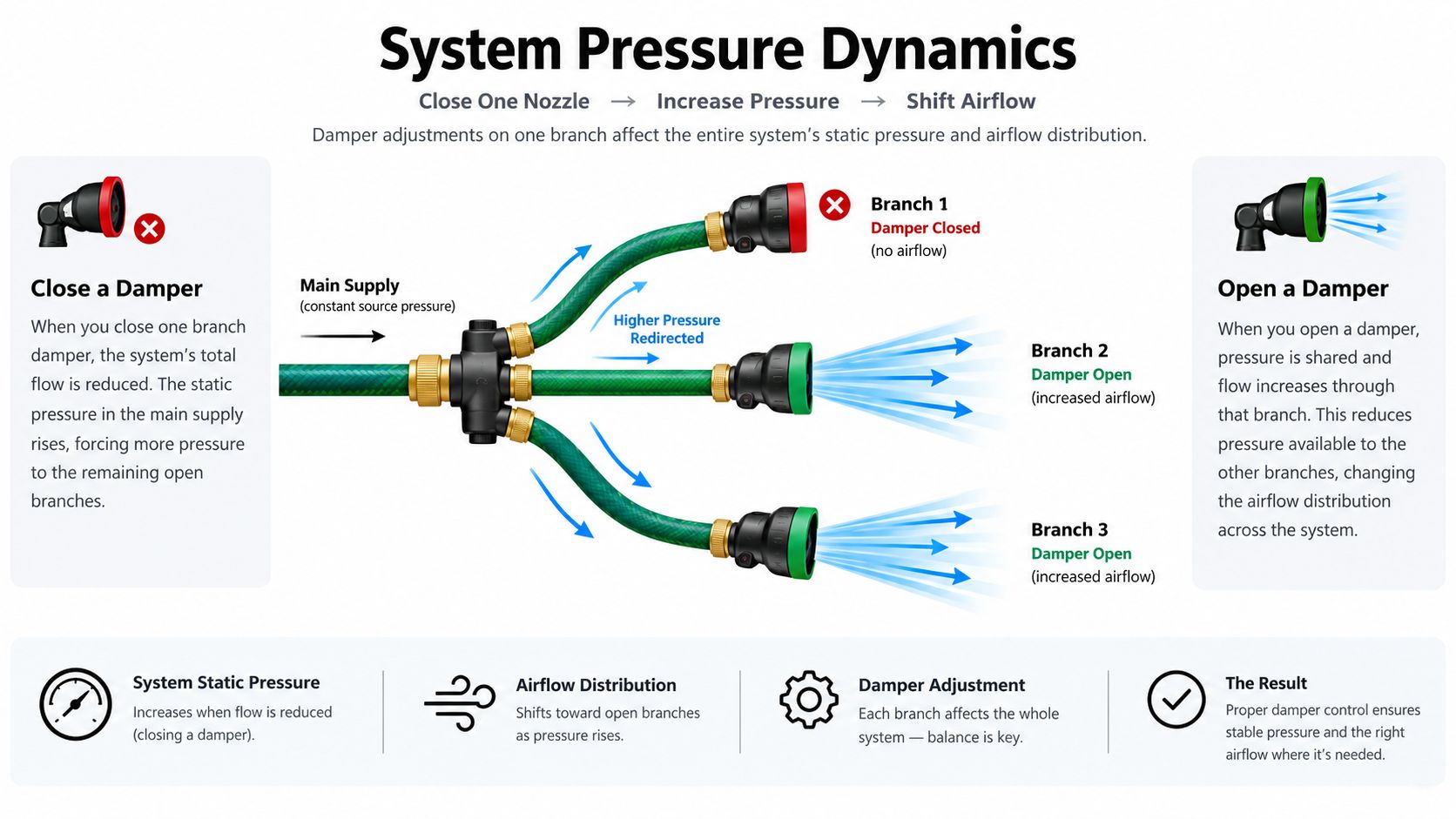
The pressure issue also explains why duct sealing and balancing belong in the same conversation. If increased resistance exposes leakage at joints or seams, the system may lose air before it reaches the room. Homeowners investigating that possibility can review information about ductwork sealing and pressure testing.
A damper adjustment is never isolated from the blower, coil, furnace, return path, and every other branch connected to the same duct system.
How Technicians Balance Air From Branch to Branch
Professional balancing starts with measurement, not with turning handles at random. The technician first checks the system's operating condition and measures airflow at the return or supply trunk. This establishes a system-level reference before individual registers are adjusted.
Next, the technician measures each outlet with a flow hood or a hot-wire anemometer. The flow hood captures air at a register, while an anemometer measures air movement. The technician compares each actual reading with the design airflow for that outlet.
The index circuit sets the reference
The most restrictive or farthest branch is commonly selected as the index circuit. That branch is kept fully open because it usually has the greatest pressure drop. The technician then adjusts other branches in relation to that reference instead of closing the difficult run to compensate for easier ones.
A typical sequence looks like this:
Measure the system: Record total airflow and relevant static pressure readings.
Identify the index branch: Use the farthest or highest-pressure-drop run as the reference circuit.
Measure every outlet: Compare actual CFM with each outlet's design airflow.
Throttle easier branches: Adjust other dampers proportionally while preserving the reference branch.
Recheck the system: Repeat measurements because one adjustment changes conditions elsewhere.
The practical benchmark used in HVAC balancing is convergence to approximately ±10% of design airflow at the outlets (HVAC balancing technical guidance). That isn't a setting a homeowner can confirm by looking at a handle. It requires instruments, design information, and repeated readings.
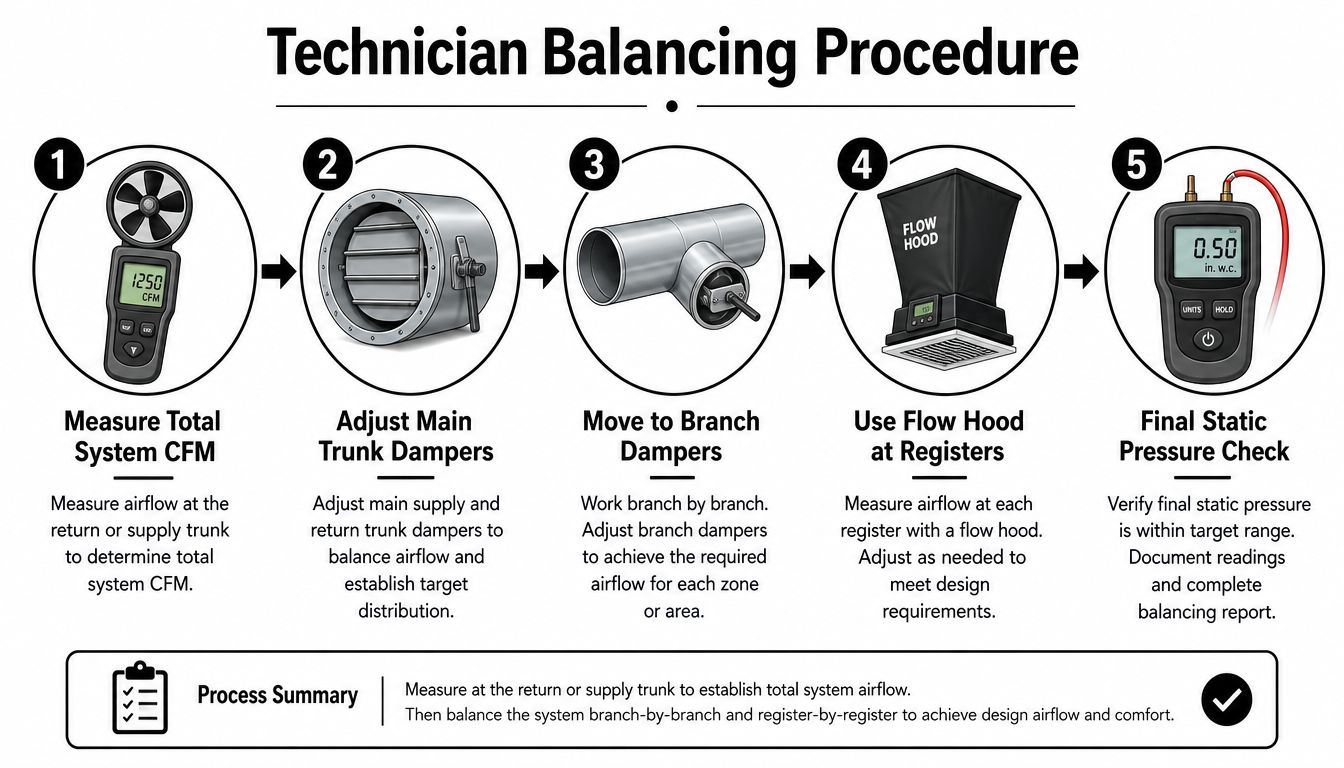
The report matters
A useful balancing report records final outlet CFM, design CFM, damper positions, and system pressure observations. That record gives future technicians a baseline. Without it, the next service visit may begin with another round of guesswork.
The following video offers a visual look at airflow balancing equipment and field technique:
What Happens When Dampers Are Closed Too Far
Closing a duct damper isn't like closing a bedroom door. The blower keeps pushing air, so the restriction remains part of the operating system. If a homeowner closes several branches too aggressively, static pressure can rise and the equipment may lose the airflow it needs.
On the cooling side, restricted airflow across the evaporator coil can make the coil freeze. Ice reduces heat transfer and can lead to dripping water when it melts. On the heating side, insufficient airflow can drive furnace temperatures high enough to trigger a high-limit safety shutdown. Repeated overheating can create serious equipment concerns, and restricted airflow can also contribute to duct leakage and reduced efficiency.
Comfort can get worse, not better
A cool room may feel more comfortable after its damper is partly restricted, but that local improvement doesn't prove the system is balanced. The blower, coil, furnace, and other branches may now be operating under greater resistance.
Warning signs include:
New whistling: Air is forcing through a narrow opening or leaking around a connection.
Popping or rushing sounds: Duct panels or flexible duct sections may be responding to pressure changes.
Frozen coil symptoms: Ice appears on the indoor coil or refrigerant line, or water appears after thawing.
Furnace short-cycling: The furnace starts and stops before completing a normal heating cycle.
Persistent weak airflow: A room remains uncomfortable even after a damper is moved.
An independent HVAC warning explains that closing dampers too far can contribute to a frozen evaporator coil in summer or furnace overheating in winter, and recommends leaving closed dampers partially open (Jackson Systems' damper adjustment guidance).
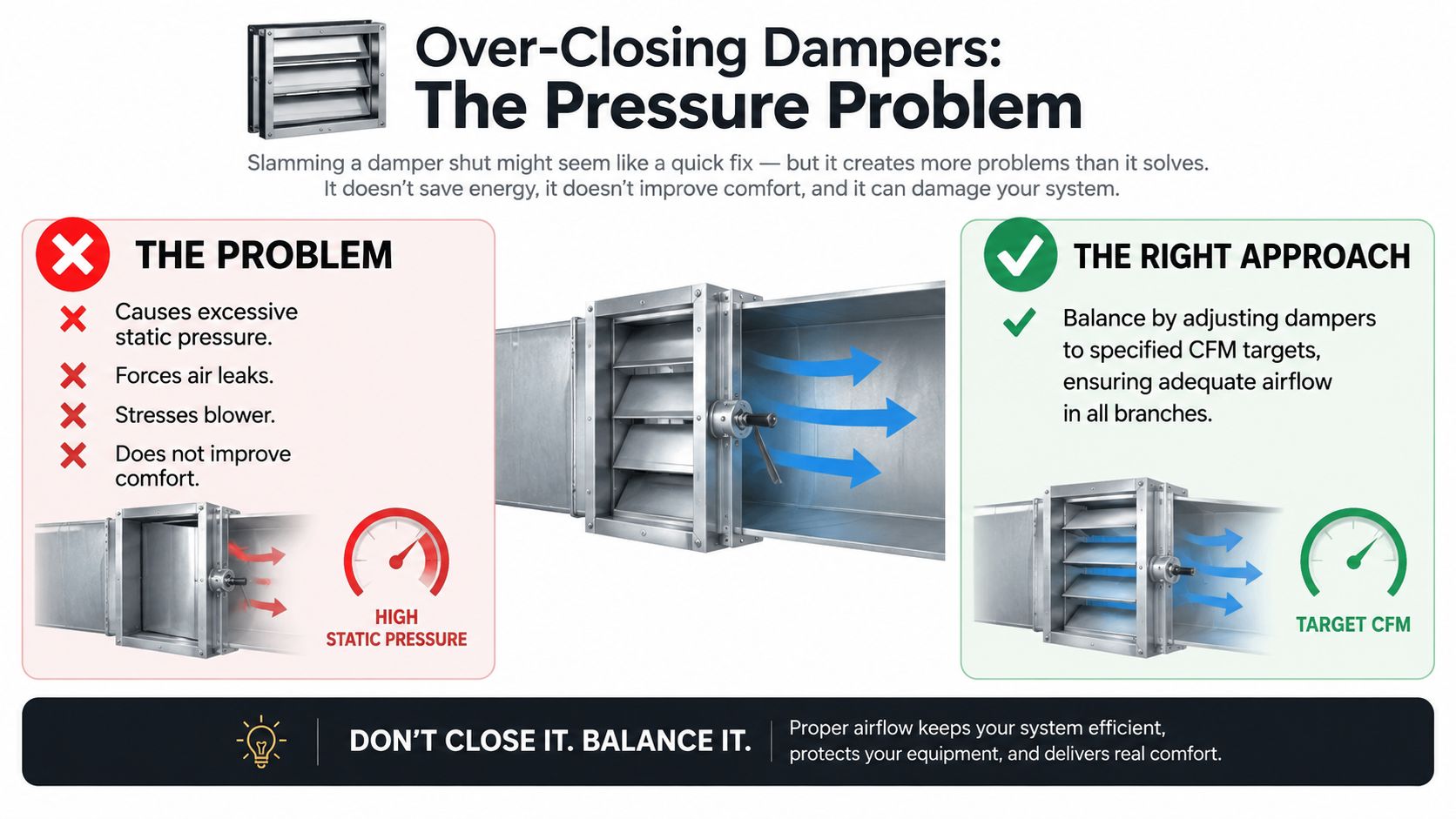
There's no universal handle position that guarantees safe airflow because duct design, blower setup, equipment capacity, and branch resistance vary. Treat a damper as a regulating device, not a shutoff. If the system develops noise, icing, overheating, or repeated cycling after an adjustment, return the damper to a more open position and arrange professional testing.
When to Adjust Yourself and When to Call a Pro
Homeowners can make limited adjustments when the control is visible, clearly identified, and located at a supply register. Move the lever gently in small quarter-turn increments, then give the room time to respond before making another change. While the system runs, listen for new whistling, whooshing, popping, or unusual blower noise.
That small adjustment is different from calibrating a branch damper. A damper inside the trunk or runout duct may sit behind an access panel, in an attic, inside a wall, or near the air handler. Reaching it can require tools and knowledge of the duct layout, while setting it correctly requires measurements from a manometer, flow hood, or balancing tablet.
A homeowner's safe boundary
Try a visible register adjustment when:
The damper is easy to reach: You can identify the handle without removing panels or entering a hazardous space.
The change is minor: You're making a small correction, not closing the branch.
The system sounds normal: No icing, furnace cycling, whistling, or sudden pressure noise is present.
You can observe the result: You're willing to monitor comfort and sound rather than keep turning the handle.
Call a qualified HVAC technician when the ductwork is hidden, the system has motorized zones, or the hot-cold imbalance continues after simple register adjustments. Professional evaluation is also appropriate when you see a frozen evaporator coil, notice furnace short-cycling, or experience rising energy bills without an obvious cause.
A technician can inspect the distribution system, verify static pressure, measure branch airflow, and check for leakage. Pressure testing is especially useful when the duct system may be losing air at seams or connections, as explained in this resource on pressure testing ductwork.
Simple rule: If you can see and reach the control without tools beyond a screwdriver, a cautious adjustment may be reasonable. If it sits inside the duct system or controls a whole zone, call a licensed HVAC technician.
Homeowners also benefit from choosing a service company that communicates clearly about findings, measurements, and recommended repairs. For contractors and business owners interested in how local service companies present their expertise online, Silva Marketing's step-by-step local SEO for HVAC provides related marketing context, but the technical decision should still come from airflow testing at the property.
For Tucson homes and commercial buildings, Covenant Aire Solutions can inspect duct distribution, evaluate balance dampers, measure system airflow, and address related heating, cooling, and indoor air quality concerns. If one room stays hot, another feels overcooled, or your system makes pressure-related noises, visit Covenant Aire Solutions to arrange an evaluation before closing more dampers.