
Dehumidifier for Central Air: A Guide to dehumidifier for central air Comfort
That sticky, damp feeling in the air is a classic Tucson monsoon season complaint, even when your AC is blasting away. It’s a common frustration because while your air conditioner is a champ at cooling, it's not a pro at removing moisture. This is where a dehumidifier for central air comes in; it's the specialized partner your HVAC system needs to pull that excess moisture out of every room and deliver true comfort.
Why Your AC Alone Can’t Handle Arizona Humidity
So many people think that just cranking the AC down a few more degrees will fix a humidity problem. It makes sense on the surface; air conditioners do remove some moisture as a byproduct of cooling. But that’s just it: it's a secondary function, not its main job.
Trying to solve humidity this way usually just leaves you with a cold, clammy house and sky-high energy bills, all without fixing the real issue.
Think of it this way: your air conditioner is a sprinter. It's built for quick, powerful bursts to drop the temperature fast. A whole-home dehumidifier, on the other hand, is a marathon runner. It works steadily and quietly in the background to keep moisture levels exactly where they should be, whether the AC is running or not.
The Limits of Standard Air Conditioning
Your AC only pulls moisture from the air when the cooling cycle is actually running. On those milder but still muggy days, or overnight when temperatures drop, your system doesn't kick on as often. This is when indoor humidity can really start to climb, leading to a few familiar problems:
Lingering Dampness: The air just feels heavy and sticky, even if the thermostat says it's cool.
Musty Odors: High moisture is the perfect breeding ground for mold and mildew, creating that basement smell.
Potential for Damage: Over time, excess humidity can warp wood floors, damage furniture, and even mess with your electronics.
A dehumidifier's primary job is to turn latent load (that hidden moisture in the air) into sensible load (the temperature you can actually feel). It tackles the humidity head-on, freeing up your air conditioner to do the one thing it does best: cool the air.
This kind of specialized climate control is exactly why demand is surging. The global dehumidifier market hit a staggering USD 4.2 billion in 2023 and is on track to reach USD 8.0 billion by 2033. North America is leading the charge, holding a massive 38.1% market share. You can read the full market analysis to see just how big this trend in home comfort has become.
At the end of the day, getting that perfectly comfortable and healthy indoor environment means controlling both temperature and humidity separately. You can learn more about finding that sweet spot in our guide to ideal indoor humidity ranges in Arizona. Relying on your AC to do both jobs is just an inefficient compromise, one that a dedicated dehumidifier for central air solves perfectly.
How a Whole Home Dehumidifier Works With Your HVAC
Think of your HVAC system like the lungs of your home, constantly breathing air in and out through the ductwork. A whole-home dehumidifier integrates directly into this "respiratory system," acting like a specialized filter that targets and removes excess airborne moisture. It's a seamless addition that works quietly behind the scenes.
Unlike a portable unit that's stuck tackling the humidity in just one room, a dehumidifier for central air is installed right into your existing ductwork. This central placement is key; it allows the unit to treat all the air circulating through your home, ensuring consistent, comfortable humidity levels everywhere, from the master bedroom to the kitchen.
The process is remarkably efficient. While it works in concert with your air conditioner, it operates on its own terms. That independence is precisely what makes it so effective, giving you total control over moisture even when you don't need the AC running.
The Core Process of Moisture Removal
So, how does it actually pull water out of the air? The magic is in its simple, continuous cycle. The dehumidifier draws humid air from your home through the return ducts, which is the same path the air takes to get to your furnace or air handler.
Once that moist air is inside the unit, it’s passed over a series of chilled coils. It's the same principle as a glass of iced tea "sweating" on a warm Tucson day: the moisture in the air can't stay in vapor form and condenses into water droplets on the cold surface.
This collected water, called condensate, is then channeled away through a dedicated drain line. Keeping this drain line clear is absolutely essential for the system to work correctly, a topic we dive into in our guide to HVAC condensate line cleaning. After being stripped of its excess moisture, the dry, comfortable air is pushed back into your home through the supply ducts.
The image below shows how an overworked AC can lead to the exact humid conditions that a whole-home dehumidifier is designed to fix.
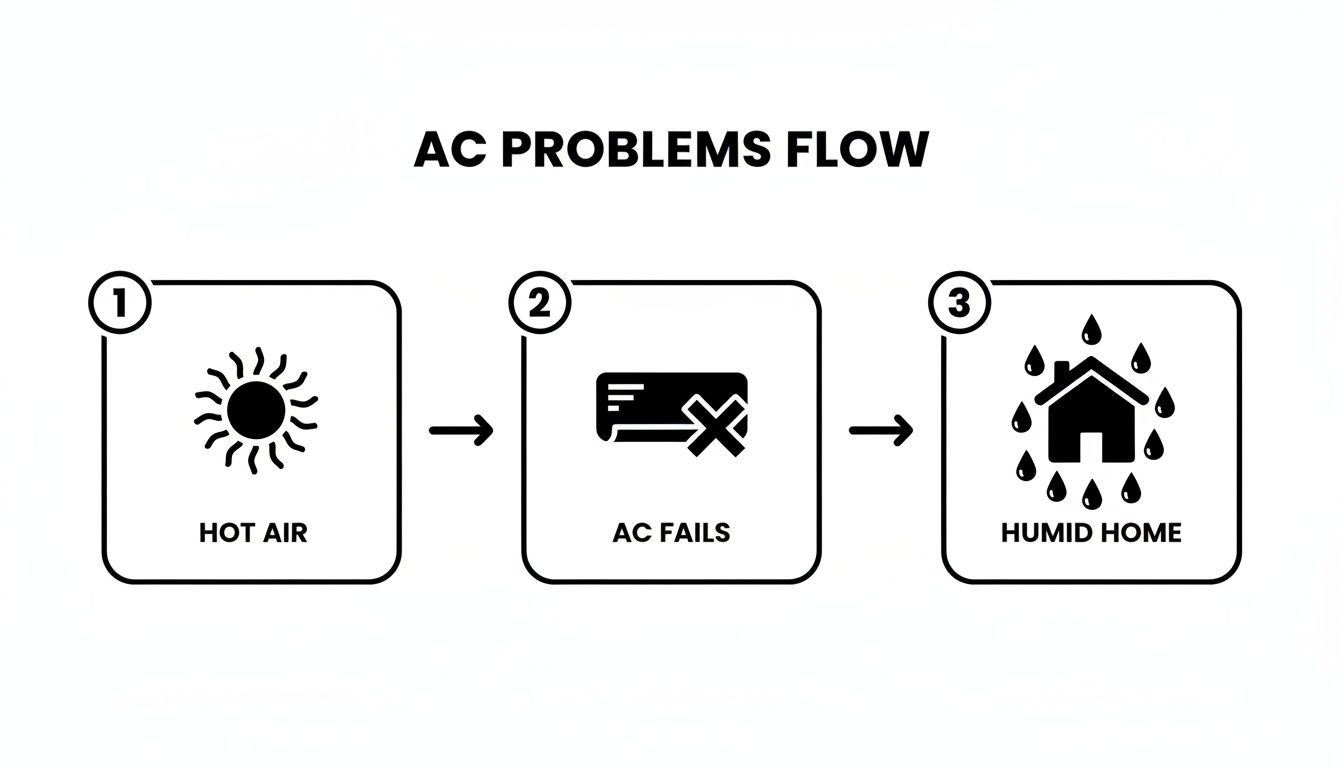
When your air conditioner can't keep up with intense heat, humidity is often the first sign of trouble. A central dehumidifier tackles that problem head-on.
Why It Works Independently From Your AC
A whole-home dehumidifier has its own brain, called a humidistat. This is completely separate from your thermostat, which only measures temperature. The humidistat is constantly sampling the air to measure its relative humidity.
You get to set the perfect humidity level for your home; most people find between 40% and 50% to be the sweet spot for health and comfort.
A dehumidifier converts latent load (the hidden moisture in the air) into sensible load (the temperature you feel). By handling the moisture, it allows your air conditioner to focus solely on cooling, making the entire system more efficient.
This independent operation gives you some serious advantages:
Year-Round Control: It can run during our cool, rainy monsoon days when you don't need the air conditioning on but still need to combat that sticky, humid feeling.
Precise Management: It only kicks on when the humidity creeps above your chosen setting, which saves a ton of energy.
Enhanced Comfort: It gets rid of that "cold and clammy" feeling you sometimes get when an oversized AC unit cools the air too fast without removing enough moisture.
By integrating a dehumidifier with your central air, you’re not just plugging in another appliance; you're fundamentally upgrading your home's entire comfort system. It's a targeted solution for a very specific problem, ensuring your home feels perfectly balanced and healthy, no matter what the Arizona weather throws at us.
The Real Benefits of a Central Dehumidifier System
Hooking up a dehumidifier to your central air does way more than just make the air feel a little less sticky. Think of it as a serious investment in your family’s health, the long-term health of your house itself, and even your monthly budget.
While a portable unit might offer a quick fix for one room, a whole-home system is a seamless, powerful solution that changes your entire living environment. The advantages are crystal clear, starting with the very air you breathe.
Promoting a Healthier Home Environment
High indoor humidity is basically an open invitation for common allergens. Mold, mildew, and dust mites absolutely thrive in damp conditions, and their presence can be a nightmare for anyone with allergies, asthma, or other respiratory issues.
A whole-home dehumidifier fights back by locking in the ideal indoor humidity level, usually somewhere between 40% and 50%. This consistent control creates an environment where those microscopic intruders just can't get a foothold. You're not just putting a band-aid on a problem; you're actively improving your home's air quality at the source.
To get the full picture of how different elements affect the air inside your home, our guide to HVAC indoor air quality is a great place to start.
Unlocking Significant Energy Savings
One of the most powerful arguments for a dehumidifier for central air is the real-world impact on your utility bills. Here’s the simple science: drier air feels cooler. This principle means that once you pull that excess moisture out of the air, you can set your thermostat several degrees higher and feel just as comfortable, maybe even more so.
Imagine being perfectly cool with the thermostat at 77°F or 78°F instead of cranking it down to 74°F. That small adjustment makes a huge difference in your air conditioner's runtime, which is by far the biggest energy hog in most Tucson homes.
Your AC fights two battles: lowering the temperature (sensible load) and removing moisture (latent load). A dehumidifier takes over the moisture fight, letting your AC work smarter, not harder. This tag-team approach can slash an air conditioner's energy use by as much as 20% to 35%.
This is a big reason why the global market for dehumidifiers, valued at USD 6.76 billion in 2024, is growing so fast. Homeowners everywhere are catching on to the direct link between humidity control and energy savings.
Protecting Your Home and Possessions
Beyond comfort and air quality, a central dehumidifier acts as a quiet guardian for your home's structure and all your valuables. Over time, excess moisture is incredibly destructive, causing damage that is often slow, silent, and expensive to fix.
A whole-home system helps prevent things like:
Warped Wood: Hardwood floors, wooden furniture, and even instruments like pianos and guitars can swell, warp, and crack in humid air.
Peeling Paint and Wallpaper: Moisture that seeps into walls will eventually cause paint to bubble up and wallpaper to peel right off.
Damage to Electronics: High humidity can cause condensation to form inside sensitive electronics, leading to corrosion and short circuits.
By keeping humidity levels stable, a central system protects the integrity and value of your home. It’s no surprise this makes it one of the top energy efficient home features you can invest in, delivering both immediate comfort and long-term protection.
This is a world away from those noisy, clunky portable units. Let's break down the key differences.
Whole-Home Dehumidifier vs Portable Units
When you look at the options side-by-side, it’s easy to see why an integrated system is the superior choice for total home comfort.
Feature | Dehumidifier for Central Air | Portable Dehumidifier |
|---|---|---|
Coverage | Entire home, every room | One room at a time |
Efficiency | Highly efficient, works with AC | Less efficient, runs constantly |
Noise Level | Whisper-quiet, located in utility space | Noisy, sits in your living space |
Maintenance | Minimal, "set it and forget it" | Constant bucket emptying |
Control | Precise, integrated with thermostat | Manual adjustments needed |
Cost | Higher initial investment, long-term savings | Lower upfront cost, higher running cost |
Ultimately, a central dehumidifier is a "do it right the first time" solution. It works quietly and invisibly in the background, delivering consistent, whole-home results without you ever having to think about it.
Choosing the Right Size Dehumidifier for Your Home
Picking the right size dehumidifier for central air isn't like grabbing an appliance off the shelf. Think of it more like getting a suit tailored; it has to be a perfect fit to actually work. One of the biggest mistakes we see is homeowners thinking bigger is always better, but that's just not how it works. An improperly sized unit, whether it's too big or too small, will just struggle to make your home comfortable and efficient.
A whole-home dehumidifier's muscle is measured in pints per day (PPD). This number simply tells you how many pints of water the unit can pull from the air in 24 hours under specific test conditions (usually 80°F and 60% humidity). A 50 PPD unit might be a good starting point for a smaller home, but a larger or more humid house could easily need a 90 PPD or even a 130 PPD model.
Getting it right involves a careful calculation that goes way beyond just the square footage of your home. It’s a delicate balance, and it’s the most important first step toward getting your humidity under control.

Key Factors in Dehumidifier Sizing
To really nail down the right PPD capacity for your home, we have to look at the whole picture. Several interconnected variables play a part in how much moisture your system will need to tackle every day. Think of them like ingredients in a recipe; if you miss one, the whole thing can be thrown off.
Here are the key considerations we look at:
Total Square Footage: This is the obvious starting point. Larger homes simply have more air that needs to be treated.
Ceiling Height: A home with 10-foot ceilings has a lot more air volume than one with the same square footage but standard 8-foot ceilings. That extra volume directly increases the dehumidification load.
Home Air-Tightness: Older, draftier homes are constantly letting humid outdoor air sneak in, which calls for a more powerful dehumidifier. On the flip side, newer, tightly sealed homes can trap moisture from things like cooking and showering, also demanding effective moisture removal.
These factors give us a solid baseline, but our local climate adds another critical layer to the math.
How Tucson’s Climate Impacts Your Choice
Living in Tucson throws a unique curveball into the mix: our intense summer monsoon season. During those months, the air gets incredibly saturated with moisture, placing a sudden and massive demand on any humidity control system. A dehumidifier that seems perfectly fine for the drier parts of the year can be completely overwhelmed during a July monsoon.
This is exactly why a professional sizing calculation is so critical here. We can't just plan for the yearly average; we have to account for those peak humidity spikes.
Sizing a dehumidifier for an Arizona home means planning for the worst-case scenario. The unit must have enough power to handle the extreme moisture load of our monsoon season to prevent your home from becoming a damp, uncomfortable swamp when you need relief the most.
If you don't account for this seasonal surge, you'll end up with an undersized unit that runs nonstop without ever hitting your target humidity level. Not only does this fail to solve the comfort problem, but it also leads to premature wear and tear on the equipment. The process shares a lot of principles with getting your AC size right; you can learn more about how to size an air conditioner for your home to see how these critical calculations work.
The Dangers of Incorrect Sizing
Getting the size wrong has real consequences for both your comfort and your wallet. It's a true Goldilocks situation; you need a unit that is "just right" for your home's specific needs.
If the Unit is Too Small: An undersized dehumidifier will run continuously, fighting a losing battle against the moisture in your air. This constant operation wastes a ton of energy and puts excessive strain on the components, leading to a shorter lifespan and poor performance. You'll be paying the electric bill without getting the dry, comfortable air you were hoping for.
If the Unit is Too Large: Believe it or not, an oversized dehumidifier is just as bad. It will rip moisture out of the air so fast that it satisfies the humidistat and shuts off before it gets a chance to properly circulate and treat all the air in your home. This rapid on-and-off cycling, what we in the industry call short-cycling, is wildly inefficient, drives up energy costs, and can leave pockets of muggy air all over your house.
In the end, proper sizing is the foundation of an effective whole-home dehumidification strategy. A professional assessment guarantees that your investment is matched perfectly to your home's unique needs, ensuring peak performance, energy efficiency, and total comfort all year long.
Understanding the Professional Installation Process
Proper installation is the key that unlocks everything your whole-home dehumidifier is capable of. While the idea sounds simple enough, the actual work involves getting elbows-deep in your home's ductwork, electrical systems, and plumbing. Knowing what a pro installation really involves makes it crystal clear why trusting a certified technician is the smartest, and safest, way to get reliable humidity control for the long haul.
A dehumidifier for central air isn’t like a portable unit you just plug into the wall; it’s a fully integrated part of your HVAC system. The process always starts with a technician carefully sizing up your existing ductwork to pinpoint the perfect spot for the new unit. This isn't a random choice, as strategic placement is what allows the dehumidifier to efficiently pull in that sticky, humid air and send dry, comfortable air back to every single room.
Getting this first step right is absolutely critical. Bad placement can choke off airflow or fail to treat the whole house evenly. You'll end up with frustrating pockets of humidity, completely defeating the purpose of a whole-home solution.
Integrating the Unit With Your HVAC System
Once the best location is locked in, the real work begins. This means physically cutting into your return and supply ducts to connect the dehumidifier. Technicians create what's called a bypass loop using special collars and insulated ducting, which essentially diverts a stream of air through the dehumidifier to get "treated."
Sealing these new connections airtight is non-negotiable. Even tiny air leaks can cause big problems:
Wasted Energy: Leaks pull in dusty, unconditioned air from your attic or crawlspace, forcing your entire HVAC system to work overtime.
Dirty Air: Unfiltered air bypassing the system can pump dust, insulation fibers, and other junk straight into your home.
Poor Performance: A leaky connection kills the pressure difference the dehumidifier needs to effectively yank moisture out of the air.
For big home upgrades like this, which touch on multiple systems, understanding the full scope of professional general contractor services can be a huge asset. It ensures every piece of the job, from ductwork to electrical, is handled the right way.
Wiring, Drainage, and Final Setup
With the ductwork connected, the next few steps are just as vital. A technician will run a dedicated electrical circuit to power the unit, making sure it’s up to all local safety codes. This isn't the place for a DIY shortcut; faulty wiring is a serious fire hazard that can put your whole HVAC system at risk.
Next up is the condensate drain line. It’s a small pipe, but it has a big job: channeling all the water pulled from your air safely away from the unit, usually to a floor drain or sump pump. If this line doesn't have the right slope or gets clogged, you’re looking at a water backup that can cause thousands in damage to your home.
The final piece of the puzzle is wiring the humidistat, the "brain" of your new dehumidifier. A pro will calibrate it to get an accurate humidity reading for your home and make sure it talks to your central air system correctly, kicking on only when it’s needed to keep you perfectly comfortable.
Think about it: your central air is running, but that sticky Arizona monsoon humidity just won't quit. It’s not just uncomfortable; it’s making your system work harder and driving up your bills. That’s why North America has become the fastest-growing market for these systems, especially in places like Tucson. Industrial-grade dehumidifiers are seeing a 6.0% CAGR because they tie right into the central ducts, holding that ideal 40-50% humidity level that stops mold in its tracks, a problem impacting over 20 million U.S. homes a year.
A professional installation is so much more than just connecting a few pieces of equipment. It’s about sweating every last detail to give you maximum efficiency and total peace of mind. To get a better feel for everything involved, take a look at our 2025 HVAC install checklist.
Frequently Asked Questions
Even after you're sold on the benefits, it's natural to have a few last questions before investing in a whole-home comfort solution. Getting straightforward answers is key to understanding the long-term value and what it’s actually like to live with a dehumidifier integrated into your central air system. Here are some of the most common questions we get from folks right here in Tucson.
Does A Dehumidifier For Central Air Use A Lot Of Electricity?
It’s a fair question, and the answer usually surprises people. While a whole-home dehumidifier does use some energy, it almost always leads to a net decrease in your overall utility bills. How? It helps your air conditioner work smarter, not harder.
Dry air feels much cooler than humid air. This simple fact allows you to set your thermostat several degrees higher and still feel perfectly comfortable. That small adjustment dramatically cuts down on the runtime for your AC compressor, the single biggest energy hog in most homes. Modern central dehumidifiers are also built for high efficiency, so the energy they use is easily offset by the savings they create. Think of it as an investment that starts paying you back on your very next summer energy bill.
How Often Does A Whole-Home Dehumidifier Need Maintenance?
One of the best parts about an integrated dehumidifier for central air is its set-it-and-forget-it design. Unlike those portable units that constantly need their buckets emptied, a whole-home system pretty much takes care of itself. The only thing a homeowner needs to do is simple: just check and replace the air filter every 6 to 12 months.
For truly seamless performance, the best approach is to have the dehumidifier professionally inspected once a year as part of your regular HVAC maintenance plan. A technician can check the coils, flush the drain line, and make sure it’s working in perfect harmony with your air conditioner.
This bit of proactive care prevents small issues from turning into big headaches and ensures the entire system runs at peak efficiency for years to come.
Can I Install A Central Dehumidifier Myself?
While a DIY project might seem like a great way to save a few bucks, installing a central dehumidifier is a complex job that should always be left to a certified HVAC professional. It requires specialized knowledge and tools to modify ductwork, run dedicated electrical circuits, and properly install a condensate drain line.
Even small mistakes during the installation can snowball into major problems:
Air Leaks: If the ducts aren't sealed perfectly, you'll reduce your entire HVAC system's efficiency and start pulling dusty, unconditioned air into your home.
Water Damage: A poorly installed drain line can easily back up, causing serious water damage to your home’s drywall, flooring, or structure.
Electrical Hazards: Incorrect wiring isn't just a risk to your expensive HVAC equipment; it's a significant safety hazard that could even cause a fire.
Hiring a professional guarantees that your dehumidifier for central air is sized correctly, integrated safely, and calibrated for optimal performance right from day one. It’s a crucial step that protects your investment and, more importantly, gives you peace of mind.
Ready to transform your home’s comfort and put an end to that sticky, humid feeling for good? Contact the experts at Covenant Aire Solutions today for a professional consultation and discover how a whole-home dehumidifier can make your Tucson home healthier and more comfortable. Visit us online at https://www.covenantairesolutions.com to schedule your appointment.