
Heat Pump Fan Motor Replacement Cost: What to Expect
Heat pump fan motor replacement typically falls in the $300 to $1,200 range, with most Tucson homeowners paying somewhere in the middle depending on motor type and access. A straightforward outdoor motor may stay near the lower end, while an indoor ECM blower in a difficult attic can move the quote toward the top.
You may be reading this after a Tucson heat pump stopped cooling during the worst possible afternoon. The thermostat says the system is running, but the vents are quiet, the house is getting warmer, and a technician has just presented a quote that feels far too broad to judge.
The quote isn't automatically unreasonable. Fan motor technology, warranty status, location, labor access, and emergency timing can change the final bill substantially. The key is knowing which motor failed and what the contractor has included before you approve the work.
When the Heat Pump Goes Quiet on the Hottest Day
A Tucson homeowner wakes on a July morning to a silent air handler. The outdoor temperature is already heading toward 105 degrees, and the indoor temperature has climbed past 85. The thermostat calls for cooling, but there's no familiar rush of air through the vents.
Within hours, a service technician arrives and explains that the fan motor may have failed. The estimate ranges from a few hundred dollars to well over a thousand. That gap creates a second problem alongside the heat: is the repair genuinely complex, or is someone taking advantage of an urgent situation?
Older heat pumps eventually reach this point, particularly outdoor condenser motors that work hard through Tucson's triple-digit afternoons. Dust, heat, electrical stress, restricted airflow, and worn bearings can all contribute to a failure. Still, a stopped fan doesn't prove that the motor itself is defective. A capacitor, control issue, wiring fault, or another component can create similar symptoms.
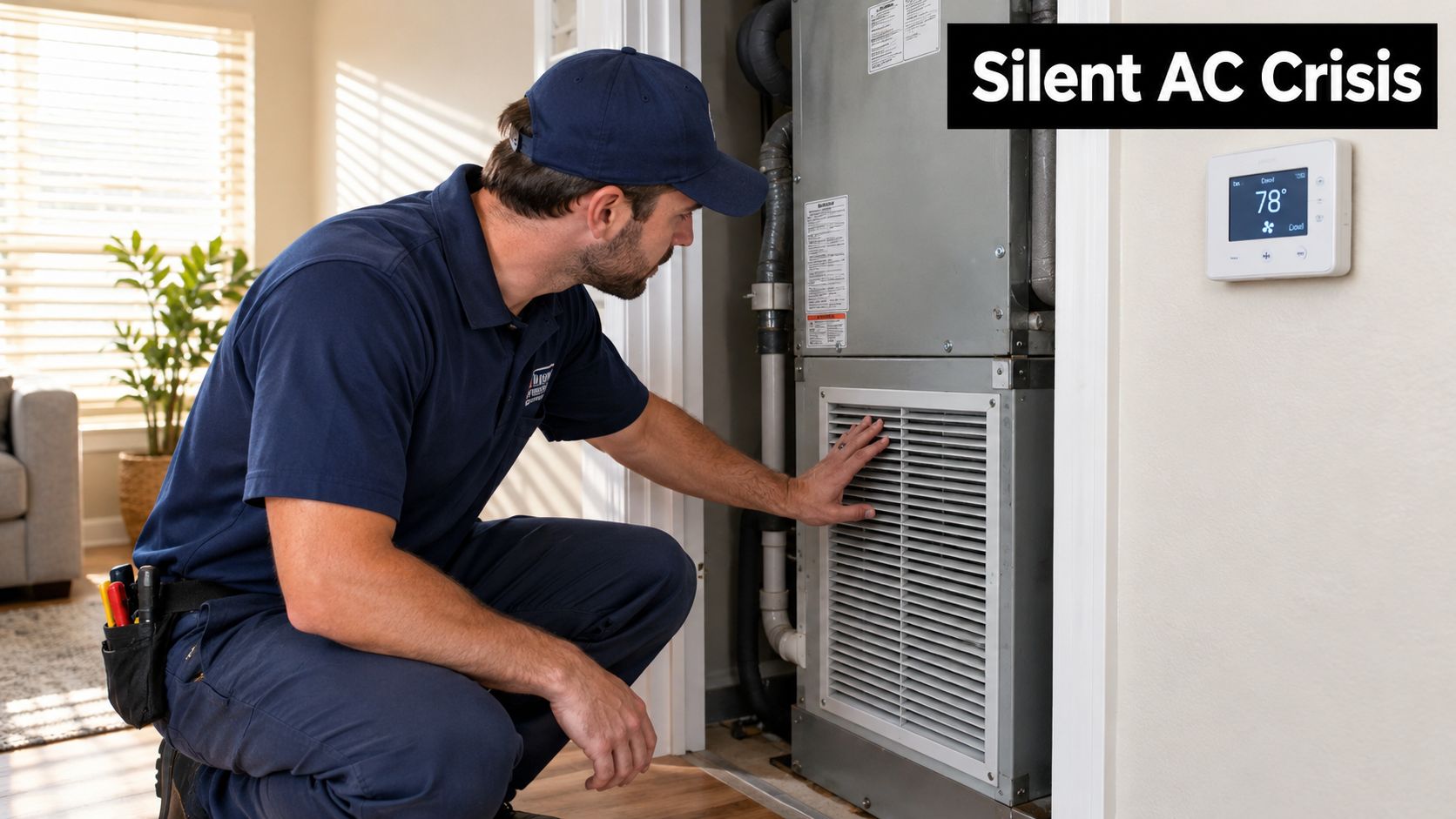
Practical rule: Don't approve a motor replacement until the technician identifies the failed motor, records its model information, and explains whether the capacitor and controls tested correctly.
For Tucson homeowners, a heat pump fan motor replacement cost of $300 to $1,200 is a useful planning range, supported by current cost guides from HomeAdvisor's blower motor replacement guide. That range becomes much easier to evaluate once you understand what the motor does and why one location costs more than another.
If the system has stopped cooling entirely, treat the situation as urgent for health and property reasons, especially for vulnerable occupants. Covenant Aire Solutions also outlines warning signs in its guide to what is considered an HVAC emergency.
What a Heat Pump Fan Motor Actually Does
Think of the fan motor as the heat pump's propeller. It moves air across the coils so the system can transfer heat instead of leaving it trapped inside the equipment.
A heat pump usually has two fan motors homeowners may hear about during a repair.
The indoor blower motor
The indoor blower motor sits inside the air handler. Its wheel pulls conditioned air across the indoor coil and pushes that air through the ductwork and into the rooms.
When this motor fails, the thermostat may still call for cooling, but the vents produce weak airflow or nothing at all. The outdoor unit might continue operating briefly, which can confuse homeowners who assume the system is working because they hear equipment outside.
The indoor motor may be difficult to reach when the air handler is inside a tight closet, attic, or restricted mechanical space. The technician may need to remove the blower assembly, match the motor to the required airflow, and inspect related controls before installing a replacement.
The outdoor condenser fan motor
The outdoor condenser fan motor sits in the heat pump cabinet, usually beneath the top grille. It pulls air across the outdoor coil, helping the system release or absorb heat as it switches between cooling and heating.
A failed outdoor motor can leave the outdoor unit running without moving enough air. You may hear a hum, see the compressor operate, or notice the fan isn't spinning. The unit can overheat and shut down to protect itself, which is especially concerning during a hot Tucson afternoon.
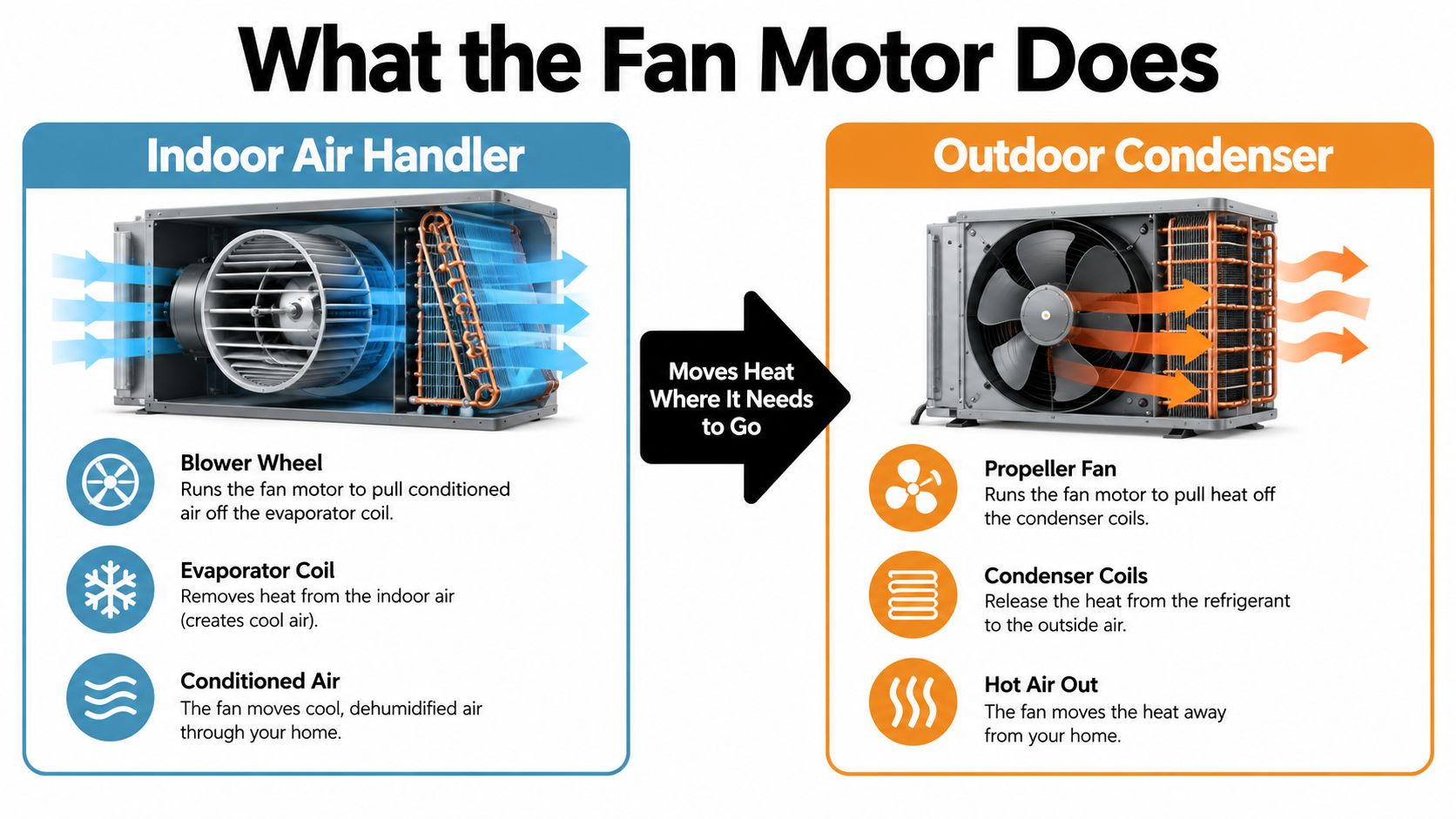
The outdoor motor is often faster to access than an indoor blower. That access difference, not just the part price, is one reason outdoor repairs frequently cost less. A practical overview of the equipment is available in this homeowner guide to the parts of a central air conditioning unit.
Typical Parts and Labor Costs by Motor Type
Motor technology is the first serious dividing line in a replacement quote. Older systems often use PSC motors, which are simpler, single-speed components. Newer high-efficiency systems may use ECM or variable-speed motors, which rely on electronic controls and require closer matching to the equipment.
Current cost data places standard outdoor and fan motor replacements broadly around $200 to $700, while high-efficiency ECM replacements can reach $600 to $1,000 or more installed, depending on equipment and access. Forbes' heat pump maintenance cost guide identifies fan motor repair in the $200 to $700 range, while a specialized replacement guide explains why ECM motors carry a higher installed cost.
Motor Type | Parts Cost | Labor Cost | Typical Total |
|---|---|---|---|
Standard PSC motor | Varies by model and equipment | Varies by access and diagnostic work | About $200 to $700 installed |
High-efficiency ECM or variable-speed motor | Higher because of electronic controls and matching requirements | Higher when programming, testing, or access is involved | About $600 to $1,000 or more installed |
Indoor blower motor | Often more expensive than an outdoor motor because of access and airflow matching | Can increase in an attic or confined air handler | About $300 to $900, with high-efficiency models reaching about $1,500 |
Outdoor condenser fan motor | Often simpler and more accessible | Usually less involved than indoor blower work | About $200 to $700 |
These are installed-cost patterns, not promises for every Tucson home. The exact price depends on the motor's specifications, whether the part remains under warranty, the equipment's location, and whether a capacitor or control component also needs attention.
A standard motor on a ground-level outdoor unit should not be priced like a difficult indoor ECM replacement without a clear reason. Before authorizing work, ask the technician to identify whether the failure is on the indoor or outdoor side. Covenant Aire Solutions provides additional homeowner guidance on blower fan repair, including the importance of accurate diagnosis.
Factors That Push Your Final Bill Up or Down
The motor itself is only one line in the quote. Tucson homeowners should judge the full job, including access, timing, warranty coverage, and the amount of diagnostic work required.
The main cost variables
Factor | What usually pushes the price down | What can push it up |
|---|---|---|
Motor technology | Standard PSC design | ECM or variable-speed design |
Equipment location | Ground-level outdoor unit | Rooftop, attic, or cramped closet |
Warranty status | Covered part or covered labor | Out-of-warranty part and labor |
Equipment age | Common, readily available replacement | Older or brand-specific component |
Timing | Planned daytime appointment | Emergency or after-hours dispatch |
System condition | Motor-only repair | Motor plus capacitor, controls, or related work |
Access deserves special attention. Neutral pricing coverage places difficult-access jobs around $500 to $1,200, compared with roughly $220 to $550 for easier installations, as described in this heat pump fan motor cost guide. That difference can reflect attic heat, rooftop logistics, restricted working space, additional labor, or the need to remove surrounding equipment.
Indoor blower work can also require a more exact performance match. A motor that physically fits may still be wrong for the system's airflow requirements. ECM replacements can involve electronic controls and diagnostic testing, not just a basic wire-for-wire swap.
Warranty status can change the economics sharply. Ask whether the manufacturer covers the motor, whether the installing contractor covers labor, and whether the warranty requires an approved service network. Emergency timing matters too. A contractor responding during a peak Tucson weekend may charge differently from one completing scheduled work during a normal appointment window.
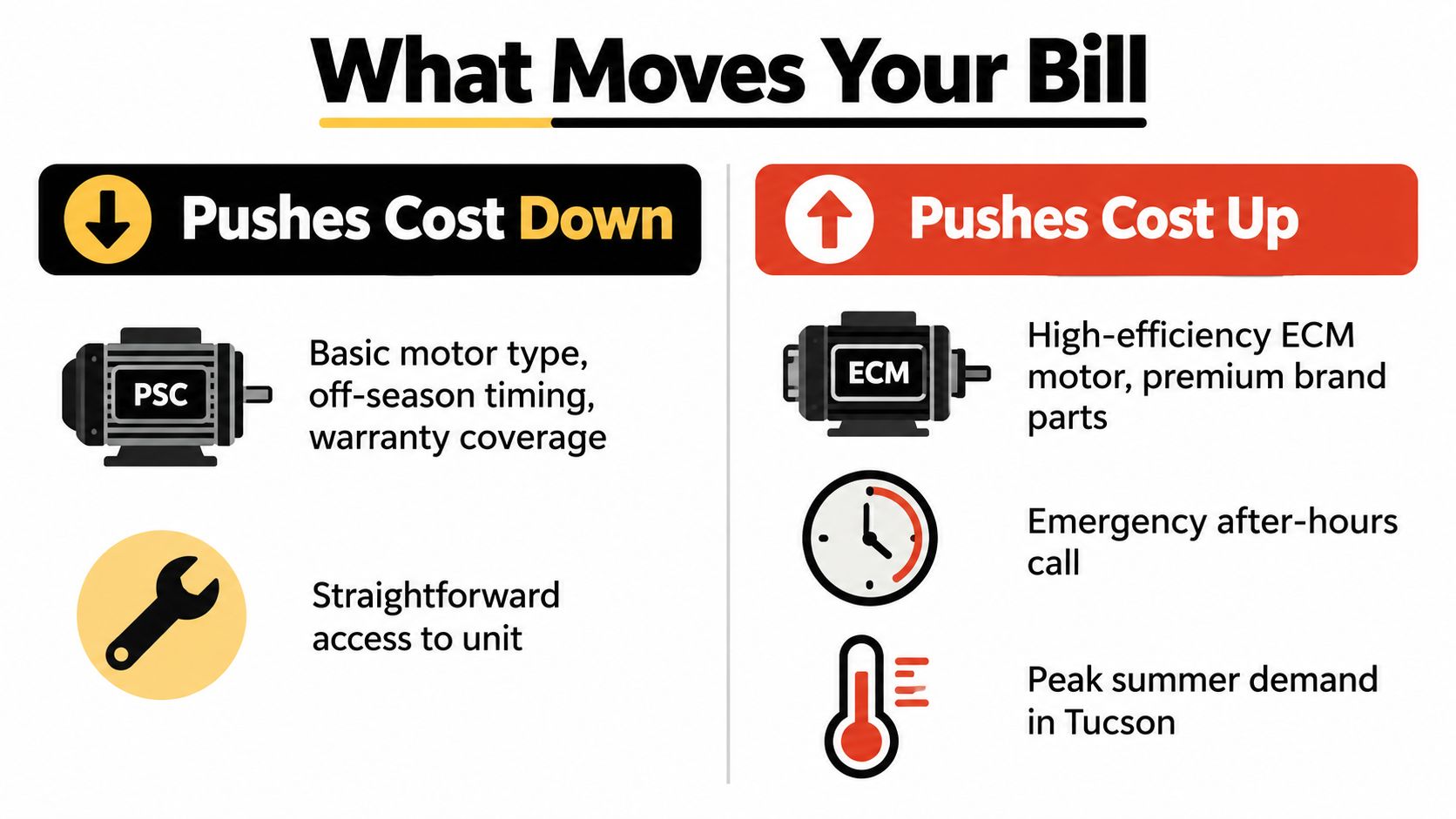
A fair estimate separates the motor, diagnostic work, labor, access complications, warranty credit, and related parts. If the quote only says “fan motor replacement” with one unexplained total, ask for an itemized version.
DIY Replacement Versus Calling a Professional
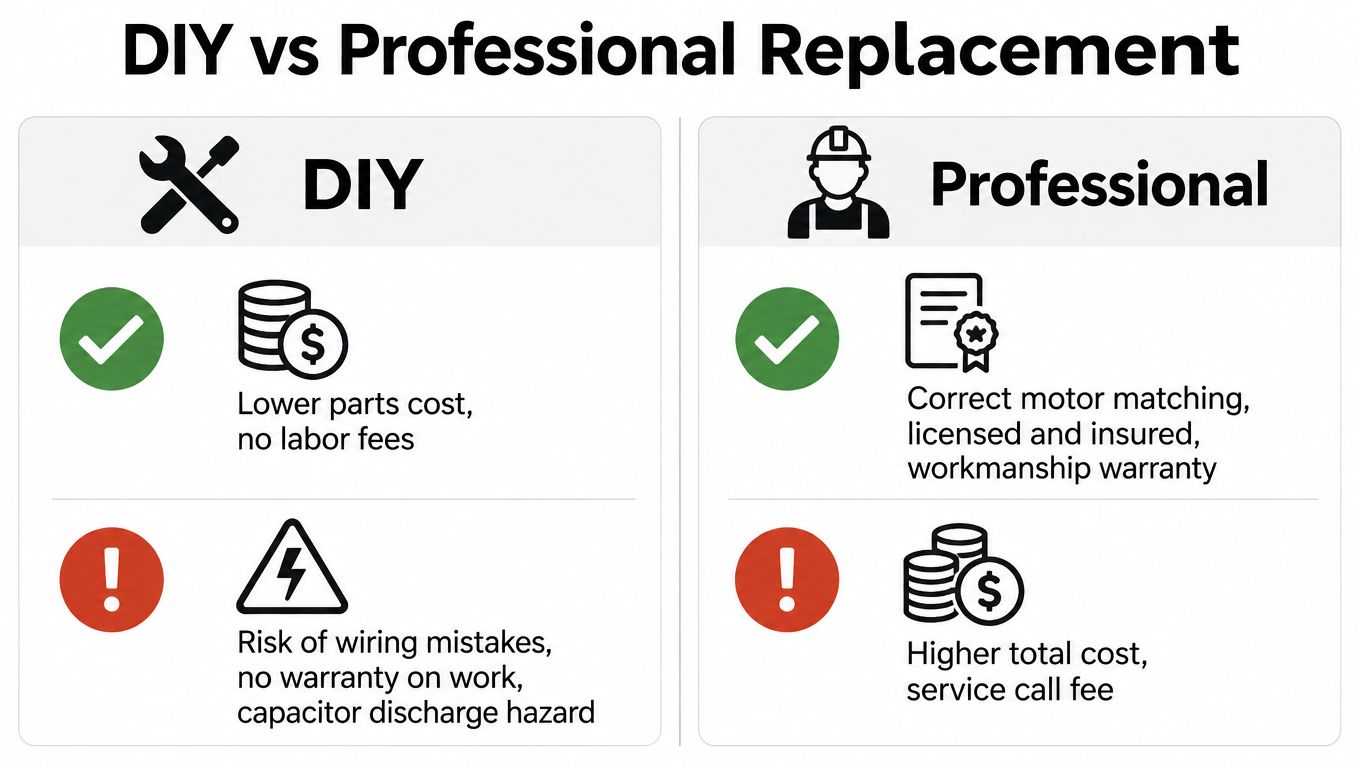
Replacing a fan motor isn't a beginner-friendly Saturday project. The equipment contains high-voltage wiring, and capacitors can retain an electrical charge even after the system stops running.
The first challenge is diagnosis. A fan that won't start may have a failed motor, but it may also have a capacitor problem, control-board fault, wiring issue, or another electrical defect. Installing a new motor without testing those possibilities can leave you with a costly new part and the same original failure.
What a capable homeowner might handle
A confident DIYer with electrical experience might consider a basic PSC replacement in a ground-level air handler. Even then, the breaker must be shut off and secured against accidental re-energization, the wiring must be documented, and the replacement motor must match the original specifications.
The risk increases with an attic unit, an ECM motor, a rooftop condenser, or equipment still covered by a manufacturer warranty. Incorrect rotation, speed settings, wiring, or airflow can damage the system and create comfort problems during a Tucson heat wave.
A lower parts bill isn't a saving if the wrong motor is installed or the original fault remains undiscovered.
Professional service costs more because it includes diagnosis, correct motor matching, electrical testing, installation, and system verification. It also gives you a clearer path for warranty or workmanship concerns. In my view, professional replacement is the sensible choice for ECM motors, indoor blowers, attic equipment, and any system that serves bedrooms or occupants who can't safely tolerate a cooling failure.
If you want to see the kind of component inspection involved, this fan motor replacement video provides useful visual context. It shouldn't replace an electrical safety assessment or a proper system diagnosis.
How to Get an Accurate Quote Before You Commit
Start with diagnosis, not price shopping. Ask the first technician to identify the failed component and provide the motor's model or part number. A reputable contractor should explain how the testing supports the diagnosis rather than just pointing to a non-spinning fan.
Then request the same information from another qualified shop. You don't need several vague opinions. You need comparable line items.
Use this quote checklist
Motor identification: Ask whether the replacement is PSC, ECM, or variable-speed, and whether it matches the heat pump's brand and model.
Scope of work: Confirm whether the quote includes removal, installation, wiring, testing, and cleanup.
Related components: Ask whether the run capacitor, control module, wiring, and blower wheel were tested.
Warranty terms: Get parts coverage and labor coverage listed separately.
Access charges: Confirm whether attic, rooftop, or restricted-space work changes the labor.
Trip charges: Ask whether diagnostic, travel, or after-hours charges appear separately.
Written total: Require the final price and payment terms in writing before work begins.
A quote of $850 isn't directly comparable to one of $1,050 if the first excludes a capacitor, access labor, or warranty coverage. Compare the motor specification, included work, warranty, and fees line by line.
Use a contractor's diagnostic process as a quality signal. Covenant Aire Solutions explains its approach to HVAC system diagnostics, which is the right place to focus before approving an expensive component replacement.
Tucson-Specific Ways to Manage the Cost
Tucson weather changes the repair decision. Waiting for a convenient appointment may be reasonable when the system still operates, but a complete cooling failure during a hot weekend creates a different calculation. Ask whether an emergency dispatch premium applies, and ask if the contractor can offer a next-available standard appointment instead.
Financing can also make a necessary repair easier to manage. Local HVAC companies may offer financing plans for qualifying repairs, but terms vary. Ask about the total repayment amount, promotional conditions, interest, approval requirements, and what happens if the balance isn't paid within the promotional period.
Look for cost levers before the repair starts
Check the warranty first. Locate the equipment's model and serial numbers, then ask the manufacturer or installing contractor whether the motor is covered. A covered part doesn't always mean covered labor, so request both answers separately.
Ask about maintenance plans. A Tucson maintenance agreement may include scheduled inspections, coil cleaning, capacitor checks, priority service, or discounts. Review the actual inclusions rather than assuming every plan provides the same value. Covenant Aire Solutions describes its heat pump maintenance approach in its guide to heat pump maintenance cost.
Investigate efficiency incentives carefully. TEP programs and federal 25C tax provisions may apply to qualifying efficiency improvements, but eligibility depends on the equipment, installation, and current program rules. Confirm requirements before treating a rebate or credit as part of your budget.
Ask about parts availability. Manufacturer warranty networks and local suppliers such as HD Supply and Johnstone may help a contractor locate a compatible component during seasonal demand. Availability doesn't guarantee a lower price, but it can reduce the risk of waiting while the home remains uncomfortable.
The best savings decision is usually the least dramatic one: verify coverage, compare a complete quote, and schedule non-emergency work when your options are widest.
Extending Motor Life and Planning for the Next Repair
Tucson's dust, heat, and heavy cooling demand make basic maintenance especially important. Keep desert debris, mesquite leaves, and loose vegetation away from the outdoor condenser. Rinse the outdoor coil gently in spring, never with a forceful spray that can bend the fins.
Schedule a pre-summer tune-up before the season becomes intense. Replace return-air filters regularly during heavy use, and listen for new grinding, squealing, rattling, or humming sounds. A motor that changes its sound may be warning you before it stops.
Prepare for the next decision
Keep the equipment model and serial number in a convenient place. Save the last service invoice, warranty information, and any written diagnosis. When a motor fails, those records help a technician identify the correct part faster and help you compare repair against replacement.
Repair makes less sense when the heat pump has multiple aging components, repeated failures, or a compressor problem alongside the motor issue. Ask for two options, a repair plan and a replacement plan, with the assumptions and warranties stated clearly.
Questions Tucson homeowners ask
How long should a replacement fan motor last?Its service life depends on motor design, airflow, electrical conditions, cleanliness, and maintenance. A contractor should explain the warranty and the conditions that could shorten its life.
Does a new motor have its own warranty?Usually, the motor's parts coverage and the contractor's labor or workmanship coverage are separate. Get both terms in writing, including exclusions and the process for making a claim.
What should I do if the fan stops spinning in summer?Turn the system off, check that the thermostat and breaker appear normal, and don't keep forcing the equipment to run. Keep doors and blinds closed, protect vulnerable occupants from the heat, and arrange a qualified diagnosis before approving a replacement.
Covenant Aire Solutions provides heat pump repair, replacement, maintenance, and emergency HVAC service for Tucson-area homes, with upfront pricing and flexible financing options. If your fan motor has stopped or your quote doesn't make sense, visit Covenant Aire Solutions to request service and discuss the right next step.