
How to Identify Asbestos Insulation in Your Home
Updated: Oct 20, 2025
The absolute first thing you have to understand about asbestos insulation is that you can't identify it just by looking at it. Seriously. No matter how many pictures you've seen online, visual confirmation alone is impossible.

What you can do is play detective. Start with the age of your home and the appearance of the material. This gives you the clues you need before calling in the pros for testing.
The Critical First Step: Spotting Potential Asbestos
Finding what you think might be asbestos in your home can be pretty unnerving. But knowing what to look for is the first real step toward making your home safe. This is especially true if your house was built before the widespread bans on asbestos-containing materials kicked in.
The real danger isn't that asbestos is just there; it's when its microscopic fibers get into the air. If the material is in good shape, undisturbed, and sealed away, the risk is pretty low. But as soon as you start a renovation, accidentally damage a wall, or even as the material naturally breaks down over time, those dangerous fibers can be released.
Understanding the Risks
Exposure to airborne asbestos fibers is directly linked to some very serious health problems, including mesothelioma and other nasty lung diseases. This is exactly why you have to be cautious and informed. You're not just protecting your house; you're protecting the health of every single person who lives there.
The goal here isn't to cause a panic. It's to encourage you to be smart and careful. When you know the potential risks, you can make responsible decisions instead of just guessing.
A lot of homeowners love a good DIY project. While tackling something like learning how to insulate a garage roof can be a great weekend task, dealing with potential asbestos is a completely different ballgame that demands professional expertise.
To get a better handle on the visual cues and where asbestos is commonly found, check out this detailed guidance on identifying asbestos in your home. It's a fantastic resource to consult before you decide what to do next. An informed homeowner is a safe homeowner, and that starts with recognizing what could be a hazard in the first place.
A Visual Field Guide to Asbestos Insulation
Think of this section as your personal, in-home guide to spotting potential asbestos insulation. Learning what to look for won't give you a definitive "yes" or "no," but it will absolutely arm you with the knowledge to recognize the biggest red flags.
Let's cut through the technical jargon and focus on what these materials actually look like in the wild.
One of the most infamous types is loose-fill vermiculite insulation. You'll often find it poured between joists in attics, and it has a very distinct, granular look. The particles are usually lightweight, almost like small, pebbly nuggets that have a silvery-gold or grayish-brown sheen.
This image gives you a realistic look at vermiculite in an attic, a classic scenario in older homes.
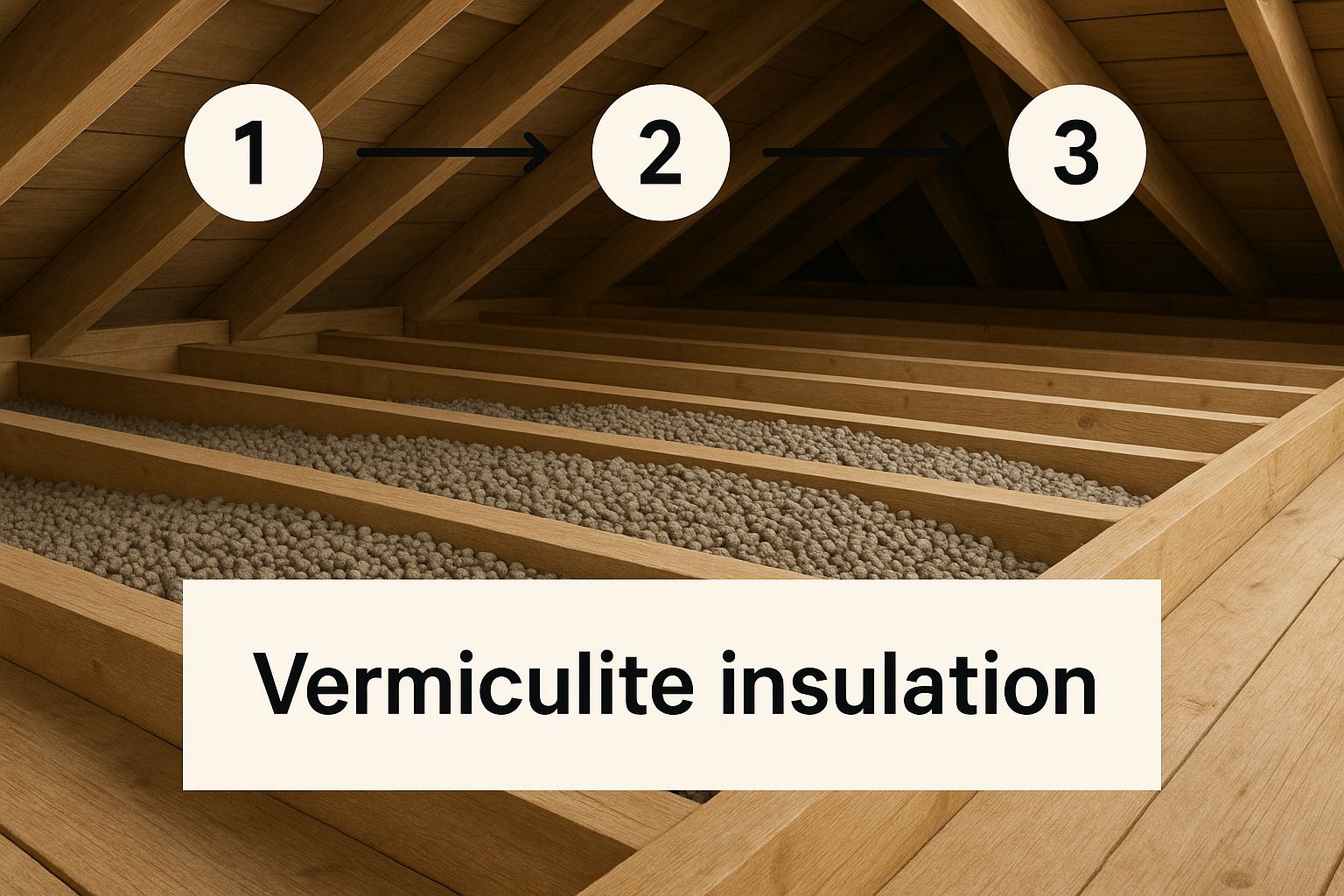
The key takeaway here is its unique, pourable texture. It's nothing like modern pink fiberglass batts or the fluffy, paper-like appearance of cellulose insulation. Because it was poured in, it fills cavities completely, but that also means it’s very easily disturbed.
Spotting Other Common Forms
Beyond the attic, asbestos can be hiding in other forms, each with its own visual signature. These materials were loved for their fire-resistant properties, so you'll find them around anything that gets hot.
A common culprit you'll see is asbestos pipe wrapping. Check around old water heaters, boilers, and the pipes running to and from them. It often looks like a brittle, chalky plaster cast that was molded around the pipes and fittings. With age, it gets incredibly crumbly and fragile to the touch.
You might also come across rigid block insulation. This is a dense, firm material that was often installed in sheets or blocks around furnaces and boilers. It can look like a piece of off-white or grayish cement board.
A critical point to remember: Don't mistake age for safety. Just because insulation has sat untouched for decades doesn't reduce the risk. Any asbestos-containing material can release dangerous fibers if it's damaged or disturbed, especially if it's "friable" (meaning it crumbles easily).
The use of asbestos as thermal system insulation (TSI) was incredibly widespread. A 1984 EPA survey found that nearly 100 percent of buildings with eight or more floors had asbestos TSI. About 40 percent of those also had asbestos in surfacing materials. This just shows how common this stuff really was.
To give you a quick reference, here’s a table summarizing what to look for and where.
Visual Guide to Potential Asbestos Insulation
Insulation Type | Common Appearance | Typical Location |
|---|---|---|
Vermiculite (Loose-Fill) | Small, pebbly, lightweight granules; silvery-gold or gray-brown color. | Poured in attics between joists. |
Pipe Wrapping | Brittle, chalky, white plaster-like material molded around pipes. | Around hot water pipes, boilers, and furnaces. |
Block Insulation | Dense, rigid sheets or blocks; off-white or grayish in color. | Around furnaces, boilers, and other heat sources. |
Asbestos Tape/Blanket | Woven, fabric-like material or tape wrapped around duct joints. | On the exterior of older HVAC ductwork. |
This table is a great starting point, but always remember that visual identification is not a guarantee.
Where to Look First
Knowing the types is half the battle; knowing where they hide is the other. Start with a systematic check of these high-probability areas in your home.
Attics and Crawlspaces: These are prime spots for loose-fill vermiculite. Grab a good flashlight and shine it across the floor joists to get a clear view of what's between them.
Basements: This is where you'll want to inspect your furnace, boiler, and hot water pipes for that chalky wrapping or any rigid block insulation.
Walls: This is tougher for a DIY inspection, but be aware that asbestos was sometimes used in spray-on or block insulation inside wall cavities, especially in commercial or multi-family buildings.
Ductwork: Older HVAC systems sometimes have asbestos tape or a blanket-like insulation on the exterior of the ducts. If you're curious about what a professional looks for, our guide on what a thorough HVAC duct inspection involves is a great resource.
Again, these are all just visual clues. The only way to know for sure if a material contains asbestos is to have it professionally tested.
What to Do If You Suspect You Found Asbestos
So, you've spotted something in your home that looks suspiciously like one of the asbestos materials we've described. What now? Your next few moves are absolutely critical.
Let's get the most important rule out of the way first, and it's a simple one: do not touch it. Seriously. The fastest way to send those dangerous fibers airborne is by disturbing the material in any way.
That means you need to fight every urge to poke it, scrape a piece off, or try to clean it up. Don't even think about sweeping or vacuuming near the area. These actions can launch microscopic fibers into the air where they can float around for days, just waiting to be inhaled. Your first job is containment, and right now, that means doing nothing at all to the material itself.
Immediate Safety Protocols to Follow
Think of this as your emergency action plan. The second you have a suspicion, you need to treat the area like a potential hazard zone. The game plan is all about isolation and minimizing any air movement.
First things first, limit access immediately. Cordon off the room or the specific area where you found the material. If it’s in a bedroom, close the door and stuff a towel under it to block the gap. If it's in a more open space like a basement, some simple tape or a makeshift barrier will work to keep kids, pets, and other family members away.
Next, you need to think about your home's airflow.
Shut Down HVAC Systems: Go to your thermostat and turn off your central heating and air conditioning. You don't want your HVAC system pulling fibers from that one spot and blasting them through the vents into every room of your house.
Turn Off Fans: Kill any nearby ceiling fans, box fans, or even bathroom exhaust fans. Any air current, no matter how small, can stir things up and spread the fibers.
These steps aren't just for show. Once asbestos fibers are floating in the air, they can travel surprisingly far, contaminating other parts of your home and creating a major inhalation risk for everyone inside.
Why DIY Sampling Is a Dangerous Idea
I get it. It’s tempting to want to grab a little piece of the material, bag it up, and send it to a lab yourself to get a quick answer. Please, don't do this. It's an incredibly risky move.
Without the proper training and personal protective equipment (PPE), I'm talking about specialized respirators, not just a dust mask, you are almost guaranteed to disturb the material. This can release a concentrated cloud of fibers right into your breathing zone.
Professional asbestos inspectors are trained to take samples using very specific, safe methods. They wet the material to keep dust down, use sealed containers for transport, and wear gear that protects them and prevents cross-contamination. This is one job that is definitely not for the DIYer.
The only truly safe and reliable way forward is to bring in a professional. A certified asbestos abatement pro can correctly identify the material and, if needed, run air quality tests to see if fibers are already present in your home's environment. For total peace of mind, looking into professional indoor air quality testing in Tucson can give you a full picture of what you're breathing. An expert assessment takes all the guesswork out of the situation and ensures it’s handled the right way from the very beginning.
So You Suspect Asbestos? Here’s How the Pros Handle Testing
While visual clues are a great first step, at the end of the day, they're just educated guesses. The only way to be 100% sure if a material in your house contains asbestos is to have it professionally tested in a lab. Calling in a certified inspector takes the guesswork out of the equation and gives you solid evidence to work with.
When a certified inspector shows up, you’ll notice their process is methodical and puts safety above all else. They don’t just walk in and start ripping things apart. Their whole approach is built around precision to avoid the very thing you’re trying to prevent: releasing dangerous asbestos fibers into the air.
First thing you'll see is the personal protective equipment (PPE), like a specialized respirator and disposable coveralls. This isn’t for show; it’s a critical safety measure to protect themselves and prevent any fibers from hitching a ride to other parts of your home.
The Sample Collection Method
Taking a sample is way more involved than just breaking off a chunk of insulation. A trained professional follows a strict, careful protocol designed to minimize any fiber release.
First, they’ll isolate the area, often laying down plastic sheeting to catch any stray debris. Then, they’ll gently wet the suspected material with a fine mist of water, sometimes mixed with a detergent. This simple but brilliant technique helps bind the fibers together, dramatically reducing the odds of them becoming airborne.
Using hand tools, they cut out a small, coin-sized piece of the material. That sample immediately goes into a sealed, airtight container like a small bag or vial. It’s then clearly labeled with the location and date. The whole process is surgical and contained.
The name of the game in professional sampling is containment. Every single step, from wetting the material to double-bagging the sample, is designed to ensure the collection process itself doesn't create a new hazard in your home.
Inside the Asbestos Testing Laboratory
With the sample secured, it’s off to an accredited lab for analysis. This is where scientists use powerful microscopes to look for the unique, tell-tale characteristics of asbestos fibers. It's this step that provides the definitive answer.
The most common method they use is called Polarized Light Microscopy (PLM). This technique involves looking at the sample under a special microscope that uses polarized light, which allows them to identify the distinct optical properties of different types of asbestos minerals. It's a highly reliable and cost-effective way to find asbestos in bulk building materials.
Professional lab analysis is incredibly precise; it can detect asbestos fibers as small as 0.1 microns in diameter using these advanced microscopy techniques. For a deeper look at the science, you can explore the full research on asbestos identification.
Once the analysis is complete, you’ll get a formal report detailing the findings. It will state clearly whether asbestos was present and, if so, what type and in what concentration. This report becomes your roadmap, giving you the concrete data needed to make an informed decision on what to do next, whether that’s encapsulation or complete removal.
Understanding this testing process is a key part of managing your home's overall air quality. If you're looking to be more proactive about your home's health, you might also want to check out your guide to an air quality home test kit for a broader look at keeping your indoor environment safe.
Your Options for Managing Confirmed Asbestos
Okay, so the lab results are in, and they've confirmed asbestos insulation. Take a deep breath. A positive test result isn't a disaster; it's a clear call to action. Getting that confirmation is actually a good thing, as it removes the guesswork and gives you the certainty needed to handle it safely.
Now, you have two primary strategies for dealing with the material. Let's walk through what they are so you can figure out which path is right for your home.
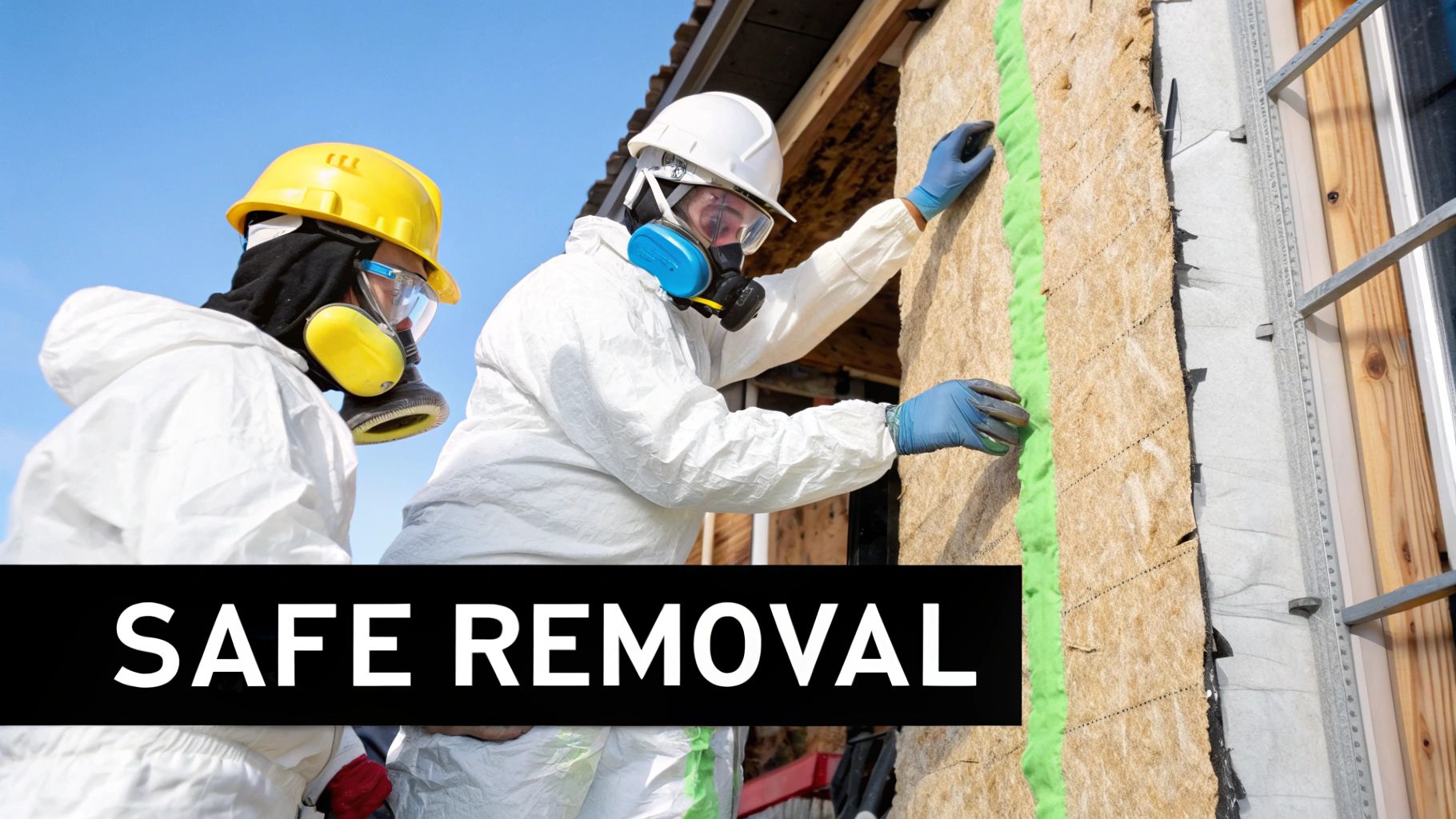
The first option is called encapsulation. This is a process where professionals come in and seal the asbestos-containing material with a special, durable coating. Think of it like a protective shell. This sealant effectively locks the dangerous fibers in place, preventing them from ever becoming airborne.
Encapsulation can be a fantastic solution if the insulation is still in good shape, not crumbling or damaged, and is in an area where it’s unlikely to get bumped or disturbed. A great example is intact pipe wrap in a low-traffic basement. It's often less disruptive and more affordable than a full-blown removal.
Understanding Abatement or Removal
Your second, more permanent option is abatement, which is just the technical term for the complete and professional removal of the asbestos. This is the route you'll need to take if the insulation is damaged, crumbling, or "friable" (meaning it can be easily crushed by hand). In that state, it's already a serious risk.
Abatement is also the standard, and frankly, non-negotiable, procedure before any major renovation or demolition. The last thing you want is a construction crew accidentally disturbing asbestos and sending fibers everywhere. This is an intensive process where licensed pros create a sealed, negative-pressure work zone to contain every last particle.
I can't stress this enough: both encapsulation and abatement are jobs strictly for licensed and certified asbestos professionals. Trying to do this yourself is illegal in many places and incredibly dangerous. You could end up contaminating your entire home.
Ensuring Safety After the Work Is Done
Once the pros have finished their work, there's one final, critical step: follow-up air monitoring. This isn’t an optional add-on; it’s an absolute must for your peace of mind.
A third-party inspector will come in to take air samples from inside the former work area and send them to a lab for analysis. This is how you verify that the job was done correctly and that the air in your home is safe to breathe again. A standard method for this is Phase Contrast Microscopy (PCM), which detects airborne fibers.
Regulatory bodies like OSHA have set strict safety limits. The permissible exposure limit is a time-weighted average of 0.1 fiber per cubic centimeter of air. If you're curious about the nitty-gritty details, you can read the full OSHA methodology on their website.
This final air clearance test is what gives you the all-clear, confirming that the air is clean and you can confidently reclaim your space. Of course, managing indoor air quality is an ongoing process. If you’re looking to upgrade your home's filtration systems, it helps to know the difference between a HEPA vs carbon filter and which is right for you.
Your Asbestos Insulation Questions, Answered
When you're dealing with something as serious as asbestos, a lot of questions pop up. It’s completely normal. Getting clear, straightforward answers is the only way to feel confident you're making the right calls for your home and your family's safety.
Let’s walk through some of the most common concerns we hear from homeowners who think they might have asbestos insulation.
Are DIY Mail-In Asbestos Test Kits a Good Idea?
You've probably seen them online. Mail-in kits that promise a fast, cheap way to know if you have asbestos. And while the labs they partner with are often accredited, the real problem isn't the lab; it's how the sample is collected.
As we've talked about, taking a sample yourself is incredibly risky without the right training and professional-grade safety gear.
A clumsy sample can release a concentrated cloud of dangerous fibers right where you're standing. A pro knows how to wet the material down and use specific containment methods to keep those fibers locked down. The risk of contaminating your home and your lungs just isn't worth the small amount you might save with a DIY kit.
What Goes Into the Cost of Professional Asbestos Work?
The price for professional testing and removal isn't a simple, flat fee. It really depends on the specifics of your situation, which is why getting a detailed, on-site quote is so important.
Several key factors will shape the final price:
Accessibility: Is the insulation in an open, easy-to-reach attic? That's going to be less expensive than dealing with asbestos packed behind walls or tucked into a cramped, awkward crawlspace.
Scope of the Job: The total square footage of asbestos-containing material that needs to be removed is one of the biggest cost drivers. The type of asbestos matters, too. "Friable" asbestos, the kind that crumbles into a powder with just hand pressure, is more hazardous and requires much stricter (and more expensive) containment protocols.
Proper Disposal: Asbestos is classified as hazardous waste. It can't just be thrown in a dumpster. It has to be taken to specialized disposal facilities, and they charge significant fees. These costs are almost always built into your contractor's quote.
Your best bet is to get multiple quotes from different licensed abatement companies. This gives you a clear picture of the costs for your unique project and helps you find a fair price for a job done right.
Is It Safe to Just Live with Undisturbed Asbestos?
This is a big one, and the short answer is often yes, but with a huge asterisk. If the asbestos-containing material is in excellent condition, totally sealed or encapsulated, and located where it absolutely will not be disturbed, it generally poses a minimal risk. The danger is from airborne fibers, so if nothing is making the material release them, it’s considered stable.
The keyword here is "undisturbed." That all changes the second you plan a renovation, or if the material gets damaged by a ceiling leak or just degrades over time. Any activity that could cut, drill, sand, or crumble the material can turn a stable situation into an active health hazard in an instant.
If you choose to leave it in place, make a habit of visually inspecting the area to make sure it's still in good shape. If you ever see signs of flaking, crumbling, or any other damage, it's time to call in the professionals immediately. Knowing how to identify asbestos insulation is just the first step; leaving its management to the pros is the only way to ensure long-term safety.
For any concerns about your home's air quality, from potential hazards to improving your HVAC system's performance, trust the experts at Covenant Aire Solutions. Our certified technicians can provide the guidance and services you need to ensure your home is both comfortable and safe. Learn more at covenantairesolutions.com.