
How to Read Your Energy Bill: Tucson Homeowners' Guide to Saving
- Feb 14
- 16 min read
When your energy bill arrives, it's tempting to just glance at the total and call it a day. But taking a few minutes to really understand what you're looking at is the first step toward getting a handle on your home's energy use, and your budget.
Let's break down how to read that first page like a pro, so you can spot issues before they become expensive problems.
Navigating the First Page of Your Energy Bill
Think of the first page of your utility bill as the highlight reel. It’s designed to give you the most critical information upfront, without bogging you down in the details just yet. For those of us in Tucson with providers like Tucson Electric Power (TEP), this page is organized to be pretty straightforward once you know where to look.
Your eyes should immediately go to the bill summary section. This is your command center. It pulls together the most important figures into one convenient spot, so you can get a quick snapshot of your account's status.
Finding the Essentials at a Glance
The layout isn't random; it prioritizes what you need to do right now, which is usually paying the bill. You can instantly see how much you owe and when it's due. This quick check gives you a baseline before you start digging into why the bill is what it is.
A common mistake is only looking at the total amount due. Taking a few extra seconds to review the entire summary gives you a much better picture of your monthly energy use and helps you spot any jarring changes from last month right away.
The first page of your TEP bill is packed with useful information, but it's easy to feel overwhelmed. The summary box is your best friend here, giving you the most important details at a glance.
Here’s a quick reference table to help you find what you need and understand why it matters.
Key Information on Your Bill Summary
Section Name | What It Tells You | Why It Matters for You |
|---|---|---|
Account Number | Your unique identifier with TEP. | You'll need this number anytime you call customer service. Keep it handy. |
Billing Period | The start and end dates for the charges on this bill. | Helps you connect your usage to a specific timeframe, like a scorching hot month. |
Total Amount Due | The bottom-line figure you owe for the billing period. | This includes all charges, taxes, and fees. It's the amount to pay. |
Payment Due Date | The deadline to pay your bill without getting hit with late fees. | Missing this date can lead to annoying penalties and dings on your account. |
Once you're comfortable with these key pieces of information, you'll be in a much better position to manage your energy costs effectively.
If you've ever looked at your statement and wondered, "why is my electric bill so high all of a sudden," the answer often starts right here. Comparing this summary to last month's, or even last year's bill for the same month, can reveal significant shifts in your spending.
This quick comparison is your first diagnostic tool. It can help you decide if you need to investigate your HVAC system’s performance or take a closer look at your household's energy habits.
Understanding Your Electricity Usage in Kilowatt-Hours
Once you’ve scanned the summary, it’s time to get into the nitty-gritty of your energy bill: the part that truly tells the story of your home's consumption. This section is all about one crucial metric: the kilowatt-hour (kWh). Getting a handle on this number is the key to managing your energy costs, especially here in Tucson where the summer heat can really put your AC to the test.
So, what exactly is a kilowatt-hour? It's the standard unit utilities use to measure how much electricity you've used. Think of it like a gallon of gas for your car; it's the unit you're actually buying from TEP or your local provider.
To put it in perspective, one kWh is what you’d use if you ran 1,000 watts of power for one hour. A more practical example? Running ten 100-watt light bulbs for a full hour uses exactly one kWh. Your total bill is a direct result of how many of these kilowatt-hours your home consumed during the billing period. That makes your kWh usage the single most important figure to track if you want to lower your bill.
The image below shows how these details come together in your bill's summary, all driven by your kWh consumption.
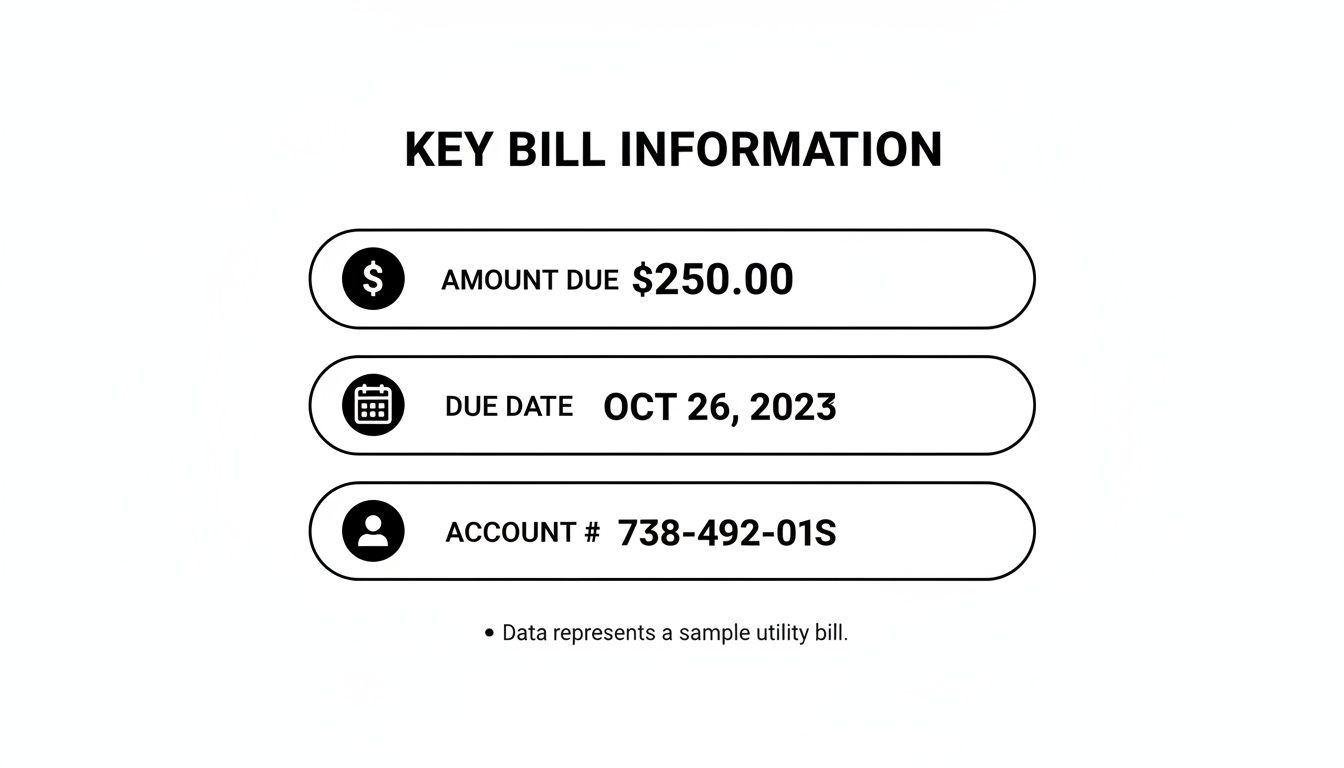
This visual makes it crystal clear: your total usage translates directly into the amount you owe. That’s why tracking kWh is so essential.
Decoding Your Meter Readings
So how does the utility company figure out your total kWh usage? They track your electricity meter. Somewhere on your bill, you’ll find a section dedicated to your meter readings, which usually breaks down into two key numbers:
Previous Read: This was the meter reading from the end of your last billing cycle.
Current Read: This is the meter reading from the end of the most recent billing cycle.
The math is simple: the difference between these two numbers is your total kilowatt-hour consumption for that period. Let's say your previous read was 15,000 kWh and your current read is 17,500 kWh. Your household used 2,500 kWh of electricity. This straightforward calculation is the foundation for your entire electricity charge.
Visualizing Your Energy Story with Usage Graphs
Most modern energy bills, including the ones from TEP, now include a bar graph showing your energy usage over time. This is an incredibly powerful tool for spotting patterns and, more importantly, potential problems. Instead of just seeing a single number, you can compare this month's usage to last month's, and even to the same month last year.
This historical comparison is your best friend for context. A high bill in July might seem normal for Tucson, but if your usage is 50% higher than last July despite similar weather, that’s a huge red flag. More often than not, it points to an issue with your HVAC system’s efficiency.
Learning to read these graphs is a game-changer. A sudden, unexplained spike in your kWh usage is often the first warning sign that your air conditioner needs a professional look. The efficiency of your HVAC system has a massive impact on its energy draw. You can get a deeper understanding of this in our article explaining what a SEER rating is and how it impacts your energy bills. By mastering your bill's usage details, you can spot trouble early and keep your own costs under control.
A Line-by-Line Breakdown of Charges and Fees
Alright, let's get into the nitty-gritty of your bill: the actual charges and fees. Beyond the total kilowatt-hours, your bill is a mix of different line items that can feel like deciphering a complex code. But once you know what you're looking at, each line tells a piece of the story about what it costs to power your home.
One of the biggest surprises for homeowners is realizing a good chunk of their bill has nothing to do with how much energy they actually used. These are the fixed charges, the baseline costs you pay every month just to stay connected to the grid.
Fixed Charges: The Costs of Connection
Think of fixed charges as the utility's cost of doing business. They cover the essentials like maintaining power lines, managing the grid infrastructure, and handling customer service. These are the predictable costs that show up month in and month out, regardless of your usage.
On a local Tucson Electric Power (TEP) bill, you'll likely spot a couple of these:
Basic Service Fee: This is simply a flat monthly charge to cover the administrative costs of having an account with them. It’s the cover charge for being connected to the grid.
Meter Charge: Some bills will break out a separate fee for renting and maintaining the electric meter on your home, making sure it’s accurately tracking what you use.
You can't really do anything to lower these charges; they're a non-negotiable part of having reliable electricity. But knowing they exist explains why your bill never hits zero, even if you go on vacation for a whole month.
Variable Charges: What You Can Control
Now we get to the part where your habits really matter. Variable charges are tied directly to your consumption, measured in kilowatt-hours (kWh). The more electricity you use, the higher these charges go. This is your prime territory for saving money.
Here are the main players in this category:
Generation Charge: This is the literal cost of making the electricity you consumed. It covers everything from fuel for the power plants to their operational expenses.
Delivery Charge: Sometimes called a transmission or distribution fee, this covers the cost of getting that electricity from the power plant, across that huge network of towers and lines, and right to your doorstep.
For a deeper dive into why those spikes happen and what to do about them, check out our guide on what causes high electricity bills and how to fix them.
Understanding Surcharges and Taxes
The final pieces of the puzzle are the various surcharges, riders, and taxes tacked onto your bill. These are often mandated by state or local governments to pay for specific programs or public initiatives.
They might look small on their own, but they definitely add up. On a TEP bill, for example, you might see things like this:
Charge Type | Purpose | How It's Calculated |
|---|---|---|
Environmental Surcharge | Funds renewable energy programs and environmental compliance efforts. | Usually a small percentage of your total energy cost. |
Purchased Power Surcharge | Recovers costs when the utility has to buy extra power from other sources to meet high demand. | Can change based on market energy prices. |
Local and State Taxes | Standard sales taxes applied to your energy service, just like with other goods and services. | A straightforward percentage of your subtotal. |
By separating these fees from your core usage charges, you get a much clearer picture of your total energy expenses. It helps you see what you can influence (like the generation charge) versus what you can't (like the basic service fee). That knowledge is power when it comes to budgeting and spotting any fees that seem out of line.
Using Your Bill to Diagnose HVAC Problems
Here in Tucson, your air conditioner isn't just a luxury during the summer, it's pretty much the most critical appliance in your home. It's also, without a doubt, the single biggest driver of your electricity bill.
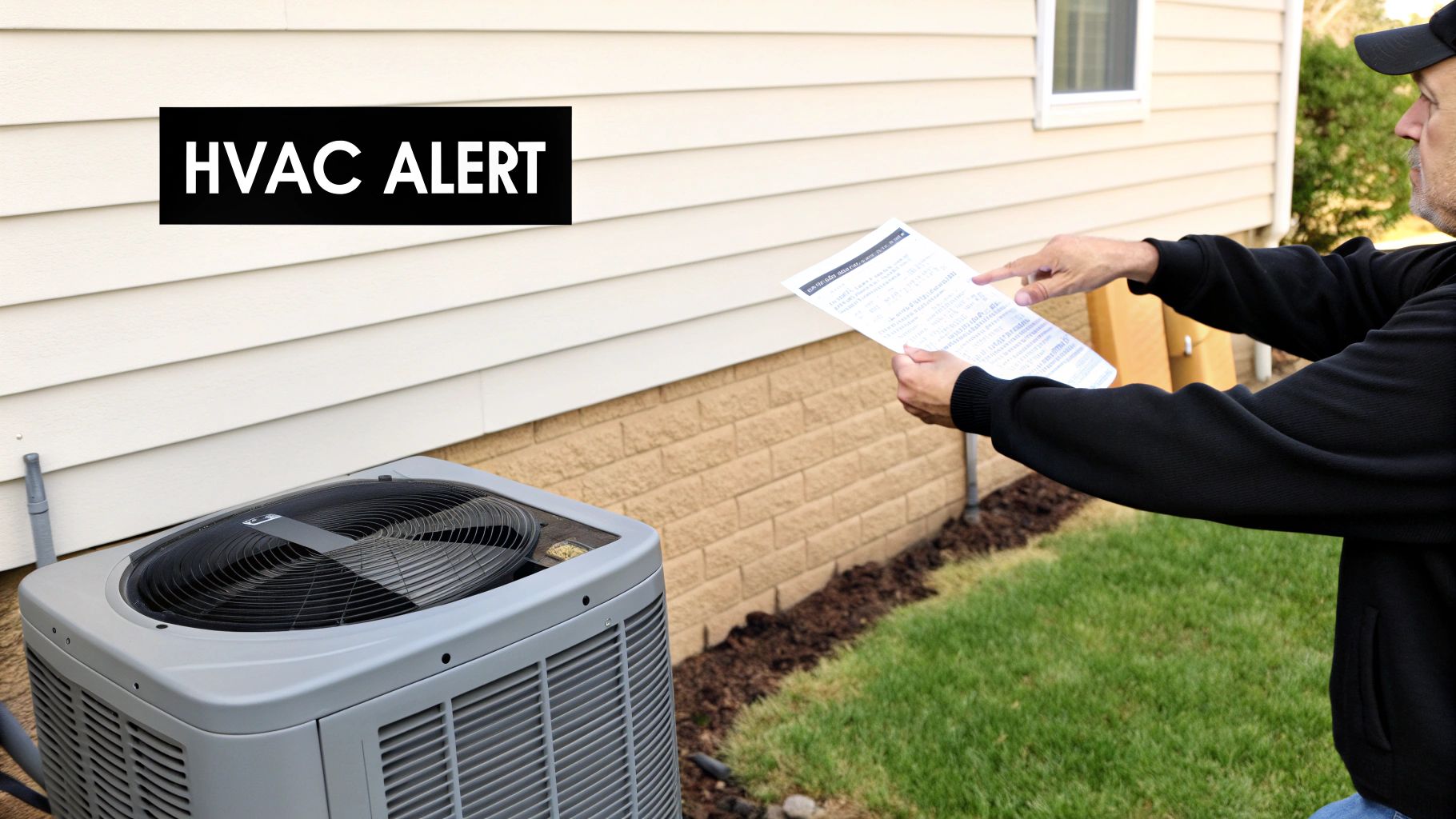
This means your monthly statement from TEP is more than just a request for payment. Think of it as a monthly report card on the health of your HVAC system. A sudden, unexplained jump in your kilowatt-hour (kWh) usage is often the very first sign of a brewing problem. If you learn to spot these warnings on paper, you can catch small issues before they snowball into expensive, system-wide failures. The trick is knowing how to tell the difference between a normal seasonal increase and a spike that's screaming for attention.
Analyzing Usage History for Red Flags
Your bill’s historical usage graph is your best friend for this kind of detective work. Don’t just glance at this month's total; the real insight comes from comparing it to the same month last year. Arizona weather is pretty consistent year-to-year, making this comparison a fantastic baseline.
Let's say your kWh usage for July was 3,500 kWh. You check last year's bill, and it was only 2,200 kWh. If the average temperatures for both months were roughly the same, that massive jump is a major red flag. It means your AC is working much, much harder, and guzzling far more energy, to deliver the same amount of cooling. This isn't just about a higher bill; it's a clear signal of a serious inefficiency somewhere in your system.
When your kWh usage skyrockets without a corresponding, extreme change in weather, your HVAC system is telling you something is wrong. Ignoring this signal can lead to a component failure that leaves you without cooling during the hottest days of the year.
This historical context is what turns you from someone just reacting to a high bill into someone who is proactively spotting a mechanical problem that needs a professional eye.
Common HVAC Culprits Behind High Energy Use
When your bill is pointing to a problem, several usual suspects could be the cause. Each one forces your system to run longer and harder, which racks up the electricity needed to keep your home comfortable. Knowing what these culprits are helps you understand what to look for.
A few of the most frequent issues we see include:
Clogged Air Filters: This is the easiest fix but also one of the most common oversights. A dirty filter chokes off airflow, forcing the fan motor to work overtime just to push air through your home.
Low Refrigerant Levels: Refrigerant is the lifeblood of your AC. If it's low, it's almost always because of a leak. The system simply can't cool effectively and will run almost constantly trying (and failing) to hit the temperature you set on the thermostat.
Failing Compressor or Capacitor: The compressor is the heart of your outdoor unit, and the capacitor gives it the electrical kick it needs to start up. If either part is struggling, it can draw a huge amount of power right before it fails completely.
Dirty Condenser Coils: The coils in your outdoor unit are designed to release heat. When they get caked with dirt, dust, and debris, they can't do their job. Heat gets trapped, and the whole system becomes less effective.
To connect the dots between your bill and your system, here's a quick reference table.
Connecting Bill Spikes to Potential HVAC Issues
Symptom on Your Bill | Potential HVAC Cause | Recommended Next Step |
|---|---|---|
Gradual increase in kWh month over month | Dirty air filter or dirty outdoor coils. | Check and replace your air filter immediately. Inspect and clean the outdoor unit. |
Sudden, sharp spike in a single month | Low refrigerant (leak) or a failing component like a capacitor or compressor. | This requires a professional. A sudden spike can precede a total system failure. |
Bill is high, but the house still feels warm | Multiple possibilities: clogged filter, refrigerant leak, or undersized system. | Start with the filter. If that doesn't help, it's time to call for a diagnostic service. |
Energy use is high even on milder days | A failing thermostat or a stuck contactor could be causing the system to run nonstop. | Check your thermostat settings. If it seems fine, professional help is needed to check the electrical components. |
If you're noticing these signs and want to understand what comes next, our guide on how to troubleshoot AC problems is a great resource for homeowners.
Of course, HVAC isn't the only power-hungry appliance. A sudden spike in your energy consumption could also point to issues with other major systems. If you suspect your water heater might be the culprit, you can find information to help you diagnose common water heater issues and see if that's the source.
Ultimately, your energy bill provides the raw data. By learning how to read your energy bill with an eye for these patterns, you empower yourself to be the first line of defense for your home's most important system. You can spot trouble early, make an informed call for service, and prevent a minor inefficiency from becoming a major, mid-summer breakdown.
What You Can Do to Lower Your Energy Bill
Okay, so you can now read your energy bill like a pro. That's the first step. But interpreting the numbers is one thing; making them smaller is the real goal. Let's move from understanding to action with some practical, effective strategies designed specifically for us here in Tucson.

We're going to skip the generic advice. These are tips that actually make a difference in our unique desert climate, from no-cost changes you can make today to smart, long-term investments that pay for themselves. This is your roadmap to taking control.
Immediate and Low-Cost Changes
You don't need a huge budget to start seeing a difference. In fact, many of the most effective strategies are simple habit adjustments and minor maintenance tasks you can knock out this weekend. These small steps really do add up to significant savings over time.
Once you know what you're being charged for, the next step is to actively cut back your consumption. You can find some great smart tips for saving electricity at home to get started right away. Most of these ideas are straightforward and easy to implement.
Here are a few high-impact changes we always recommend:
Optimize Your Thermostat: In Tucson, your thermostat should be your best friend. Aim for 78°F or higher when you're home and bump it up a few degrees when you're out. Every single degree you raise the temperature can save you up to 3% on cooling costs.
Seal Up Air Leaks: Those little gaps around windows, doors, and where pipes enter your home are like open invitations for hot desert air. Grab some caulk and weatherstripping to seal them up and keep your cool, conditioned air inside.
Use Your Window Coverings: Blackout curtains and reflective blinds are non-negotiable in the desert. Keep them closed during the day, especially on your south- and west-facing windows. This simple habit can dramatically reduce how much heat gets into your house.
Manage Appliance Use: Run your dishwasher and clothes dryer during off-peak hours, which is usually late at night. These appliances kick out a lot of heat, and using them after the sun goes down means your AC doesn't have to work overtime to compensate.
These tactics cost little to nothing but can make a noticeable dent in your next energy bill. For more summer-specific strategies, check out our guide on how to lower your electric bill in summer as a Tucson homeowner.
Strategic Long-Term Investments
While those quick fixes are great, the biggest savings often come from more substantial investments in your home's efficiency. These are the upgrades that pay for themselves over time through lower energy bills and a much more comfortable home.
A strategic upgrade, like improving insulation or replacing an aging HVAC unit, is one of the most powerful ways to lock in long-term energy savings. These investments tackle the root causes of high consumption, not just the symptoms.
Here are a few of the most impactful upgrades for a Tucson home:
Attic Insulation: So many older homes around here are under-insulated. Bringing your attic insulation up to modern standards is one of the best ways to stop the sun from baking your living spaces from above.
Energy-Efficient Windows: If you've got old single-pane windows, you're losing the battle against the heat. Dual-pane windows with low-E coatings are designed to reflect heat while still letting in light, and they make a massive difference.
Upgrade to an Energy-Efficient HVAC System: This is the big one. If your air conditioner is over 10-15 years old, it's running on outdated, inefficient technology. Upgrading to a new, high-SEER system can slash your cooling costs by a whopping 20% to 50%, delivering the single biggest return on investment for energy savings.
The Critical Role of HVAC Maintenance
Maybe the most important long-term strategy of all is simply committing to regular, professional HVAC maintenance. An unmaintained system can lose up to 5% of its efficiency every single year. A neglected unit has to run longer and harder to keep you cool, which shows up directly as higher kilowatt-hour consumption on your TEP bill.
Regular tune-ups ensure your system is running at its absolute best. During a maintenance visit, a certified technician will handle the critical tasks that keep your system efficient.
Maintenance Task | Why It Saves You Money |
|---|---|
Clean Coils | Dirty condenser and evaporator coils can't transfer heat effectively, forcing the system to work harder. |
Check Refrigerant Levels | Incorrect refrigerant charge cripples efficiency and cooling power. |
Inspect and Clean Blower Components | This ensures proper airflow, which is crucial for both efficiency and comfort. |
Lubricate Moving Parts | Reduces friction and electricity use, extending the life of motors and other key parts. |
Preventive maintenance isn't just about dodging expensive breakdowns; it's a direct investment in lowering your monthly energy bill. It keeps your system efficient, helps it last longer, and makes sure your home stays comfortable during those brutal Tucson summers without breaking the bank.
Still Have Questions About Your Energy Bill? Let's Clear Them Up.
Even after a deep dive, it's totally normal to have a few lingering questions. Your energy bill is a dense document, and it’s easy to get puzzled by the specifics, especially when you see a number that feels way too high.
To make sure you're completely confident reading your bill, we've pulled together the most common questions we hear from Tucson homeowners. Think of this as your final cheat sheet for any confusion that’s left.
Why Is My Tucson Energy Bill So High in the Summer?
In Tucson, a sky-high summer bill almost always points to one culprit: your air conditioner. The relentless desert heat forces your AC to run nearly non-stop just to keep your home comfortable. If your system is older, inefficient, or hasn't been maintained, it has to work even harder, which sends your electricity usage through the roof.
Other issues like poor insulation or leaky windows and doors just make the problem worse by letting all that cool air escape. A quick glance at your bill's usage graph can tell you if a spike is just typical for the season or a sign of trouble. A sudden, unusual jump is a clear signal that it's time to call for an HVAC service.
It's a common myth that a painful summer energy bill is just a fact of life here. While you'll always use more power in July than in March, a well-maintained, efficient HVAC system can absolutely keep those costs from getting out of control.
What Is a Demand Charge on a Utility Bill?
You’ll typically see a demand charge on commercial accounts, but it can pop up on certain residential time-of-use plans. It’s a fee based on your peak electricity usage during a single moment in the billing cycle, measured in kilowatts (kW), not your total kilowatt-hours (kWh) for the month.
Basically, the utility is charging you for the maximum amount of strain you put on the electrical grid at any one time. For homeowners, this is a good reminder to stagger the use of your big-ticket appliances. Try to avoid running your AC, oven, and clothes dryer all at once during peak hours, and you can keep those demand charges down.
How Can I Spot a Billing Error on My TEP Bill?
Finding a potential error starts with a simple comparison. Pull up your last few bills and put them side-by-side with your current one. That month-over-month or year-over-year look is the best way to spot something fishy.
Here’s a quick checklist to follow:
Look for Weird Usage Spikes: Is your kWh consumption way higher than usual, even though the weather was normal and your routine didn't change? A random doubling of usage is a major red flag.
Verify the Meter Readings: Make sure the meter readings on the bill make sense. The "current read" should always be higher than the "previous read." A simple typo here could be the cause of a shockingly high bill.
Scan All the Line Items: Read through every single charge. Is there anything new, duplicated, or totally unexpected on there?
If you've gone through this and still think something is wrong, give Tucson Electric Power (TEP) a call. Have your account info and the bill handy, and they can help verify everything and explain any charges that don't add up.
Does Regular HVAC Maintenance Really Save Money on My Bill?
Absolutely. It's not just a nice-to-have; it's one of the most reliable ways to control your energy costs. A professional tune-up ensures your HVAC system runs at peak efficiency, which has a direct and immediate impact on its electricity consumption.
During a maintenance visit, technicians do things you can't, like deep cleaning essential components, checking refrigerant levels, and lubricating moving parts. All of this helps your system cool your home with less effort. An efficient system runs less often and draws less power when it does, which directly lowers your monthly kWh usage.
Even more importantly, routine maintenance catches small issues before they snowball into major breakdowns that need an emergency repair. It also helps your unit last longer, saving you thousands by pushing back a premature replacement. Just think of it as a small investment to protect a very, very big one.
Getting a handle on your energy bill is the first step to creating a more efficient, comfortable home. If your bill has been dropping hints that your HVAC system is struggling, don't wait for it to give out completely. Covenant Aire Solutions offers expert maintenance, repair, and installation services to keep your system running at its best all year round.