
ac wont blow cold air? Tucson HVAC Guide
It's the moment every Tucsonan dreads: that first blast of warm, stagnant air from your AC vents on a scorching afternoon. It’s more than just uncomfortable; it’s a genuine cause for alarm. It's easy to jump to the worst-case scenario, picturing a catastrophic system failure and a hefty repair bill.
But before you panic, take a deep breath. In my experience, many cooling problems, especially in a place like Tucson where our systems work overtime, are caused by simple oversights, not total breakdowns. A kid messing with the thermostat or a brief power surge can be all it takes to throw your comfort off track.
Running through a few quick checks yourself can often solve the problem in minutes, saving you the time, money, and stress of an unnecessary service call.
What To Check First When Your AC Stops Blowing Cold Air
Before you start digging into the hardware, let’s rule out the most common and easily fixed culprits. These steps don't require any special tools and can often get that cool air flowing again right away.
Quick Safety Checks & Simple Fixes
Think of this as the initial triage for your air conditioner. Go through these simple steps before you even think about calling a pro.
Check Your Thermostat Settings: This might sound obvious, but you’d be surprised how often it's the root cause. Make sure the thermostat is set to "Cool" and the temperature is set at least 5 degrees below the current room temperature. A big one we see all the time is the fan setting. It should be on "Auto," not "On." If the fan is set to "On," it will blow air constantly, even when the cooling cycle is off.
Inspect the Circuit Breaker: Your AC system actually has two separate breakers: one for the indoor unit (the air handler) and another for the outdoor unit (the condenser). Head to your home's electrical panel and make sure both breakers are firmly in the "On" position.
A tripped breaker can be a sign of an electrical problem, but sometimes it's just a fluke from a momentary power surge. Try resetting it once. If it immediately trips again, that's a clear signal of a more serious issue. At that point, it’s time to call in a professional.
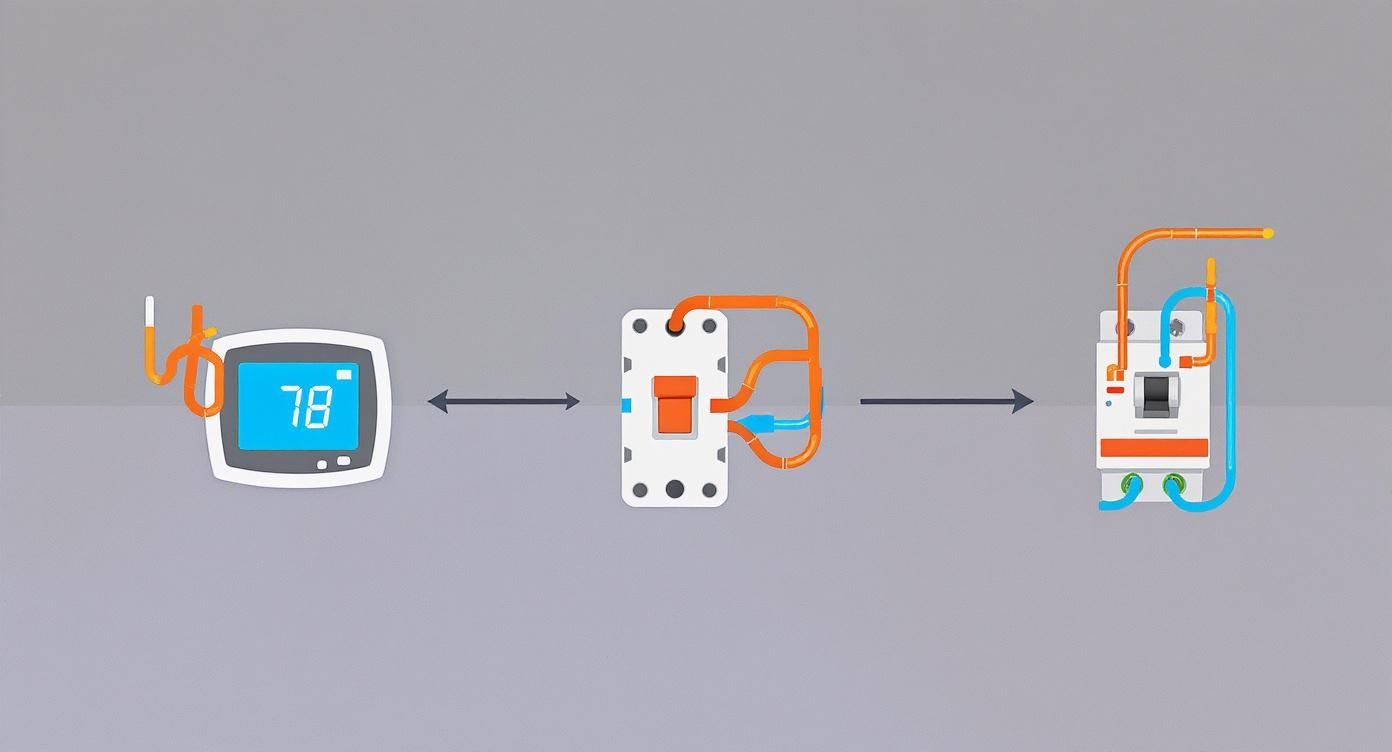
Before diving deeper, it's helpful to have a simple checklist. This table summarizes the most important first steps every homeowner should take.
Quick Troubleshooting Checklist for Your AC
Check | What to Look For | Simple Solution |
|---|---|---|
Thermostat | Is it set to "Cool"? Is the temperature setting low enough? Is the fan on "Auto"? | Adjust settings to "Cool," lower the temp, and switch the fan to "Auto." |
Circuit Breakers | Are the breakers for both the indoor and outdoor units in the "On" position? | Flip any tripped breakers back to "On." If it trips again immediately, stop and call a pro. |
Air Filter | Is the filter visibly dirty, gray, or clogged with dust? | Replace the filter with a new, clean one of the correct size. |
Vents & Registers | Are any supply or return vents blocked by furniture, rugs, or curtains? | Move any obstructions to ensure clear airflow. |
Running through these quick checks can often resolve the most common issues without needing any technical expertise.
Is It Just Poor Airflow?
Another incredibly common reason for an AC to blow warm air is restricted airflow. The main offender here is almost always a dirty air filter. When a filter gets clogged, it essentially suffocates your system. This forces it to work much harder and dramatically reduces its ability to cool the air passing through it.
In Tucson's dusty climate, this is a huge deal. A clean filter isn't just a suggestion; it's critical maintenance. If you're not sure how often you should be swapping it out, our guide on how often to change an AC air filter in Arizona has all the specifics you need.
Common Airflow Problems You Can Fix Yourself
When your AC starts blowing warm air, it’s natural for your mind to jump to the worst-case scenario: a busted compressor or a massive refrigerant leak. But hold on before you panic. More often than not, the real issue is much simpler: your system just can't breathe properly.
The problem isn't usually a broken part, but a blocked pathway preventing air from moving the way it should. Before you even think about calling a pro, there are a few straightforward checks you can do yourself. These issues are incredibly common, especially here in dusty Tucson, and you can usually sort them out in less than an hour.

The Dirty Air Filter Dilemma
Hands down, the number one cause of airflow problems is a clogged air filter. Picture trying to run a marathon while breathing through a coffee stirrer; that’s what your AC’s blower motor is up against. A dirty filter forces it to work way too hard to pull in air, which means a lot less cool air actually makes it to your vents.
This extra strain doesn’t just make your house feel warm. It can actually cause the evaporator coils to freeze over into a solid block of ice, bringing the whole cooling process to a screeching halt. In fact, the Department of Energy found that a clogged filter can slash your system's efficiency by up to 15%.
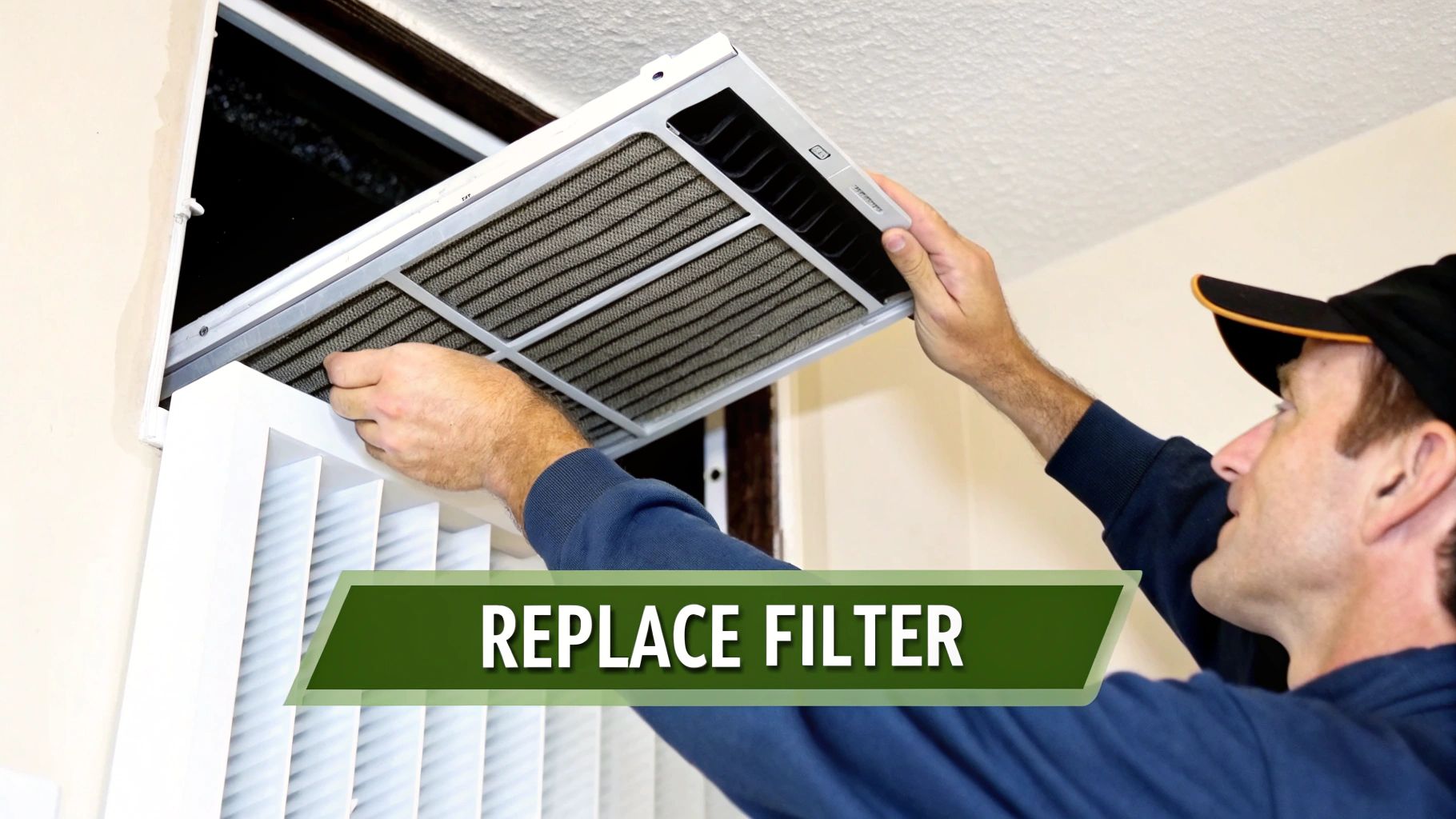
For those of us in Tucson, that fine desert dust is no joke. It clogs up filters fast. Make it a habit to check your filter every month. A good rule of thumb? If you hold it up to a light and can't see through it, it's way overdue for a change.
How to Check and Replace Your Filter
Swapping out your air filter is probably the easiest and most impactful piece of DIY home maintenance you can do. It takes five minutes, tops, and you don’t need any special tools.
Find the filter. It's usually tucked behind a return air grille on a wall or ceiling. Sometimes, it’s in a slot right next to your indoor air handler unit (the big metal box in a closet, garage, or attic).
Slide out the old one. Just unlatch the cover or pull the filter out. Take a look at the arrow printed on the cardboard frame, which shows you which way the air is supposed to flow.
Check the size. The filter’s dimensions are always printed on the side. Snap a picture with your phone or jot it down so you get the right replacement.
Put the new one in. Slide the new filter into the slot, making sure the airflow arrow points toward the furnace or air handler, not out into the room.
Clear Your Outdoor Condenser Unit
Your air conditioner is a team with two main players: an indoor unit and an outdoor unit. That big, noisy box outside is called the condenser, and its whole job is to dump the heat it pulled from inside your house. To do that job right, it needs room to breathe.
Over time, leaves, grass clippings from the lawnmower, dust, and even tumbleweeds can pile up against the condenser, smothering the metal fins. This debris acts like a thick winter coat, trapping heat and making it impossible for the unit to cool down. The result? Your AC works itself to death but can’t produce cold air.
Take a quick look. Walk outside and inspect your condenser. Are bushes growing right up against it? Is it caked in a layer of cottonwood fluff or dust?
Do a simple cleanup. First things first, turn off the power to the unit at the circuit breaker. Safety first. Then, you can use a garden hose on a gentle spray setting to rinse the gunk off the fins. Never use a pressure washer; it’s too powerful and will bend the delicate fins. While you’re at it, trim back any plants or weeds so you have at least two feet of clear space all the way around the unit.
Clearing these simple airflow blockages can make a world of difference. If you've done all this and the air still isn't cold, the issue might be hidden deeper in the system, like in your ductwork. You can learn more by checking out our ultimate guide to HVAC duct inspection.
Alright, you’ve checked the simple stuff like the thermostat and the air filter, but your AC is still just pushing warm air around. Now we're getting into the real nuts and bolts of the system, where mechanical or electrical failures are usually the culprit.
Knowing what's going on under the hood helps you have a much more productive conversation with a technician, which honestly saves everyone time and money.
Uncovering a Refrigerant Leak
Let’s clear up a common myth right away: air conditioners don’t "use up" refrigerant like a car uses gas. It’s a closed-loop system, meaning the amount of refrigerant you have on day one should be the same amount you have ten years from now.
If your system is low, it’s not because it was consumed. It’s because there’s a leak somewhere. This is a big deal. Refrigerant is the lifeblood of your AC; it’s the substance that actually absorbs the heat from inside your house and moves it outside.
A refrigerant leak is one of the top reasons an . In my experience, these leaks are surprisingly common, accounting for roughly 30% of all air conditioning repair calls. They don’t just kill your cooling power; they also release harmful greenhouse gases.
You can often spot the signs of a leak yourself. Keep an eye (and an ear) out for these clues:
A hissing or bubbling sound near your indoor or outdoor unit.
Ice or frost building up on the copper lines that run into your outdoor condenser.
A major drop in cooling performance, where the air coming out of the vents just feels lukewarm.
It's incredibly important to understand that handling refrigerant requires a special EPA certification. It’s a federally controlled substance. Attempting a DIY recharge is illegal, dangerous, and can cause even more damage to your system. If you suspect a leak, your only move is to call a licensed professional.
Identifying Electrical Failures
If refrigerant isn't the problem, the next place to look is the electrical system. These components work overtime during a brutal Tucson summer and eventually just wear out. A very common point of failure is the capacitor.
The capacitor is a small, can-shaped part that gives the compressor and fan motors the jolt of electricity they need to start. Think of it like the flash on an old camera: it stores up a charge and releases it in a powerful burst.
When a capacitor goes bad, the motors can't get going, even if they're getting power. A classic sign is a humming or buzzing sound from the outdoor unit, but the fan blades aren't spinning.
It’s easy to get lost in the weeds with all these wires and components. If you’re curious about how it all connects, you can get a better sense by learning how to read HVAC wiring diagrams in our guide. While you should never attempt electrical repairs on your own, recognizing these symptoms gives a technician valuable information, helping them diagnose the issue faster once they arrive.
What a Failing Compressor or Fan Motor Sounds Like
Alright, if you’ve worked through the easy stuff and your AC is still just blowing warm air, it's time to play detective and listen closely to the outdoor unit. The most serious, and often most expensive, problems don't hide. They scream for attention.
We're talking about the compressor and the outdoor fan motor. Think of them as the heart and lungs of your air conditioner. When they start to go, it’s a critical situation.
A compressor on its last legs makes some truly awful sounds. You might hear a violent grinding or screeching noise that’s impossible to ignore. Another dead giveaway is if the entire outdoor unit shakes and clatters like it’s about to fall apart when it tries to kick on. These aren’t just normal operational hums; they're the sounds of a machine in distress, signaling major internal damage.
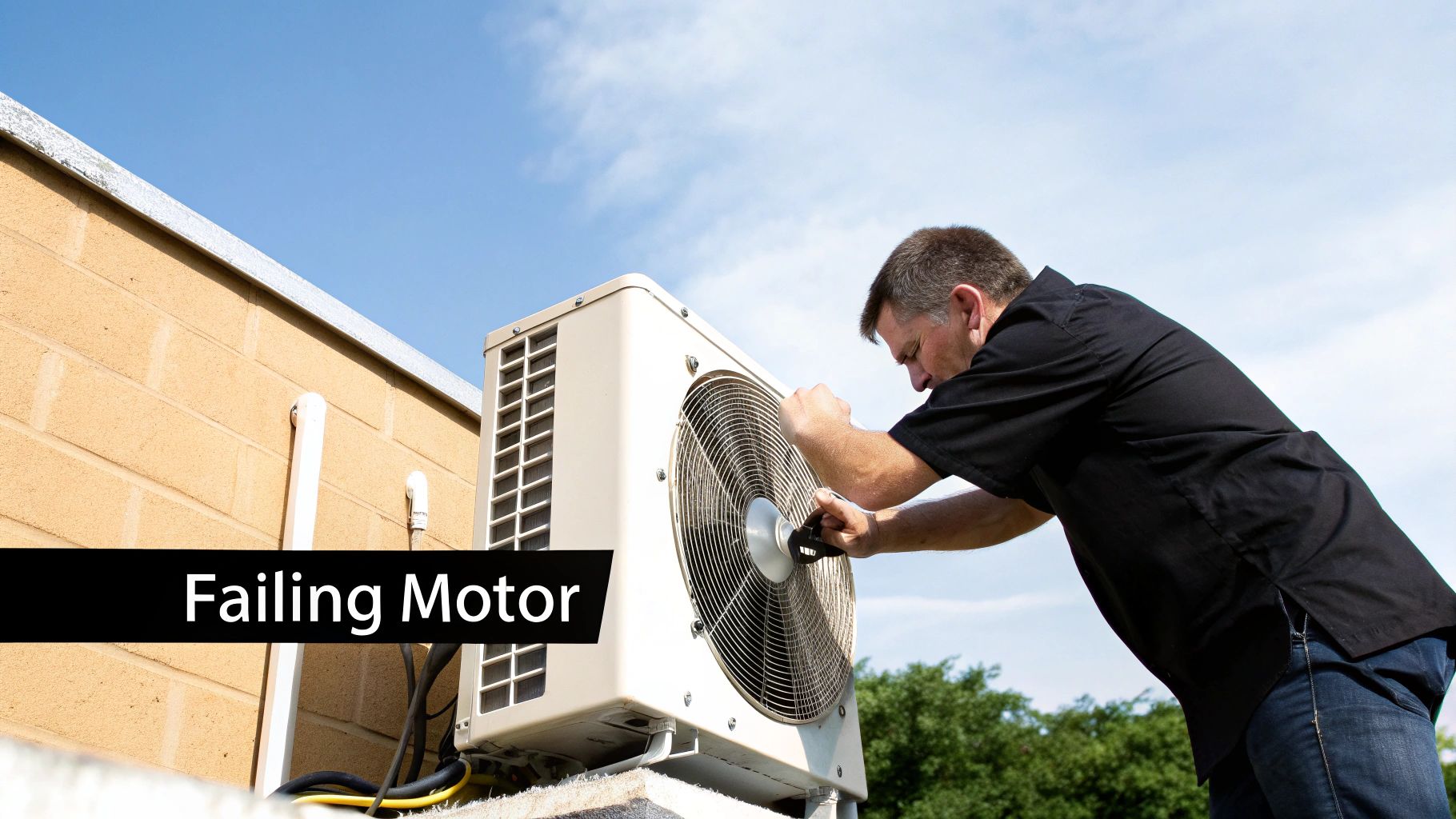
The fan motor has its own tell-tale signs of failure. The most obvious is when you can hear the unit running, but the fan blades aren’t moving at all. You might also see them spinning much slower than they should or struggling to get started. Don't ever try to give them a "helping hand" with a stick, since that's a recipe for injury and further damage.
Symptoms of Major Component Failure
It's one thing to have a clogged filter, but it's another thing entirely when a core component is about to die. Here’s how to spot the difference and know when it’s time to pick up the phone and call a pro immediately.
Loud Grinding or Squealing: This is classic sign of worn-out bearings inside the compressor. It's not going to fix itself.
Violent Shaking on Startup: When a compressor is struggling, it can cause the whole condenser unit to shudder violently.
Outdoor Fan Won't Spin: If you hear a hum but see no blade movement, you’re likely looking at a seized fan motor or a bad capacitor.
Circuit Breaker Trips Repeatedly: A failing motor or compressor pulls way more electricity than it should, and the breaker trips to prevent a fire. This is a serious safety warning.
When the compressor fails, your AC system is essentially dead in the water. It’s the component responsible for circulating the refrigerant that actually does the cooling. Ignoring the warning signs of a failing compressor or fan doesn’t just risk a bigger repair bill; it can lead to a complete system meltdown, turning what could have been a repair into a full-on replacement.
Industry stats show that compressor failures are behind roughly 20% of all AC repair calls globally. Here in the U.S., HVAC techs consistently report compressor issues as a top reason people call when their . If you're curious about the tech inside your unit, we have an explainer covering what a scroll compressor is and how it works. You can also see how common AC is becoming worldwide by checking out this data on worldpopulationreview.com.
When to Call a Tucson HVAC Professional
Knowing your limits is the best tool you have. It's one thing to change a filter or hose down the outdoor unit; those are satisfying, simple fixes. But your home's HVAC system is a complex beast, and trying to tackle a repair beyond your experience can quickly turn a small problem into an expensive, dangerous mess.
If you’ve gone through the basic checks and the air coming from your vents is still stubbornly warm, it’s time to step back and call in a pro.
There are certain symptoms that are absolute, non-negotiable red flags. These aren’t just suggestions; they’re your AC screaming for help from someone with the right tools and training.
Signs You Need an Expert Immediately
See or smell any of these? Your next move is to shut the AC off at the circuit breaker and pick up the phone. Don't hesitate.
Burning Smells: An odor like burning plastic, metal, or wiring is a serious electrical fault. It’s a major fire hazard.
Loud Metallic Screeching or Grinding: Those aren't normal operational sounds. That's the sound of expensive internal parts, like the compressor, grinding themselves to death. Letting it run will only cause more damage.
Constantly Tripping Breaker: You reset it, and it immediately trips again. This signals an electrical short or a motor that’s dangerously overloaded. A professional needs to diagnose this.
Visible Smoke or Sparks: This one is obvious. It’s a true emergency. Cut all power to the system right away.
Your safety and your home's integrity come first. Trying to save a few bucks on a complex electrical or refrigerant-based repair is never worth the risk of fire, electrocution, or catastrophic equipment damage. A licensed technician has the training and specialized tools to handle these jobs safely.
Understanding Repair Costs in Tucson
The fear of a surprise four-figure bill keeps a lot of homeowners from calling for help. While every AC problem is different, we believe in transparency. Here’s a realistic look at what you can generally expect to pay for common professional repairs here in the Tucson area.
Common Repair | Typical Cost Range (Tucson) | What It Fixes |
|---|---|---|
Capacitor Replacement | $150 – $350 | Fixes a humming outdoor unit where the fan won't start. |
Refrigerant Leak & Recharge | $400 – $1,200+ | Addresses low refrigerant by finding and sealing the leak, then refilling the system. Cost varies greatly by leak location. |
Condenser Fan Motor Replacement | $450 – $850 | Replaces a seized or burned-out motor for the outdoor fan. |
Clogged Condensate Drain Service | $100 – $250 | Professionally clears a stubborn clog causing water backups and system shutdowns. |
These numbers should help you feel more prepared and avoid sticker shock. If you're facing a sudden breakdown and need more guidance, our emergency air conditioning repair guide for homeowners is a great resource.
Choosing a Reputable HVAC Contractor
When it’s 105 degrees out and your AC quits, the pressure to hire someone, anyone, is intense. But taking just a few minutes to choose the right company can save you a world of hurt. Here in Tucson, you need a contractor who truly understands what our climate does to these systems.
First and foremost, only work with a company that is licensed, bonded, and insured in Arizona. Check their reviews on sites like Google and ask neighbors for their go-to recommendations. A trustworthy company will give you clear, upfront pricing and explain the issue in plain English, never pressuring you into an expensive repair or replacement you don't actually need.
Still Have Questions About Your AC?
Even after going through the basic checks, it's normal to have a few more questions pop up. Here are some of the most common things we hear from homeowners across Tucson when their air conditioner isn't pulling its weight.
How Often Should I Change My AC Filter In Tucson?
Living in the dusty Sonoran Desert means our air filters have a tougher job than in most places. A good rule of thumb is to check your filter every month and plan on replacing it every 30 to 60 days.
If you have pets that shed or family members with allergies, you should absolutely stick to a strict 30-day schedule. It’s the single best thing you can do to maintain good airflow and keep your system from choking in the middle of a July heatwave.
Is It Cheaper To Repair Or Replace My Old Air Conditioner?
This is the big question, and it really comes down to the age of your unit and how much the repair will cost. We often use the 5,000 rule to help homeowners decide: multiply the unit's age in years by the estimated repair cost.
If that number is over 5,000, replacement is almost always the more sensible financial decision. For example, if you're looking at a $500 repair on a 12-year-old unit (12 x 500 = 6,000), you’re better off putting that money toward a new, more reliable and efficient system.
Why Is My AC Unit Freezing Up?
Seeing ice on your AC unit is a red flag. It’s usually caused by one of two things: either restricted airflow from a clogged filter or a refrigerant leak.
Your first move should always be to swap out that air filter. If you put a fresh one in, let the unit thaw completely, and it still ices over, you're very likely dealing with a refrigerant leak that needs a professional to find and fix.
Expert Tip: A frozen AC is a system in distress. Never, ever run your air conditioner while it's iced over. You risk causing catastrophic damage to the compressor, which is the heart of your system. Turn it off, let it melt, and then figure out the root cause.
And while you're thinking about home comfort, don't forget the impact of the sun. Learning about effective ways to block heat from windows can take a huge load off your AC and make your home feel much more comfortable.
Can I Add Refrigerant To My AC Myself?
Absolutely not. This is a job that must be left to a licensed professional. Refrigerant (like Freon) is a federally regulated chemical that requires an EPA certification to handle safely and legally.
More importantly, your air conditioner is a sealed, closed-loop system. If it's low on refrigerant, it means there's a leak somewhere. Simply "topping it off" is like putting air in a tire with a nail in it; it doesn't fix the actual problem. A pro will need to locate the leak, repair it, and then charge the system with the precise amount of refrigerant it needs.
If you’ve walked through these steps and your home still feels like an oven, it’s time to call in the professionals. The certified technicians at Covenant Aire Solutions are on call 24/7 to get to the bottom of the issue fast. We provide honest, clear solutions to get the cool air flowing again in your Tucson home. Don't sweat it out—visit us at https://www.covenantairesolutions.com to schedule your service today.