
Why is my ac blowing hot air? Quick fixes & pro tips
When your air conditioner decides to blow hot air during a brutal Tucson heatwave, it’s more than just an inconvenience; it’s an emergency. But don't panic just yet. The root of the problem can range from a ridiculously simple fix to a major component failure, and figuring out which one you're dealing with is the first step.
Think of it like being a detective for your HVAC system. Each symptom your AC is showing, from the air temperature to the sounds it's making, is a clue pointing you toward the culprit.
Sometimes, the solution is as easy as flipping a switch. A quick check of your thermostat settings can often save the day. In fact, truly mastering your air conditioning controller functionality can head off a lot of these frustrating moments before they even start. Other times, though, the problem runs deeper, signaling a mechanical or electrical issue that needs a professional eye.
Common Culprits Behind a Warm AC
So, why is your AC betraying you with warm air? Let's break down the usual suspects, from the simple slip-ups to the more serious system failures.
Incorrect Thermostat Settings: This is the most common and easiest fix. Someone might have accidentally switched the system to "Heat" or set the fan to "On" instead of "Auto."
Loss of Power: A tripped circuit breaker is another frequent offender. If the breaker for your outdoor unit flips, the inside fan will still blow air, but it won't be cooled.
Refrigerant Leaks: Refrigerant is the essential fluid that absorbs heat from your home's air. If it leaks out, your AC loses its ability to cool. It's like a car trying to run without oil.
Compressor or Fan Failure: The outdoor unit houses the compressor and a large fan. These are the workhorses of the cooling cycle. If either one gives out, the whole process grinds to a halt.
Frozen Evaporator Coils: Icy coils might sound like a good thing, but they're not. Usually caused by a dirty filter restricting airflow or low refrigerant, frozen coils completely block cool air from getting into your vents.
In a state like Arizona, where over 90% of households rely on AC, these issues are all too familiar. As cooling becomes even more critical globally, these problems are only going to become more common.
To help you troubleshoot, this decision tree can guide you through the initial steps to figure out if you have a simple DIY fix on your hands or if it's time to call in the pros.
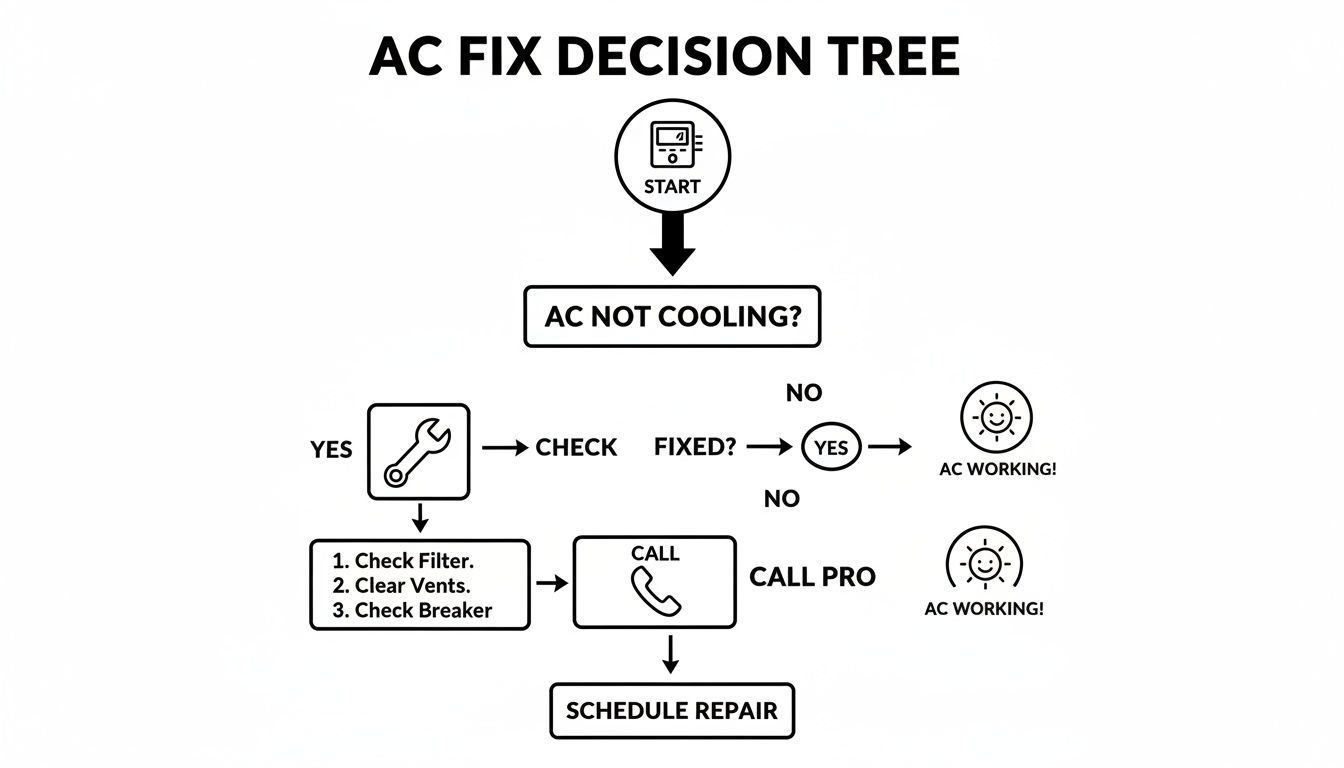
As you can see, starting with the basics like your thermostat and circuit breaker can often save you the time, money, and headache of a service call. If those simple checks don't solve it, then you'll have a much better idea of what you're dealing with.
To make things even clearer, here’s a quick rundown of what to look for and what to do next.
Quick Diagnostic Chart for an AC Blowing Hot Air
This table breaks down the most common issues, what you'll typically see, how hard it is to check yourself, and your best next move.
Common Cause | Key Symptom | DIY Check Difficulty | Next Step |
|---|---|---|---|
Thermostat Settings | Fan runs, but air isn't cold. | Easy | Check that mode is "Cool" and fan is "Auto." Lower temp setting. |
Tripped Breaker | Indoor unit runs, but outdoor unit is silent. | Easy | Locate your breaker panel and reset the AC/condenser breaker. |
Dirty Air Filter | Weak airflow from vents; unit may freeze up. | Easy | Inspect and replace the filter if it's clogged with dirt. |
Frozen Coils | No cool air, and you see ice on the indoor or outdoor unit. | Medium | Turn the system off to thaw. Change the filter. Call a pro if it persists. |
Refrigerant Leak | Hissing sounds; warm air; greasy residue on refrigerant lines. | Advanced | You can't fix this yourself. Turn off the AC and call a technician. |
Component Failure | Loud, unusual noises (grinding, squealing) from the outdoor unit. | Advanced | Turn off the AC immediately to prevent further damage and call for service. |
Remember, your safety comes first. If a check involves anything beyond a filter or a breaker switch and you're not comfortable, it's always best to leave it to a trained professional.
Troubleshooting Your AC with Simple DIY Checks
Before you jump to the worst-case scenario and start Googling repair costs, you should know that the answer to "why is my AC blowing hot air?" is often surprisingly simple. A few quick, safe checks can solve the problem in minutes, saving you from a sweltering Tucson afternoon and an unnecessary service call.
Think of these steps as first aid for your cooling system. They empower you to handle the small stuff yourself before you need to call in a specialist for something more serious. Let's walk through the three most common areas to check first.
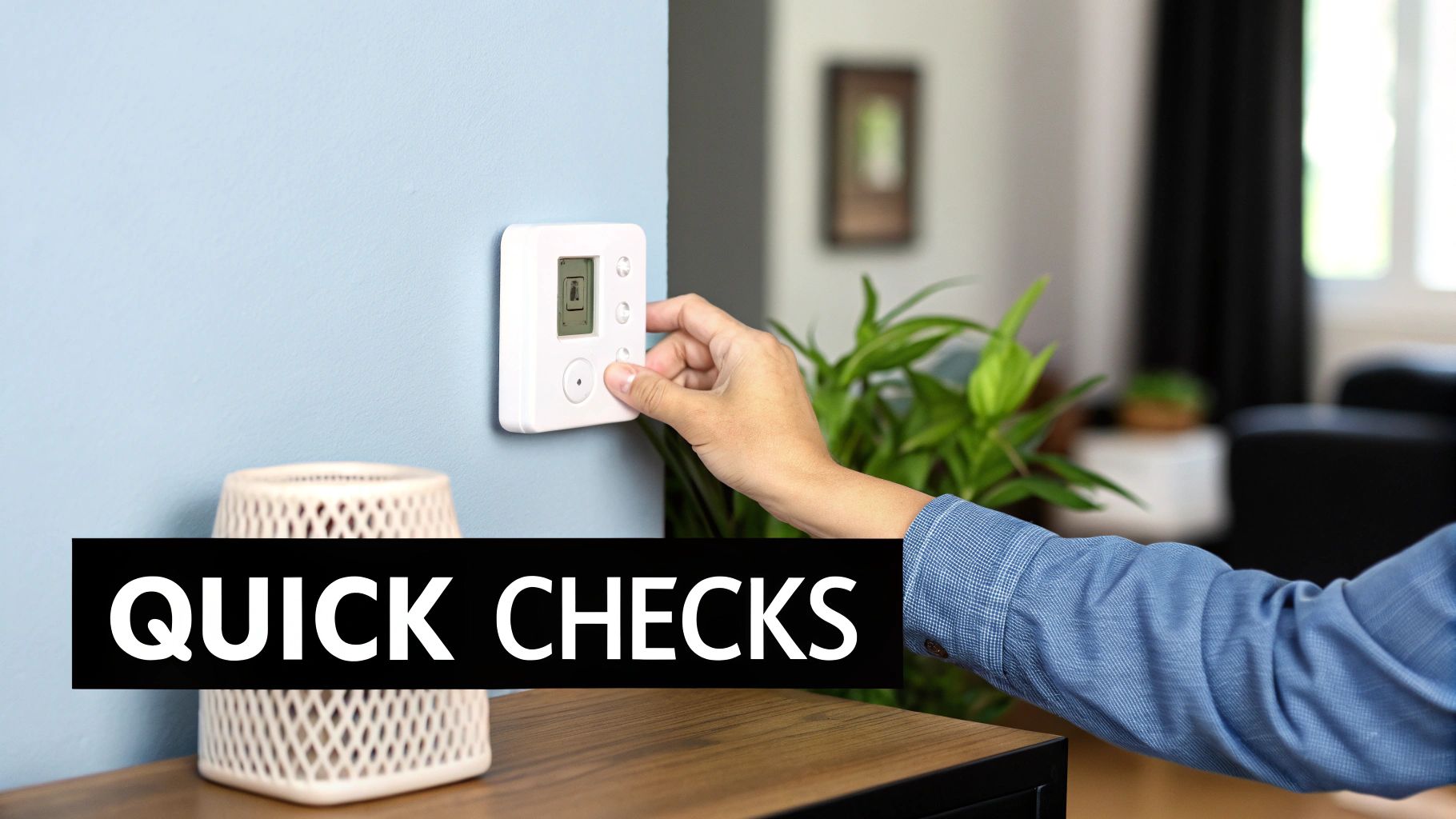
First Stop: Your Thermostat Settings
The thermostat is the brain of your entire HVAC system, telling it when to turn on, what temperature to aim for, and whether to heat or cool. It's also the number one source of user error. It’s incredibly easy for settings to get bumped accidentally by family, guests, or even just a quick dusting.
Before you touch anything else, take a close look at your thermostat. Here’s what to look for:
Mode Setting: Make sure the system is set to "Cool." If it’s been accidentally switched to "Heat" or "Fan Only," your system will just circulate room-temperature air instead of cooling it.
Temperature Setting: The temperature you set needs to be lower than the current room temperature. If the thermostat shows it’s 75°F inside but it's set to 78°F, the AC has no reason to kick on.
Fan Setting: See if the fan is set to "On" instead of "Auto." When it's set to "On," the fan runs 24/7, even when the cooling cycle is off. This means it will blow un-chilled, warm air between cycles, making it feel like your AC is broken when it's not.
Next, Check the Circuit Breaker
If your thermostat settings are correct but the big outdoor unit is completely silent, the problem could be as simple as a tripped breaker. Your AC system has two major parts, the indoor air handler and the outdoor condenser, and they often run on separate electrical circuits. A quick power surge or an overloaded circuit can trip the breaker for your outdoor unit.
When this happens, the indoor fan might still be running and blowing air through your vents, but without the outdoor unit doing its job, none of that air will be cool. This is a very common reason for an AC blowing hot air.
Safety First: Always use caution when you're looking at your electrical panel. Make sure your hands are dry and you’re standing on a dry surface. If you feel unsure about any of this, it's always better to call a professional.
Here's how to check it safely:
Find Your Breaker Panel: Locate your home's main electrical panel. It's usually in the garage, a basement, or a utility closet.
Look for the AC Breaker: Find the breakers labeled "AC," "Condenser," or "HVAC." Sometimes there are two of them.
Reset It: If a breaker is in the "Off" position or stuck in the middle, flip it all the way to "Off," then firmly back to "On." If it trips again right away, do not reset it again. This points to a more serious electrical issue that needs a professional.
Finally, Inspect the Air Filter
One of the most critical yet most forgotten parts of your AC is the air filter. A clogged air filter is like trying to breathe through a thick, dusty blanket; it basically suffocates your system. This restricted airflow causes a whole chain reaction of problems that leads directly to warm air.
A dirty filter forces your system to work way too hard to pull in air. This can cause the evaporator coils inside to get too cold and freeze over into a solid block of ice. That ice block completely obstructs any cool air from getting through, leaving you with nothing but warm air blowing from your vents.
This inefficiency also hits you right in the wallet. A dirty filter can increase your energy use by 5-15%. Here in Tucson, with all our dust, that buildup can happen fast, potentially slashing your system's efficiency by 20% in just a few months without regular changes. You can discover more about how cooling needs impact energy use and why keeping that filter clean is so vital in our climate. For more in-depth tips, check out our guide on how to troubleshoot AC problems specifically for Arizona homeowners.
What’s Happening Inside My AC Unit? Mechanical and Electrical Issues
So, you’ve checked the thermostat, flipped the breaker, and swapped out the air filter, but your vents are still pushing out warm air. It’s time to look a little deeper. We're now moving past the simple fixes and into the mechanical and electrical core of your system: the place where the real magic of cooling is supposed to happen.
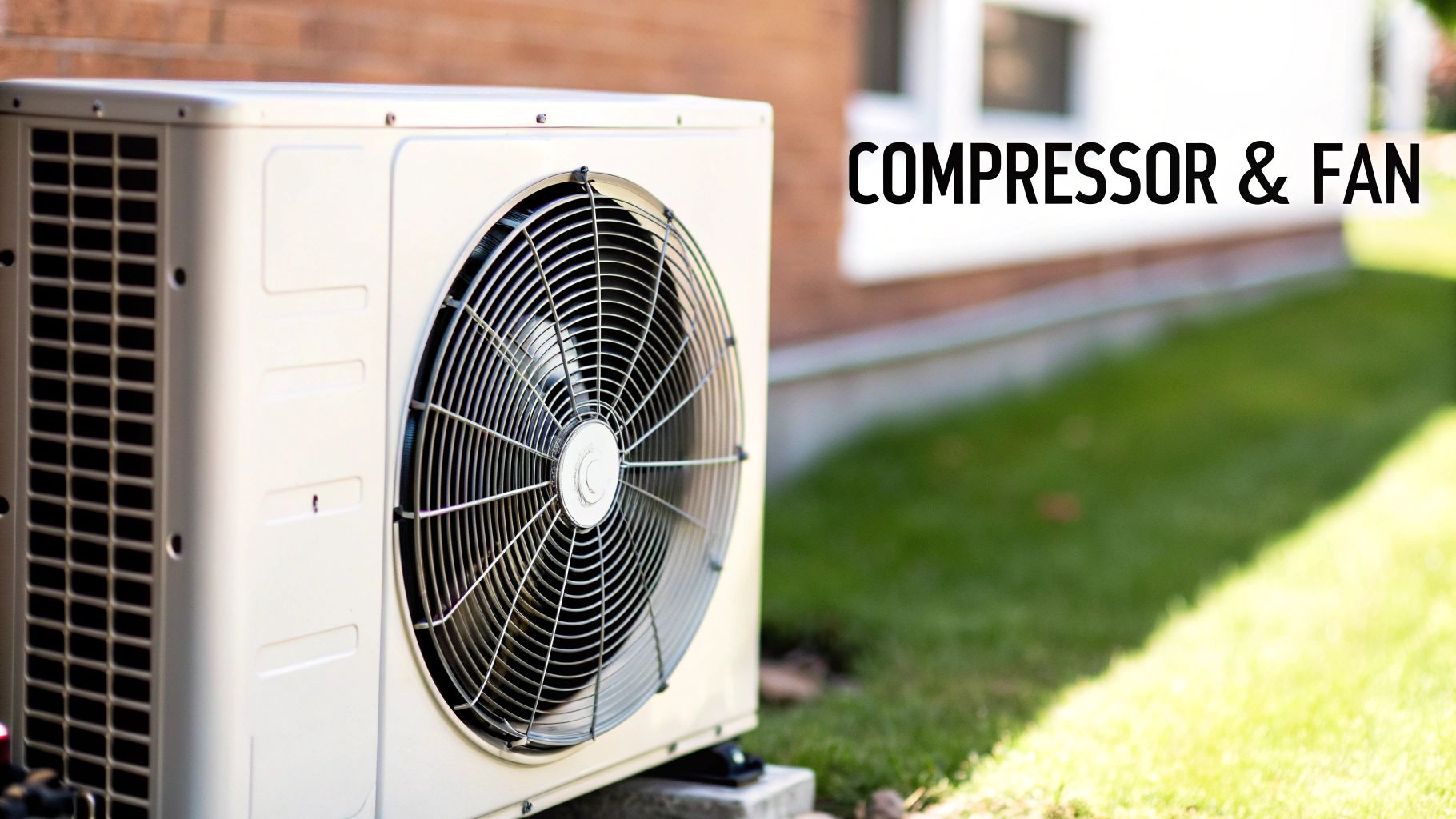
Think of your outdoor AC unit as the engine room. It’s home to two of the most critical players in the whole operation: the compressor and the condenser fan. If something’s wrong out there, your whole system is dead in the water.
The Heart and Lungs of Your Cooling System
The compressor is the true heart of your air conditioner. Its job is to pressurize the refrigerant and pump it through the system’s coils. Without a working compressor, the entire cooling cycle grinds to a halt. No exceptions.
The condenser fan, on the other hand, is like the system's lungs. After the hot refrigerant collects heat from inside your house, it flows to the outdoor unit. This big fan blows air across the coils to get rid of that heat, exhausting it into the outside air. If that fan stops spinning, the heat has nowhere to go.
When either of these essential parts gives out, your AC simply can't cool anymore. Here are a few dead giveaways that one of them is in trouble:
Loud, unsettling noises: A failing compressor often makes its presence known with loud grinding, rattling, or squealing. Those aren't happy sounds; they're signs of serious mechanical distress.
The outdoor fan isn't spinning: You can hear the unit humming or buzzing, but the fan blades are completely still. This usually points to a busted fan motor or a related electrical issue.
The circuit breaker keeps tripping: A compressor that’s struggling to start can draw a massive amount of power, tripping the breaker over and over. If this happens, leave the breaker off and call a pro immediately.
A failing compressor is a major problem, and understanding its behavior is key. You can learn more about what causes an AC compressor to turn on and off and how to fix it in our detailed guide.
The Tiny Part Causing a Big Problem: The Capacitor
More often than you’d think, the reason a fan or compressor motor won't start isn't the motor itself. It’s a much smaller, less expensive part called a capacitor. An AC capacitor acts like a short-burst battery, delivering a powerful jolt of electricity to get the motors spinning from a complete stop.
Think of it like trying to push a heavy, stalled car. It takes a huge initial shove to get it rolling, but once it’s moving, it’s much easier to keep pushing. The capacitor provides that big initial shove for the compressor and fan motor.
When a capacitor goes bad, the motor gets power and tries to run, but it just doesn't have that "kick" to get started.
A humming or buzzing sound from the outdoor unit, without the fan actually spinning, is the classic symptom of a failed capacitor. The motor wants to work but can't get going.
Capacitors wear out over time, and the brutal Tucson heat only speeds up their decline. If you see one that’s bulging at the top or leaking an oily substance, it’s definitely failed. While it's a quick and easy job for a technician, it's incredibly dangerous for a homeowner.
Crucial Safety Warning: Never, ever attempt to handle or replace a capacitor yourself. These components can hold a powerful, high-voltage electrical charge even when the power is off, and they can cause a severe shock. This is a job that must be left to a licensed HVAC professional. The best thing you can do is observe from a safe distance and report what you see and hear.
Decoding Refrigerant Leaks and Frozen Coils
When the simple stuff doesn’t fix the problem, the real answer to "why is my AC blowing hot air" usually boils down to two of the most misunderstood issues: refrigerant leaks and frozen coils. These two troublemakers often go hand-in-hand, and understanding their connection is the key to knowing why you need to call a pro.
Think of refrigerant as the lifeblood of your air conditioner. It’s a specialized chemical that cycles through your system, absorbing heat from inside your house and dumping it outside. When it's working right, this continuous loop is what gives you that wonderfully cold air.
But here’s the most important thing to know: your AC is a closed-loop system. It should never "use up" or run out of refrigerant. If your system is low, it only means one thing: you have a leak somewhere.
The Myth of a Refrigerant "Top-Off"
We hear this all the time. A homeowner thinks their AC just needs a quick "top-off" of refrigerant, like putting gas in a car. This is never, ever a real solution.
Adding more refrigerant without finding and fixing the leak is like trying to fill a bucket with a hole in it. It’s a temporary patch for a permanent problem. Not only does this ignore the root cause, but it’s also bad for the environment and can wreck your system's most expensive part, the compressor.
Your AC needs a very precise amount of refrigerant to operate correctly. Running it with the wrong levels will eventually lead to a total system breakdown.
From Leaks to Ice: The Frozen Coil Connection
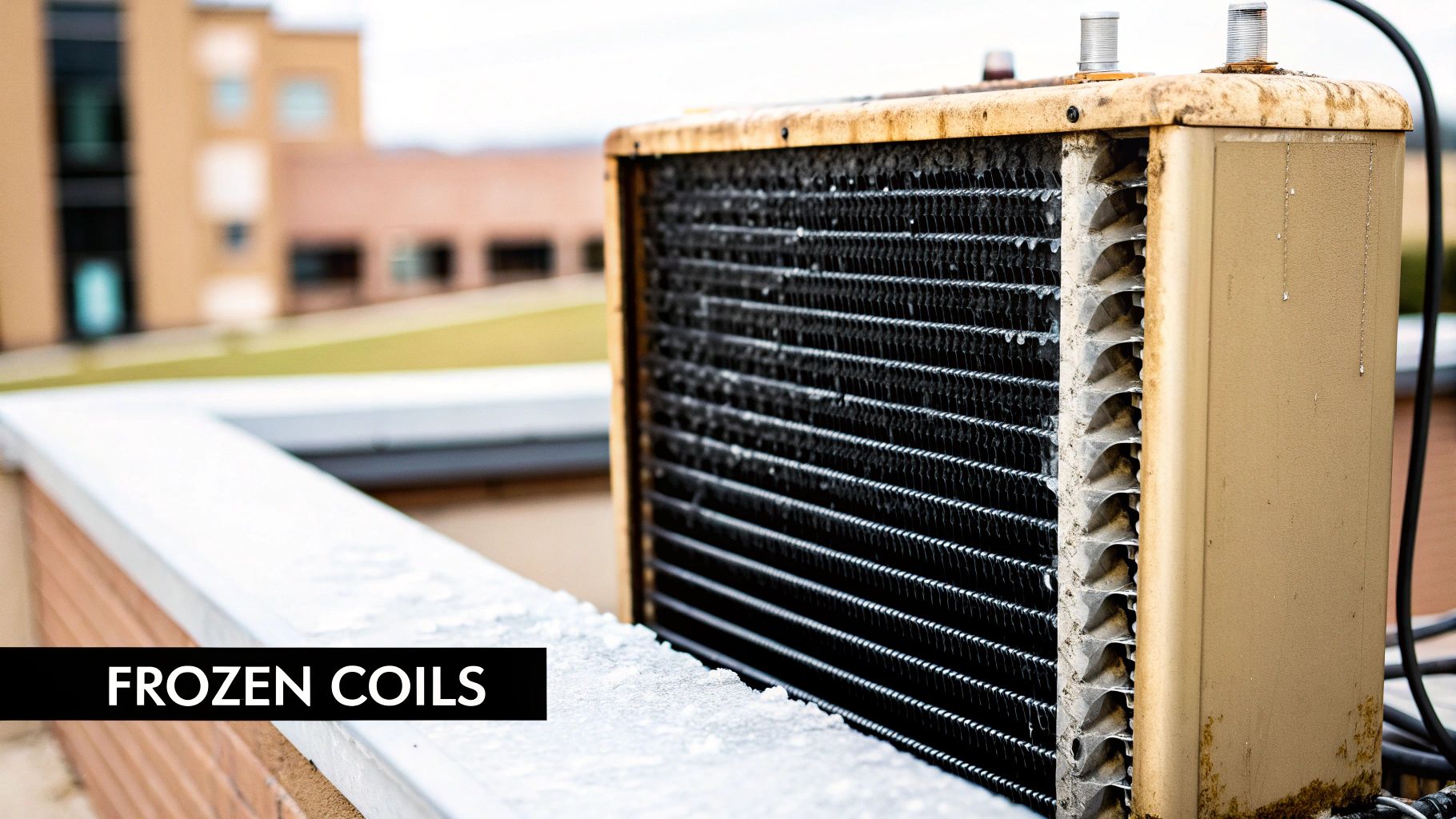
Low refrigerant is the number one cause of our second major issue: a frozen evaporator coil. This is the part of your indoor unit that actually gets cold and pulls the heat out of your air. When refrigerant levels drop, the pressure inside the coil plummets.
This sudden pressure drop causes the coil's surface temperature to fall below freezing. Think about what happens when you take a cold drink outside on a humid day; moisture from the air condenses all over the glass. The same thing happens on your evaporator coil, but when its surface is below 32°F, that moisture instantly freezes into a solid block of ice.
Once the coil is encased in ice, air can't pass through it to get cooled. Your fan will keep blowing, but it's just pushing room-temperature air through your vents, which feels hot in comparison.
This is often the first thing a homeowner notices. You might also spot a few other tell-tale signs that your coil has turned into an ice block.
Symptoms of a Frozen Evaporator Coil
Weak or No Airflow: The ice is physically blocking the air from passing through, so you'll feel very little coming out of your vents.
Water Puddles: When the system cycles off, that ice starts to melt. This can lead to water pooling around your indoor furnace or air handler.
Visible Ice: Sometimes you can actually see frost or ice building up on the copper refrigerant lines that connect to your indoor unit.
If you think you have a frozen coil, the very first thing to do is turn your AC system completely off at the thermostat. Next, switch the fan setting to "On". This will help circulate air across the ice and speed up the thawing process, which can take several hours.
While it’s thawing, it's a good idea to check your air filter. A severely clogged filter can also restrict airflow enough to cause freezing. But if the problem comes back after everything has thawed, it's almost certainly a refrigerant leak that needs a professional fix. For a deeper dive, you can learn more about what causes AC coils to freeze in Arizona homes and find out what to do next.
Knowing When to Call for Professional HVAC Service
While many of the reasons your AC is blowing hot air are fixable, some problems are flat-out emergencies. Being able to spot these critical warning signs is key to protecting your home, your family, and your HVAC system from serious damage.
When you run into these symptoms, the only right move is to shut your system down immediately and call a professional. Trying to fix these issues yourself isn't just risky; it can be downright dangerous. Your air conditioner uses high-voltage electricity and pressurized refrigerant, a mix that demands certified training and specialized tools to handle safely.
Red Flags That Demand Immediate Action
If you notice any of the following signs, don't wait. Turn off your air conditioner at both the thermostat and the circuit breaker to stop any further damage, then contact a certified HVAC technician for emergency service.
Burning Smells: An odor like burning plastic, wiring, or metal is a massive electrical red flag. It could mean an overheating motor, damaged wiring, or a short circuit, all of which are serious fire hazards.
Loud Metallic Grinding or Squealing: These aren't normal operational sounds. A loud grinding or screeching noise almost always points to a severe mechanical failure, like busted motor bearings or a dying compressor. If you keep it running, you risk a catastrophic system failure.
Frequently Tripping Breaker: You reset your AC's circuit breaker, and it immediately trips again. This signals a major electrical fault. It could be a short in the wiring or a compressor pulling way too much power as it fails. Don't keep resetting it.
Visible Smoke or Sparks: This is the most obvious sign of an emergency. If you see smoke or sparks coming from any part of your indoor or outdoor unit, shut down all power right away and call for help.
Why You Should Never Ignore These Signs
Think of these symptoms as your system's emergency alerts. Ignoring them won’t make them go away; it will only lead to more expensive and dangerous problems. That burning smell could escalate into a house fire, and a grinding compressor can completely destroy itself, turning what might have been a repair into a full system replacement.
An AC blowing hot air is an inconvenience, but an AC with a serious electrical or mechanical fault is a genuine safety risk. Knowing the difference is the most important part of troubleshooting.
Understanding what to look for is the first step in handling a crisis. For more detailed information, our emergency air conditioning repair guide for homeowners provides crucial steps to take while you wait for a technician to arrive. Your quick and safe response can make all the difference in a critical situation.
How Preventive Maintenance Keeps Your AC Reliable
The absolute best way to deal with an AC blowing hot air is to make sure it never happens in the first place. This is especially true here in Tucson, where our air conditioners are pushed to their absolute limits for months on end. Trust me, proactive care is far less stressful, and much cheaper, than dealing with an emergency repair when it’s triple digits outside.
Think of preventive maintenance as a routine check-up for your HVAC system. You go to the doctor to catch health issues before they become serious, right? A professional tune-up does the same thing for your AC, allowing a skilled technician to spot and fix small problems before they cause a total meltdown on a 105-degree afternoon.
What Happens During a Professional Tune-Up
A certified technician doesn't just glance at your unit; they perform a detailed inspection and cleaning that directly targets the most common causes of AC failure. Every step is designed to keep your system humming along efficiently and reliably.
These are some of the key tasks that are essential for your system's health and performance:
Thorough Coil Cleaning: Your technician will deep clean both the indoor evaporator coils and the outdoor condenser coils. This gets rid of the layers of dust and grime that act like an insulating blanket, which stops the system from transferring heat and often leads to frozen coils.
Refrigerant Level Inspection: They'll check the refrigerant charge to make sure it’s exactly where the manufacturer says it should be. This is critical because an incorrect charge, too low or too high, puts a massive strain on the compressor and kills your cooling efficiency.
Electrical Connection Tightening: Over time, the constant vibration of the system can loosen electrical connections. Tightening them up prevents dangerous short circuits, protects sensitive electronics, and ensures the compressor and fans get the steady power they need.
Condensate Drain Line Flush: Technicians will flush the drain line to clear out any gunk, algae, or sludge buildup. This simple step prevents clogs that cause water damage and can trigger an automatic shutdown of your whole system.
Regular maintenance isn’t just another bill; it’s an investment in your home’s comfort and your system’s future. A well-maintained unit can easily last years longer than a neglected one, saving you thousands in premature replacement costs.
Connecting Maintenance to Preventing Problems
It's easy to see how each of these maintenance tasks directly prevents a specific problem we've talked about. Cleaning the outdoor condenser coils helps the fan motor and compressor avoid overheating. Checking the refrigerant charge can catch a tiny leak before it empties the system and turns your evaporator coils into a solid block of ice.
This proactive approach keeps every part of your AC working together in harmony, which dramatically reduces the wear and tear that leads to those unexpected breakdowns. If you want to dive deeper into what a tune-up involves, you might find our guide that explains how often you should service your air conditioner helpful.
At the end of the day, scheduling regular tune-ups changes your AC from a potential headache into a dependable workhorse. Instead of waiting for it to fail and leave you scrambling, you stay in control. It's the smartest, most cost-effective way to ensure your home stays a cool sanctuary during the hottest days of the year, and to avoid ever having to ask, "Why is my AC blowing hot air?"
A Few More Questions We Hear Around Tucson
When your AC starts blowing hot air, it’s understandable to have a few more things on your mind, even after doing some basic checks. We get it. Here are some of the most common follow-up questions we hear from homeowners right here in Tucson, with practical answers to help you figure out what’s next.
How Often Should I Change My Air Filter In Tucson?
Living in a dusty climate like ours in Tucson means you have to be extra vigilant with your air filter. We always tell homeowners to at least glance at their filter once a month.
For the common 1-inch filters, you’ll probably need to swap it out every 30 to 60 days. If you have pets shedding dander or family members with allergies, you should really stick to the 30-day mark. For those thicker, high-efficiency filters, you have a bit more leeway; usually every six to nine months is fine. A clean filter is truly the easiest and most important thing you can do for proper airflow.
Is It Better To Repair My Old AC Unit Or Replace It?
This is the big question, isn't it? A great rule of thumb we use in the field is the "5,000 rule". It’s a simple calculation: just multiply the age of your air conditioner by the estimated repair cost.
If that number comes out to more than $5,000, replacement is almost always the smarter financial move in the long run. For instance, let's say you have a 12-year-old unit and the repair is going to cost $500. You'd calculate 12 x 500 = 6,000. Since that’s over 5,000, that system is a very strong candidate for replacement. Of course, other things matter too, like its energy efficiency (SEER rating) and how many times it's broken down before. A good technician can walk you through the pros and cons honestly.
Why Is My AC Blowing Hot Air Only Sometimes?
When cooling becomes a now-you-see-it-now-you-don't game, it’s a clear warning sign of a problem that’s just getting started. This isn't something you want to ignore.
Intermittent cooling often points to a few usual suspects:
The AC unit is starting to freeze up but then thaws out later, causing a temporary return to normal.
A capacitor is on its last legs and only works sporadically.
There's a loose wire somewhere that’s making an inconsistent connection.
It might also mean the system is overheating during the hottest part of the day because the outdoor coils are caked in dirt or the fan motor is struggling. This is your AC’s way of telling you to schedule an inspection before the problem turns into a complete, and much more expensive, breakdown.
If you’re done with the guesswork and just want your cool, comfortable home back, Covenant Aire Solutions is ready to step in. Our certified technicians have the experience to find the real problem fast and deliver a solution that lasts. Don't let a small issue turn into a major headache; contact us today for service you can count on. Visit us at https://www.covenantairesolutions.com to schedule your appointment.